Prefab homes are residences built partially or entirely in a controlled factory environment, then transported to a prepared site and assembled on a foundation. The category spans six distinct construction types — modular, manufactured, panelized, kit, SIP-built, and container — each governed by different building codes, financing programs, and resale rules.
Choosing the wrong prefab category can transform a mortgage-eligible investment into a personal-property asset that depreciates and limits your loan options significantly.
This guide covers every prefab type in full, what each genuinely costs in 2025, how the buying process unfolds, what quality and code standards apply, how permits and zoning shape your options, and how to find the right builder and financing for your project.
What Is a Prefab Home? All Types and Categories Explained
The term “prefab” is short for prefabricated — it means major structural components or the completed home shell is built inside a factory under controlled conditions, then transported and assembled at the buyer’s site rather than constructed entirely on-site from raw materials.
This single definition covers a surprisingly wide range of homes, each built and regulated differently.
Modular homes are factory-built to local IRC (International Residential Code) standards, the same code that governs traditional stick-built homes. They arrive at the site in large completed sections called modules, are lifted onto a permanent foundation by crane, and once assembled are treated identically to site-built homes by lenders, appraisers, and local jurisdictions.
Manufactured homes (formerly called mobile homes) are built to the HUD Code — a federal standard maintained by the U.S. Department of Housing and Urban Development. They travel to the site on an integrated steel chassis and can be placed on either permanent or semi-permanent foundations. HUD-code homes are classified and financed differently from IRC homes, which has significant consequences for buyers.
Panelized homes are constructed as flat wall, floor, and roof panels in the factory, shipped flat to the site, and assembled by a crew into a complete structure. The process is faster than traditional framing, and the panels are built with tighter tolerances than most field-framed walls.
Kit homes provide all structural materials pre-cut and labeled for fast assembly on-site. They require more on-site labor than modular homes but significantly less than conventional framing, and they allow buyers willing to self-manage assembly to reduce labor costs substantially.
SIP-built homes use Structural Insulated Panels — factory-fabricated sandwich assemblies with a rigid foam core bonded between structural sheathing — that deliver highly airtight, energy-efficient building envelopes. They’re widely used in passive house and net-zero construction where thermal performance matters most.
Container prefab homes use standard ISO shipping containers as structural modules, cut and reconfigured into living spaces. They’re known for industrial aesthetics, extreme durability, and efficient stacking for multi-story layouts, though permitting remains challenging in many jurisdictions.
The category you choose determines which building code governs your home, which loan programs you can access, how your local zoning department will classify your project, and what your resale market will look like. Our complete guide to prefab home types and categories breaks down every classification, the legal distinctions between them, and which type best matches each buyer profile and budget.

The Six Prefab Types: Critical Differences That Affect Financing and Resale
The most consequential difference between prefab types is not size or style — it is legal classification, and that classification follows each home throughout its entire ownership life.
The HUD Code vs. IRC distinction is the fault line that matters most. Manufactured homes are built to the HUD Code, a single federal standard that preempts local codes. Modular homes are built to local IRC standards identical to site-built homes. This distinction determines whether a home is classified as real property or personal property, which in turn determines:
- What mortgage products are available to you (conventional, FHA, VA, USDA for modular; limited specialized programs for manufactured)
- What interest rate tier applies (chattel loans for manufactured homes on rented lots carry rates 2 to 5 percent above conventional)
- How local zoning departments categorize the structure
- How appraisers value the home at resale
- Whether the property appreciates alongside the local real estate market or follows a depreciation schedule more common to personal property
Panelized homes, SIP homes, and kit homes are treated identically to site-built homes by virtually all lenders and jurisdictions because they are assembled on-site under local building department oversight — they never carry the manufactured-home classification.
A modular home properly placed on a permanent foundation on owned land qualifies for the same 30-year conventional mortgage, at comparable rates, as any site-built house on the same street. A manufactured home on a rented lot in a manufactured home community qualifies for a chattel loan that behaves more like a vehicle loan than a mortgage.
For buyers who need a side-by-side breakdown of every legally and financially relevant difference between types, our guide to the modular vs manufactured comparison covers each distinction in plain language, with specific implications for financing approval, zoning compliance, long-term appreciation, and resale.
If the modular path is the one that fits your needs, our modular home buying guide covers the full process from selecting an IRC-certified manufacturer through delivery day, local permitting, and first-year ownership expectations.
True Cost of a Prefab Home in 2025
Prefab homes are frequently marketed with headline prices that reflect only the base factory cost — the home itself before land, site preparation, foundation work, utility connections, delivery, and onsite finishing. The all-in cost is substantially higher, and failing to account for every component leads to broken budgets and delayed projects.
Base home price ranges by type (2025 estimates, US national):
- Single-wide manufactured homes: $60,000 to $105,000
- Double-wide manufactured homes: $90,000 to $185,000
- Entry-level modular homes: $150,000 to $280,000
- Mid-range modular homes: $280,000 to $500,000
- Luxury modular homes: $500,000 to $1,500,000 and above
- Panelized homes: $120,000 to $400,000
- Kit homes (materials only): $40,000 to $160,000
- SIP-built homes: $150,000 to $450,000
These prices reflect the factory cost exclusive of all site work.
Site preparation and foundation costs vary most based on site conditions. A level, accessible lot with utility stubs already in place can see site prep costs under $25,000. A sloped, wooded, or remote lot requiring clearing, grading, a full basement, and utility extensions can push site prep to $80,000 to $120,000.
Transportation and crane-set costs depend on the distance from the manufacturing facility to your site and the number of modules in the home. Expect $5,000 to $20,000 for transportation and $3,000 to $15,000 for the crane-set and module securing process.
Onsite finishing costs after module delivery cover mate-line work (sealing and finishing the seams between modules), HVAC system connections, plumbing and electrical trim-out, porch and deck additions, driveway completion, and final grading. Budget $20,000 to $80,000 depending on scope and local labor rates.
Because the hidden costs of prefab builds routinely catch buyers off guard — site prep, foundation, and utility connections alone commonly add $30,000 to $80,000 to the total project cost — our dedicated guide identifies every budget line item buyers underestimate and walks through how to build each one into your budget before committing to any purchase agreement.
For a complete picture of what you will actually spend, organized by home type and US region with 2025 price data, our breakdown of the true cost of a prefab home covers every component from the factory price through your first occupancy costs.

The Prefab Home Buying Process: From Order to Move-In
The prefab buying process differs meaningfully from purchasing an existing home or contracting a site-built custom home. Understanding each phase in advance prevents expensive surprises and timeline overruns.
Phase 1: Land and Site Selection
Before selecting a manufacturer, secure your land and confirm that your chosen prefab type is permitted by local zoning. Many jurisdictions explicitly allow IRC modular homes but restrict HUD-code manufactured homes. Verify soil conditions for foundation type requirements, utility availability, site access for large delivery trucks, and whether any deed restrictions, HOA rules, or easements affect your project.
Phase 2: Builder and Dealer Selection
For manufactured homes, you typically work with an authorized dealer who coordinates factory ordering, delivery logistics, financing, and setup. For modular homes, you work with a modular-specific dealer or a general contractor who manages the full project. Both paths require careful vetting — the dealer or GC you choose will determine how smoothly every subsequent phase runs.
Phase 3: Floor Plan Selection and Factory Order
Work through the manufacturer’s available plans or customization process to finalize floor plan, elevation, finish package, and upgrade selections. Once the factory order is placed, changes are expensive or impossible. Finalize every detail before the order is submitted.
Phase 4: Site Preparation
While your home is being built in the factory (typically eight to sixteen weeks for modular homes; two to six weeks for manufactured homes), your site contractor prepares the land: grading, foundation pour, utility stub-outs, and access road. Both timelines must coordinate precisely for delivery day.
Phase 5: Delivery and Crane-Set Day
For modular homes, large sections arrive on flatbed trucks and are crane-lifted onto the foundation in a single day. Witnessing delivery with an experienced third-party inspector present is strongly recommended. Any transportation damage or misset modules are far easier to address before the crews leave the site than after.
Phase 6: Onsite Finishing and Certificate of Occupancy
After modules are set and secured, onsite trades complete mate-line work, utility connections, interior trim, decks, and final grading. Local building inspectors conduct phase inspections throughout, and the final inspection produces your Certificate of Occupancy, which is required before legal occupancy.
From factory order to move-in, most modular home projects take four to eight months. Manufactured home projects typically complete in two to four months. Our full prefab home buying process guide walks through every phase with decision-point checklists, key questions to ask at each stage, and realistic timelines for each major prefab type.
Design and Customization: How Much Control Do You Have?
The “cookie-cutter” stigma attached to prefab homes applies to some categories and not to others. The reality of customization varies substantially by type and manufacturer.
Modular homes offer meaningful customization within factory process constraints. Most modular manufacturers provide dozens of base floor plans that buyers can modify: relocating walls within structural limits, adjusting roofline profiles, selecting exterior siding styles and colors, and specifying interior finishes across kitchens, bathrooms, flooring, cabinetry, and fixtures. Fully custom modular homes — designed from scratch with buyer-directed architectural input — are available at a premium from design-build modular companies.
Manufactured homes offer less flexibility. Buyers select from a fixed catalog of floor plans with limited structural modification options. Interior finish upgrades, appliance packages, and cabinetry selections are typically available, but changing room configurations is generally not.
Panelized and SIP homes can accommodate nearly any architectural design since the factory produces custom-cut panels to supplied plans. These systems are commonly used for architecturally distinctive homes, passive house designs, and off-grid builds where standard floor plans would not serve the project’s performance goals.
Kit homes are similarly flexible in design, since the manufacturer produces custom component sets from buyer-supplied or architect-supplied drawings.
Adding a garage, covered porch, finished basement, or sunroom to a modular home is possible but typically involves coordination between the factory-delivered home and site-built additions completed by your general contractor — a scope of work that must be planned and contracted before delivery day.
Our in-depth guide to prefab customization options explains exactly what buyers can and cannot modify by manufacturer and home type, where factory constraints apply, what upgrade packages typically look like, and how to negotiate effectively during the order process.
Prefab Quality and Construction Standards
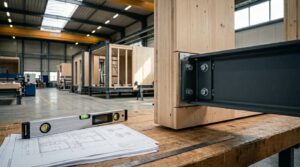
The assumption that factory-built homes are lower quality than site-built homes does not hold up against the evidence from well-run modern manufacturing facilities. In a controlled factory environment, framing lumber is never exposed to rain during construction, structural tolerances are measured to tighter specifications than field framing allows, and quality control inspections occur at every stage of production.
The factory building process uses dedicated workstation teams performing consistent, repetitive tasks across an assembly-line workflow. Framing, insulation installation, rough-in wiring and plumbing, drywall hanging, and finish work all happen in specialized stations by crews who do only those tasks, every day. The consistency this produces is difficult for site-built construction — subject to weather, changing crews, and project-specific variability — to replicate reliably.
Code standards by type:
Modular homes are built to the full International Residential Code, identical to site-built homes, and inspected by state-approved third-party inspection agencies at each production phase in the factory. Local building officials then inspect the home after set, the same as any site-built project.
Manufactured homes are built to the federal HUD Code (24 CFR 3280), a single national standard that supersedes local codes. HUD-approved inspection agencies certify the factory before production begins and inspect each home during production.
Panelized, SIP, and kit homes are built to or assembled under local IRC standards, with on-site phase inspections by local building departments identical to any site-built project.
Wind, seismic, and energy engineering is incorporated into every prefab type based on the geographic zone the home will be placed in. Manufactured homes in high-wind zones require certified installation systems including anchor bolts, over-the-top straps, and engineered pier designs. Modular homes in hurricane zones can be designed and certified to HiVhZ (high-velocity hurricane zone) standards that equal or exceed typical site-built construction requirements in the same area.
Our guide to prefab homes and building codes addresses the IRC, IBC, and HUD code frameworks in detail, clarifies exactly which standard governs each build type and why, and explains the full inspection path from factory floor to Certificate of Occupancy.
Our full guide to prefab factory quality standards explains what third-party inspections cover, what certifications manufacturers must maintain, what to look for when touring a factory before purchase, and how to verify your specific manufacturer’s track record through warranty claim rates and builder review data.
Prefab Permits, Zoning, and Regulatory Requirements
Permitting a prefab home is one of the most variable aspects of the purchase process, and underestimating regulatory complexity is a leading cause of project delays and budget overruns.
Zoning restrictions represent the first barrier. Many standard residential zones explicitly allow IRC modular homes but restrict or prohibit HUD-code manufactured homes. Agricultural zones and rural unincorporated areas are often more permissive across all types. HOA-governed communities typically require architectural review committee approval that can favor traditional or craftsman aesthetics and effectively disqualify certain prefab designs or exterior material choices.
The modular home permit process typically involves:
- Submitting the manufacturer’s state-certified engineering plans to the local building department for plan review
- Receiving a streamlined local review, since the home was already inspected and certified in the factory
- Pulling separate site permits covering foundation, utilities, and driveway
- Scheduling site work inspections and a post-set inspection after module delivery
- Receiving the Certificate of Occupancy after final inspection sign-off
Manufactured home permitting requires a separate HUD installation permit in most states, combined with local permits for the foundation, utilities, and any permanent structures added to the site. Installation must comply with both the manufacturer’s installation manual and applicable state installation standards.
Interstate delivery permitting adds another layer: oversize loads require state travel permits, and some states require escorts or limit delivery to specific hours and routes. Your manufacturer or dealer handles this process, but understanding it prevents scheduling surprises.
Our prefab permits by state guide maps the complete approval process, plan review requirements, installation permit rules, and common regulatory delay points for every major prefab building type across all US states.
How Prefab Compares to Custom, Stick-Built, and Other Options
Prefab construction sits within a larger decision context. Understanding how it compares to the alternatives helps buyers confirm they’re on the right path.
Prefab vs. Custom Home
Custom homes offer maximum design freedom — every room, detail, and specification is engineered to the buyer’s requirements. They’re typically 15 to 30 percent more expensive per square foot than comparable modular construction, and timelines run 14 to 24 months versus 4 to 8 months for most modular projects. Custom homes require an architect, a general contractor, and a longer permitting runway.
The advantage is unlimited design latitude and the strongest possible positioning in premium resale markets where buyer discernment extends to documented originality and architectural distinction. Buyers who conclude that prefab’s design ceiling does not serve their goals can explore our complete custom home building guide, which covers the full path from architect hiring and land selection through custom financing and the construction phase timeline.
Prefab vs. Traditional Stick-Built Construction
In comparable markets, modular and panelized homes typically cost 10 to 20 percent less per square foot than conventional site-built construction at similar quality levels. Construction timelines are 30 to 50 percent faster. Quality is generally comparable or superior in controlled factory settings, particularly for framing precision and moisture management during construction.
The trade-offs are reduced design flexibility compared to fully custom builds and the need for careful coordination between factory production and site preparation timelines.
Prefab vs. Tiny Homes, Park Models, and Barndominiums
These alternatives each occupy a distinct niche. Tiny homes on wheels (THOWs) offer mobility but face significant land access, parking, and permitting constraints that limit their viability as permanent residences in most markets. Park model homes max out at 400 square feet under RVIA certification and are best suited for resort or recreational communities. Barndominiums offer large open spans and rural aesthetic appeal but face financing challenges similar to manufactured homes in most lending markets.
For buyers making the prefab-versus-custom decision with specific financial data, our prefab versus custom home comparison breaks down cost-per-square-foot differences, construction timeline advantages, customization trade-offs, financing implications, and long-term resale value data for both paths.
Prefab Use Cases: When Factory-Built Is the Right Choice
Prefab is not universally the optimal construction method, but it is specifically well-suited to a distinct set of applications and buyer situations.
Primary Residence
Modular homes are an excellent primary residence choice for buyers who want new construction quality, faster delivery than site-built, strong cost predictability, and the full suite of conventional mortgage financing options. They’re available in all sizes, architectural styles, and price points, from 1,200-square-foot starter homes to sprawling luxury residences above 5,000 square feet.
ADU and Accessory Structures
Prefab construction has become one of the most efficient pathways to an accessory dwelling unit. Factory-built ADU panels can be assembled in days rather than months, several manufacturers specialize in sub-1,000-square-foot ADU-optimized designs, and the speed of factory production fits the compressed timelines many ADU projects require. One of the fastest-growing applications for factory-built construction is the backyard ADU — our guide to prefab ADU options and brands covers the most popular formats, typical cost ranges, zoning and permitting considerations, and which brands optimize specifically for ADU placement on existing residential lots.
For homeowners approaching the ADU from a rental income or property investment perspective, our full ADU build and investment guide covers every construction method, cost model, regulatory requirement by jurisdiction, and rental income projection framework in comprehensive detail.
Vacation and Recreational Homes
Prefab excels in vacation home applications where remote location, limited local contractor availability, challenging access conditions, or compressed seasonal construction windows make site-built approaches impractical or prohibitively expensive. Kit homes, small modular cabin packages, and container homes are especially well-suited to these contexts.
Off-Grid Living and Disaster Replacement
SIP panels and modular construction work effectively in off-grid applications — tight building envelopes reduce heating and cooling loads dramatically, and factory precision reduces air infiltration that undermines off-grid energy budgets. After wildfires, hurricanes, or flooding events, factory-built homes can be delivered and made occupancy-ready far faster than conventionally constructed replacements.
Common Prefab Home Problems and How to Avoid Them
Understanding the known failure modes of prefab construction helps buyers choose wisely and protect their investment from the start.
The Depreciation Myth vs. the Real Data
The depreciation stigma attached to prefab homes applies specifically and accurately to HUD-code manufactured homes on rented lots that are classified as personal property — not to all prefab types. Modular homes on permanent foundations on owned land have documented appreciation patterns comparable to site-built homes in the same market. Data on HUD-code homes that have been properly titled as real property on owned land also shows improved appreciation profiles far closer to site-built trends than to vehicle depreciation curves.
The takeaway: placement type, lot ownership structure (owned versus rented), proper real-property titling, and build type matter far more than the “prefab” label when forecasting long-term value.
Mate-Line Issues in Modular Homes
The seam between adjacent modular home sections — the mate-line — is a known quality point that requires meticulous factory preparation, careful transportation to prevent structural shifting, and precise on-site finishing work. Poorly sealed mate-lines are a leading cause of moisture intrusion, drywall cracking at seams, and visible settling in older modular installations. The preventive solution is selecting manufacturers with documented mate-line sealing systems, requiring independent third-party inspection at delivery, and ensuring your warranty explicitly covers mate-line defects separately from general construction warranty terms.
Financing and Insurance Challenges
Manufactured homes face more complex and less favorable financing requirements than modular homes. Conventional mortgage financing for manufactured homes requires a permanent foundation affidavit from a licensed engineer, real-property title status (title retirement from personal property classification), and a certified installation. Homes that do not meet these criteria require chattel (personal property) loans, which carry substantially higher rates and shorter terms, significantly affecting your cost of ownership over time.
The full reality of prefab resale value — including appreciation data by type, what separates modular from manufactured on the open real estate market, and how today’s purchase decisions shape your future exit options — is covered thoroughly in our dedicated guide.
Top Prefab Home Brands and Models in 2025
The prefab market spans from large national manufacturers serving the broad affordable housing market to boutique design-focused brands serving luxury and sustainability buyers.
National Manufactured and Modular Home Builders
Clayton Homes is the largest manufactured and modular home builder in the United States by volume, operating production plants across dozens of states through a national dealer network covering both HUD-code and IRC product lines. Champion Homes, Skyline Homes, Fleetwood Homes, Cavco Industries, and Palm Harbor Homes are among the other major national producers offering a full spectrum of manufactured and modular options across most price points.
Modern and Luxury Prefab Brands
The modern prefab segment has grown substantially over the past decade, driven by buyers who want architectural quality and energy performance alongside factory efficiency. Method Homes (Pacific Northwest), Karoleena Homes, Stillwater Dwellings, LivingHomes, Dvele, and Connect Homes produce architecturally distinctive modular and panelized homes in the $400,000 to $2,000,000 and above range, combining contemporary design with factory precision and high energy performance standards.
Affordable and Mid-Range Options
For buyers targeting under $200,000 total home costs, the national manufactured home builders offer the widest selection. Regional modular builders in most states offer competitive mid-range options between $200,000 and $400,000. ADU-specific brands including Boxabl, Abodu, Villa Homes, Studio Shed, and Cover serve the compact prefab market with designs optimized for urban and suburban accessory structure placement.
With hundreds of manufacturers and dealers active nationally, selecting the right builder requires systematic vetting of warranty programs, dealer network strength, factory certifications, and consumer review history. Our guide to the best prefab builders in 2025 filters the full market by category — modular, manufactured, luxury, eco-certified, ADU-focused, and affordable — with vetting criteria for each segment and a pre-contract verification checklist.
Financing a Prefab Home: Loans, Programs, and Lenders
Financing strategy is where the legal classification distinctions discussed earlier translate directly into dollars and monthly payments.
Modular Home Financing
Modular homes qualify for the same loan products as site-built homes without restriction: conventional mortgages through Fannie Mae and Freddie Mac, FHA loans, VA loans for veterans, and USDA rural development loans for qualifying properties. The construction phase is financed with a construction-to-permanent loan (also called a construction-perm), which converts to a standard mortgage at occupancy. Down payment requirements, credit score minimums, and interest rates are all comparable to site-built home financing under the same programs.
Manufactured Home Loan Programs
HUD-code manufactured homes have access to more limited programs. Fannie Mae’s MH Advantage and MH Standard programs, FHA Title I and Title II loans, VA loans, and USDA programs all cover manufactured homes under specific conditions — permanent foundation certification, real property title status, minimum square footage, and roof pitch requirements among them. These programs allow conventional-style mortgage terms for homes that meet eligibility criteria.
Manufactured homes that do not meet those criteria, or that sit on rented lots in land-lease communities, require chattel (personal property) loans. Chattel loans typically carry interest rates 2 to 5 percentage points above conventional mortgage rates and term lengths of 15 to 20 years rather than 30, creating significantly higher monthly payments and total interest costs for equivalent purchase prices.
Why Classification Determines Your Financing Options
The underlying logic is collateral risk. A modular home on a permanent foundation on owned land is real property — the same type of collateral as any house. A manufactured home on a rented lot is personal property, with a depreciation and mobility profile that lenders price into higher rates and shorter terms.
Understanding which prefab home financing options apply to your specific home type, ownership structure, and financial profile — and which specialty lenders actively participate in each program — is one of the most important steps to take before committing to any prefab purchase path.
Regional Prefab Markets Across the United States
Prefab construction costs, available manufacturers, regulatory environments, and permitting timelines vary significantly by region, and what works in one market can face serious friction in another.
High-Cost States: California and Hawaii
California and Hawaii represent the most expensive and most complex prefab markets nationally. California’s Title 24 energy code imposes strict insulation values, glazing specifications, and HVAC performance requirements that factory homes must meet before receiving state energy compliance certification. ADU-focused prefab has expanded rapidly in California, with multiple state-focused brands including Cover, Villa Homes, Abodu, and Den serving the demand. Our California prefab home market guide covers Title 24 compliance, the ADU permitting environment, active regional builders and dealers, and what a realistic California prefab project timeline looks like from start to occupancy.
Cold-Climate and Mountain Markets
The upper Midwest, New England, and Mountain West present site-specific engineering requirements: frost-depth foundations typically ranging from 36 to 72 inches, heavier snow load engineering, heating system sizing for extreme cold, and vapor management details suited to mixed-humid or cold-dry climates. Several manufacturers offer cold-climate packages with R-30 or greater wall assemblies, triple-pane window specifications, and heating systems rated for sustained below-zero temperatures.
Hurricane-Zone and Coastal Markets
Florida, the Gulf Coast, and coastal Southeast states require homes built to Florida Building Code wind provisions or equivalent, including impact-rated openings, reinforced roof-to-wall connections, and specific anchor systems. HUD-code manufactured homes in these zones must meet Wind Zone II or Zone III standards. Several manufacturers hold certifications specifically for high-velocity hurricane zones and can provide third-party engineering documentation that local jurisdictions require for permit approval.

Finding a Prefab Dealer, Builder, or Design-Build Service
Navigating the prefab supply chain effectively requires understanding which parties are responsible for which outcomes.
The Manufacturer builds the home in the factory. They are responsible for factory quality, specifications to your order, and warranty coverage on factory-built components. They do not manage your site, foundation, delivery coordination, or local permitting — those responsibilities fall elsewhere.
The Dealer is the buyer’s primary point of contact for manufactured homes and many modular projects. They manage the transaction between buyer and manufacturer, coordinate delivery logistics, sometimes arrange financing, and may manage or subcontract site setup and installation. Dealer quality varies substantially across the industry, and vetting your dealer independently of the manufacturer is essential.
The General Contractor manages all on-site work: foundation construction, utility installations, delivery day preparation, module crane-set coordination, and all finish trade work after the home is set. For modular projects, hiring a GC with specific modular delivery experience is important — a GC unfamiliar with modular logistics can create problems on delivery day that are costly to correct.
Turnkey packages bundle site work, foundation, delivery, installation, and finishing into a single contract with one accountable party. They typically cost more than managing each trade independently, but they eliminate the coordination risk that causes most prefab project delays and disputes.
Identifying the right combination of manufacturer, dealer, and site contractor is the most consequential pre-purchase decision you will make. Our prefab dealer and builder services guide explains what each party is responsible for, how to vet all three effectively, what questions to ask before signing any contract, and what a properly structured turnkey prefab package should include.
Conclusion
Prefab homes offer a cost-effective, faster path to quality new construction when buyers select the right type and partner with qualified manufacturers and site professionals.
Every major category covered in this guide has a dedicated spoke resource that goes deeper into process specifics, current costs, brand vetting, and regional requirements to guide your next decision.
Contact Mr. Local Services today to connect with vetted prefab professionals in your area and get expert guidance at every stage of your prefab home project.
Frequently Asked Questions
What is the difference between a modular home and a manufactured home?
A modular home is built to local IRC building codes, sits on a permanent foundation, and is classified as real property — just like a site-built house. A manufactured home is built to the federal HUD Code, can sit on a semi-permanent foundation, and may be classified as personal property, which affects financing rates, loan programs, and long-term resale value significantly.
How long does the prefab home buying process take from order to move-in?
Most modular home projects complete in four to eight months from factory order placement to Certificate of Occupancy, depending on factory lead times, site preparation complexity, and local permitting speed. Manufactured home projects typically complete in two to four months since they require less onsite finishing work after delivery.
Are prefab homes less expensive than site-built homes?
Modular and panelized homes typically cost 10 to 20 percent less per square foot than comparable site-built construction when base factory price and site work are combined. Entry-level manufactured homes are substantially cheaper than any site-built equivalent at similar square footage, though the total cost-of-ownership difference narrows over time when financing rate differences are factored in.
Can you get a standard mortgage for a prefab home?
Yes, for modular homes on permanent foundations — they qualify for conventional, FHA, VA, and USDA loans at standard rates, identical to site-built homes. Manufactured homes have more limited mortgage options through programs like Fannie Mae MH Advantage and FHA Title II, but must meet eligibility requirements including permanent foundation certification and real-property title status. Homes not meeting those criteria require chattel loans at higher rates.
Do prefab homes appreciate in value like regular homes?
Modular homes on owned land with permanent foundations appreciate at rates comparable to site-built homes in the same market, based on available resale data. HUD-code manufactured homes on owned land with proper real-property titling show improving appreciation data. Manufactured homes on rented lots classified as personal property typically do not appreciate at the same rate as real property.
How customizable are prefab homes compared to custom builds?
Modular homes offer meaningful customization including floor plan modifications, roofline options, exterior finish selections, and complete interior finish packages. Panelized and SIP homes can accommodate fully custom architectural designs. Manufactured homes have the least flexibility, with modifications largely limited to interior finish upgrades within fixed floor plan catalogs. Fully custom site-built homes offer the greatest design freedom but at significantly higher cost and longer timelines.
What are the most common problems reported with prefab homes?
The most frequently reported issues are: mate-line cracking at module seams in modular homes, significant underestimation of site preparation and utility connection costs, zoning or HOA rejection of manufactured home placement, financing complications for HUD-code homes not titled as real property, and buyers signing with manufacturers or dealers without independently verifying warranty coverage terms and installation track records.