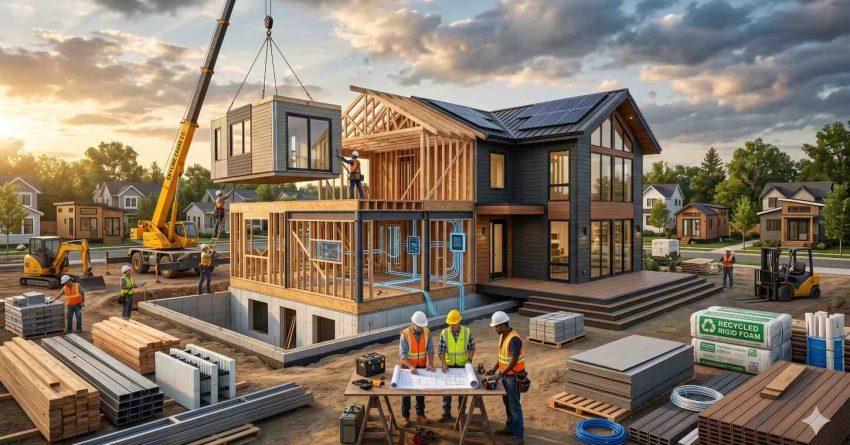
Building materials and construction methods are the physical components and assembly techniques that determine how a new home performs, looks, and holds its value over decades, covering everything from the type of shingles on the roof to the framing system inside the walls and the insulation filling every cavity in between.
Every material decision you make in new construction carries cascading effects on energy efficiency, maintenance costs, resale value, and long-term livability — yet most homeowners make these choices with insufficient information.
This guide covers roofing materials, exterior siding, windows, insulation systems, concrete and masonry, structural framing, sustainable alternatives, lifecycle cost analysis, climate-driven selection, key brand comparisons, and modern construction assembly methods.
What Are Building Materials? Understanding the Full Spectrum
Building materials are any substance used to construct a home’s structure, protective envelope, or interior systems. In residential new construction, materials fall into three broad categories that carry different performance priorities and replacement timelines.
Structural vs. Envelope vs. Finish Material Categories
Structural materials bear loads and form the skeleton of the building. Concrete, dimensional lumber, engineered wood products, steel, and masonry resist gravity, wind, seismic, and snow loads. These are the materials whose specification errors are most costly to correct after the fact, and where cutting corners produces the most severe long-term consequences.
Envelope materials protect the structure from weather and control heat, moisture, and air movement through the building’s skin. Roofing systems, siding, windows, doors, insulation, air barriers, and vapor control layers form the building enclosure. Envelope performance determines energy bills, moisture durability, and interior comfort for the entire lifespan of the building.
Finish materials include flooring, cabinetry, countertops, tile, paint, and trim. These affect aesthetics and surface performance but are generally replaceable without structural implications. Experienced builders and building scientists consistently advise allocating budget toward envelope and structural materials first, and treating finishes as upgrades that can be phased in later.
How Materials Shape Cost, Performance, and Longevity
The relationship between upfront material cost and lifetime value is rarely linear. According to the National Association of Home Builders, material and labor costs account for approximately 61% of total new home construction costs, making material selection one of the highest-leverage decisions in the building process.
Asphalt shingles cost far less than metal roofing at installation, but metal may never need replacement during the homeowner’s lifetime. Vinyl siding is cheaper than fiber cement but can degrade significantly faster in extreme heat or UV exposure. Fiberglass batt insulation is affordable but frequently delivers 20-30% below its rated R-value in the field due to installation defects — while closed-cell spray foam consistently achieves its rated value regardless of installation quality variation.
Understanding the full cost picture — installed cost, maintenance frequency, replacement timeline, and energy performance impact — is the foundation of every material decision this guide covers. Building materials do not exist in isolation from the decisions that surround them, and our complete guide to building a custom home situates every material and method choice within the full construction process, from land selection through final inspection and move-in, so you understand how each decision connects to the next.
Roofing Materials for New Construction
Roofing is the single building component most exposed to weather, UV radiation, temperature extremes, and precipitation. Your roofing material choice determines not just cost today but the replacement schedule, energy performance, and insurance cost for the next 30 to 100 years depending on what you select.
Asphalt Shingles
Asphalt shingles cover approximately 70% of American homes and remain the dominant choice for new construction due to their combination of low installed cost, wide contractor availability, and adequate performance across most US climate zones. Two main product grades define the market: 3-tab shingles (largely legacy product in new construction) and architectural (dimensional or laminated) shingles, which have become the standard new-build specification.
Architectural shingles are thicker, more visually dimensional, and rated for higher wind speeds — typically 110-130 mph — compared to 3-tab products. They carry 25-to-30-year warranties under standard installation and up to 50-year warranties in enhanced contractor programs. Installed costs range from $4.50 to $7.00 per square foot for architectural shingles in most US markets.
The primary weakness of asphalt is performance at climate extremes: granule loss in high-rain regions, UV degradation in the Southwest, and impact vulnerability in the Great Plains hail corridor. Class 4 impact-resistant shingles address hail risk specifically and frequently qualify for 5-30% insurance discounts in eligible markets, making their cost premium recoverable within 3-5 years of reduced premiums.
Metal Roofing
Metal roofing has grown steadily in new residential construction, particularly in hurricane zones, wildfire-prone areas, and premium markets seeking long-term value. Standing seam metal — where hidden fasteners connect interlocking panels — is the dominant residential type and carries 40-to-50-year warranties with minimal maintenance requirements.
Installed costs for steel and aluminum standing seam systems range from $9 to $16 per square foot, versus $4.50-$7.00 for architectural asphalt. That premium is typically recovered through eliminated replacement cycles, lower insurance premiums in high-risk zones, and cool-roof reflectivity that reduces cooling loads in southern climates.
Corrugated and exposed-fastener metal panels cost less ($5-$9 per square foot installed) but require periodic maintenance of fasteners and sealant — a meaningful lifecycle cost consideration their lower upfront price does not fully reflect.
Metal roofing has grown from a specialty product to a mainstream new-construction choice across hurricane zones, wildfire-prone areas, and premium residential markets, and our metal roofing guide for new construction covers standing seam versus corrugated systems, regional installed cost ranges, warranty structures, and the 40-to-70-year performance case that makes metal one of the highest-ROI roofing choices available.
Tile, Slate, and Premium Options
Clay and concrete tile roofing offers 50-to-100-year service lives in appropriate climates and is the standard in Florida, the Southwest, and coastal California, where its thermal mass, wind resistance, and appearance align with both climate demands and architectural expectations. Tile costs $15-$30 per square foot installed, with clay tile typically premium priced versus concrete tile.
Natural slate is the most durable roofing material available, lasting 75-150 years with proper installation, but requires specialized installer expertise, structural consideration for its weight (700-1,500 lbs per square), and high upfront cost ($30-$50+ per square foot installed). Synthetic slate products — made from recycled rubber and plastic — replicate the appearance at lower weight and cost ($7-$14 per square foot installed) with 40-to-50-year warranties.
Cool Roofs and Solar-Integrated Roofing
Cool roofs use reflective pigments or coatings to reduce solar heat absorption, directly lowering attic temperatures and cooling loads. White membranes on flat roofs and light-colored tiles or metal panels on sloped roofs qualify as cool roofs under ENERGY STAR criteria and meet cool-roof mandates in California Title 24 and several other state codes.
Solar-integrated roofing includes traditional panels mounted over existing roofing material and newer solar tile products (including Tesla Solar Roof) where the tile itself generates power. The roofing material chosen directly affects which solar integration options are viable, what they cost, and how well they perform over time.
Asphalt shingles cover approximately 70 percent of American homes and remain the default new-construction choice, and our asphalt shingle roofing guide breaks down every product tier from 3-tab to architectural to Class 4 impact-resistant, with cost ranges, climate performance expectations, and warranty comparison data so you can make an informed specification with your builder.
Siding and Exterior Cladding Options
Your home’s siding is its primary weather defense, its visual identity, and a 30-year maintenance commitment. Every siding choice involves genuine trade-offs between upfront cost, maintenance requirements, moisture performance, fire resistance, and long-term durability. Understanding those trade-offs before your builder orders materials is the difference between a cladding you are satisfied with and one that costs you money for decades.
Fiber Cement (James Hardie)
Fiber cement has become the leading premium cladding material in US new construction, commanding approximately 35% of the residential siding market and growing. Composed of cement, sand, and cellulose fibers under high pressure, fiber cement is dimensionally stable, non-combustible, and resistant to moisture, insects, and rot in a way that wood-based products cannot match.
James Hardie’s HardiePlank and HardiePanel dominate the category with a 30-year product warranty and a 15-year paint finish warranty on factory-primed and pre-finished options. Installed costs range from $10 to $18 per square foot — roughly 30-50% more than vinyl at installation — but with repainting required only every 10-15 years and no warping, swelling, or brittleness over time.
In Wildfire Urban Interface (WUI) zones in California, Oregon, Colorado, and other western states, fiber cement or non-combustible alternatives are frequently required by code, removing the price premium from the decision entirely for homeowners in those areas.
Fiber cement is difficult to install poorly without it being visually detectable, but the most consequential failures happen at joints, flashing, and cut edges where moisture intrusion begins. Our fiber cement siding installation guide explains why James Hardie commands its pricing premium, how LP SmartSide compares product line by product line, and what installation details separate a 30-year exterior finish from one that fails within a decade due to poor flashing, inadequate caulking, or improper nailing patterns.
Vinyl Siding
Vinyl remains the most installed cladding material in the US by volume, with approximately 25% market share in new residential construction, driven by its low installed cost ($3-$7 per square foot), zero painting requirement, and broad contractor familiarity. Premium vinyl siding — thicker gauge, deeper color penetration, impact-resistant formulations — addresses some of vinyl’s historical weaknesses including brittleness in cold weather and heat distortion on south-facing exposures.
For homeowners seeking the lowest installed cost with acceptable performance in moderate climates, vinyl remains a reasonable choice. In extreme heat, severe cold, or coastal environments, the performance gap between vinyl and fiber cement justifies the additional investment.
For a comprehensive look at vinyl siding specifications, our vinyl siding guide covers every product tier from builder-grade to premium, climate-appropriate selection criteria, and the realistic maintenance and replacement timeline a homeowner should plan for over 20-30 years.
Brick, Stone Veneer, and Stucco
Brick veneer construction — a single wythe of brick attached to a wood-framed wall — offers a 50-to-100-year exterior requiring virtually no maintenance beyond mortar repointing every 25-30 years. Installed brick runs $15-$30 per square foot, making it suitable for full-facade or accent application depending on budget. Its fire resistance, moisture durability, and perceived value premium at resale make it an enduringly popular choice in traditional architectural markets.
Manufactured stone veneer provides similar aesthetics at substantially lower cost ($8-$18 per square foot installed) with a much wider range of installation quality outcomes. Proper installation over a drainage plane with weep screed at the base is critical — improperly installed stone veneer is one of the most common water intrusion failure modes in new construction.
Traditional three-coat stucco over metal lath is the dominant exterior finish in the Southwest and Florida, offering thermal mass, design flexibility, and longevity when properly detailed. EIFS (Exterior Insulation and Finish Systems) provides superior insulation value but carries well-documented moisture vulnerability when improperly installed or flashed — a significant concern in wet climates.
Engineered Wood Siding
LP SmartSide, the leading engineered wood siding product, has captured a growing market share between vinyl and fiber cement. Its OSB-based construction, zinc borate treatment, and resin impregnation provide moisture and insect resistance, with a 50-year warranty and installed costs of $6-$12 per square foot. Engineered wood accepts paint well, provides a more authentic wood appearance than fiber cement in some profiles, and installs with conventional carpentry tools.
Proper edge sealing and flashing at all cuts and joints is the critical installation requirement for engineered wood — moisture at unprotected cut ends is the primary failure mode.
Every siding material makes real trade-offs between upfront cost, maintenance frequency, moisture performance, and longevity, and our residential siding materials comparison covers vinyl, fiber cement, engineered wood, brick, stone veneer, metal, and stucco side by side with 30-year cost projections, climate performance data, and the installer quality variables that determine where each material actually lands on the lifespan spectrum.
Windows and Doors for New Builds
Windows represent the most thermally vulnerable points in any building envelope. In a well-insulated new home, windows can account for 25-30% of total heating and cooling energy loss, making glazing specification one of the most consequential energy decisions in a new build. Every choice — frame material, glazing layers, coatings, spacer type — affects your home’s energy performance for decades.
Frame Materials: Vinyl, Fiberglass, Wood, and Aluminum
Vinyl frames are the most common choice in new construction due to their low cost, zero maintenance requirement, and adequate thermal performance. Premium vinyl frames are foam-filled for improved performance and structural rigidity. Vinyl cannot be painted, which limits future exterior color changes.
Fiberglass frames outperform vinyl in thermal performance, structural rigidity, dimensional stability across temperature extremes, and longevity — typically lasting the full service life of the building. Fiberglass expands and contracts at nearly the same rate as glass, reducing seal failure risk over decades. The 20-30% cost premium over comparable vinyl is justified in cold climates and performance-oriented builds.
Clad wood frames — wood interior with aluminum or fiberglass exterior cladding — offer superior thermal performance and natural interior aesthetics at significant premium pricing. They remain a preferred choice in custom home and high-end production construction where appearance and warmth of natural materials matter.
Aluminum frames have been largely replaced by vinyl and fiberglass in cold climates due to their high thermal conductivity (cold-transfer at frame edges). In mild coastal climates where corrosion resistance and low maintenance outweigh thermal concerns, aluminum remains viable.
Double Pane vs. Triple Pane Glazing
Double-pane windows with low-e coatings and argon gas fill are the code-minimum standard across most US climate zones. A quality double-pane window achieves U-factors of 0.25-0.30 — meaning it resists 25-30% of heat transfer compared to a single reference condition — meeting ENERGY STAR requirements in Zones 1 through 5.
Triple-pane windows add a third glass layer and second gas cavity, achieving U-factors of 0.15-0.22, a meaningful step improvement in cold-climate performance (Zones 5-8) where winter heating load is the primary driver. In warm climates, the 25-40% cost premium over comparable double-pane rarely recovers through energy savings within a reasonable timeframe.
Low-E Coatings, U-Factor, and SHGC
Low-e (low-emissivity) metallic coatings on glass surfaces reduce radiant heat transfer. The solar heat gain coefficient (SHGC) measures what fraction of solar energy passes through: lower SHGC limits summer cooling loads in hot climates, while higher SHGC allows passive solar gain to reduce heating loads in cold climates.
The correct SHGC specification is opposite in different climate zones — south-facing windows in Zone 6 should have HIGHER SHGC to maximize passive solar gain, while the same south-facing exposure in Zone 3 should have LOWER SHGC to block unwanted heat gain. Builders in production housing often use one standard window specification across all orientations, which represents a meaningful missed optimization opportunity.
Windows are the most thermally vulnerable points in any building envelope and the one component most commonly under-specified in new construction, and our new construction window buying guide walks through frame material trade-offs, glazing specifications, U-factor and SHGC targets by climate zone, top brand comparisons, and the exact contract language that protects you from builder substitution during construction.
Insulation Types and Building Envelope Design
Insulation is the most important energy-related decision in new construction, yet it is also the least visible — and therefore the least scrutinized — component homeowners tend to inspect during building. The building envelope includes every layer separating conditioned interior space from unconditioned exterior: foundation insulation, wall insulation, roof or attic insulation, air barriers, and vapor control layers working in concert.
Fiberglass Batt Insulation
Fiberglass batt is the most widely installed insulation in US residential construction, with low installed cost ($0.30-$0.50 per square foot), broad availability, and deep contractor familiarity. However, fiberglass batt is also the most frequently underperforming insulation type. Field studies from the Oak Ridge National Laboratory consistently find 20-30% R-value reduction from typical installation defects including compression, voids, incomplete cavity fill, and gaps around electrical boxes and plumbing penetrations.
Proper batt installation requires precise width cutting, contact with all six surfaces of each cavity, and complete fill of all irregular spaces. Specifying a pre-drywall inspection — either by an independent inspector or a HERS rater — is one of the most cost-effective steps a homeowner can take to ensure batt insulation achieves its rated performance.
Spray Foam — Open vs. Closed Cell
Spray polyurethane foam comes in two formulations with fundamentally different performance profiles. Open-cell foam (0.5 lb density) achieves approximately R-3.5 per inch and functions as an excellent air barrier, but is vapor-permeable and absorbs moisture — making it appropriate for interior applications and inappropriate as the sole air barrier in very humid climates without vapor management strategy.
Closed-cell foam (2 lb density) achieves R-6 to R-7 per inch and is both an air barrier and a Class II vapor retarder, making it the most comprehensive insulation and moisture management solution for complex geometries, rim joists, unvented roof assemblies, and cold climate exterior applications. Installed costs reflect the performance premium: open-cell runs $0.65-$1.00 per board foot installed, while closed-cell runs $1.00-$2.00 per board foot.
For new construction homeowners evaluating whether the spray foam premium is worth it, see our spray foam insulation guide, which covers the full open-versus-closed-cell decision, climate-zone appropriate applications, and the performance gaps that separate excellent from mediocre foam installations.
Cellulose, Mineral Wool, and Rigid Foam Board
Dense-pack cellulose — recycled newspaper treated with borate fire retardant — achieves approximately R-3.5 per inch when blown in at proper density. Its advantage over batt insulation is superior performance around obstacles and framing members: blown-in cellulose fills irregular spaces that batt cannot. Cellulose’s hygroscopic properties allow it to absorb and release small amounts of moisture without degrading, making it a preferred option in mixed-humid climates.
Mineral wool (Rockwool/Roxul) batt insulation achieves R-3.8 to R-4.3 per inch versus fiberglass batt’s R-2.9 to R-3.8 per inch. Mineral wool resists compression, provides superior fire resistance (with a melting point above 2,000°F), offers better acoustic performance, and does not support mold growth. Installed costs run 30-50% above fiberglass batt — a premium that is genuinely warranted in applications where fire resistance, acoustic performance, or thermal performance consistency matters.
Rigid foam boards — EPS (expanded polystyrene), XPS (extruded polystyrene), and polyisocyanurate — are used primarily as continuous exterior insulation applied over wall sheathing to eliminate thermal bridging through framing members. Polyiso achieves the highest R-value per inch (R-6 to R-6.5) but loses performance in cold temperatures. XPS offers excellent moisture resistance but is manufactured with high-global-warming-potential blowing agents, making EPS the preferred sustainable choice at R-3.6 to R-4 per inch.
R-Value Targets, Vapor Control, and Air Sealing
R-value targets for new construction are set by the International Energy Conservation Code (IECC) and vary by climate zone. The 2021 IECC requires wall cavity insulation from R-13 to R-20 and attic insulation from R-38 to R-60 depending on zone, with additional requirements for continuous exterior insulation in Zones 4 and above.
Vapor control strategy is climate-dependent and frequently misunderstood. In cold climates (Zones 5-8), vapor moves from the warm, humid interior toward the cold exterior during winter, potentially condensing within wall cavities. Interior vapor retarders or vapor barriers control this movement. In hot climates (Zones 1-3), moisture drives inward from a hot, humid exterior into a cooled interior, reversing the requirement — vapor control belongs on the exterior side. In mixed climates (Zone 4), a variable-permeance vapor retarder (like Certainteed MemBrain) accommodates seasonal vapor drive direction changes.
Air sealing — the systematic sealing of every penetration, gap, and joint in the building envelope — often delivers more energy savings than additional insulation, because air movement transports heat far more effectively than conduction. Code minimum air tightness is typically 3-5 ACH50 (air changes per hour at 50 pascals test pressure); high-performance homes target 1-2 ACH50; Passive House certification requires 0.6 ACH50 or below.
Air sealing is consistently the most undervalued energy measure in residential new construction, and our building envelope air sealing strategies resource explains how continuous insulation, water-resistive barriers, vapor control layers, and systematic penetration sealing work together as a system, with blower door test targets and the pre-drywall inspection checklist that catches envelope deficiencies before they are sealed behind finished walls. For the complete comparison of every insulation type available to new construction builders, our complete insulation types and R-value guide covers fiberglass batt, open- and closed-cell spray foam, cellulose, mineral wool, and rigid foam board with installed cost per square foot, climate-zone R-value targets, real-world performance compared to rated values, and the installation quality indicators that separate effective insulation from under-performing installations.
Concrete, Masonry, and Foundation Materials
Concrete is the foundation material of virtually every new residential home in the United States. Understanding the basic principles of concrete specification and installation helps homeowners ask the right questions and verify that their builder is meeting the specifications their structural engineer has prescribed.
Concrete Mix Design and Curing
Concrete is specified by compressive strength (psi at 28 days), water-cement ratio, and aggregate characteristics. Residential foundations typically use 3,000 to 4,000 psi concrete, with higher-strength mixes required in sulfate soils, severe freeze-thaw exposure, or seismic regions. The water-cement ratio is critical: excess water raises slump (workability) but directly reduces strength and increases shrinkage cracking. Contractors sometimes add water at the truck to make concrete easier to place — a practice that meaningfully degrades the structure.
Concrete reaches approximately 70% of its design strength in 7 days and full design strength at 28 days. Curing — maintaining adequate moisture and temperature to support continued strength gain — is frequently rushed in residential construction. In cold weather (below 40°F), concrete must be protected from freezing, which stops hydration and permanently reduces strength. This requires heated enclosures or insulating curing blankets for critical pours in northern climates.
Block (CMU) Construction
Concrete masonry unit (CMU) construction uses hollow concrete blocks, filled with grout and reinforced with rebar, as the primary wall structure. CMU is standard for basements in much of the Southeast, for below-grade walls in freeze-thaw climates, and for above-grade walls in Florida and parts of the Gulf Coast where hurricane wind loads, moisture resistance, and insect resistance align with CMU’s strengths.
CMU walls require exterior waterproofing for below-grade applications and insulation to meet current energy codes, because uninsulated concrete block has virtually no thermal resistance (approximately R-0.25 per 8″ block). Interior rigid foam, exterior continuous foam, or fill-insulated cores with foam-in-place insulation are the standard approaches.
Decorative and Polished Concrete
Polished concrete floors have grown substantially in new construction as a low-maintenance alternative to tile in main living areas, particularly in modern and industrial architectural styles. Costs range from $3-$8 per square foot depending on aggregate exposure level and sheen, versus $8-$20 for ceramic tile and $8-$25 for hardwood. Polished concrete has negligible thermal resistance on its own and is uncomfortable to walk on in cold climates without radiant heating beneath it.
Stamped concrete patios and driveways cost $8-$20 per square foot for stamped versus $20-$40+ for real stone, but require sealing every 1-3 years in most climates and are susceptible to cracking in freeze-thaw cycles without proper joint placement and base preparation.
Concrete and masonry materials perform only as well as the structural system they are part of, and our foundations and structural systems complete guide covers every foundation type, concrete mix and cure specification, anchor bolt and hold-down requirements, and foundation waterproofing strategy relevant to new residential construction across all soil types, frost depths, and seismic or flood zones.
Framing Lumber, Engineered Wood, and Structural Materials
Wood framing is the structural system used in approximately 90% of new single-family homes in the United States, according to the American Wood Council. Understanding the difference between dimensional lumber and engineered wood products — and when each is the right specification — helps homeowners evaluate builder drawings and understand the structural logic of their design.
Dimensional Lumber Grades and Species
Dimensional lumber is sawn from solid logs and graded by strength, moisture content, and allowable defect characteristics. The two primary structural grades in residential framing are No. 1 (higher quality, fewer defects, used in critical applications and exposed conditions) and No. 2 (standard structural framing grade used in most wall, floor, and roof framing applications).
Species selection matters: Southern Yellow Pine dominates structural framing in the Southeast due to its high density and nail-holding strength. Douglas Fir-Larch is standard in the Pacific Northwest and Mountain West. Hem-Fir and SPF (Spruce-Pine-Fir) are common in the Northeast and Midwest. Each species carries slightly different design values that structural engineers use when sizing members.
Green (unseasoned) lumber contains excess moisture, causing shrinkage and warping during construction and after. Kiln-dried lumber (KD-19, indicating moisture content below 19%) is dimensionally more stable and is preferred for interior framing applications where movement causes nail pops, sticking doors, and drywall cracking.
LVL, PSL, Glulam, and I-Joists
Engineered wood products are manufactured under controlled conditions from wood fiber and structural adhesives, achieving consistent properties superior to dimensional lumber in specific high-demand applications.
LVL (Laminated Veneer Lumber) is made from layered wood veneers bonded with adhesive, providing consistent, predictable strength for headers, beams, and ridge boards. LVL costs 2-3 times more per lineal foot than comparable solid lumber but eliminates the dimensional variation, crown, and defects that complicate dimensional beam performance.
PSL (Parallel Strand Lumber) is made from oriented wood strands and used for heavily loaded posts and beams where dimensional stability and high load capacity are the priority. PSL is also used architecturally for exposed structural elements where appearance matters.
Glulam (Glued Laminated Timber) is manufactured from laminated dimensional lumber, creating large beams capable of spanning distances far exceeding what any sawn timber could achieve. Glulam is used for long-span applications, exposed timber frame aesthetics, and anywhere that conventional lumber cannot span the required distance without intermediate support.
I-Joists are prefabricated floor joists with solid-sawn or LVL flanges and an OSB web, engineered to specific spans and loads. I-joists are lighter than dimensional lumber at equivalent strength, more consistent, less prone to warping or shrinkage-related floor squeaks, and engineered to eliminate the span limitations of dimensional lumber.
When dimensional lumber cannot span the distances that modern open-concept floor plans demand, builders reach for engineered alternatives, and our engineered lumber options for residential framing resource explains the structural properties, span tables, cost premiums, and appropriate applications of LVL, PSL, glulam, and I-joists so you can understand and evaluate the specifications your engineer and builder are providing.
OSB vs. Plywood Sheathing
Wall sheathing and roof decking represent one of the largest single engineered wood purchases in new construction. OSB (Oriented Strand Board) dominates the market at lower cost ($8-$15 per sheet versus $22-$38 for comparable plywood), with adequate structural performance for the vast majority of residential applications.
Plywood maintains performance advantages in edge-nailing applications, high-humidity environments with repeated moisture cycling, and specific structural diaphragm applications. ZIP System sheathing — OSB with an integrated water-resistive barrier facing — has grown substantially as a combination sheathing and air-barrier product, improving installation speed and air-sealing consistency compared to separate housewrap systems.
For a complete analysis of which sheathing product is appropriate for which application, see our OSB vs plywood sheathing guide, which covers structural ratings, moisture performance under real conditions, cost comparison across product types, and the specific applications where each material holds a genuine performance advantage over the other.
Understanding how framing materials integrate with the broader structural system — including load paths, shear wall design, and code-required hurricane or seismic connections — requires a whole-structure perspective that our structural framing systems for new homes pillar covers in full, from stick framing through SIPs, ICF, and timber frame alternatives.
Sustainable and Alternative Building Materials
Sustainable building materials minimize environmental impact across their full lifecycle — from extraction and manufacturing through installation, in-service performance, and eventual end-of-life disposal or recycling. In new construction, this encompasses embodied carbon, operational energy performance, indoor air quality, and material longevity working together.
FSC-Certified Lumber and Chain of Custody
Forest Stewardship Council (FSC) certification guarantees that lumber is harvested from forests meeting rigorous standards for biodiversity protection, worker rights, and community impact. FSC-certified lumber costs a 5-15% premium over conventional lumber and is increasingly standard in LEED and green building projects.
From a structural performance standpoint, FSC-certified lumber is functionally identical to conventional lumber — the certification addresses harvest practice and chain of custody, not the wood’s structural properties. Major retailers and lumber yards have expanded FSC availability substantially as market demand has grown across the residential sector.
Recycled Steel and Reclaimed Wood
Light-gauge cold-formed steel framing — used in approximately 25% recycled content product — offers advantages in termite resistance, fire resistance, and dimensional stability over wood, particularly in regions with aggressive wood-boring insects or persistent moisture challenges. Steel framing is more common in commercial construction but has gained ground in residential applications where termite pressure or moisture risk justifies the higher installed cost.
Reclaimed lumber — old-growth timber salvaged from demolished structures — is prized for its tight grain, visual character, and carbon story. Reclaimed wood carries no new-harvest environmental impact and is used in exposed structural applications, flooring, feature walls, and architectural elements where visual character commands premium value. It requires inspection for lead paint, embedded hardware, and moisture content before structural use.
Bamboo, Hempcrete, and Bio-Based Options
Bamboo matures in 3-7 years versus 20-50 years for commercial timber species, making it one of the most renewable structural plant fibers available. Bamboo flooring and interior panels perform well in climate-controlled environments, though bamboo’s structural use in North American residential construction remains limited by code adoption pace and installer expertise availability.
Hempcrete — a mixture of hemp fiber, lime binder, and water — is a lightweight, carbon-negative insulating material used in wall construction. Hempcrete requires a separate structural frame (it bears no structural load), but provides excellent thermal mass, vapor permeability, and biodegradability. Code recognition in the US has expanded modestly in recent years, though it remains a niche specification.
Low-VOC Material Selection for IAQ
Volatile organic compounds off-gas from adhesives, paints, sealants, flooring products, cabinetry, and insulation materials, degrading indoor air quality for months to years after construction depending on ventilation rates and temperature. In a tightly sealed new home, VOC management matters more than it does in a leaky older building.
For comprehensive guidance on identifying and specifying low-VOC alternatives across every interior material category, see our low-VOC building materials guide, which covers paint specifications (VOC content by sheen and use), cabinet material alternatives (formaldehyde-free MDF and plywood), adhesive substitutions, and flooring options that protect indoor air quality from the first day of occupancy.
Making eco-conscious material choices in new construction requires separating genuine sustainability credentials from marketing claims, and our guide to sustainable construction materials covers FSC lumber, recycled steel, reclaimed wood, bio-based insulation alternatives, and low-VOC product selections with honest performance trade-offs and the certifications that actually signal environmental responsibility versus those that do not. Sustainable material selection is one layer within a broader performance strategy, and our energy-efficient and sustainable home building guide connects material choices to Passive House air tightness targets, LEED for Homes certification pathways, net-zero design principles, and the federal IRA tax credits and utility rebates available to homeowners who build to verified performance standards.
Comparing Materials: Cost, Durability, and Lifecycle Value
Understanding building materials requires thinking beyond installed cost to total lifecycle cost — the sum of initial installation, maintenance, repair, and eventual replacement expenses over the building’s functional life. This longer view frequently reverses the apparent economics of lower-cost material choices.
Material Lifespan Rankings at a Glance
Roofing service life expectations:
- 3-Tab Asphalt: 15-20 years
- Architectural Asphalt: 25-30 years
- Metal Standing Seam: 40-70 years
- Concrete Tile: 50+ years
- Clay Tile: 75-100 years
- Natural Slate: 75-150 years
Siding service life expectations:
- Vinyl (standard grade): 20-40 years
- Engineered Wood (LP SmartSide): 30-50 years
- Fiber Cement (James Hardie): 30-50 years
- Brick Veneer: 50-100 years
- Natural Stone Veneer: 50-75 years (installation-dependent)
These are performance ranges, not guarantees — installation quality and climate exposure dramatically affect where within the range any specific installation falls. Roofing replacement is one of the most expensive single-item maintenance costs a homeowner faces, making lifespan data essential to upfront material selection, and our roofing material lifespan and durability data resource compares the expected service lives of all major roofing materials with the maintenance requirements and early-failure warning signs associated with each type.
How to Read a Lifecycle Cost Analysis
Lifecycle cost analysis compares materials over a shared time horizon (typically 30 or 50 years) by accounting for installed cost, annual maintenance cost, repair frequency and average cost, replacement cost and timing including removal of the existing material, and energy performance impact over the full period.
A common real-world finding: vinyl siding costs roughly half of fiber cement at installation, but over 30 years, repainting of adjacent trim, replacement timing (vinyl may require full replacement before fiber cement would), and regional insurance factors can make fiber cement the more economical choice in moderate and harsh climates alike.
The cheapest siding material at install is rarely the most economical choice over 30 years once repainting cycles, repair frequency, and replacement timing are factored in, and our siding lifecycle cost analysis by material breaks down the total 30-year cost of ownership for vinyl, fiber cement, and brick veneer so you can make a financially grounded selection rather than one based on installed price alone.
Climate-Appropriate Material Selection
No single building material performs best across all US climates. The United States spans IECC Climate Zones 1 through 8, each with distinct temperature profiles, humidity patterns, precipitation characteristics, and weather hazard exposures that should directly inform material specification decisions.
Hot and Humid Climates (Zones 1-3)
In Gulf Coast states, Florida, South Texas, and the Deep South, moisture management is the dominant material design challenge. Vapor drive pushes moisture inward from the hot, humid exterior toward the air-conditioned interior during cooling season — the opposite of cold climate vapor movement. Vapor barriers belong on the exterior side of wall assemblies in these climates, or are omitted entirely in favor of vapor-permeable assemblies that dry to the interior.
Fiber cement, concrete masonry, and stucco exteriors resist moisture and insect damage more reliably than wood-based cladding products. Metal roofing with cool-roof coatings significantly reduces cooling loads in hot, sunny conditions. Open-cell spray foam should be specified cautiously in extremely humid climates without a vapor management strategy.
Cold and Snowy Climates (Zones 5-8)
In the upper Midwest, Northeast, and Mountain states, thermal performance and freeze-thaw material durability drive specification decisions. Continuous exterior rigid foam insulation over wall sheathing is increasingly required by energy codes in cold zones to eliminate thermal bridging through framing. Triple-pane windows, enhanced air sealing targets, and comprehensive foundation insulation (exterior and interior) are standard in high-performance cold-climate builds.
Metal roofing performs advantageously in snow climates due to its smooth panel profile that allows snow to shed cleanly rather than accumulate for ice dam formation. Impact-resistant shingles address hail risk in cold-climate transitional zones. Above-grade masonry and brick require careful joint design and flashing to prevent freeze-thaw spalling at mortar joints.
Hurricane, Wildfire, and Hail-Exposed Zones
Hurricane zones along the Southeast Atlantic coast and Gulf Coast require impact-rated windows and doors (Florida Product Approval ratings), enhanced roof-to-wall connections (hurricane straps and clips), and roofing systems tested to relevant ASTM or Miami-Dade protocols. Metal roofing, concrete tile, and impact-resistant shingles all perform well under high wind-uplift testing.
WUI code (Wildfire Urban Interface) requires non-combustible or ignition-resistant exterior materials in designated fire-hazard areas. Fiber cement siding, stucco, brick, concrete tile, or metal roofing replace wood or wood shake in these mandatory applications. The California, Oregon, and Colorado WUI requirements have expanded significantly in recent code cycles.
Hail-prone regions (primarily a belt from Texas north through the Great Plains into the upper Midwest) benefit from Class 4 impact-rated shingles, metal roofing, or concrete tile. The 5-30% insurance discount available for Class 4 products in eligible markets frequently produces payback within 3-6 years of premium savings.
Climate-appropriate material selection extends beyond individual product choices to how every layer of the exterior assembly works together as a system, and our exterior building envelope design guide covers roof assembly layers, water-resistive barrier selection, cladding integration, rain screen design, and climate-specific flashing and sealing details that protect the entire assembly from the regional weather hazards most likely to degrade your home’s exterior.
Key Brand Comparisons at a Glance
The building materials market is dominated by a handful of manufacturers in each category. Understanding brand positioning helps homeowners evaluate builder specifications and identify where genuine performance upgrades are available versus where multiple brands offer equivalent performance at different price points.
Roofing: GAF vs. CertainTeed vs. Owens Corning
These three manufacturers produce the vast majority of asphalt shingles sold in the United States. Each offers comparable product architectures across entry (builder-grade), mid (residential standard), and premium (enhanced warranty) tiers. GAF’s Timberline HDZ is among the best-selling shingles in the US; CertainTeed’s Landmark series competes closely in the same quality tier.
Meaningful differentiation comes from warranty program depth and contractor certification programs — both GAF’s WeatherStopper and CertainTeed’s SureStart programs offer enhanced warranty terms when shingles are installed by certified contractors, providing a genuine installation quality incentive worth specifying in your construction contract.
Choosing between the three dominant asphalt shingle manufacturers comes down to warranty program depth, contractor certification tiers, and product-line alignment with your performance goals, and our GAF vs CertainTeed vs Owens Corning shingle comparison evaluates each brand across entry, mid, and premium tiers so you understand exactly what you are getting when your builder specifies one brand over another.
Siding: James Hardie vs. LP SmartSide
Neither of these two premium siding products is universally superior — each holds advantages in specific applications. James Hardie (fiber cement) excels in fire resistance, extreme moisture exposure environments, and long-term dimensional stability. LP SmartSide (engineered wood) provides superior workability, better nail-holding at edges and ends, and a more authentic wood appearance in certain product profiles.
In WUI fire zones where non-combustible cladding is required, Hardie wins by default. In standard residential applications where both are code-acceptable, climate, builder experience with each product, and long-term maintenance preferences should guide the choice. The two dominant premium siding brands in US residential new construction each carry distinct advantages depending on climate, installation crew experience, and long-term maintenance preferences, and our James Hardie vs LP SmartSide detailed comparison evaluates both brands on cost, warranty depth, moisture performance, fire resistance, workability, and regional installer availability so you can make a specification your builder can execute with confidence.
Insulation: Rockwool vs. Fiberglass Brands
Rockwool (stone wool) consistently outperforms fiberglass batt in acoustic performance (STC ratings 4-7 points higher in comparable configurations), fire resistance (melting point above 2,000°F versus fiberglass’s approximately 1,000°F), and dimensional stability under compression over time. The 30-50% cost premium over fiberglass batt is justified in applications where acoustic separation between living areas, fire compartmentalization, or long-term R-value retention under compression matter.
In standard exterior wall cavity applications in dry or moderate climates where acoustic and fire performance are not priorities, quality fiberglass batt from Owens Corning, Johns Manville, or equivalent manufacturers performs adequately at lower cost. Mineral wool and fiberglass batt insulation are the two most common cavity insulation choices in new construction, yet they perform very differently in fire resistance, acoustic control, moisture tolerance, and installed R-value reliability, and our mineral wool vs fiberglass insulation comparison identifies where the mineral wool cost premium is genuinely justified and where fiberglass delivers equivalent performance at lower cost.
Construction Methods and Assembly Systems
The method by which materials are assembled into a building system significantly affects performance, cost, construction timeline, and quality control outcomes. Beyond conventional stick framing, a range of assembly systems offer genuine advantages worth understanding when specifying a new build.
Stick Framing vs. Advanced Framing
Conventional stick framing — 2×4 or 2×6 studs at 16″ on center with double top plates, triple studs at openings, and redundant corner assemblies — is the industry standard due to contractor familiarity, code acceptance in every US jurisdiction, and the widest availability of trained installation crews.
The thermal weakness of conventional framing is the framing member itself: wood conducts heat roughly 13 times faster than the cavity insulation filling the space between studs. Framing members typically represent 20-25% of wall area in conventional construction, creating thermal bridges that reduce effective wall R-value by 20-30% below the nominal cavity insulation value.
Advanced framing (Optimum Value Engineering, or OVE) reduces this thermal bridging by specifying 2×6 studs at 24″ on center, single top plates, in-line framing aligned with roof trusses, and two-stud corners that eliminate the “stud sandwich” that conventional corners create. Advanced framing typically reduces framing lumber by 15-20%, reduces thermal bridging, and allows more insulation volume in wider stud bays — producing an 8-12% improvement in effective wall thermal performance at lower framing material cost.
SIPs (Structural Insulated Panels)
Structural insulated panels are factory-manufactured building components consisting of a rigid foam insulation core (EPS or polyurethane) bonded between two structural facing layers, typically OSB. SIP walls range from 4.5″ to 12.25″ total thickness and achieve R-14 to R-50 depending on foam type and thickness — with factory precision that eliminates the installation variability that degrades batt-insulated stud wall performance.
SIP homes achieve air tightness levels of 0.5-1.5 ACH50 routinely, compared to 3-6 ACH50 for code-minimum stick-framed construction. This superior air tightness requires intentional mechanical ventilation (ERV or HRV) to maintain indoor air quality — a cost that must be factored into the total SIP cost comparison.
The SIP cost premium over conventional framing runs 15-25% on the material side, partially offset by faster framing timeline (1-2 weeks versus 3-4 weeks for comparable stick-framed structure), which reduces construction financing carrying costs and weather exposure during the build.
Structural insulated panels deliver factory-precision construction with superior air tightness and faster framing timelines compared to conventional stick framing, and our structural insulated panel construction guide walks through the complete SIP assembly sequence from foundation connection through roof closure, with cost-premium analysis, design coordination requirements, and the building science performance data that explains why SIPs are a popular choice in high-performance new construction.
ICF (Insulated Concrete Form) Construction
Insulated concrete forms are interlocking foam-block formwork that remains in place after concrete is poured, providing a continuous composite wall system that combines structural concrete mass with integrated insulation and interior/exterior finish substrate. ICF walls achieve continuous R-values of R-20 to R-40 depending on foam thickness specification, with the thermal mass of concrete moderating daily temperature swings in ways that insulated frame walls cannot replicate.
ICF provides exceptional disaster resistance — properly designed ICF walls have withstood Category 5 hurricane winds and F5 tornado conditions. Sound transmission through ICF walls is dramatically lower than wood-framed construction, making ICF an appealing choice for homes near highways, flight paths, or high-noise environments. ICF costs approximately $5-$8 per square foot more than stick-framed walls at installed comparison, a premium that lifecycle energy performance and insurance benefits can offset in appropriate climates.
Insulated concrete form construction creates a continuous mass wall with exceptional thermal performance, sound attenuation, and disaster resistance in a single integrated system, and our insulated concrete form construction guide covers the block layout sequence, concrete pour and bracing requirements, window buck installation, and a side-by-side performance and lifecycle cost comparison versus conventionally stick-framed walls at equivalent insulation levels.
CLT, Mass Timber, and Hybrid Systems
Cross-laminated timber (CLT) is a mass timber panel made from layers of dimensional lumber bonded perpendicular to each other, creating structural panels capable of spanning significant distances with predictable, engineered strength values. CLT is most active in commercial and multifamily construction but is entering premium residential markets as both a structural and aesthetic specification.
CLT carries genuine embodied carbon advantages over concrete and steel, and its exposed structural surface — warm, natural, visually detailed — provides architectural value difficult to replicate with any manufactured material. Prefabricated panelized systems, roof trusses, and floor cassettes represent hybrid approaches between full SIP or ICF construction and conventional framing, delivering factory quality control on specific building components while retaining the cost advantages of conventional framing for the remainder of the structure.
Working With Material Suppliers and Service Providers
Material selection knowledge is genuinely valuable only when it translates into specifications that your builder executes correctly, your suppliers provide at the quality level specified, and your inspectors verify before the opportunity to intervene closes. The gap between what is specified and what is installed is where most material performance failures originate.
Homeowners and property managers who achieve the best outcomes work with service providers who understand the relationship between specification, installation quality, and long-term performance — not just the materials themselves. Building materials do not exist in isolation from the decisions that surround them, and our complete guide to building a custom home situates every material and method choice within the full construction process, from land selection through final inspection and move-in, so you understand how each decision connects to the next.
When you are planning new construction and need professional guidance on material selection, building envelope design, installation verification, or contractor coordination, Mr. Local Services connects homeowners and property managers with verified construction and home services professionals across every relevant service category. Contact our team to discuss your project scope and get matched with experienced professionals in your area.
Conclusion
Building materials and construction methods are the physical foundation of every performance, comfort, and financial outcome in new home construction. From the R-value of the insulation to the gauge of the metal roofing and the adhesive behind the fiber cement panels, every specification cascades into decades of real-world consequences.
The decisions that matter most are often the least visible: building envelope air sealing, framing lumber quality, insulation installation technique, and window glazing specifications that no one sees after drywall is hung but everyone lives with in their utility bills and comfort levels.
When you are ready to turn material knowledge into confident decisions, Mr. Local Services connects homeowners with trusted, verified construction professionals.
Frequently Asked Questions
What is the most durable exterior siding material for a new home?
Brick veneer offers the longest lifespan of any common residential cladding, typically lasting 50-100 years with minimal maintenance beyond mortar repointing every 25-30 years. Fiber cement is the most durable painted siding option, with a realistic 30-50 year service life when properly installed and repainted on schedule.
How much of a home’s energy loss comes through windows?
Windows typically account for 25-30% of total heating and cooling energy loss in a well-insulated new home. Upgrading from code-minimum double-pane to high-performance triple-pane windows reduces this meaningfully in cold climates (Zones 5-8), though the payback period depends on energy costs, climate zone, and window-to-wall area ratio.
What is the difference between OSB and plywood in wall sheathing?
OSB (Oriented Strand Board) is manufactured from compressed wood strands and costs less than plywood while meeting structural code requirements for the vast majority of residential sheathing applications. Plywood handles repeated moisture cycling more reliably and performs better in specific edge-nailing and high-uplift structural diaphragm applications, making it the preferred specification where moisture exposure or seismic demand is elevated.
Which insulation type delivers the most reliable real-world performance?
Closed-cell spray foam consistently delivers its rated R-value in the field because it fills every void, adheres to all surfaces, and simultaneously air-seals the cavity. Fiberglass and mineral wool batts achieve their rated values only with careful, defect-free installation — field studies consistently document 20-30% performance reduction from typical residential batt installation quality.
What is advanced framing and how does it improve a home’s performance?
Advanced framing (Optimum Value Engineering) uses 2×6 studs at 24″ on center rather than 2×4 at 16″, reducing lumber volume by 15-20%, decreasing thermal bridging through framing members, and allowing more insulation volume in the wider stud cavity. The result is typically an 8-12% improvement in effective wall thermal performance at lower framing material cost than conventional construction.
How do material choices affect homeowner insurance premiums?
Impact-resistant Class 4 shingles, metal roofing, and concrete tile qualify for 5-30% insurance discounts in hail-prone regions. Fire-resistant exterior materials (fiber cement, stucco, brick, metal roofing) reduce premiums in wildfire-zone policies. Hurricane impact-rated windows and doors reduce windstorm premiums in coastal markets — often recovering their cost premium within 3-7 years of reduced insurance expense.
What does embodied carbon mean when choosing building materials?
Embodied carbon refers to the greenhouse gas emissions produced during the extraction, manufacturing, transportation, and installation of building materials, distinct from operational carbon generated by the home’s energy use over time. Concrete and steel carry high embodied carbon. Wood, bamboo, and bio-based materials store carbon and carry lower or net-negative embodied carbon footprints, making them preferable choices for homeowners and builders pursuing whole-life carbon reduction goals.