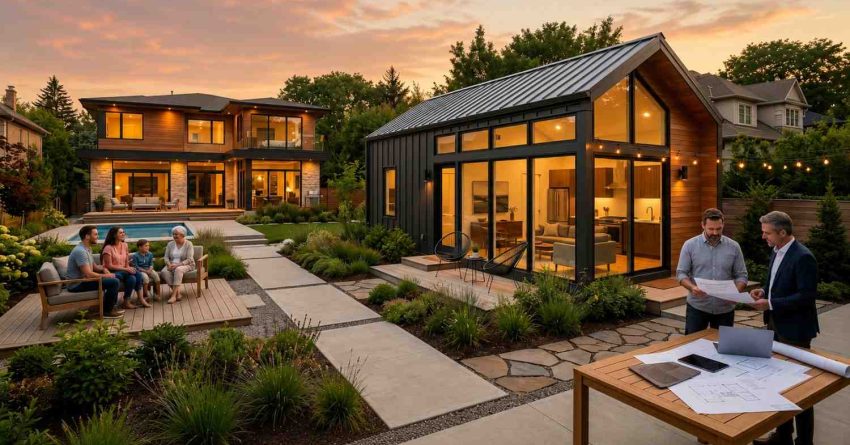
An accessory dwelling unit (ADU) is a self-contained secondary residential unit on the same lot as a primary home. From detached backyard cottages to garage conversions, basement apartments, and prefab structures, ADUs give US homeowners a powerful path to rental income and multigenerational housing.
ADUs are fundamentally reshaping how American homeowners generate rental income, house aging parents or adult children, and increase long-term property values while meaningfully addressing the country’s accelerating housing affordability shortage.
This complete guide covers ADU types, costs, zoning regulations, the full permit process, design principles, financing options, rental investment potential, construction specifics, common problems, and how to find professional services.
What Is an ADU? Definition, Types, and Why They Matter
An accessory dwelling unit is a secondary, fully independent residential unit located on the same parcel of land as a primary single-family or multifamily home. Unlike a home addition that expands the main structure without creating an independent living space, an ADU functions as a complete dwelling — with its own kitchen, bathroom, sleeping area, and dedicated entrance.
The term “ADU” is used interchangeably in different regions with “granny flat,” “in-law suite,” “backyard cottage,” “secondary suite,” “casita,” or “carriage house.” While these names reflect regional terminology and structural variations, they all describe the same underlying concept: a livable, independent residential space that is secondary to the primary residence on the lot.
Structural Categories
From a regulatory and construction standpoint, ADUs fall into three primary structural categories:
- Detached ADUs: Freestanding structures entirely separate from the primary home — backyard cottages, standalone studios, and purpose-built guest houses.
- Attached ADUs: Units that share at least one wall with the primary residence, such as an addition off the rear or side of the main home.
- Conversion ADUs: Existing spaces within or attached to the primary structure converted to independent living quarters — garages, basements, and above-garage spaces are the most common sources.
Junior ADUs (JADUs)
California and a growing number of other states recognize a fourth category: the Junior ADU, or JADU. A JADU is created by converting existing space within the primary structure into a unit of up to 500 square feet. JADUs require owner-occupancy in most jurisdictions, may share laundry facilities with the primary home, and are subject to ministerial (non-discretionary) approval in many California cities — making them the fastest ADU format to permit where the program exists.
ADUs gained enormous legislative momentum after California passed a series of reform bills beginning in 2016, including AB 68, SB 1069, and subsequent legislation that removed minimum lot size requirements, reduced setback requirements to four feet, eliminated replacement parking mandates for conversions, and mandated streamlined approval. By 2025, more than 30 states have enacted similar laws limiting local governments’ ability to restrict ADU construction.
Whether you are exploring ADUs for the first time or need to confirm specific definitions, our dedicated guide to what an ADU is and how it works covers every ADU type, subtype, and classification with detailed explanations for homeowners at every stage of the decision process.
The Six Main ADU Types: Which One Fits Your Property?
Selecting the right ADU type is one of the most consequential early decisions in the planning process. Each type carries distinct cost profiles, permit complexity levels, construction timelines, and design possibilities. Understanding the differences before engaging a designer or builder prevents costly course corrections.
Detached ADU
A detached ADU is a completely freestanding structure — the most design-flexible and marketable option on the spectrum. Because it sits on its own footprint with no structural connection to the primary home, a detached ADU can be optimized purely for the tenant or occupant experience, with independent sound management, private outdoor space, and full design freedom. Detached ADUs typically range from 300 to 1,200 square feet and can be configured as studios, one-bedrooms, or two-bedrooms. Costs range from $80,000 to $400,000+ depending on region, size, and finish level.
Attached ADU
An attached ADU shares one or more walls with the primary residence, which can reduce construction cost by leveraging shared structure while still providing a fully independent living experience with a separate entrance. Many attached ADUs are built as additions off the rear or side of the main home.
Garage Conversion ADU
For homeowners with a single-car or two-car garage, converting the existing structure is frequently the most cost-effective path to a permitted ADU. The garage’s existing footprint, roof, and walls reduce construction costs substantially relative to ground-up builds. Costs typically fall between $50,000 and $150,000 — well below detached construction costs — making this path accessible to a wider range of homeowners.
For homeowners with an existing attached or detached garage, the process of converting a garage into an ADU is typically the fastest and most cost-effective path to a permitted rental unit, and our complete guide covers every step from structural assessment to permit requirements by jurisdiction.
Basement ADU Conversion
Finished or partially finished basements can be converted to self-contained ADUs with proper egress windows, ceiling height verification (minimum 7 feet under the IRC), and independent utility connections. Basement ADUs generally require less exterior construction but may require investment in moisture management systems and natural light solutions.
Above-Garage (Carriage House) ADU
The space above a detached garage — the “carriage house” configuration — is among the most popular platforms for ADU creation because it adds livable square footage without consuming additional lot coverage. These units require structural engineering to confirm the existing garage can carry the load of an occupied upper level.
Prefab and Modular ADUs
Factory-built prefab ADUs offer speed and cost predictability that site-built construction cannot match. Manufacturers including Abodu, Cover, Plant Prefab, and Studio Shed produce certified ADU units deliverable and installable in weeks once the foundation and utility prep work is complete. All-in costs typically fall between $100,000 and $250,000.
Detached ADUs remain the most popular and highest-value format, Our detached ADU complete guide walks through every consideration from foundation selection to interior layout, utility setup, and how detached units compare in cost and complexity to other ADU types.
How Much Does an ADU Cost to Build in 2025?
ADU construction costs span an enormous range depending on type, size, location, site conditions, and finish specification. Understanding the full cost picture before committing to a design or builder is the single most important financial planning step.
Cost by ADU Type: Current Benchmarks
| ADU Type | Estimated Cost Range (2025) |
| Garage Conversion (attached) | $50,000 – $150,000 |
| Basement Conversion | $60,000 – $175,000 |
| Prefab ADU (site-delivered, all-in) | $100,000 – $250,000 |
| Above-Garage (Carriage House) | $100,000 – $200,000 |
| Attached ADU (addition) | $120,000 – $250,000 |
| Detached ADU (ground-up) | $150,000 – $400,000+ |
Costs in California, New York, and the Pacific Northwest skew toward the upper end of these ranges; the Southeast, Midwest, and Mountain West generally come in toward the lower end due to lower labor rates and less regulatory overhead.
Regional Variation
Construction labor accounts for approximately 39% of single-family construction cost according to NAHB’s 2024 Cost of Constructing a Home survey, and that proportion holds broadly for ADU projects. Areas with high prevailing wages, strong union labor markets, and scarce skilled subcontractor availability produce higher ADU costs regardless of material prices.
Hidden Costs First-Time Builders Miss
Many first-time ADU builders are caught off-guard by fees and expenses beyond the construction contract — our guide to hidden ADU costs to plan for covers impact fees, utility connection charges, permit fees, engineering costs, and the soft costs that regularly push budgets 15–25% over initial estimates.
For detailed, up-to-date cost data broken down by ADU type and US region, our dedicated resource on current ADU build costs by type gives homeowners realistic budget frameworks, contractor rate benchmarks, and a breakdown of every major cost category from site prep through final finishes.
ADU Zoning Laws and Regulations: What You Need to Know
Zoning and regulatory compliance is the foundational layer of every ADU project. Building a unit without proper permits or in violation of setback requirements can result in fines, mandatory demolition orders, and severe consequences at resale. The good news: the regulatory environment for ADUs has improved dramatically in most US jurisdictions since 2017.
The State ADU Law Revolution
California led the national ADU reform movement, passing a series of bills that progressively dismantled previous barriers. SB 1069 (2016), AB 68 (2019), and subsequent legislation collectively eliminated minimum lot size requirements for ADU eligibility, reduced setback requirements to four feet for most detached ADUs, prohibited replacement parking mandates for conversions, streamlined owner-occupancy requirements, and mandated ministerial (non-discretionary) approval for qualifying ADUs.
Oregon, Washington, Maine, Montana, Massachusetts, Connecticut, and more than two dozen other states have passed similar reforms by 2025, creating the most permissive national environment for secondary units in modern residential history. Local jurisdictions in states with reform legislation are increasingly prohibited from imposing restrictions that exceed state minimums.
Setbacks, Height Limits, and Parking
Setback requirements — the minimum distance between a structure and a property line — typically run 4 to 5 feet at the sides and rear in reformed jurisdictions, though some cities maintain stricter standards for specific zones. Height limits are commonly set at 16 feet for detached ADUs in lower-density zones, with some jurisdictions permitting up to 25 feet. Parking requirements have been substantially reduced in many states: California prohibits local jurisdictions from requiring replacement parking when a garage is converted to an ADU, and also waives parking mandates for ADUs within half a mile of public transit.
If your property is subject to HOA governance, understanding HOA restrictions on ADUs versus your state’s superseding ADU statutes is critical before you invest in design or permitting — our guide explains which party’s rules take legal precedence and how to navigate HOA pushback even when state law is on your side.
Because zoning requirements vary significantly from city to city and change frequently as states pass new ADU legislation, our comprehensive guide to ADU zoning laws and setback rules provides a state-by-state regulatory overview, explains the key terms every homeowner must understand, and identifies the jurisdictions with the most streamlined approval processes.
The ADU Permit Process: From Application to Approval
The permit process is where ADU project timelines diverge most sharply. Some projects navigate approval in 30 to 60 days in jurisdictions with fully streamlined ministerial review; others take 6 to 18 months in slower, discretionary-review environments. Understanding the process before you start helps you plan an accurate project schedule and avoid the missteps that generate re-review delays.
The Eight Core Permit Steps
- Feasibility assessment: Confirm lot eligibility, setback compliance, and utility availability before committing design dollars.
- Site plan documentation: Record existing structures, property lines, and proposed ADU placement.
- Architectural drawings: Prepare permit-ready plans, or purchase a pre-approved plan set where available.
- Plan check submission: Submit to the local building department for combined zoning and structural review.
- Plan check response: Address any corrections or clarifications requested by plan reviewers.
- Building permit issuance: Receive the permit authorizing construction to begin.
- Phase inspections: Pass required inspections during construction — framing, rough-in MEP, insulation, and others.
- Final inspection and certificate of occupancy (CO): Receive the CO permitting legal occupancy of the completed unit.
Pre-Approved ADU Plan Programs
Many cities and counties now maintain pre-approved ADU plan libraries — standardized architectural drawings that have already completed plan check review and can be purchased and submitted without a separate review cycle. This compresses the permit timeline by 2 to 4 months and eliminates custom architectural drawing costs. Cities including Los Angeles, San Jose, San Diego, Portland, and Seattle have active pre-approved programs with multiple plan options at varying price points.
The permitting phase is where most ADU timelines either compress or expand dramatically, and our resource on the step-by-step ADU permit process walks through every required application stage, explains what each review covers, identifies the most common denial triggers, and provides a realistic timeline by jurisdiction type.
ADU Design and Floor Plans: Making Small Spaces Work
ADU design is a discipline of deliberate constraint. The most successful ADUs are not smaller versions of a conventional home — they are purpose-engineered spaces where every square foot performs multiple functions and where natural light, storage, and traffic flow are designed in from the beginning.
Design Principles for ADUs Under 600 sqft
Small ADU design demands ruthless prioritization. The kitchen should not compete with the living area for square footage; galley kitchen configurations and concealed appliances allow a combined kitchen-living zone of 180 to 200 square feet to function at the quality of a 350-square-foot space in a standard home. Bathroom placement adjacent to the kitchen wall minimizes plumbing run length and cost. Sleeping areas separated from the main living zone — even by a partial wall or furniture arrangement — make units far more marketable to tenants.
Kitchen, Bathroom, and Bedroom Essentials
A functional ADU kitchen requires at minimum: a two-burner or compact four-burner cooktop, a full-size or apartment-size refrigerator, undercounter or full dishwasher, and adequate counter and storage. Bathroom essentials include a tub/shower combination or walk-in shower, toilet, and vanity in 40 to 55 square feet. IRC-compliant sleeping space requires a minimum 70 square feet — though 100 to 120 square feet is more marketable as a true bedroom.
Accessible and ADA-Compliant ADU Design
ADUs built for aging parents or tenants with mobility limitations require specific accessibility features: zero-step entrances, doorway widths of 32 to 36 inches, roll-under sink space in kitchens and bathrooms, grab bar blocking in bathroom walls during framing, and lever-style door and faucet hardware. These features cost relatively little to incorporate at the design stage but are expensive to retrofit after construction is complete.
Space efficiency is the defining challenge of ADU design, and our guide to ADU floor plan design for small spaces covers the core principles that separate functional, rentable ADU layouts from cramped, hard-to-lease ones — including kitchen configuration, bathroom placement, storage integration, and the importance of natural light in units under 600 square feet.
Financing Your ADU Build: All the Options Explained
Financing is the second most common reason ADU projects stall — after permit complications. Most homeowners do not carry $150,000 to $300,000 in liquid cash savings, and ADUs rarely qualify for standalone conventional mortgage financing. Understanding the full menu of available financing tools before engaging a builder is essential to launching a project you can actually see through to completion.
HELOCs, Cash-Out Refinances, and Construction Loans
The three most commonly used ADU financing instruments are:
Home Equity Line of Credit (HELOC): A revolving credit line secured against your home equity, offering a draw period of 5 to 10 years at variable interest rates. HELOCs are flexible and suitable for phased construction, but variable rates introduce cost uncertainty in rising-rate environments. Most lenders offer HELOCs up to 80% to 85% of combined loan-to-value.
Cash-Out Refinance: Replaces the primary mortgage with a larger loan at a new rate, delivering the equity difference as cash at closing. Best suited for homeowners with significant equity whose current rate is at or above current market rates.
Construction-to-Permanent Loan: A single-close loan that funds construction draws during the build phase and then converts automatically to a standard amortizing mortgage at completion. This product requires detailed project plans and an “as-completed” appraisal confirming the projected value after the ADU is built.
State and Local ADU Grant Programs
California’s CalHFA ADU Grant Program has provided up to $40,000 in pre-development cost assistance to qualifying lower-income homeowners for architectural, engineering, and permit costs. Oregon, Connecticut, Vermont, and several other states maintain similar subsidy programs. Many municipalities also offer low-interest ADU loans or technical assistance grants. Program availability changes annually — check your state housing finance agency’s current offerings before ruling out grant assistance.
Can Projected Rental Income Help You Qualify?
Most conventional lenders require documented rental history before counting income toward debt-to-income ratio calculations. However, certain ADU-specialized lenders and some FHA and USDA products allow projected rental income to be factored into qualification — making ADU financing accessible for homeowners with equity but limited current cash flow.
Because ADUs rarely qualify for standard mortgage products on their own, understanding your full range of financing options for ADU construction from HELOCs and cash-out refinances to ADU-specific construction loans and state grant programs — is essential before committing to a builder or project timeline.
ADU as a Rental Investment: ROI, Income, and Tax Considerations
The financial case for building an ADU frequently rests on rental income potential. Understanding that potential accurately — before breaking ground — is what separates successful ADU investors from those who discover the math doesn’t work after the unit is built.
Long-Term vs. Short-Term ADU Rental
Long-term rentals — 12-month leases — offer stability, lower management burden, and predictable monthly cash flow. In most US markets, a well-located ADU of 400 to 800 square feet generates between $900 and $3,000 per month in long-term rental income, with San Francisco, Los Angeles, Seattle, and New York commanding the upper end of that range.
Short-term rentals through platforms like Airbnb and VRBO can generate 1.5x to 3x the monthly revenue of a comparable long-term rental in high-demand markets — but introduce significantly higher operational complexity, platform fees, occupancy variance, and local regulatory risk. Many jurisdictions require owner-occupancy for short-term rental operation, and some cities limit the number of rental nights permitted per year.
The choice between renting your ADU to a long-term tenant or operating it as a short-term rental platform fundamentally changes your income potential, liability exposure, and management burden — our deep dive into long-term vs short-term ADU rental strategy compares both models across markets and helps you match your rental approach to your specific financial goals.
For investors tracking return on investment, the fundamental calculation is: annualized net rental income divided by total investment cost. A $200,000 ADU generating $1,800 per month net after operating expenses produces $21,600 per year — a 10.8% cash-on-cash return, before accounting for property value appreciation in markets where ADU construction adds 20% to 35% to property values.
Investors evaluating ADUs as part of a broader real estate strategy will find the financial frameworks and market data in our ADU investment and new construction ROI guide helpful for comparing ADU returns against other build-and-hold investment models.
Tax Implications of ADU Rental Income
Rental income from an ADU is ordinary income subject to federal and applicable state income tax. ADU landlords may deduct depreciation (typically over 27.5 years for residential rental property), mortgage interest attributable to the ADU percentage of the property, operating expenses, repairs, property management fees, and insurance. Proper expense tracking and cost allocation between the primary residence and ADU is important for accurate reporting and maximum deduction capture.
Accurately projecting your ADU’s income potential before you build is critical to evaluating whether the investment makes financial sense, our guide to calculating ADU rental ROI provides the methodology, market rate data by region, and formula-based break-even analysis you need to make a fully informed decision.
ADU Construction: What Happens From Foundation to Finish
Once permits are secured, the physical build process begins. Understanding the major construction phases helps you manage your builder relationship effectively, anticipate inspection windows, and identify quality issues before they become expensive corrections.
Foundation Choices for ADUs
Foundation selection for a detached ADU depends on site conditions, local frost depth, budget constraints, and lot characteristics:
- Slab-on-grade: The most common and cost-effective option in mild climates; minimal excavation, fast pour, low moisture risk. Suitable for most US regions except those with extreme frost depth.
- Raised foundation with crawlspace: Better suited to sloped lots, high-moisture sites, or conditions requiring future utility access beneath the unit. Adds $5,000 to $20,000 versus slab.
- Pier or helical pile foundation: Used for challenging soil conditions, steep slopes, or situations requiring minimal site disturbance — common in areas with high water tables or expansive clay soils.
The foundation decision affects your ADU’s structural longevity, site preparation cost, and drainage performance — our guide to ADU foundation types and costs compares slab-on-grade, pier systems, stem wall, and crawlspace options with regional considerations and cost benchmarks for each.
Utility Hookup Options and Separate Metering
ADUs can connect to the main home’s existing utility services through a shared panel and meter, or be equipped with separate meters for electricity, water, and gas. Separate metering adds upfront cost — typically $5,000 to $15,000 for all utilities — but simplifies billing between owner and tenant, removes the complication of shared utility bills, and often increases the ADU’s appeal and rental price. Many jurisdictions now waive utility connection fees for ADUs under state mandate.
HVAC, Insulation, and Fire Separation
Mini-split heat pump systems have become the standard HVAC solution for most ADUs: they provide both heating and cooling without ductwork, are highly energy-efficient, install in one to two days, and require no integration with the primary home’s HVAC system. Wall insulation must meet the same energy code requirements as the primary residence — in California, that means Title 24 compliance; in other states, the applicable IECC climate zone minimum R-values apply.
For attached ADUs sharing a wall with the primary residence, a one-hour fire-rated wall assembly — typically 5/8-inch Type X drywall on both faces of the shared wall — is required by code in most jurisdictions. Some municipalities also require automatic fire sprinklers in new ADUs above a certain size threshold.
Common ADU Problems and How to Navigate Them
ADU projects involve more complexity than most homeowners anticipate. Understanding the most common friction points before you encounter them — and knowing your options when they arise — keeps projects moving forward.
Dealing with ADU Permit Denial
Permit denial is more common than most homeowners expect, particularly in cities where local regulations have not fully aligned with state ADU reform legislation. Common denial reasons include: inconsistent architectural drawings, setback miscalculations, non-compliant utility design, failure to demonstrate required owner-occupancy, or plans submitted to the wrong review agency.
If your ADU application has been rejected, our guide to appealing an ADU permit denial explains the formal appeals process, the most common grounds for reversal, how to engage a permit expediter, and what timeline to expect before resubmitting.
Builder Disputes and Construction Defects
ADU builder disputes typically arise from contract ambiguity, underbid projects where contractors cut corners to maintain profitability, or disagreements over change order pricing. Protecting yourself starts before construction begins: document every specification in writing, negotiate a fixed-price contract with clearly defined allowances, and retain a percentage of each payment draw as holdback contingent on satisfactory completion of the prior phase.
ADU Insurance: What Standard Policies Miss
Standard homeowner’s insurance policies rarely provide adequate coverage for an occupied ADU rental unit. Depending on policy language, you may have no coverage for tenant-caused damage, liability from tenant injuries on the ADU portion of the property, or loss of rental income following a covered event. Consulting with your insurance agent before your ADU is occupied — and likely adding a landlord endorsement or separate rental dwelling policy — is not optional; it is essential risk management for any ADU being rented.
Who Builds ADUs? Use Cases by Audience
ADUs serve remarkably diverse needs. The same building type that generates rental income for an investor also houses a grandparent for a multigenerational family and provides a caregiving space for a homeowner with an aging parent. Understanding which use case most closely aligns with your situation shapes every major ADU decision, from design to financing structure to management approach.
ADU for Aging Parents or Adult Children
An ADU built for an aging parent or adult child creates proximity without sacrificing the independence that both the resident and the main household typically want. The parent or child has their own entrance, kitchen, bathroom, and living space; the main household has peace of mind from the close proximity without the friction of fully shared living quarters. This configuration also creates a natural live-in caregiving arrangement when health conditions require more direct support.
An ADU purpose-built for an aging parent requires specific design accommodations that differ substantially from a rental-focused unit, Our guide on building an ADU for aging parents covers accessibility features, ADA design standards, proximity and privacy trade-offs, and how to structure the arrangement legally and financially.
ADU for House Hackers and Real Estate Investors
House hackers — homeowners who rent out a portion of their property to offset their housing cost — find ADUs exceptionally powerful as financial instruments. ADU rental income in many markets is sufficient to cover the majority of the primary mortgage payment, allowing the homeowner to live near-free while building equity in a property that is simultaneously appreciating. According to Pew Research Center data on multigenerational households, more than 59 million Americans currently live in multigenerational arrangements — a figure that underscores the scale of demand for ADU-compatible housing solutions.
ADU for Multi-Generational and Caregiving Households
Multi-generational families — three or more generations occupying the same property — represent a growing share of the US housing market driven by rising housing costs, immigration patterns, cultural preference, and an aging population. ADUs provide these families with the physical separation and privacy that makes long-term multi-generational cohabitation sustainable across different life stages.
ADU vs. Alternatives: Is an ADU the Right Move?
ADUs compete with several other uses of the same investment capital. Clarifying how they compare helps homeowners allocate resources to the option that most closely matches their specific goals.
ADU vs. Home Addition
A traditional home addition expands the primary residence’s square footage without creating an independent dwelling unit — it adds rooms to the main home. Additions typically cost $150 to $250 per square foot in labor and materials. A 400-square-foot addition in this range costs $60,000 to $100,000, but it provides no rental income potential, no multigenerational living independence, and no separate utility billing. An ADU costs more but generates income and property value increases that typically produce a higher long-term total return on the same capital.
ADU vs. Buying a Separate Investment Property
For homeowners with sufficient equity, the comparison between building an ADU and purchasing a separate rental property is common. ADUs typically win on financing flexibility (leveraging existing equity rather than a new purchase), management simplicity (on-site unit), and no additional property tax baseline. Separate investment properties offer portfolio diversification and potentially higher gross rental income at scale. The right choice depends on market conditions, personal liquidity, and management bandwidth.
ADU vs. Tiny Home on Wheels (THOW)
A tiny home on wheels costs $60,000 to $150,000 for a quality build and can be placed on the same lot in some jurisdictions — but is typically not permitted as a permanent dwelling unit eligible for standard long-term rental in most US cities without specific zoning accommodation. A permitted ADU, while more expensive, is a legal permanent structure that increases property value, qualifies as permanent rental housing, and can be listed on standard rental platforms without restriction.
For those deciding between a permanent ADU and an expansion of the primary home, our side-by-side ADU vs home addition comparison analyzes cost, complexity, permitting burden, rental income potential, and long-term property value impact for both paths so you can make the choice that fits your actual goals.
Getting Started: ADU Builder Services and Professional Help
Building an ADU requires a coordinated team of professionals — and the quality of that team is the single variable most correlated with project success. The right builder, designer, or design-build firm determines whether your ADU comes in on time, on budget, and to code.
What to Look for in an ADU Builder
ADU construction requires contractors who understand the full permit-to-finish lifecycle, not just framing and finishing. Qualifying criteria include: documented ADU project experience in your specific city or county, valid general contractor licensing, current general liability and workers’ compensation insurance, and verifiable references from recent ADU clients in your jurisdiction. A contractor who builds residential additions but has never navigated a standalone ADU permit process in your city is a higher-risk choice than a specialist who has completed 20 ADUs under your jurisdiction’s specific review process.
For homeowners who want a single point of accountability from design through construction, our overview of ADU design-build services explains how design-build firms work, what’s included in a typical package, and how to evaluate whether the integrated model suits your budget and project complexity.
ADU Feasibility Studies: Know Before You Build
A feasibility study — provided by an ADU design firm, architect, or specialist contractor — confirms lot eligibility, identifies the most viable ADU type for your property’s specific conditions, provides a preliminary cost estimate, and flags potential zoning or utility complications before you commit to design costs. Feasibility studies typically run $500 to $2,500 and are among the highest-return investments a homeowner can make before committing to a full project. Many design-build firms include a feasibility assessment as part of their initial consultation.
If you are planning a primary residence build and want to incorporate an ADU as part of the same project, our complete guide to building a custom home addresses the full process, costs, and design considerations for the main structure, with a dedicated section on planning for a concurrent or future ADU.
Finding the right contractor is the single most important decision in your ADU project — our resource for connecting with a local ADU builder near you explains how to evaluate ADU-specific experience, verify licensing and insurance, and compare bids from specialists who understand local permit requirements and site conditions.
Conclusion
ADUs represent one of the most accessible paths to rental income, generational housing, and property value growth on a lot you already own.
From zoning navigation to construction management and rental setup, every step of the ADU journey has dedicated resources within this guide to explore in depth.
At Mr. Local Services, our network of licensed ADU specialists is ready to help you plan, permit, build, and rent your ADU successfully.
Frequently Asked Questions
What is the difference between an ADU and a JADU?
An ADU is a fully independent residential unit with its own kitchen, bathroom, and entrance, up to 1,200 square feet in most jurisdictions. A JADU (Junior ADU) is smaller — up to 500 square feet — created within the existing primary structure, and typically requires owner-occupancy while sharing some facilities with the main home.
How long does it take to build an ADU from permit application to move-in?
Total timelines typically range from 6 to 18 months depending on jurisdiction and ADU type. In streamlined markets like many California cities with ministerial review, permit approval can take 30 to 60 days; in slower discretionary-review jurisdictions, permit approval alone may take 6 to 12 months. Construction typically adds 3 to 6 months once the permit is issued.
Can I build an ADU if my neighborhood has an HOA?
In many states, HOA restrictions that prohibit or unreasonably restrict ADU construction have been superseded by state law. California, Oregon, Washington, and more than a dozen other states prohibit HOAs from preventing homeowners from building state-compliant ADUs. HOAs may still enforce design standards consistent with state law, so always verify your state’s current statutory position before assuming HOA approval is required.
What does it cost to convert a garage to an ADU?
Garage conversion ADUs typically cost between $50,000 and $150,000, making them the most affordable ADU type. Key cost variables include the garage’s existing structural condition, the extent of new plumbing installation required, HVAC system selection, insulation upgrades needed to meet code, local labor rates, and finish level chosen for the completed unit.
Will building an ADU increase my property taxes?
Yes — completing an ADU typically triggers a supplemental property tax assessment on the value added by the new construction. Most jurisdictions assess only the incremental value of the ADU addition rather than the entire property’s new market value, so the tax increase is proportional to the ADU’s assessed contribution. In California, Proposition 13 protections apply to the existing structure, and only the new ADU construction is reassessed at completion.
Do I need to live on the property to rent an ADU?
Owner-occupancy requirements for ADU rentals vary significantly by jurisdiction and have been substantially loosened in recent years. California eliminated the statewide owner-occupancy requirement for standard ADUs (not JADUs) in 2020 legislation. Many other states and cities impose no owner-occupancy requirement for long-term residential ADU rentals. Short-term rental platforms and local STR ordinances may apply separate and additional residency requirements.
How do I find a qualified ADU builder near me?
Look specifically for contractors who have completed multiple permitted ADUs in your city or county — local jurisdiction experience is a critical qualification because permit processes, site conditions, and utility connection requirements vary substantially by location. Mr. Local Services connects homeowners with vetted, licensed ADU specialists across the US who carry documented ADU project histories, verified licensing and insurance, and available references from recent clients.