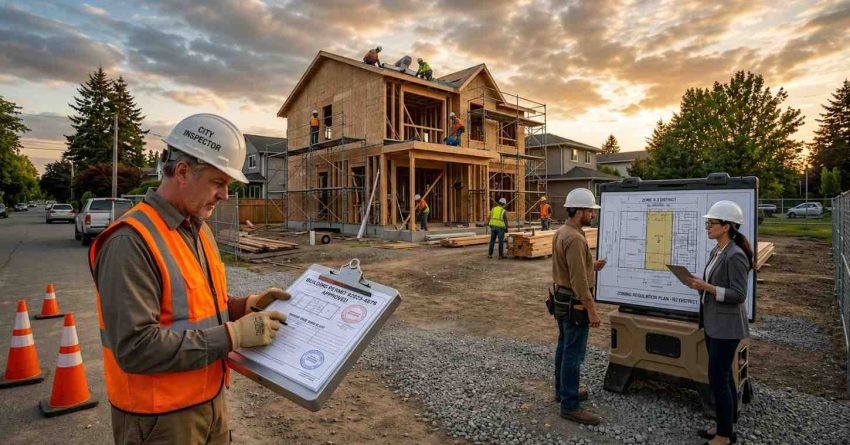
Building permits, zoning laws, and building codes form the regulatory framework governing every construction project in the United States. Understanding these requirements protects your investment, prevents costly violations, and ensures your structure is safe and legally habitable.
Skipping a required permit or violating a zoning rule can result in stop-work orders, substantial fines, forced demolition, and complications that make your property nearly impossible to refinance or sell.
This complete guide covers building permit fundamentals, zoning laws, building codes, state-specific regulations, HOA restrictions, phase inspection schedules, permit costs, special overlay zones, and professional permit services for your project.
What Is a Building Permit?
A building permit is an official approval issued by a local government authority – typically a city or county building department – that authorizes construction, renovation, or demolition work on a property. It is not administrative bureaucracy. It is a legal mechanism that protects homeowners, future buyers, and the surrounding community by ensuring all construction meets adopted safety standards before walls are closed and work is concealed.
The permit process follows a clear sequence: design and plan preparation, formal application and fee payment, plan review by the building department, permit issuance, construction, phase inspections at key milestones, and a final inspection that leads to a Certificate of Occupancy (CO). Every step in this sequence matters.
Why Permits Exist and Who Requires Them
Building permits exist because construction without oversight creates real and measurable public safety risks. Faulty wiring causes residential fires. Undersized structural members fail under load. Inadequate drainage damages adjacent properties. Improperly installed gas lines endanger entire neighborhoods. The permit and inspection system is designed to catch these issues before they become tragedies.
All 50 states have building permit requirements, though specific rules, fees, timelines, and processes are administered at the local level by a city, county, or regional building department. Some rural counties have minimal requirements. Urban markets like Los Angeles, Chicago, and New York have complex, multi-department approval processes that can take a year or more for major residential projects.
What Happens If You Skip the Permit?
Building without a required permit has serious and lasting consequences. Municipalities regularly discover unpermitted work through neighborhood canvasses, neighbor complaints, and property sale disclosures. When unpermitted work is discovered, owners face fines ranging from hundreds to tens of thousands of dollars, mandatory remediation requiring permits and potential structural exposure, and in egregious cases, forced demolition of non-compliant improvements.
Unpermitted work also creates complications during real estate transactions. Lenders routinely require all prior improvements to be permitted and signed off before issuing a purchase or refinance mortgage. Homeowner insurance policies may deny claims for losses tied to unpermitted work. If you purchase a property with unpermitted improvements, you inherit both the liability and the cost to cure it.

Building Permit Fundamentals
The building permit system is broader than most homeowners initially expect. Understanding what triggers a permit requirement, how approval timelines work, and what causes applications to fail gives you the practical foundation to plan any project accurately.
What Requires a Permit and What Doesn’t
Most jurisdictions require permits for any work affecting structural systems, fire safety systems, electrical service, plumbing, or mechanical equipment. Specific permit triggers typically include new construction of any habitable space, additions or structural alterations, HVAC system replacement or new installation, electrical panel upgrades, window replacements that alter rough opening dimensions, decks above a specified height, and any work that changes the use or occupancy classification of a space.
Work that typically does not require a permit includes like-for-like cosmetic repairs such as painting and flooring replacement, replacing fixtures with identical units without moving rough-in locations, minor landscaping, and small prefabricated sheds under a jurisdiction-specific size threshold – often under 120 or 200 square feet. These thresholds vary significantly. Always verify with your local building department before beginning any work, regardless of how minor it appears.
How Long Permits Take
Permit timelines vary significantly based on project complexity and local department workload. Over-the-counter permits for simple projects may be issued same-day at the counter. Standard residential permits in suburban jurisdictions with moderate volume typically move through plan check in two to eight weeks. Complex projects in high-volume urban markets can take six months to over a year for plan check review alone – before a single shovel of dirt has moved.
According to the National Association of Home Builders (NAHB), permitting delays are consistently cited by builders as one of the top contributors to project cost overruns and schedule extensions. Plan check timelines belong on every project’s critical path from the earliest stages of design.
Why Permits Get Denied
Common denial reasons include incomplete plan sets missing required drawings or calculations, insufficient structural engineering documentation, failure to meet current energy code requirements, zoning noncompliance identified during plan review, and missing licensed professional stamps where required. Understanding these triggers before submitting allows you to correct deficiencies before they become formal delays. Many jurisdictions offer pre-application meetings or preliminary plan review services that let you get written feedback before a formal submittal.
Re-submittals after a correction notice are typically charged an additional plan check fee, and each re-submittal restarts the review clock. Getting the application right on the first pass is worth significant effort.
If your project receives a stop work order during construction, every hour of delay has direct cost implications – our guide on how to handle a stop work order explains what triggers them, how to respond to the inspector immediately, and the fastest documented path back to active construction status.
For a comprehensive walkthrough of every application step, required documents, common denial reasons, and what the stop-work order response process looks like in practice, our building permit fundamentals guide walks through the complete permit system from pre-application research through final sign-off so you enter the process fully prepared.

Zoning Laws and Land Use Regulations
Zoning laws govern what can be built on a parcel of land, how it can be used, and the dimensional standards a structure must meet. Before any building permit can be issued, the proposed use and structure must comply with the applicable zoning district regulations. Zoning violations cannot be corrected through the building permit process alone – they require separate relief through the planning or zoning department, often through a public hearing process.
Understanding Residential Zoning Types
Most residential properties fall within districts designated as R-1, R-2, R-3, or similar classifications depending on the local system. R-1 districts typically restrict parcels to single-family detached residential use at low density. R-2 and R-3 districts may allow duplexes, attached townhomes, or small multi-family structures. Some jurisdictions use letter-number codes while others use descriptive names like “Low Density Residential” or “Neighborhood Residential.”
Within each zone, the code establishes the detailed rules for everything that can be built: minimum lot area required per dwelling unit, maximum lot coverage percentage, maximum floor area ratio (FAR), required setbacks from each property line, maximum building height, minimum parking spaces required, and any special standards for accessory structures.
Setbacks, Lot Coverage, and FAR
Setback requirements specify the minimum distance a structure must maintain from each property line – front yard, rear yard, and both side yards. These setbacks collectively define the “building envelope” – the three-dimensional area within which any structure must fit.
Lot coverage limits the total percentage of the lot that may be covered by structures and, in many jurisdictions, by all impervious surfaces. FAR – floor area ratio – limits the total floor area of all structures on the lot relative to the lot size. On a 10,000 square foot lot with a 0.5 FAR, the total floor area of all buildings combined may not exceed 5,000 square feet. Both coverage and FAR are commonly miscalculated at the concept stage, leading to costly design revisions later.
The Variance Process
When a proposed project cannot comply with one or more zoning standards and no code-permitted exception applies, the property owner may apply for a variance – a discretionary approval from the zoning board or planning commission that grants relief from a specific numerical standard.
Variances require demonstrating that strict literal compliance would impose an undue hardship on the property owner that is unique to the parcel’s physical characteristics – not merely financial inconvenience. Most jurisdictions require that the hardship was not self-created, and that granting the variance will not adversely affect adjacent properties or the general public. Variance hearings are quasi-judicial proceedings with formal evidence requirements and appeal rights.
When your build cannot comply with current zoning rules, our zoning variance application process guide explains who qualifies, how to document hardship, what evidence convinces a zoning board, and how long the approval process typically takes.
Whether you are planning a new home, an addition, or an accessory dwelling unit, understanding how your zoning district works before design begins is foundational – our residential zoning basics guide explains every zoning district type, how to read a zoning map, and how setbacks, height limits, and FAR collectively define what you can legally build on your lot.
Building Codes: The Technical Standards Behind Every Permit
While zoning determines what you can build and where, building codes specify how it must be built. These technical standards govern every element of construction – from the size of structural members to the clearances required around electrical panels to the minimum R-values for wall insulation. Compliance with the adopted building code is verified through the plan review process and confirmed through field inspections.
The International Residential Code (IRC)
The International Residential Code (IRC), published by the International Code Council (ICC), is the model code adopted – in whole or with state and local amendments – by most US jurisdictions for construction of one- and two-family residential buildings not exceeding three stories. It covers structural design loads, fire-resistance construction methods, energy efficiency requirements, plumbing systems, mechanical systems, electrical systems, and fuel gas installations.
According to the International Code Council, versions of the IRC are in effect across all 50 states. However, not all jurisdictions adopt the current edition. Some local governments still enforce the 2015 or 2018 edition while the ICC has published the 2021 edition. Local amendments layered on top of the base code can change requirements significantly.
IRC vs. IBC: Which Applies?
The International Building Code (IBC) applies to commercial buildings and multi-family residential structures of three or more dwelling units. The IRC applies to one- and two-family detached dwellings and townhouses not exceeding three stories in height. For the vast majority of homeowners and custom home builders, the IRC is the primary governing code. Larger multi-family projects, mixed-use buildings, and commercial construction fall under the IBC.
HUD Code for Manufactured Homes
Manufactured homes built in a factory are regulated under a separate federal standard – the HUD Code – administered by the U.S. Department of Housing and Urban Development. The HUD Code establishes construction and safety standards applied at the factory; local building permits govern the site work, foundation, and utility connections, not the manufactured home structure itself.
Park model homes and tiny homes on wheels (THOWs) certified under RVIA or ANSI A119.5 standards are classified as recreational vehicles, not residential dwellings under the building code system. This distinction has significant implications for where they may be parked, how long they may be occupied, and what permits are required for site installation.
Local Code Amendments
Even when a jurisdiction has formally adopted the IRC, local amendments can significantly alter the requirements for projects in that market. California’s Title 24 energy requirements impose some of the most stringent residential energy performance standards in the nation. Florida’s building code mandates hurricane wind-load design across the entire state. Oregon, Colorado, and California add Wildfire Urban Interface (WUI) overlay requirements for properties in designated fire hazard zones.
Always obtain the specific version of the adopted code plus all local amendments from your building department before finalizing structural and mechanical design. The International Residential Code is the foundation for residential construction standards across most of the country – our IRC code guide for homeowners demystifies every major section, from structural requirements to energy compliance, so you know exactly what your build must meet before submitting your permit application.
State-by-State Permit Regulations
While building permits are administered locally, states establish the overarching regulatory framework through statewide building codes, contractor licensing requirements, and enabling legislation that shapes what local governments may and may not regulate. Understanding your state’s environment is essential for accurate project planning.
How States Shape Local Permitting
Some states maintain highly prescriptive statewide building codes enforced through a state building official structure – California, Florida, and New York are primary examples. Other states like Texas delegate almost all permitting authority to local jurisdictions, creating dramatic variation even between neighboring counties.
State legislatures have increasingly pre-empted local zoning authority on specific development types. California’s SB 9 requires local governments to permit duplexes on single-family lots; SB 10 enables upzoning near transit corridors. Oregon’s HB 2001 eliminated single-family-only zoning statewide. Washington and Montana have adopted similar ADU pre-emption legislation. These state pre-emptions directly affect what you can build, what permits you need, and what fees you can be charged.
Key State Differences to Know
California has the most complex and multi-layered permit environment in the nation. Title 24 energy compliance documentation, Coastal Commission approval for projects within the coastal zone, wildfire WUI overlay requirements, seismic design categories, and high-volume building departments with stretched review timelines combine to make California permit management a specialized discipline. For builders working in this environment, our California building permit process guide covers Title 24 requirements, the Coastal Commission approval pathway, wildfire zone overlays, and the specific workflow across major California jurisdictions.
Texas operates with significant local variation. Cities have broad permitting authority but unincorporated county areas often have minimal requirements. Austin, Dallas, Houston, and San Antonio each operate distinct permit processes with different fee structures, review timelines, and submittal requirements.
Florida requires compliance with the Florida Building Code (FBC), which incorporates hurricane wind-load design requirements statewide. Coastal construction in Florida is additionally subject to oversight by the Florida Department of Environmental Protection through the Coastal Construction Control Line (CCCL) program.
How to Find Your Local Requirements
Always go directly to your local building department’s official website or visit in person to obtain the current fee schedule, submittal requirements, plan set standards, and current review timeline estimates. County GIS portals and assessor records provide public access to zoning maps, property details, and sometimes recorded documents that affect buildability. A pre-application meeting with a plan reviewer – available in most larger jurisdictions at low or no cost – is consistently one of the highest-ROI steps in project planning.

HOA Rules, Deed Restrictions, and Private Covenants
A building permit from the local government is not the only approval your project may require. If your property sits within a homeowners association or is subject to recorded deed restrictions, private covenants, or conditions and restrictions (CC&Rs), these layer additional requirements on top of – and sometimes in direct conflict with – the municipal permitting process. Private restrictions are often more demanding than zoning.
HOA Architectural Review
Homeowners associations typically administer an Architectural Review Committee (ARC) or Design Review Board (DRB) with authority to approve or deny exterior changes, new structures, additions, ADUs, landscaping modifications, and sometimes even paint colors. This review process is entirely separate from and parallel to municipal permitting – it operates on its own timeline, uses its own criteria, and is enforced through private contractual rights rather than government authority.
Obtaining a building permit does not substitute for HOA approval. A project fully approved by the city building department may be denied by the HOA if it fails to conform to neighborhood design standards. Conversely, an HOA-approved project may still require plan revisions before the building department issues a permit. Running both review processes in parallel, with coordination between them, is critical to avoiding expensive delays.
HOA architectural review adds a completely separate approval layer on top of municipal permits, with its own submittal requirements and timelines – our HOA architectural review process guide explains what HOA boards evaluate, how to prepare a compliant submittal package, and what to do if your initial application is rejected.
Deed Restrictions vs. Zoning
Deed restrictions (CC&Rs) are contractual obligations recorded against the title of the property and enforceable by other property owners or the HOA through civil litigation. They may impose standards more restrictive than the applicable zoning: lower building height limits, larger minimum setbacks, prohibited architectural styles, requirements for specific exterior materials, or outright prohibition of accessory structures or ADUs.
Zoning violations are addressed by the government through code enforcement and permit denial. Deed restriction violations are addressed through private civil lawsuits brought by neighboring property owners or the HOA. Both are real legal risks with real financial consequences. Any due diligence on a property purchase should include review of all recorded documents – not just the title – for restrictions that affect developability.
Easements and Building Restrictions
Easements recorded against a property give third parties the right to use specific areas of the parcel for defined purposes: utility lines, drainage corridors, shared access driveways, or view preservation. Building structures within an easement area is generally prohibited and can result in a court-ordered removal of any encroaching structure at the property owner’s expense.
Before finalizing any site plan, obtain a current title search, request a survey showing all easements, and have the surveyor plot easement boundaries on your site plan before design proceeds. Utility easements frequently run along rear and side property lines in widths of 10, 15, or 20 feet – invisible on the ground, but legally binding restrictions on what you can build there.
The Phase Inspection Schedule
A building permit does not operate as a single one-time approval. It initiates a scheduled series of field inspections that must occur and pass at defined milestones throughout construction. Each inspection creates a hold point: no work may proceed beyond that milestone until the inspection has been performed, passed, and documented by the building department. Covering work before it is inspected – intentionally or accidentally – can result in a required demolition of finished construction to allow the inspector to examine what was concealed.
Required Inspections by Phase
Foundation Inspection: Before concrete is placed, the inspector verifies that the formwork, reinforcement placement, anchor bolt locations, and underslab vapor barriers conform to the approved structural drawings. Some jurisdictions require both a pre-pour and post-pour inspection.
Framing Inspection: After the structural frame is complete but before any insulation or wallboard is installed, the inspector reviews the entire structural frame for code compliance – nailing patterns, header and beam sizing, shear wall installation, hurricane strapping locations, anchor bolt verification, and fire blocking at penetrations and horizontal breaks.
Rough-In Inspections: Electrical, plumbing, and HVAC rough-in work is inspected after installation but before walls are closed. In most jurisdictions, each trade requires a separate rough-in inspection. Low-voltage rough-in for smart home pre-wiring, structured wiring panels, and security camera runs should also be coordinated with the inspection schedule to ensure work is accessible.
Insulation Inspection: In jurisdictions with stringent energy code enforcement, insulation type, R-value, and installation method must be inspected before drywall is hung. Some jurisdictions accept a third-party energy compliance certificate in lieu of a separate insulation inspection.
Final Inspection: After all work is complete, a final inspection covers the entire scope of permitted work. The final inspection is the gateway to the Certificate of Occupancy.
What Inspectors Check
Building inspectors compare work in progress against the approved stamped plan set and the adopted building code. They evaluate code compliance, not finish quality. Common framing inspection failures include missing or insufficient hurricane/wind strapping connections, incorrect nailing patterns in shear wall panels, improperly sized headers above openings, missing fire blocking, and incorrect anchor bolt placement or embedment.
Rough-in electrical failures commonly include improper breaker sizing, missing junction box covers, insufficient wire stapling, improper conduit fill, and missing GFCI protection at required locations. Plumbing failures include incorrect drain slope, missing cleanouts, improper pipe support, and venting deficiencies.
Inspection Failures and Re-Inspection
When an inspection fails, the inspector issues a written correction notice listing each deficiency with the applicable code citation. The contractor must remedy every cited item, request a re-inspection, and typically pay a re-inspection fee. Most re-inspections take several business days to schedule, adding time to the project critical path. Understanding which inspections are required at each construction milestone – and scheduling them proactively – is one of the most important project management tasks in any build, directly affecting contractor sequencing and loan draw timing – our construction phase inspection schedule guide maps every required inspection from foundation pour to final walkthrough, including exactly what inspectors look for at each stage.
Permits for Specific Build Types
Not all construction projects follow the same permit pathway. ADUs, prefab homes, manufactured housing, solar installations, septic systems, and wells each have distinct regulatory requirements that differ from standard residential permits. Understanding the specific pathway for your build type before starting design prevents costly plan revisions and process delays.
ADU Permit Process
Accessory dwelling units have been the subject of significant state legislative reform over the past several years, with California, Oregon, Washington, Montana, and other states passing laws that limit local restrictions on ADU size, fees, parking, and approval timelines. These reforms have made ADUs more financially and procedurally accessible than in prior years.
Despite state pre-emption of some local restrictions, ADUs still require a complete permit process: plan submittal, structural engineering where required, energy code compliance documentation, separate utility connection permits, and a certificate of occupancy issued for the ADU independent of the main dwelling. Many jurisdictions have developed pre-approved ADU plan programs – a limited library of pre-reviewed designs that can be pulled with simplified review, cutting approval time from months to weeks for qualifying designs.
ADUs face some of the most layered permit pathways in residential construction, requiring coordination between state pre-emption law, local implementation, and utility hookup approvals – our ADU permit pathway guide walks through every step from pre-application research through final certificate of occupancy so you know exactly what to expect and when.
Prefab and Manufactured Home Permits
Modular homes are factory-built to the local building code (IRC or state equivalent), with factory inspection serving as a substitute for some local inspections. On-site, a local building permit is required for the foundation, utility connections, and the marriage of modular sections. The modules arrive with a factory inspection tag that documents compliance with the applicable code edition.
Manufactured homes (HUD Code) require a state agency label on the home itself (obtained at the factory), plus local permits for the installation site, foundation system, and all utility connections. The permit for a manufactured home installation covers the site – not the home structure itself, which was addressed at the factory under federal HUD oversight.
Solar, Septic, Well, and Demolition Permits
Solar photovoltaic installations require electrical permits in all US jurisdictions, as the inverter, service panel modifications, and grid interconnection all involve work covered by the National Electrical Code. Roof-mounted systems may additionally require structural permits to document that the existing roof framing can carry the added load. According to the U.S. Energy Information Administration, residential solar installations have grown dramatically, with many jurisdictions streamlining the permit process in response through simplified application forms and online submittal systems.
Septic system installation and replacement require county health department permits that are separate from building department permits. Septic permits involve a separate application, percolation testing, design approval, and field inspection by the health department. Well drilling requires permits from the state or county water authority, covering well location, construction specifications, and water quality testing. Demolition of structures requires demolition permits, and many jurisdictions require a hazardous materials assessment for asbestos and lead paint before a demolition permit will be issued.
Permit Costs, Fees, and Impact Charges
Permit fees are commonly underestimated in residential project budgets. The total cost of obtaining all required permits and complying with all associated regulatory requirements can add up to a significant soft cost component – one that must be budgeted accurately from the earliest stages of project planning.
How Building Permit Fees Are Calculated
Most jurisdictions calculate permit fees as a percentage of the estimated construction value. Common rate structures charge a sliding-scale fee per $1,000 of project valuation – for example, $8 per $1,000 for the first $500,000 of construction value and a reduced rate above that threshold. Permit fee schedules are public documents available from the building department.
Plan check fees – charged separately from the permit fee in most jurisdictions – cover the cost of the plan reviewer’s time for reviewing submitted drawings for code compliance. Plan check fees for complex residential projects commonly equal 65-85% of the base permit fee, and multiple re-submittals generate additional plan check charges. A $600,000 project in a high-cost California jurisdiction might pay between $8,000 and $15,000 in combined permit and plan check fees before a single trade permit is considered.
Impact Fees
Impact fees are one-time charges imposed by local governments on new construction to fund the infrastructure demands that new development places on the community. Impact fee categories include school fees, transportation and traffic fees, park and recreation fees, fire protection fees, water and sewer capacity fees, and general government facilities fees.
Impact fees vary enormously by jurisdiction. The NAHB has documented residential impact fees ranging from under $1,000 per unit in low-cost markets to over $100,000 per unit in high-cost metros like the San Francisco Bay Area and parts of Hawaii. Impact fees are typically due at permit issuance – before a shovel of dirt is turned – making them a significant upfront cash requirement.
Our upcoming guide on impact fees by category covers every impact fee type including school, traffic, park, fire, water, and sewer charges, with regional data showing the full range of what builders should budget in different markets.
Utility Connection Fees
Connecting a new structure to public water and sewer service requires payment of connection fees – also called capacity fees or tap fees – to the water and sewer utility district. These fees fund the infrastructure capacity required to serve a new connection and are entirely separate from both the building permit fee and any impact fees.
Connection fees for water and sewer service in many markets range from $5,000 to $25,000 per unit. High-density, high-infrastructure-cost markets can be significantly higher. These fees must be paid before water and sewer connections can be made and before a certificate of occupancy can be issued. Permit fees are just one component of total regulatory costs – our permit and fee cost breakdown covers plan check fees, separate trade permits, re-inspection charges, impact fees, and utility connection fees so you can budget every regulatory dollar accurately before breaking ground.

Special Overlay Zones and Jurisdictional Nuances
Many properties across the United States are subject to special overlay regulations that impose additional requirements based on specific geographic, environmental, historical, or hazard characteristics. These overlays can significantly extend approval timelines, require coordination with multiple agencies, and impose construction cost premiums that must be factored into project budgets from the earliest stages of planning.
Wildfire Urban Interface (WUI)
In California, Colorado, Oregon, and other western states, properties within officially designated Wildfire Urban Interface (WUI) zones must comply with fire-hardening construction requirements that go beyond the standard residential building code. California’s Chapter 7A of the California Residential Code mandates specific requirements for roofing materials (Class A fire-rated), exterior wall cladding materials, eave and vent protection, deck construction materials, and fencing materials adjacent to structures.
Properties in wildfire-prone states face code overlays governing exterior materials, vent protection, deck construction, and defensible space clearance – our guide on wildfire zone construction requirements covers every enhanced standard under state WUI code designations and the separate approval process specific to properties in these zones.
Historic Districts
Building within a locally or nationally designated historic district subjects your project to design review by a Historic Preservation Commission, Architectural Review Board, or State Historic Preservation Office (SHPO) depending on the level of designation. These bodies assess new construction and alterations for compatibility with the established historic character of the district – a subjective standard that frequently requires multiple hearing appearances and significant design iteration.
Our guide on historic district building approval covers the design review process, applicable preservation standards, compatibility criteria, and strategies for achieving approval while maintaining project economics – including what triggers full SHPO involvement versus local board review only.
Flood Zones and FEMA Requirements
Properties within FEMA-designated Special Flood Hazard Areas (SFHAs) – Flood Zones A, AE, V, and VE – are subject to mandatory floodplain management requirements under the National Flood Insurance Program (NFIP). These requirements include minimum finished floor elevation standards above the Base Flood Elevation (BFE), flood-proofing requirements for non-residential portions of structures, restrictions on fill and grading within floodways, and Elevation Certificate documentation required before and after construction.
According to FEMA, over 5 million properties in the US carry flood insurance policies, reflecting the significant geographic footprint of flood-prone development. For a complete guide to building in a designated flood zone including Zone A, AE, V, and VE requirements, elevation certificate procedures, and every compliance step required before and after construction, our FEMA flood zone construction guide covers every compliance pathway and documentation requirement.
City vs. County Jurisdictional Differences
Properties within incorporated city limits fall under city building codes, zoning ordinances, and city building department jurisdiction. Properties in unincorporated areas fall under county jurisdiction. In many states, unincorporated county areas have less stringent requirements than nearby cities – a factor that sometimes influences where projects are sited.
However, some California counties, Hawaii counties, and other high-cost markets have comprehensive permit requirements equal to or exceeding nearby city standards. Always confirm which authority has jurisdiction over your specific parcel using county assessor records or GIS parcel maps before beginning the design process.
How Permits Connect to the Full Home Building Timeline
Building permits are not a discrete task to be completed before construction begins. They are woven throughout the project timeline from initial land evaluation through certificate of occupancy – triggering approvals, creating hold points, and determining when each subsequent phase can proceed. Understanding this integration is essential for realistic project scheduling.
Pre-Construction: Before Ground Is Broken
For many projects, the permitting process begins six to twelve months before the intended construction start date. Plan preparation, structural engineering, energy modeling, civil engineering for grading and drainage, and the plan check review period all occur before a permit is issued. In high-volume jurisdictions, plan check timelines alone can consume six months of this pre-construction window.
Managing construction financing timelines begins with understanding that permit delays are a critical path item. A six-month permit delay extends your construction loan interest-only period by six months, increasing carrying costs before a single foundation pour occurs. Permit fees, plan check costs, impact charges, and utility connection fees are soft costs that must be incorporated into your construction loan budget from the earliest planning stage – our construction cost and financing guide covers how to account for all regulatory costs alongside hard construction costs in your overall project financial model.
During Construction: Inspection Hold Points
Once construction begins, each required phase inspection creates a formal hold point that must be cleared before work can proceed. Foundation inspections must pass before concrete is placed. Framing inspections must pass before insulation is installed. Rough-in trade inspections must pass before walls are closed. Missing an inspection or scheduling one too late results in required demolition of finished work to allow inspector access.
Experienced builders schedule inspections two to three business days in advance and build inspection buffer days into their construction schedule. Failed inspections require correction time plus a re-inspection appointment, adding unpredictable delays. Permits are not a standalone event but a sequenced series of approvals and hold points woven throughout every phase of construction – our complete home building process guide maps every milestone from pre-construction planning through move-in, showing exactly where each permit application, plan review, and phase inspection falls within the master project timeline.
Close-Out: Certificate of Occupancy
The Certificate of Occupancy is the final legal authorization to occupy a newly constructed structure. It is issued by the building department only after the final inspection has been passed, all correction notices from prior inspections have been resolved, and all required close-out documentation has been submitted. Documentation requirements vary by jurisdiction but commonly include energy code compliance certificates, licensed engineer final letters, septic system approval from the health department, utility connection confirmations, and soil engineer certification of compaction.
Without a CO, you cannot legally occupy the structure, your construction loan cannot convert to a permanent mortgage, and the project cannot be transferred as a completed habitable dwelling. Obtaining the CO cleanly – without missed items discovered at the final inspection – requires proactive coordination throughout the build, not a last-minute scramble.
Permit Expediters and Professional Permit Services
For complex projects, developments in high-volume jurisdictions with long standard review queues, or time-sensitive construction schedules, professional permit expediting services offer a meaningful path to compressing approval timelines without compromising application quality.
What a Permit Expediter Does
A permit expediter – variously called a permit consultant, permit runner, or permit processor – manages the permit application process on behalf of the owner or contractor. Their value derives from deep relationships with building department staff, firsthand knowledge of each jurisdiction’s current submittal requirements and common correction triggers, and the ability to navigate internal departmental processes that routinely frustrate first-time applicants.
Experienced expediters in major markets reduce timelines primarily by getting applications right on the first submission – eliminating the round-trip delay caused by incomplete or incorrect plan sets. In some jurisdictions, expediters can facilitate priority review status or pre-consultation meetings with plan reviewers before formal submittal. These capabilities can compress months of potential delay into weeks.
Plan Review and Code Consulting Services
Beyond permit expediters, professional services available to builders include third-party plan review – in which a private state-approved agency reviews plans for code compliance in lieu of or in parallel with the local building department – code consulting engagements to interpret code requirements before design is finalized, and zoning variance preparation assistance.
For complex projects or time-sensitive builds in high-volume jurisdictions, working with a professional permit expediter can compress approval timelines by weeks or months – our professional permit expediting services page explains what the service includes, what it typically costs, and the specific project scenarios where engaging an expediter delivers clear return on investment.
Getting Your Project Permit-Ready: Next Steps
Building permits, zoning compliance, and code adherence are not obstacles to construction – they are the foundation of a legally sound, insurable, and resalable property. Starting any project with a clear understanding of the regulatory landscape saves money, prevents costly delays, and produces a better long-term outcome for the owner and the community.
The path from a design concept to a permitted, inspected, and CO’d structure is navigable with the right preparation: know your zoning district before design begins, understand your applicable building code, confirm all overlay zones and special review requirements, submit a complete first application, and schedule inspections proactively throughout the build.
At Mr. Local Services, our network of experienced builders, permit consultants, code specialists, and local service professionals is ready to support every phase of your project – from initial code and zoning research through final inspection and certificate of occupancy. Contact us today to connect with qualified professionals in your area who know your local regulatory environment.
Conclusion
Building permits, zoning laws, and building codes work together as a three-part regulatory system governing every construction project, protecting homeowners, communities, and the built environment.
Knowing how your project intersects overlay zones, HOA restrictions, and state requirements is what separates a smooth, on-budget build from a costly, delayed disaster.
Mr. Local Services connects you with experienced professionals who navigate this system every day, helping you move from permit application to final certificate of occupancy.
Frequently Asked Questions
What is a building permit and why is it required?
A building permit is an official government authorization to perform specified construction work on a property. It is required to ensure all construction meets adopted safety codes, verifying through a series of field inspections that the work is structurally sound, electrically safe, and legally habitable.
How much does a building permit typically cost?
Permit fees vary widely by project size and jurisdiction. Most fees are calculated as a percentage of project construction value, with plan check fees charged separately. Total permit costs for a major residential project commonly range from a few thousand dollars to well over $15,000, not counting impact fees and utility connection charges.
What happens if I build something without a permit?
Building without a required permit can trigger stop-work orders, substantial fines, mandatory remediation requiring reopening finished walls for inspection, and in serious cases, forced demolition. Unpermitted work also creates serious complications when selling or refinancing, as lenders and title companies require all prior construction to be properly permitted and closed out.
How long does it take to get a building permit?
Timelines range from same-day for simple over-the-counter permits to more than a year in high-volume urban markets like Los Angeles or New York. Standard residential permits in typical suburban jurisdictions generally complete plan review in two to eight weeks. Plan check timelines are one of the most common sources of project schedule overruns.
What is the difference between zoning and a building code?
Zoning determines what you can build and where on your property – governing use, density, setbacks, height, and lot coverage. Building codes govern how construction must be performed, specifying technical standards for structural systems, electrical, plumbing, mechanical, energy efficiency, and fire safety.
Do I need HOA approval even if I have a building permit?
Yes. HOA architectural review is entirely separate from the municipal building permit process. Your HOA can reject your plans even after the city has issued a permit. Secure both approvals independently and run both processes in parallel to avoid sequential delays on your project timeline.
What is a Certificate of Occupancy and why does it matter?
A Certificate of Occupancy is the final building department document certifying that a structure is safe and legally habitable, issued only after the final inspection passes. Without a CO, you cannot legally occupy the building, your construction loan cannot convert to a permanent mortgage, and the property cannot close as a completed residential dwelling.