HVAC system sizing for new builds is the engineering process of calculating exactly how much heating and cooling capacity a newly constructed home requires — and selecting equipment, ductwork, and controls that deliver that capacity efficiently and reliably across every room.
Getting this right from the start determines whether your home stays comfortable year-round, whether your energy bills are reasonable, and whether your HVAC equipment lasts its full expected lifespan. An oversized system short-cycles and wastes energy. An undersized system runs constantly and still fails to maintain target temperatures. Neither outcome is acceptable in a new build where the HVAC design is set before the first wall goes up.
This guide covers every dimension of HVAC sizing for new construction: what sizing actually means, how Manual J load calculations work, the key variables that drive sizing decisions, which system types suit different new build profiles, how BTUs and tonnage translate into real-world capacity, how ductwork design affects system performance, when zoning adds value, what energy codes require, how indoor air quality fits into the design, how to choose the right contractor, which mistakes to avoid, and what proper sizing costs.
What Is HVAC System Sizing?
HVAC system sizing is not about picking the largest unit that fits your budget or applying a rough square-footage rule of thumb. It is a precise, data-driven process that determines the exact heating and cooling load your home places on its mechanical systems under the most demanding conditions your local climate produces.
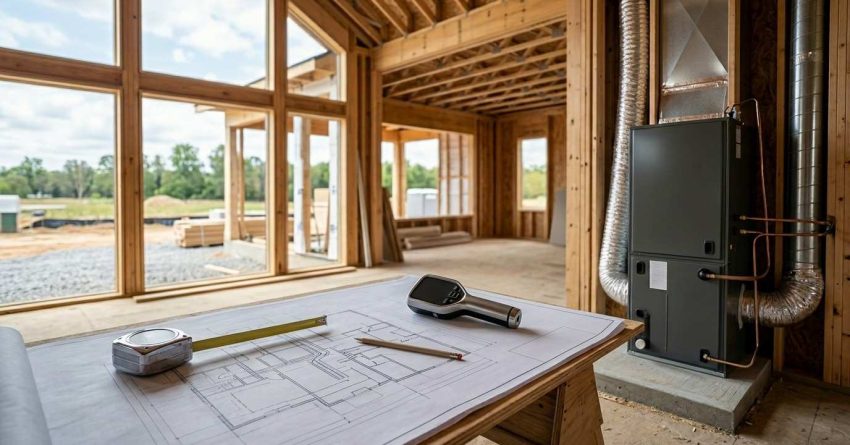
In a new build, sizing happens before equipment is purchased and before ductwork is installed. This sequencing matters because the HVAC system must be designed around the building, not retrofitted to it after the fact. When sizing is done correctly, the system runs in long, efficient cycles, maintains consistent temperatures throughout the home, controls humidity effectively, and operates within its designed performance envelope for 15 to 20 years or more.
The Role of Sizing in New Construction
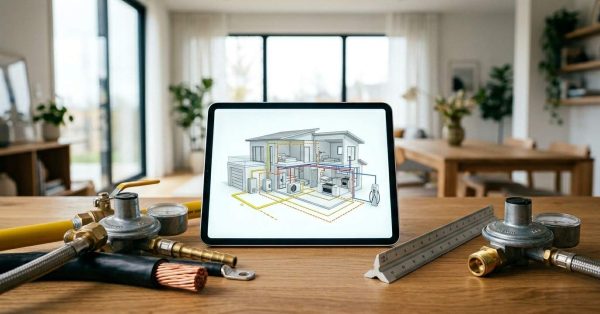
New construction offers a rare advantage: the HVAC system can be designed from scratch to match the building’s actual thermal characteristics. The insulation levels, window specifications, ceiling heights, orientation, and air sealing details are all known before the system is specified. This means there is no excuse for guesswork. A properly executed sizing process uses all of that building data to produce a load calculation that drives every downstream decision — equipment selection, duct sizing, zoning layout, and ventilation design.
Oversized vs. Undersized Systems: What Goes Wrong
An oversized system reaches its temperature setpoint quickly and shuts off before completing a full operating cycle. This short-cycling prevents adequate dehumidification, creates temperature swings between rooms, and accelerates wear on compressors and motors. An undersized system runs continuously during peak demand periods, never fully satisfying the load, driving up energy costs, and shortening equipment life. According to the U.S. Department of Energy, oversized air conditioners are one of the most common causes of comfort complaints and premature equipment failure in residential buildings.
HVAC system sizing is a precise engineering process rooted in the Manual J load calculation — our Manual J load calculation guide explains exactly how this industry-standard method works, what inputs it requires, and why no accurate sizing decision can be made without it.
Manual J Load Calculation: The Industry Standard
Manual J is the residential load calculation methodology developed by the Air Conditioning Contractors of America (ACCA) and recognized by the International Energy Conservation Code (IECC) as the required method for sizing HVAC equipment in new residential construction across most U.S. jurisdictions. It is not optional in code-compliant new builds — it is the standard.
The calculation produces two outputs: the design heating load and the design cooling load, both expressed in BTUs per hour. These figures represent the maximum rate at which the building gains or loses heat under the most extreme outdoor conditions expected in your climate zone. Every piece of HVAC equipment you select must be capable of meeting these loads without being significantly oversized.
What Manual J Measures
Manual J accounts for heat transfer through every element of the building envelope — walls, roof, floors, windows, and doors — as well as heat generated internally by occupants, lighting, and appliances, and heat introduced through ventilation and infiltration. It factors in the orientation of the building, the local design temperatures for your climate zone, the thermal resistance (R-value) of insulation assemblies, and the solar heat gain characteristics of your windows. The result is a room-by-room load profile, not just a whole-house total, which is essential for sizing individual supply registers and return air pathways correctly.
Who Performs a Manual J Calculation
Manual J calculations should be performed by a licensed HVAC engineer or a certified HVAC contractor with specific training in load calculation software such as Wrightsoft or Elite RHVAC. Many states and local jurisdictions require a Manual J report to be submitted as part of the building permit application for new construction. Homeowners and builders who allow contractors to size equipment based on rules of thumb — such as “one ton per 500 square feet” — are accepting a significant risk of comfort problems, energy waste, and premature equipment failure.
The Manual J process draws on a wide range of property-specific inputs — our dedicated resource on HVAC sizing factors for new builds breaks down every variable that feeds into the calculation, from climate zone data to building envelope performance, so you understand exactly what drives your system’s size requirements.
Key Factors That Affect HVAC Sizing in New Builds
No two new builds produce the same Manual J result, even when they share the same floor plan. The sizing outcome is shaped by a combination of fixed geographic factors and design choices made during the planning and construction process. Understanding these variables helps homeowners and builders make informed decisions that reduce load requirements and lower long-term operating costs.
Square Footage and Ceiling Height
Total conditioned floor area is the most obvious sizing input, but it is far from the only one. Ceiling height multiplies the conditioned volume significantly — a 2,500-square-foot home with 10-foot ceilings has 25 percent more conditioned volume than the same footprint with 8-foot ceilings, which increases both heating and cooling loads. Open floor plans with large vaulted spaces require careful load analysis because they create uneven temperature stratification that affects both equipment sizing and duct layout.
Climate Zone and Geographic Location
The U.S. Department of Energy’s Building America climate zone map divides the country into eight climate zones ranging from very hot-humid to subarctic. Your climate zone determines the outdoor design temperatures used in Manual J — the extreme high and low temperatures your system must be capable of handling. A home in Phoenix, Arizona, carries a dramatically higher cooling load than an identical home in Minneapolis, Minnesota, which carries a dramatically higher heating load. Geographic location also affects solar radiation levels, humidity profiles, and wind exposure, all of which feed into the calculation.
Insulation, Windows, and Building Envelope
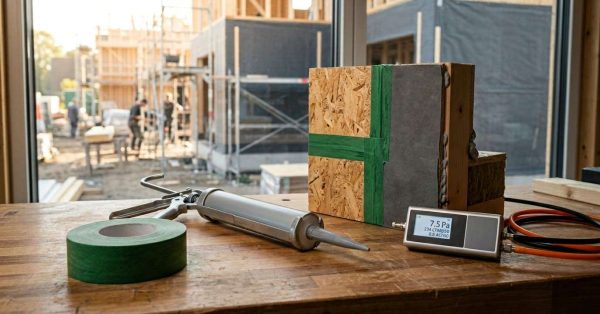
The thermal performance of the building envelope is the single most powerful lever available to reduce HVAC load requirements. Higher R-value insulation in walls, attics, and floors reduces heat transfer rates directly. High-performance windows with low U-factors and appropriate solar heat gain coefficients (SHGC) reduce both conductive heat loss and solar heat gain. Air sealing quality — measured through blower door testing — determines infiltration rates, which represent a significant portion of the total load in leaky buildings. According to ENERGY STAR, air leakage accounts for 25 to 40 percent of the energy used for heating and cooling in a typical home.
Occupancy and Internal Heat Loads
Each occupant in a home generates approximately 250 BTUs per hour of sensible heat and additional latent heat through respiration and perspiration. Lighting, appliances, and electronics add further internal heat gains that must be accounted for in the cooling load calculation. A home designed for a large family with a professional kitchen and home theater will carry a meaningfully higher internal heat load than a similarly sized home occupied by one or two people.
Once you understand the factors that determine your load requirements, the next step is matching those requirements to the right equipment — our guide to HVAC system types for new construction covers every major system category, from central forced-air to geothermal, with a clear breakdown of which configurations perform best under different load profiles.
HVAC System Types for New Construction
New construction provides the flexibility to install any HVAC system type from the ground up, without the constraints of existing ductwork, equipment locations, or structural limitations. The right system type depends on your climate zone, load profile, budget, energy goals, and the specific characteristics of the building design.
Central Forced-Air Systems
Central forced-air systems remain the most common HVAC configuration in new U.S. residential construction. They use a central air handler or furnace to condition air and distribute it through a network of supply and return ducts to every room in the home. In cooling-dominated climates, a split-system air conditioner paired with a gas furnace or air handler is the standard configuration. These systems are well-understood by contractors, supported by a wide range of equipment options, and compatible with most new construction duct layouts.
Heat Pumps
Heat pumps transfer heat rather than generating it, making them significantly more efficient than resistance heating in moderate climates. Modern cold-climate heat pumps maintain effective heating performance at outdoor temperatures as low as -13°F, expanding their viable range well beyond the mild-climate applications where they were historically concentrated. The U.S. Department of Energy reports that heat pumps can reduce electricity use for heating by approximately 50 percent compared to electric resistance heating. In new builds targeting high energy efficiency or net-zero performance, heat pumps are increasingly the system of choice.
Ductless Mini-Split Systems
Ductless mini-split systems deliver conditioned air directly to individual rooms or zones through wall-mounted air handlers connected to an outdoor compressor unit by refrigerant lines. They eliminate duct losses entirely — a significant advantage given that ENERGY STAR estimates that duct losses in a typical forced-air system account for more than 30 percent of energy consumption. Mini-splits are particularly well-suited to new builds with additions, bonus rooms, or areas that are difficult to serve with conventional ductwork.
Geothermal Systems
Geothermal heat pump systems use the stable temperature of the earth below the frost line as a heat source in winter and a heat sink in summer. They deliver the highest efficiency ratings of any HVAC system type, with heating efficiencies expressed as coefficients of performance (COP) typically ranging from 3.0 to 5.0 — meaning three to five units of heat energy delivered for every unit of electrical energy consumed. The upfront installation cost is substantially higher than conventional systems due to ground loop installation, but long-term operating costs are significantly lower.
Selecting the right system type is only meaningful when paired with accurate capacity figures — our guide to HVAC BTU and tonnage sizing explains how to translate your Manual J results into the correct unit capacity, what tonnage ratings mean in practice, and how SEER ratings affect long-term operating costs.
Understanding BTUs, Tonnage, and SEER Ratings
HVAC equipment capacity and efficiency are expressed in standardized units that allow direct comparison across manufacturers and system types. Understanding what these numbers mean — and how they connect to your Manual J results — is essential for making informed equipment selections.
What Is a BTU and Why It Matters
A BTU (British Thermal Unit) is the amount of energy required to raise the temperature of one pound of water by one degree Fahrenheit. In HVAC applications, capacity is expressed as BTUs per hour — the rate at which a system can add or remove heat from a conditioned space. Your Manual J calculation produces a design load in BTUs per hour, and the equipment you select must match that figure within an acceptable tolerance. ACCA’s Manual S standard, which governs equipment selection, specifies that cooling equipment should not be oversized by more than 15 percent of the calculated sensible cooling load.
Tonnage Explained
HVAC cooling capacity is commonly expressed in tons, where one ton equals 12,000 BTUs per hour — a unit derived from the cooling effect of melting one ton of ice over 24 hours. Residential systems typically range from 1.5 to 5 tons, with most single-family homes falling between 2 and 4 tons depending on size, climate, and envelope performance. Tonnage is a shorthand for capacity, not a sizing method — the correct tonnage for your home is determined by Manual J, not by square footage rules.
SEER Ratings and Energy Efficiency
The Seasonal Energy Efficiency Ratio (SEER) measures the cooling efficiency of an air conditioner or heat pump over an entire cooling season. Higher SEER ratings indicate greater efficiency and lower operating costs. As of January 2023, the U.S. Department of Energy’s updated minimum efficiency standards require SEER2 ratings of 14.3 or higher for new central air conditioners in most U.S. regions, with higher minimums in the Southeast and Southwest. High-efficiency systems with SEER2 ratings of 18 or above can reduce cooling energy consumption by 20 to 30 percent compared to minimum-compliant equipment.
Capacity figures only deliver their full value when the distribution system is designed to match — our resource on ductwork design and sizing covers Manual D standards, duct layout principles, and the most common ductwork errors that cause properly sized equipment to underperform in new builds.
Ductwork Design and Sizing for New Builds
A correctly sized HVAC unit paired with a poorly designed duct system will not perform as intended. Ductwork is the delivery infrastructure of a forced-air system, and its design directly determines whether conditioned air reaches every room at the correct flow rate, temperature, and pressure. In new construction, ductwork design should be completed before framing is finalized so that duct pathways can be accommodated within the building structure without compromises.
Manual D: The Duct Design Standard
Manual D is ACCA’s duct design methodology and the companion standard to Manual J. Where Manual J determines how much conditioned air each room needs, Manual D determines the duct sizes, layouts, and configurations required to deliver that air at the correct velocity and static pressure. A Manual D calculation specifies the diameter or dimensions of every duct segment, the location and size of supply registers and return grilles, and the total external static pressure the air handler must overcome. Systems designed without Manual D frequently suffer from uneven airflow, excessive noise, and reduced equipment efficiency.
Common Ductwork Mistakes in New Construction
The most prevalent ductwork errors in new builds include undersized return air pathways, which restrict airflow and increase static pressure across the system; duct runs installed in unconditioned attic or crawl space locations without adequate insulation, which can lose 20 to 30 percent of conditioned air energy to the surrounding environment; and excessive duct length or the use of too many fittings, which increases resistance and reduces airflow at terminal registers. Flex duct, while convenient to install, must be properly supported and stretched to its full length to avoid the significant airflow restrictions caused by compressed or kinked sections.
For homes with multiple floors, large open plans, or rooms with significantly different solar exposure, a single-zone duct system may not be enough — our guide to HVAC zoning for new builds explains how multi-zone systems work, when they add genuine value, and how to plan zoning into your new construction HVAC design from the start.
Zoning Systems and Multi-Zone HVAC Planning
HVAC zoning divides a home into independently controlled thermal areas, each with its own thermostat and damper-controlled airflow. Rather than conditioning the entire home to a single setpoint, a zoned system can maintain different temperatures in different areas simultaneously, responding to the specific occupancy patterns and solar exposure of each zone.
What Is HVAC Zoning?
A zoned HVAC system uses motorized dampers installed within the ductwork to direct conditioned air to active zones while restricting flow to unoccupied or already-satisfied zones. A zone control panel coordinates the dampers with multiple thermostats and communicates with the air handler or furnace to modulate output. Variable-speed air handlers and two-stage or variable-capacity compressors work particularly well in zoned systems because they can reduce output when only a portion of the home requires conditioning, improving efficiency and reducing the pressure imbalances that fixed-speed equipment creates when dampers close off portions of the duct system.
When Zoning Makes Sense in a New Build
Zoning adds the most value in homes with significant thermal diversity between areas — multi-story homes where upper floors accumulate heat, homes with large south- or west-facing glass areas that create high afternoon solar loads in specific rooms, homes with finished basements or bonus rooms that are used differently from the main living areas, and homes where occupants have consistently different comfort preferences in different parts of the building. For smaller, single-story homes with relatively uniform thermal characteristics, a well-designed single-zone system with proper duct balancing may deliver equivalent comfort at lower cost and complexity.
Zoning decisions intersect directly with energy code requirements that govern all new construction HVAC installations — our resource on HVAC energy codes and compliance explains the current IECC standards, ENERGY STAR thresholds, and local code requirements that your system design must satisfy before a certificate of occupancy is issued.
Energy Efficiency Standards and Building Codes
Every new residential HVAC installation in the United States must comply with a layered set of energy efficiency standards and building codes. These requirements establish minimum performance thresholds for equipment efficiency, duct leakage, and system commissioning, and they are enforced through the building permit and inspection process.
IECC and Local Energy Codes
The International Energy Conservation Code (IECC) is the model energy code adopted, with local amendments, by most U.S. states and jurisdictions. The 2021 IECC requires duct leakage testing for new construction, with total duct leakage not to exceed 4 CFM25 per 100 square feet of conditioned floor area. It also mandates Manual J load calculations as the basis for equipment sizing and requires that HVAC systems be commissioned and tested before occupancy. Many states have adopted the 2021 IECC or are in the process of doing so, while others operate under earlier versions with varying requirements. Your local building department is the authoritative source for the specific code version and amendments in effect for your project.
ENERGY STAR and High-Efficiency Requirements
ENERGY STAR certification for new homes requires HVAC systems to meet efficiency thresholds above the minimum code requirements, including higher SEER2 ratings for cooling equipment, higher HSPF2 ratings for heat pumps, and verified duct leakage below 4 CFM25 per 100 square feet. Some utility companies and state energy programs offer rebates for ENERGY STAR-certified equipment or homes, which can partially offset the premium cost of high-efficiency systems. Builders targeting LEED certification or net-zero energy performance will face additional HVAC efficiency requirements beyond ENERGY STAR thresholds.
Meeting energy codes is a minimum threshold, not a complete design goal — our guide to indoor air quality in new construction covers ASHRAE 62.2 ventilation requirements, filtration standards, humidity control strategies, and fresh air system options that protect occupant health in tightly sealed new builds.
Indoor Air Quality Considerations in New Build HVAC Design
Modern new construction techniques produce tightly sealed building envelopes that dramatically reduce energy losses but also restrict the natural air exchange that older, leakier homes relied on for ventilation. In a well-sealed new build, the HVAC system must actively manage indoor air quality — not just temperature and humidity — to maintain a healthy living environment.
Ventilation Requirements (ASHRAE 62.2)
ASHRAE Standard 62.2 establishes the minimum mechanical ventilation rates required for acceptable indoor air quality in low-rise residential buildings. The standard specifies a whole-building ventilation rate based on floor area and number of bedrooms, typically delivered through a dedicated mechanical ventilation system such as an energy recovery ventilator (ERV) or heat recovery ventilator (HRV), or through a controlled fresh air intake integrated with the central air handler. Many jurisdictions have adopted ASHRAE 62.2 as part of their building code requirements for new construction, and ENERGY STAR and LEED certification programs require compliance as a baseline.
Filtration, Humidity Control, and Fresh Air Systems
The filtration capacity of a new build HVAC system should be specified based on the occupants’ health needs and the local outdoor air quality conditions. Standard 1-inch fiberglass filters provide minimal particle removal; MERV 8 to 13 filters capture a significantly higher proportion of fine particles including dust, pollen, and pet dander without creating the airflow restriction associated with HEPA-level filtration in residential systems. Humidity control is particularly important in hot-humid climate zones where latent loads are high — a correctly sized system with adequate dehumidification capacity maintains indoor relative humidity between 30 and 60 percent, the range recommended by ASHRAE for occupant comfort and mold prevention. ERV and HRV systems recover 70 to 80 percent of the energy in exhaust air while introducing fresh outdoor air, making them the preferred ventilation solution for high-performance new builds.
Getting every element of your HVAC design right — from load calculations to air quality systems — requires a contractor with specific new construction expertise, and our professional HVAC installation services connect you with certified technicians who handle sizing, equipment selection, ductwork, and commissioning for new builds from start to finish.
How to Choose the Right HVAC Contractor for New Construction
The quality of your HVAC system’s performance over its lifetime depends as much on the contractor who designs and installs it as on the equipment itself. New construction HVAC work requires a specific combination of load calculation expertise, duct design capability, equipment knowledge, and coordination with other trades — not all HVAC contractors have all of these competencies.
Credentials and Certifications to Look For
Look for contractors who hold NATE (North American Technician Excellence) certification, which verifies technical competency through independent testing. ACCA membership and adherence to ACCA’s quality installation standards (ANSI/ACCA 5 QI) is a strong indicator that a contractor follows industry best practices for load calculations, equipment selection, and system commissioning. In states that require Manual J calculations to be submitted with building permits, verify that the contractor has demonstrated experience producing compliant load calculation reports, not just applying rules of thumb.
Ask whether the contractor uses recognized load calculation software such as Wrightsoft or Elite RHVAC, and request a sample Manual J report from a comparable recent project. A contractor who cannot or will not produce a Manual J report for a new construction project is a significant red flag regardless of their other qualifications.
Questions to Ask Before Hiring
Before committing to an HVAC contractor for a new build, ask: Will you perform a full Manual J load calculation and Manual D duct design for this project? What software do you use? Will you provide the calculation reports as part of the project documentation? How do you handle commissioning and testing after installation? What is your process for verifying duct leakage compliance? Do you carry the required licenses and insurance for new construction work in this jurisdiction? The answers to these questions will quickly distinguish contractors who approach new construction HVAC as an engineering discipline from those who treat it as a commodity installation.
Even experienced contractors make preventable errors during new construction HVAC planning — our dedicated resource on common HVAC sizing mistakes in new builds documents the most costly errors, from skipping Manual J to undersizing return air pathways, so you can identify red flags before they become expensive corrections.
HVAC Sizing Mistakes to Avoid in New Builds
The most consequential HVAC sizing mistakes in new construction are not random errors — they are predictable patterns that recur when contractors prioritize speed or cost over engineering rigor. Knowing what these mistakes look like helps homeowners and builders hold contractors accountable during the design and installation process.
Relying on Rules of Thumb Instead of Manual J
The most common and costly sizing mistake is using square footage rules of thumb — such as one ton per 500 or 600 square feet — instead of performing a proper Manual J calculation. These rules produce wildly inaccurate results because they ignore climate zone, building envelope performance, ceiling height, window area, orientation, and internal heat loads. A home in Miami and a home in Denver with identical floor plans require dramatically different HVAC systems. Rules of thumb cannot account for this variation and routinely produce oversized systems that short-cycle, fail to dehumidify, and wear out prematurely.
Ignoring Duct Design
Installing correctly sized equipment in a poorly designed duct system is one of the most common sources of comfort complaints in new builds. Undersized return air ducts, excessive duct length, improper register placement, and duct runs through unconditioned spaces all degrade system performance regardless of equipment quality. Manual D duct design is not optional — it is the engineering foundation that allows correctly sized equipment to actually deliver its rated performance to every room in the home.
Skipping Commissioning and Testing
A new HVAC system should be commissioned and tested after installation to verify that it is operating within its design parameters. Commissioning includes measuring airflow at each supply register, verifying refrigerant charge, testing duct leakage, and confirming that the system meets the load calculation targets under actual operating conditions. ACCA’s quality installation standard specifies the commissioning procedures that constitute a complete new construction HVAC installation. Systems that are not commissioned frequently operate with refrigerant charge errors, airflow imbalances, or duct leakage levels that significantly reduce efficiency and comfort without any visible indication of a problem.
Understanding what mistakes cost you is inseparable from understanding what proper installation should cost — our HVAC installation costs for new construction guide breaks down average equipment and labor costs by system type, explains what drives price variation, and shows how upfront investment in correct sizing pays back through lower energy bills over the system’s lifetime.
HVAC Sizing Costs for New Construction
The cost of a correctly sized and installed HVAC system in a new build varies significantly based on system type, home size, climate zone, equipment efficiency tier, and local labor markets. Understanding the cost structure helps homeowners and builders budget accurately and evaluate contractor proposals on a like-for-like basis.
What Affects HVAC Installation Cost
For a typical new single-family home in the United States, a complete HVAC installation — including equipment, ductwork, controls, and commissioning — ranges from approximately $8,000 to $20,000 or more depending on system type and home size. Central forced-air systems with gas furnaces and standard-efficiency air conditioners represent the lower end of this range for homes under 2,500 square feet. High-efficiency heat pump systems, zoned configurations, or homes with complex duct layouts push costs toward the upper end. Geothermal systems carry significantly higher upfront costs — typically $20,000 to $40,000 or more — due to ground loop installation, though operating costs are substantially lower over the system’s lifetime.
The primary cost drivers are equipment capacity (larger homes require larger, more expensive equipment), efficiency tier (higher SEER2 and HSPF2 ratings command a premium), duct complexity (more floors, more zones, and more difficult routing increase labor costs), and local labor rates (HVAC installation labor costs vary significantly by region and market conditions).
Cost vs. Long-Term Energy Savings
Investing in correct sizing and higher-efficiency equipment in a new build produces measurable long-term returns. A system that is correctly sized and properly commissioned operates more efficiently than an oversized system that short-cycles, reducing annual energy consumption and extending equipment life. Upgrading from a minimum-compliant 14.3 SEER2 system to a high-efficiency 18 SEER2 system typically adds $1,000 to $3,000 to the upfront cost but can reduce annual cooling energy costs by 20 to 25 percent over the system’s lifetime. In climate zones with high cooling loads, this payback period is often five to eight years.
When you are ready to move from planning to installation, Mr. Local Services provides new construction HVAC services that cover every phase — from initial load calculations and equipment selection through ductwork installation, system commissioning, and final performance verification.
Conclusion
HVAC system sizing for new builds is a multi-layered engineering process that connects load calculations, equipment selection, duct design, zoning, energy codes, and indoor air quality into a single integrated system. Every decision in the chain — from insulation levels to equipment tonnage to duct layout — affects the performance, efficiency, and longevity of the finished installation.
The resources available through this guide’s cluster of spoke give you the depth to understand each component of the sizing process, from Manual J methodology to installation cost benchmarks, so you can approach your new build HVAC project with the knowledge to ask the right questions and evaluate the answers.
At Mr. Local Services, our certified HVAC professionals bring the expertise, tools, and standards-based approach that new construction sizing demands — contact us today to connect with a specialist who will get your new build’s HVAC system right from the start.
Frequently Asked Questions
What is the most accurate method for sizing an HVAC system in a new build?
The Manual J load calculation is the industry-standard and code-required method for sizing HVAC systems in new residential construction. It accounts for climate zone, building envelope performance, square footage, ceiling height, window area, and internal heat loads to produce a precise heating and cooling load figure.
How many tons of HVAC do I need for a new 2,000-square-foot home?
Tonnage cannot be determined by square footage alone. A 2,000-square-foot home in a hot-humid climate with standard insulation may require 3 to 4 tons, while the same home in a mild climate with high-performance insulation and windows may require only 2 to 2.5 tons. A Manual J calculation is required for an accurate answer.
What happens if my HVAC system is oversized for my new build?
An oversized system short-cycles — it reaches the thermostat setpoint quickly and shuts off before completing a full operating cycle. This prevents adequate dehumidification, creates temperature swings between rooms, increases wear on compressors and motors, and raises long-term maintenance costs.
Do I need a Manual J calculation for a new construction permit?
In most U.S. jurisdictions, yes. The International Energy Conservation Code (IECC), adopted by most states, requires a Manual J load calculation to be submitted as part of the building permit application for new residential construction. Check with your local building department for the specific requirements in your area.
What is the difference between SEER and SEER2 ratings?
SEER (Seasonal Energy Efficiency Ratio) and SEER2 both measure cooling efficiency, but SEER2 uses a more rigorous test procedure that better reflects real-world operating conditions. As of January 2023, SEER2 is the required efficiency rating standard for new HVAC equipment sold in the United States, with minimum thresholds varying by region.
How does ductwork design affect HVAC system performance in a new build?
Poorly designed ductwork — including undersized return air pathways, excessive duct length, and runs through unconditioned spaces — restricts airflow, increases static pressure, and prevents correctly sized equipment from delivering its rated performance. Manual D duct design is the standard method for ensuring that ductwork matches the system’s airflow requirements.
When should I consider a zoned HVAC system for a new build?
Zoning adds the most value in homes with significant thermal diversity between areas — multi-story homes, homes with large south- or west-facing glass, homes with finished basements or bonus rooms, and homes where occupants consistently prefer different temperatures in different areas. A qualified HVAC contractor can assess whether your new build’s load profile justifies the added cost and complexity of a zoned system.