Air sealing a new build correctly from the start can reduce heating and cooling energy loss by up to 30%, according to the U.S. Department of Energy. Choosing the right materials, sealing at the right stages, and targeting the right locations makes the difference between a tight, efficient home and one that leaks conditioned air from day one.
Skipping or rushing air sealing during new construction creates problems that are expensive and disruptive to fix after drywall goes up.
This guide covers where air leaks occur, which materials work best, how to sequence sealing through the build, and what code requires — so your new home performs the way it should.
What Is Air Sealing in New Construction?
Air sealing is the process of closing all unintended gaps, cracks, and openings in a building’s envelope — the boundary between conditioned interior space and the unconditioned exterior or attic. In new construction, this means sealing penetrations, joints, and transitions before and during the framing, rough-in, and drywall stages.
The goal is to control where air moves in and out of the home. Uncontrolled air movement carries moisture, allergens, and outdoor pollutants inside while pushing conditioned air out — raising energy bills and reducing comfort. A properly sealed new build allows the mechanical ventilation system to manage air quality intentionally rather than relying on random leakage.
Air sealing works hand-in-hand with your home’s mechanical systems — our HVAC service solutions page explains how proper ventilation and heating equipment are sized and installed to complement a well-sealed building envelope.
How Air Sealing Differs From Insulation
Air sealing and insulation are related but serve different functions. Insulation slows the transfer of heat through solid materials — walls, ceilings, and floors. Air sealing stops the physical movement of air through gaps and openings. Both are required for an energy-efficient building envelope, but neither substitutes for the other.
A well-insulated wall with unsealed penetrations still loses significant energy through air movement. Conversely, a tightly sealed wall with inadequate insulation still conducts heat. New builds need both systems working together, installed in the correct sequence.
Where Air Leaks Occur in New Builds
Air leaks in new construction are predictable. They occur at the same locations in nearly every build because those locations involve transitions between materials, structural assemblies, or mechanical systems. Identifying these locations before drywall installation is the most cost-effective time to address them.
The most significant leakage areas in new residential construction include:
- Top plates where interior walls meet the ceiling plane
- Rim joists and band joists at the foundation level
- Electrical boxes, plumbing penetrations, and HVAC chases
- Recessed lighting cans in insulated ceilings
- Attic hatch frames and pull-down stair openings
- Exterior wall corners and intersections with interior walls
- Window and door rough openings before trim installation
Top-of-Wall and Ceiling Plane Gaps
The top plate — where wall framing meets the ceiling — is one of the highest-priority sealing locations in any new build. In platform-frame construction, gaps between the top plate and ceiling drywall allow air to move freely between the wall cavity and the attic. This pathway bypasses insulation entirely and accounts for a disproportionate share of total building air leakage.
Sealing the top plate requires applying a continuous bead of caulk or spray foam along the entire perimeter of the ceiling plane before insulation is installed. This step is easy to complete during framing and nearly impossible to address properly after drywall.
Penetrations, Chases, and Mechanical Openings
Every pipe, wire, duct, and flue that passes through the building envelope creates a potential air leakage pathway. In new construction, these penetrations are numerous — plumbing supply and drain lines, electrical conduit, HVAC supply and return chases, exhaust fans, and combustion appliance vents all require individual sealing.
Spray foam is the preferred material for sealing around pipes and conduit because it conforms to irregular shapes and adheres to most substrate materials. Fire-rated foam must be used in any penetration that passes through a fire-rated assembly, including between floors and around mechanical chases.
Best Air Sealing Materials for New Construction
Selecting the right material for each application determines how durable and effective the air seal will be. No single product works for every location — the correct choice depends on the gap size, substrate material, movement potential, and fire rating requirements.
Spray Foam vs. Caulk vs. Weatherstripping
Spray foam (both two-component and single-component canned foam) is the most versatile air sealing material for new construction. It expands to fill irregular gaps, adheres to wood, concrete, metal, and masonry, and provides both air sealing and a degree of thermal resistance. Two-component spray foam is used for larger areas and continuous applications; single-component canned foam is used for individual penetrations and smaller gaps.
Caulk is appropriate for narrow, stable gaps — typically less than half an inch — where movement is minimal. Paintable latex caulk works for interior applications at drywall joints and trim transitions. Silicone caulk is preferred for exterior applications and locations exposed to moisture or temperature cycling.
Weatherstripping is used at operable assemblies — doors, windows, and attic hatches — where a rigid seal would prevent operation. Foam tape, V-strip, and door sweeps each address different gap geometries and movement patterns. In new construction, weatherstripping is typically installed as part of door and window unit installation rather than as a separate air sealing step.
The right material selection reduces callbacks, extends seal longevity, and ensures the building envelope performs as designed through seasonal temperature changes.
Air Sealing Sequence During the Build Process
Timing is as important as material selection. Air sealing must be integrated into the construction schedule at specific stages — not treated as a single task completed at one point in the build. Missing a stage means sealing opportunities are buried behind finishes and become inaccessible without destructive work.
If you are planning a renovation rather than a ground-up build, understanding the home remodeling process helps clarify where air sealing fits within an existing structure versus new construction sequencing.
Rough-In Stage Air Sealing
The rough-in stage — after framing is complete and mechanical systems are roughed in but before insulation and drywall — is the primary air sealing window in new construction. At this stage, every penetration, chase, and transition is visible and accessible.
Tasks completed during rough-in air sealing include:
- Sealing all plumbing and electrical penetrations through top and bottom plates
- Foaming around HVAC supply and return chases
- Sealing rim joists and band joists with spray foam or rigid foam board plus caulk
- Applying caulk or foam at all wall-to-ceiling transitions
- Sealing around recessed light housings with airtight covers or foam
Completing these tasks before insulation installation ensures the air barrier is continuous and that insulation is not used as a substitute for sealing.
Pre-Drywall Inspection and Blower Door Testing
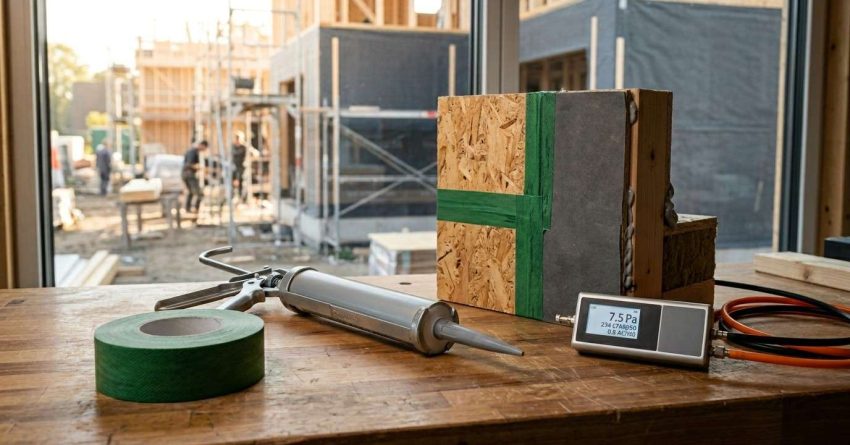
Many builders and energy programs require a pre-drywall inspection and blower door test before drywall installation is permitted. A blower door test depressurizes the building and measures total air leakage in air changes per hour (ACH). This test identifies whether the rough-in sealing achieved the target leakage rate and pinpoints remaining leakage locations while they are still accessible.
The ENERGY STAR New Homes program requires new homes to achieve a maximum of 3.0 ACH50 — meaning no more than 3 air changes per hour at 50 pascals of pressure. Many high-performance programs target 1.0 ACH50 or lower.
Completing a blower door test before drywall allows corrections to be made without tearing out finishes — a significant cost and schedule advantage compared to post-construction testing. For a dedicated breakdown of this testing process, see our blower door testing guide
Air Sealing and HVAC System Performance
A tightly sealed building envelope directly affects how HVAC equipment is sized, selected, and operated. In a leaky home, heating and cooling systems must compensate for continuous conditioned air loss — leading to oversized equipment, short cycling, uneven temperatures, and higher operating costs.
When a new build achieves a low air leakage rate, HVAC equipment can be right-sized to actual load calculations rather than oversized to compensate for leakage. Right-sized equipment runs longer cycles, maintains more consistent temperatures, removes more humidity, and operates more efficiently over its service life.
One often-overlooked penetration in a sealed building envelope is the dryer exhaust — our dryer vent air sealing guide covers how to properly terminate and seal dryer vents to prevent conditioned air loss and backdrafting.
Tight construction also requires intentional mechanical ventilation. When a home achieves less than 3.0 ACH50, the American Society of Heating, Refrigerating and Air-Conditioning Engineers (ASHRAE) Standard 62.2 requires mechanical ventilation to maintain indoor air quality. This is typically provided through a heat recovery ventilator (HRV) or energy recovery ventilator (ERV) integrated with the HVAC system.
Building Code Requirements for Air Sealing in the USA
Air sealing requirements for new residential construction in the USA are governed primarily by the International Energy Conservation Code (IECC). The 2021 IECC — adopted in whole or in part by most states — requires new homes to meet a maximum air leakage rate of 3.0 ACH50 in most climate zones, verified by a blower door test.
The U.S. Department of Energy’s Building Energy Codes Program tracks state-by-state adoption of the IECC. As of 2025, the majority of states have adopted the 2018 or 2021 IECC, though some states maintain older versions or have adopted amendments that modify the air leakage requirements.
Key IECC air sealing requirements for new construction include:
- Mandatory blower door testing to verify compliance
- Specific sealing requirements for recessed lighting, attic hatches, and rim joists
- Visual inspection checklists for penetrations and transitions
- Climate zone-specific ACH50 targets
For homeowners who need a professional to handle code-required sealing tasks after rough-in, our handyman air sealing help outlines the range of skilled trade support available for sealing gaps, penetrations, and transitions.
Common Air Sealing Mistakes in New Builds
Even experienced builders make air sealing errors that reduce building performance. Understanding the most common mistakes helps homeowners, project managers, and contractors catch problems before they are covered by finishes.
Relying on insulation to seal air gaps is the most widespread mistake. Batt insulation does not stop air movement — it only slows heat transfer through solid material. Gaps behind and around insulation remain open air pathways unless sealed separately.
Missing the rim joist is a consistent source of significant leakage. The rim joist runs along the perimeter of the floor framing at the foundation level and is exposed to exterior conditions. Leaving it unsealed creates a continuous leakage pathway around the entire building perimeter.
Incomplete sealing around recessed lights is another common failure. Standard recessed light cans are not airtight and create direct pathways between the living space and the attic. Airtight IC-rated housings or sealed covers installed from the attic side are required to address this location properly.
Windows are among the most common sources of air leakage in new construction — our window installation sealing details how proper window flashing, framing, and sealing prevent the infiltration issues that undermine an otherwise tight building envelope.
Door frames and thresholds are equally vulnerable to air leakage when not properly sealed during installation — our door frame air sealing resource explains the sealing steps that should accompany every exterior door installation in a new build.
Conclusion
Air sealing in new construction is a sequenced, material-specific process that protects building performance, energy efficiency, and indoor air quality from the foundation up. Addressing the right locations at the right stages — rough-in, pre-drywall, and final inspection — creates a continuous air barrier that insulation alone cannot provide.
A tight building envelope reduces HVAC load, supports right-sized mechanical systems, and meets the code requirements that govern new residential construction across the USA.
Mr. Local Services connects homeowners and builders with skilled professionals who understand air sealing sequencing, material selection, and code compliance — so your new build performs efficiently from day one.
Frequently Asked Questions
What is the best air sealing method for new construction?
Spray foam is the most effective air sealing method for new construction because it expands to fill irregular gaps, adheres to multiple substrates, and provides both air sealing and thermal resistance. Caulk is used for narrow, stable gaps, and weatherstripping is used at operable assemblies like doors and windows.
When should air sealing be done during a new build?
Air sealing should be completed primarily during the rough-in stage — after framing and mechanical rough-in but before insulation and drywall. This is when all penetrations, chases, and transitions are visible and accessible. A blower door test before drywall confirms the seal is complete.
Does air sealing replace insulation in new homes?
No. Air sealing and insulation serve different functions and both are required. Insulation slows heat transfer through solid materials, while air sealing stops physical air movement through gaps and openings. A well-insulated wall with unsealed penetrations still loses significant energy through air movement.
How does air sealing affect HVAC sizing?
A tightly sealed building envelope reduces the heating and cooling load, allowing HVAC equipment to be right-sized to actual load calculations. Right-sized equipment runs more efficiently, maintains more consistent temperatures, removes more humidity, and has a longer service life than oversized equipment compensating for air leakage.
What is a blower door test and why does it matter?
A blower door test depressurizes a building and measures total air leakage in air changes per hour (ACH50). It verifies whether air sealing meets code requirements and identifies remaining leakage locations. Testing before drywall installation allows corrections without tearing out finishes, saving significant time and cost.
How much does air sealing cost in new construction?
Air sealing costs in new construction typically range from $0.50 to $2.50 per square foot of conditioned floor area, depending on the scope of work, materials used, and local labor rates. Addressing air sealing during construction is significantly less expensive than retrofitting after finishes are installed.
Is air sealing required by building code in the USA?
Yes. The International Energy Conservation Code (IECC), adopted in most U.S. states, requires new homes to meet a maximum air leakage rate of 3.0 ACH50, verified by a blower door test. Specific sealing requirements apply to recessed lighting, attic hatches, rim joists, and mechanical penetrations.