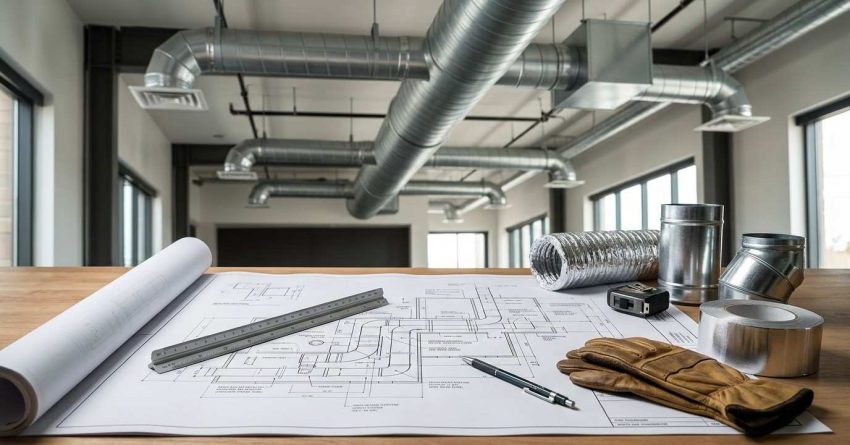
Ductwork design best practices are the engineering and installation principles that determine how efficiently, safely, and reliably a forced-air HVAC system delivers conditioned air throughout a residential or commercial property. A well-designed duct system controls comfort, manages energy consumption, and protects indoor air quality across every room it serves. Poor design, by contrast, creates uneven temperatures, inflated utility bills, and accelerated equipment wear that costs property owners significantly over time.
Understanding ductwork design matters now because energy costs continue to rise and building performance standards are tightening across the United States. A duct system that was adequate a decade ago may be actively undermining your HVAC equipment’s efficiency today.
This guide covers ductwork fundamentals, sizing and load calculations, layout principles, material selection, sealing, airflow balance, placement, zoning, common design mistakes, and long-term maintenance — everything you need to make informed decisions about your property’s duct system.
What Is Ductwork and Why Does Design Matter?
Ductwork is the network of channels — typically constructed from sheet metal, flexible tubing, or fiberboard — that distributes heated or cooled air from a central HVAC unit to individual rooms and returns spent air back to the system for reconditioning. Every forced-air heating and cooling system depends on this network to function. Without a properly designed duct system, even the most efficient HVAC equipment cannot deliver consistent comfort or operate at its rated performance level.
Design matters because ductwork is not a passive component. Every decision made during the design phase — how large the ducts are, where they run, how they are sealed, and how air is balanced across the system — directly affects how hard the HVAC equipment must work, how much energy it consumes, and how long it lasts. According to the U.S. Department of Energy, duct systems that leak or are poorly designed can waste 20 to 30 percent of the energy used for heating and cooling in a typical home.
For homeowners, landlords, and property managers, this is not an abstract engineering concern. It translates directly into monthly utility costs, tenant comfort complaints, equipment replacement timelines, and property value. A duct system that is undersized restricts airflow and causes the blower motor to strain. One that is oversized moves air too quickly, reducing the system’s ability to dehumidify properly. One that runs through unconditioned attic space without adequate insulation loses a significant portion of its thermal load before the air ever reaches a living space.
The Role of Ductwork in HVAC Performance
The duct system is the delivery mechanism for every dollar spent on heating and cooling. The HVAC unit generates conditioned air, but the duct network determines how much of that conditioning actually reaches its intended destination. Pressure imbalances, leaks at joints and connections, sharp bends that restrict airflow, and inadequate return air capacity all reduce system efficiency and create comfort problems that no amount of thermostat adjustment can fully correct.
Understanding how your duct network is structured from the start is the foundation of every efficient HVAC system — our ductwork systems overview explains how supply, return, and exhaust pathways work together to move conditioned air through every room of your property.
Ductwork Sizing and Load Calculations
Proper duct sizing is the most technically demanding aspect of ductwork design, and it is also the area where the most consequential errors occur. Ducts that are too small create high static pressure, restrict airflow, and force the blower to work harder than its design specifications allow. Ducts that are too large reduce air velocity to the point where conditioned air drops its thermal load before reaching the register, resulting in rooms that never reach the set temperature.
Sizing is not a matter of estimation or rule-of-thumb approximation. It requires a structured calculation process that accounts for the specific heating and cooling loads of each room, the total system capacity, the length and configuration of each duct run, and the pressure drop introduced by fittings, transitions, and registers.
Manual J and Manual D — The Industry Standards
The industry standard for residential duct sizing is a two-step process. Manual J, developed by the Air Conditioning Contractors of America (ACCA), calculates the heating and cooling load for each room based on factors including square footage, ceiling height, insulation levels, window area and orientation, local climate data, and occupancy patterns. Manual D then uses those room-by-room load calculations to determine the correct duct dimensions, airflow rates, and system configuration needed to deliver the right amount of conditioned air to each space.
These calculations are not optional for a properly functioning system. A duct system sized without them is essentially a guess — and guesses in duct design produce systems that underperform from day one. Accurate sizing begins with a precise understanding of your property’s heating and cooling demands, and our HVAC load calculation methods guide walks through every variable — from square footage and insulation values to window orientation and local climate data — that determines the right duct dimensions for your system.
Ductwork Layout and System Design Principles
Once sizing calculations are complete, the next design decision is how the duct system will be physically arranged throughout the building. Layout determines how air travels from the air handler to each room, how many transitions and bends the air must navigate, and how evenly the system can distribute conditioned air across the entire property.
Three primary distribution configurations are used in residential and light commercial HVAC design, each with distinct advantages depending on the building’s size, shape, and construction type.
Trunk-and-Branch vs. Radial vs. Extended Plenum Systems
A trunk-and-branch system uses a large central duct — the trunk — that runs the length of the building, with smaller branch ducts extending from it to individual rooms. This configuration works well in long, rectangular floor plans and is one of the most common layouts in single-family homes.
A radial system routes individual ducts directly from a central plenum to each room without a shared trunk line. This layout is common in smaller homes and manufactured housing where the plenum is centrally located and duct runs are relatively short.
An extended plenum system uses a large plenum that runs the full length of the building, with branch ducts connecting at intervals. It is similar to trunk-and-branch but uses a consistent plenum size rather than a tapering trunk, which simplifies installation but requires careful pressure management.
The layout decisions made during the planning phase have a direct and lasting impact on comfort, energy efficiency, and equipment lifespan — our HVAC system design principles resource covers how professionals map airflow paths, select distribution configurations, and account for structural constraints before a single duct is installed.
Duct Materials — Choosing the Right Type for Your Property
The material used to construct a duct system affects its durability, thermal performance, installation cost, acoustic properties, and long-term maintenance requirements. No single material is universally superior — the right choice depends on the application, the building type, the climate, and the budget.
Sheet Metal, Flexible Duct, and Fiberboard Compared
Sheet metal ducts, typically fabricated from galvanized steel or aluminum, are the most durable option available. They resist moisture, do not harbor mold growth as readily as porous materials, and maintain their shape and airflow characteristics over decades of use. Sheet metal is the preferred material for main trunk lines and in applications where durability and low air resistance are priorities.
Flexible duct — commonly called flex duct — consists of a wire coil wrapped in plastic and insulation. It is significantly less expensive than sheet metal and easier to install in tight spaces, making it a practical choice for branch runs and final connections to registers. However, flex duct is prone to kinking, sagging, and compression, all of which dramatically increase airflow resistance. Proper installation requires careful support and routing to avoid these performance penalties.
Fiberboard duct is constructed from compressed glass fibers and is used primarily in commercial applications. It offers good acoustic dampening and thermal insulation properties but is more susceptible to moisture damage than metal alternatives.
Each material type carries distinct trade-offs in cost, durability, thermal performance, and installation complexity, and our guide to choosing the right duct materials breaks down sheet metal, flexible duct, and fiberboard options side by side so you can make an informed decision for your specific property type and budget.
Duct Sealing and Insulation Best Practices
A duct system can be perfectly sized and expertly laid out and still waste a substantial portion of the energy it is meant to deliver if it is not properly sealed and insulated. Leaks at joints, connections, and transitions allow conditioned air to escape into unconditioned spaces — attics, crawlspaces, wall cavities — where it provides no comfort benefit whatsoever. Inadequate insulation on ducts running through unconditioned spaces allows thermal exchange with the surrounding environment, warming cool air in summer and cooling warm air in winter before it reaches its destination.
Why Leaky Ducts Cost Homeowners More Than They Realize
The U.S. Environmental Protection Agency’s ENERGY STAR program estimates that the typical home loses about 20 to 30 percent of the air that moves through its duct system due to leaks, holes, and poorly connected sections. For a homeowner spending $2,000 annually on heating and cooling, that represents $400 to $600 in energy that is being paid for but never delivered to the living space.
Sealing is accomplished using mastic sealant — a paste-like compound applied to joints and seams — or with UL 181-rated metal foil tape. Standard cloth duct tape is not an approved sealing material for HVAC applications; it degrades rapidly under the temperature cycling that duct systems experience and fails within a few years of application.
Insulation requirements depend on where the duct runs. Ducts in conditioned spaces require minimal insulation, while those in attics, crawlspaces, and garages in most U.S. climate zones require insulation with an R-value of R-6 to R-8 or higher to meet current energy codes.
Sealing and insulating your duct system is one of the highest-return investments a property owner can make in HVAC efficiency, and our duct sealing and insulation methods covers every approved technique — from mastic sealant application and metal tape to insulation R-value selection for attic, crawlspace, and basement duct runs.
Airflow Balance and Static Pressure Management
A duct system achieves its purpose only when the right volume of air reaches each room at the right pressure. Airflow balance refers to the relationship between the air delivered through supply registers and the air returned through return grilles. Static pressure refers to the resistance the blower must overcome to push air through the duct network. Both must be managed carefully for a system to perform as designed.
Supply, Return, and Pressure Differentials Explained
Every room that receives supply air must also have a path for that air to return to the air handler. When return air capacity is insufficient — a common design error in older homes — rooms with closed doors become pressurized, forcing air out through gaps in the building envelope rather than back through the return system. This creates comfort problems, increases infiltration of unconditioned outdoor air, and forces the blower to work against elevated static pressure.
Static pressure is measured in inches of water column (in. w.c.) and must remain within the HVAC equipment manufacturer’s specified range. Excessive static pressure — caused by undersized ducts, too many sharp bends, dirty filters, or blocked registers — reduces airflow, strains the blower motor, and can cause the heat exchanger to overheat in gas furnace applications.
When supply and return air volumes are mismatched, the entire system works harder than it should — our resource on balancing HVAC airflow explains how technicians measure static pressure, identify imbalances, and adjust damper positions and register sizes to restore even comfort distribution across every zone.
Ductwork Placement and Building Integration
Where duct runs are located within a building’s structure is a design decision with significant long-term consequences. Ducts placed in conditioned spaces — inside the thermal envelope of the building — perform far better than those routed through attics, crawlspaces, or garages, where they are exposed to extreme temperatures and are more difficult to inspect and maintain.
Conditioned vs. Unconditioned Spaces — Where Ducts Should Run
The ideal duct placement keeps all duct runs within the conditioned envelope of the building. When this is not structurally feasible, ducts in unconditioned spaces must be insulated to the level required by local energy codes and sealed meticulously to prevent both air leakage and moisture infiltration.
Attic duct runs are particularly problematic in hot climates, where attic temperatures can exceed 130 degrees Fahrenheit in summer. Even well-insulated ducts in these environments experience significant thermal gain that reduces cooling efficiency. Building science research increasingly supports the practice of bringing attic duct systems inside the thermal envelope by air-sealing and insulating the roof deck rather than the attic floor — a strategy known as an unvented or conditioned attic.
Duct routing must also account for structural elements, fire blocking requirements, and accessibility for future maintenance. Ducts buried in concrete slabs, while sometimes used in slab-on-grade construction, present particular challenges for inspection, cleaning, and repair.
Where ducts are routed through a building determines how much energy is lost before conditioned air reaches its destination, and our ductwork installation best practices guide details how professionals plan routing paths, secure duct runs, and integrate systems within walls, ceilings, and mechanical chases to minimize thermal loss and maximize delivery efficiency.
Ductwork for Zoning Systems and Multi-Room Properties
Standard single-zone HVAC systems treat an entire building as one thermal unit, delivering the same amount of conditioned air regardless of occupancy patterns, solar gain differences between rooms, or the varying comfort preferences of different occupants. For larger homes, multi-story buildings, and commercial properties, this approach is inherently inefficient and often inadequate.
Zoning systems divide a building into independently controlled thermal areas, each with its own thermostat and airflow control. The duct system must be designed from the outset to support zoning, or retrofitted with the appropriate components to enable it.
Dampers, Zone Controllers, and Variable Air Volume Design
Motorized dampers installed within the duct system open and close in response to signals from zone thermostats, directing conditioned air only to the zones that currently require it. A zone controller coordinates the damper positions with the HVAC equipment’s operation, ensuring that the system does not create excessive static pressure when multiple zones are closed simultaneously.
Variable air volume (VAV) systems take zoning a step further by modulating the volume of air delivered to each zone rather than simply opening and closing dampers. VAV design requires careful duct sizing and pressure management to function correctly, as the system must maintain adequate airflow to all active zones across a wide range of operating conditions.
Multi-room and multi-story properties benefit significantly from zoned airflow control, and our HVAC zoning system design resource explains how dampers, zone controllers, and variable air volume components are integrated into the duct network to deliver independent temperature control to different areas of the same building.
Common Ductwork Design Mistakes and How to Avoid Them
Even experienced contractors make ductwork design errors, and many of the duct systems currently installed in American homes contain at least one significant design flaw that is reducing system performance. Understanding the most common mistakes helps homeowners and property managers recognize symptoms, ask the right questions during contractor evaluations, and make informed decisions about remediation.
Undersizing, Poor Routing, and Inadequate Return Air
Undersized ducts are the most prevalent design error in residential HVAC systems. They are often the result of contractors using rules of thumb rather than performing proper Manual J and Manual D calculations, or of systems being upgraded to higher-capacity equipment without corresponding upgrades to the duct system. The symptoms are predictable: high static pressure, reduced airflow, rooms that never reach the set temperature, and premature blower motor failure.
Poor routing compounds the problem. Every 90-degree elbow in a duct system introduces resistance equivalent to several feet of straight duct. Systems with multiple sharp bends, unnecessary transitions between duct sizes, or excessively long branch runs accumulate resistance that the blower must overcome at the cost of airflow and efficiency. Best practice calls for minimizing the number of fittings, using long-radius elbows rather than sharp turns, and keeping duct runs as short and direct as structurally feasible.
Inadequate return air is the third most common design failure. Many older homes were built with a single central return grille, which was adequate for the open floor plans of that era but creates significant pressure imbalances in homes with multiple closed rooms. Adding return air pathways — through transfer grilles, jump ducts, or dedicated return duct extensions — is one of the most cost-effective improvements available for underperforming systems.
When design errors go unaddressed, they compound over time into system failures that require more than a simple fix — our ductwork repair and replacement options outlines when targeted repairs are sufficient, when full section replacement is warranted, and what the process looks like for both residential and commercial properties.
When to Repair, Replace, or Redesign Your Duct System
Duct systems do not last forever, and the decision between repairing, replacing, or fully redesigning a duct system depends on the age of the system, the nature and extent of the problems present, and the cost-benefit relationship between remediation options.
Signs Your Ductwork Is Failing
Several indicators suggest that a duct system has moved beyond the point where minor repairs will restore adequate performance. Rooms that are consistently too hot or too cold despite a functioning HVAC unit, unusually high energy bills without a corresponding change in usage patterns, visible damage to duct sections in accessible areas, excessive dust accumulation near registers, and unusual noises during system operation are all signs that warrant a professional duct inspection.
Duct systems in homes built before 1990 are particularly likely to contain design deficiencies, deteriorated insulation, and accumulated leakage at joints and connections. Flexible duct installed more than 15 to 20 years ago may have degraded to the point where replacement is more cost-effective than repair. Sheet metal systems can last significantly longer but are not immune to joint separation, corrosion in humid environments, and insulation deterioration.
A full duct system redesign is warranted when the existing layout is fundamentally incompatible with the building’s current use — for example, when a home has been significantly remodeled, when a new high-efficiency HVAC system has been installed that requires different airflow characteristics, or when a zoning system is being added to a building that was not originally designed for it.
Knowing when a duct problem has moved beyond DIY territory is critical to protecting your HVAC investment and your property’s comfort — our professional HVAC services explains the full range of diagnostic, repair, and replacement services available and how to schedule an assessment with a qualified technician.
Ductwork Maintenance and Long-Term Performance
A well-designed and properly installed duct system still requires ongoing maintenance to sustain its performance over time. Maintenance needs vary depending on the duct material, the building environment, and the HVAC system’s operating patterns, but all duct systems benefit from periodic inspection and cleaning.
Inspection Schedules and Cleaning Intervals
The National Air Duct Cleaners Association (NADCA) recommends that duct systems be inspected every two to three years and cleaned when inspection reveals significant accumulation of dust, debris, mold growth, or pest activity. Homes with pets, occupants with allergies or respiratory conditions, or properties that have undergone recent renovation work may benefit from more frequent inspection intervals.
Inspection should include a visual assessment of accessible duct sections for signs of damage, disconnection, or insulation deterioration, as well as a check of all accessible joints and connections for evidence of air leakage. Infrared thermography can identify temperature differentials along duct runs that indicate leakage or insulation failure in areas that are not directly accessible.
While central duct systems require their own maintenance schedule, dedicated exhaust pathways like dryer vents demand separate attention — our dryer vent cleaning and maintenance explains why lint accumulation in exhaust ducts creates fire hazards and how routine professional cleaning protects both your appliances and your home.
Filter maintenance is the most frequent and most impactful maintenance task for any forced-air system. A clogged filter increases static pressure across the entire duct system, reduces airflow, and forces the blower to work harder. Filters should be checked monthly and replaced according to the manufacturer’s recommendation — typically every one to three months depending on filter type and household conditions.
Accurate sizing begins with a precise understanding of your property’s heating and cooling demands, and our HVAC load calculation methods guide walks through every variable that determines the right duct dimensions for your system. For properties where duct leakage is suspected but not confirmed, professional duct leakage testing using a blower door or duct pressurization test can quantify the extent of the problem and identify the most productive areas for sealing — our duct leakage testing guide explains the testing process, what the results mean, and how to use them to prioritize remediation work.
Conclusion
Ductwork design best practices encompass sizing, layout, material selection, sealing, airflow balance, placement, and zoning — each dimension directly affecting how efficiently and reliably your HVAC system delivers comfort throughout your property.
Mastering these principles connects to a broader network of HVAC knowledge, from load calculations and system design to maintenance schedules and zoning controls, all of which are covered in depth across the cluster resources linked throughout this guide.
At Mr. Local Services, our qualified HVAC professionals are ready to assess, design, repair, or replace your duct system — contact us today to schedule a comprehensive ductwork evaluation for your residential or commercial property.
Frequently Asked Questions
What is the most important factor in ductwork design?
Proper sizing based on Manual J load calculations is the most critical factor. Undersized or oversized ducts create airflow imbalances, reduce system efficiency, and accelerate equipment wear regardless of how well other design elements are executed.
How do I know if my ductwork is the right size?
Signs of undersized ductwork include rooms that never reach the set temperature, high static pressure readings, and unusually loud airflow noise at registers. A qualified HVAC technician can perform a duct system assessment and compare your existing duct dimensions against Manual D calculations for your system.
What is the difference between supply and return ducts?
Supply ducts carry conditioned air from the HVAC unit to individual rooms. Return ducts carry spent air back to the unit for reconditioning. Both must be properly sized and balanced — inadequate return air capacity is one of the most common causes of comfort and efficiency problems in residential HVAC systems.
How often should ductwork be inspected or cleaned?
The National Air Duct Cleaners Association recommends inspection every two to three years and cleaning when inspection reveals significant accumulation of dust, debris, or mold. Homes with pets, allergy sufferers, or recent renovation activity may benefit from more frequent inspections.
Can leaky ductwork really affect my energy bills that much?
Yes. The U.S. Department of Energy estimates that leaky duct systems waste 20 to 30 percent of the energy used for heating and cooling in a typical home. For most households, sealing and insulating ductwork is one of the highest-return energy efficiency improvements available.
What is the best material for residential ductwork?
Sheet metal is the most durable and lowest-resistance option for main trunk lines. Flexible duct is practical for branch runs and final connections when properly supported and routed without kinks or compression. The best choice depends on the application, budget, and installation environment.
When should ductwork be replaced rather than repaired?
Replacement is typically warranted when flexible duct is more than 15 to 20 years old and has deteriorated significantly, when the existing layout is fundamentally incompatible with current system requirements, or when the cost of repairing multiple sections across the system approaches the cost of full replacement with a properly designed new system.