ERVs and HRVs both improve indoor ventilation, but they handle moisture very differently — and choosing the wrong one for your climate can reduce comfort, raise energy bills, and create air quality problems. Understanding the distinction between an energy recovery ventilator and a heat recovery ventilator is one of the most practical decisions a homeowner or property manager can make when upgrading a home’s mechanical systems.
Getting this choice wrong is more common than most people realize, and the consequences show up slowly — in stuffy rooms, condensation on windows, or heating and cooling systems working harder than they should.
This guide explains how each system works, where each performs best, what installation and maintenance involve, and how to make a confident, informed decision for your specific property.
What Is an ERV and How Does It Work?
An energy recovery ventilator, or ERV, is a mechanical ventilation system that exchanges stale indoor air with fresh outdoor air while transferring both heat and moisture between the two airstreams. The key function of an ERV is its ability to retain humidity from the outgoing air and pass it to the incoming air — or vice versa — depending on the season and conditions outside.
In winter, an ERV captures warmth and moisture from the air being exhausted and uses both to pre-condition the cold, dry air coming in. In summer, it works in reverse — pulling heat and excess humidity out of the incoming outdoor air before it enters the living space. This dual transfer makes ERVs particularly effective in climates where maintaining balanced indoor humidity is a year-round concern.
Understanding how an ERV fits into your home’s ventilation strategy is easier when you know the full range of HVAC service options available for residential and commercial properties.
Key Components of an Energy Recovery Ventilator
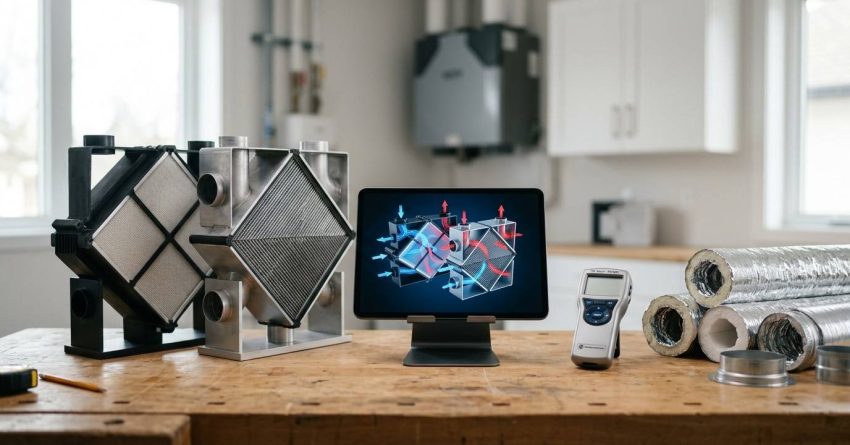
An ERV contains a heat and moisture exchange core — typically made from a permeable membrane material — along with two fans, intake and exhaust ductwork, and filtration components. The exchange core is the defining element: it allows water vapor to pass between airstreams without the two streams ever mixing. Most residential ERV units are designed to integrate with existing forced-air duct systems, though dedicated ductwork configurations are also available for homes without central air.
What Is an HRV and How Does It Work?
A heat recovery ventilator, or HRV, is a mechanical ventilation system that exchanges stale indoor air with fresh outdoor air while recovering heat from the outgoing airstream. Unlike an ERV, an HRV transfers heat only — it does not transfer moisture. The outgoing warm air heats the incoming cold air through a heat exchanger core, improving energy efficiency without allowing humidity to cross between the two airstreams.
This makes an HRV highly effective in cold climates where indoor air tends to be too humid during winter months. By exhausting moisture-laden air and bringing in drier outdoor air — while still recovering the heat — an HRV helps prevent condensation, mold growth, and the structural damage that excess indoor humidity can cause over time.
Key Components of a Heat Recovery Ventilator
An HRV uses a rigid, non-permeable heat exchanger core — often made from aluminum or polypropylene — along with dual fans, ductwork connections, and filters. Because the core does not allow moisture transfer, it is easier to clean and less prone to biological growth than an ERV core in certain conditions. HRV units are similarly designed to connect to existing duct systems and are available in a range of capacities suited to different home sizes.
ERV vs HRV — Core Differences Explained
The fundamental difference between an ERV and an HRV comes down to one word: moisture. Both systems recover heat and improve ventilation efficiency. Only an ERV also transfers water vapor between airstreams.
| Feature | ERV | HRV |
| Heat recovery | Yes | Yes |
| Moisture transfer | Yes | No |
| Best for humid climates | Yes | No |
| Best for cold, dry climates | No | Yes |
| Prevents over-humidification | No | Yes |
| Maintains humidity in dry winters | Yes | No |
| Core material | Permeable membrane | Rigid, non-permeable |
Both systems improve indoor air quality, reduce energy waste, and help meet modern building ventilation standards. The right choice depends almost entirely on your local climate and your home’s existing humidity levels.
For a broader look at how both units fit within the full spectrum of home ventilation systems, our dedicated guide covers every major ventilation type and how each one serves different property needs.
Moisture Transfer: The Critical Distinction
In an ERV, the exchange core is made from a semi-permeable material that allows water vapor molecules to pass through while keeping the two airstreams physically separate. This means humidity moves from the more humid side to the drier side — which is useful in mixed or humid climates where you want to retain some moisture in winter and limit how much enters in summer.
In an HRV, the core is solid and impermeable. Heat transfers through the material via conduction, but no moisture crosses. This is the preferred design for cold climates where indoor air is already too humid from cooking, bathing, and breathing — and where exhausting that moisture while recovering the heat is the goal.
Which Climate Is Each System Best For?
Climate is the single most important factor in choosing between an ERV and an HRV. Getting this right means your system will work with your environment rather than against it.
An ERV performs best in:
- Mixed climates with hot, humid summers and cold winters (much of the southeastern and mid-Atlantic United States)
- Climates where outdoor humidity is moderate to high year-round
- Homes where occupants want to maintain comfortable humidity levels in both heating and cooling seasons
An HRV performs best in:
- Cold climates with long, dry winters (northern United States, upper Midwest, mountain regions)
- Homes where indoor humidity is consistently high due to occupant activity, cooking, or poor ventilation
- Climates where summer humidity is low and moisture retention is not a concern
Homes in humid climates that choose an ERV should also pay attention to moisture-producing appliances — dryer vent maintenance is one often-overlooked factor that affects overall indoor air quality and humidity balance.
Matching Your Region to the Right Ventilation System
As a general guide for U.S. homeowners: if you live in ASHRAE Climate Zones 1 through 4 — which cover most of the South, Southeast, and parts of the West — an ERV is typically the better choice. If you live in Climate Zones 5 through 7 — covering the northern states, upper Midwest, and mountain regions — an HRV is generally recommended. Zone 4 is a transition zone where either system can work, and a professional assessment of your specific home’s humidity levels is the most reliable way to decide.
ERV vs HRV for Indoor Air Quality and Energy Efficiency
Both ERVs and HRVs improve indoor air quality by continuously replacing stale, pollutant-laden air with fresh outdoor air — without the energy loss that comes from simply opening windows or relying on uncontrolled air infiltration. In tightly sealed modern homes, mechanical ventilation is not optional; it is essential for maintaining healthy air.
Both systems directly affect indoor air quality — understanding how ventilation interacts with filtration, humidity control, and pollutant removal helps homeowners make more informed decisions. From an energy efficiency standpoint, both systems recover a significant portion of the energy that would otherwise be lost when exhausting indoor air. Heat recovery efficiency for quality residential units typically ranges between 70% and 85%, meaning the system recaptures most of the thermal energy from the outgoing airstream before it leaves the building. ERVs add the benefit of latent energy recovery — the energy stored in water vapor — which can further reduce the load on heating and cooling equipment in climates where humidity management matters.
Neither system filters air to the same standard as a dedicated air purifier or high-MERV filtration system, but both include basic filtration that removes larger particulates from the incoming airstream. Regular filter maintenance is essential for both unit types to maintain performance.
Installation, Maintenance, and Cost Considerations
Installing an ERV or HRV is a professional job that involves connecting the unit to your home’s ductwork, running intake and exhaust penetrations through the building envelope, and commissioning the system for balanced airflow. Most residential installations take one to two days depending on the complexity of the duct configuration and the accessibility of the installation location.
Typical installed costs for a residential ERV or HRV range from $1,500 to $4,000 depending on unit capacity, brand, duct configuration, and local labor rates. Homes with existing forced-air systems are generally easier and less expensive to connect. Homes without central ductwork may require a dedicated duct system, which adds to the overall project cost.
For smaller ventilation-related tasks that fall outside a full HVAC installation — such as ductwork adjustments or filter access panels — handyman installation support can be a practical and cost-effective option.
What to Expect During Professional Installation
A qualified HVAC technician will begin by assessing your home’s existing ductwork, identifying the best location for the unit (typically in a basement, utility room, or attic), and calculating the required ventilation rate based on your home’s square footage and occupancy. The technician will then install the unit, connect supply and exhaust ducts, seal all penetrations, and test the system for balanced airflow. Most manufacturers recommend annual maintenance that includes cleaning or replacing filters, inspecting the heat exchange core, and checking fan operation.
How to Choose Between an ERV and HRV for Your Home
Choosing between an ERV and an HRV comes down to three practical questions: What is your climate zone? What are your home’s current humidity levels? And what are your primary goals — retaining moisture, removing it, or simply improving fresh air exchange?
If you live in a humid or mixed climate and want to maintain comfortable humidity levels year-round while improving ventilation, an ERV is the stronger choice. If you live in a cold climate, experience high indoor humidity during winter, or want to exhaust excess moisture while recovering heat, an HRV is the better fit. If you are genuinely unsure, a blower door test and humidity assessment from a qualified HVAC professional will give you the data you need to decide with confidence.
Questions to Ask Before Making a Decision
Before committing to either system, consider asking your HVAC contractor the following: What is my home’s current air changes per hour, and what does current ventilation code require? What are the average indoor humidity readings in my home during winter and summer? Does my existing duct system support balanced ventilation, or will modifications be needed? What is the expected payback period based on my current energy costs?
The most reliable way to confirm which system is right for your specific home is to schedule a professional HVAC assessment with a qualified technician who can evaluate your climate zone, existing ductwork, and air quality needs.
Conclusion
ERVs and HRVs both solve the same core problem — stale, unhealthy indoor air — but they do it differently, and climate determines which approach works. Moisture transfer is the deciding factor between the two systems.
Choosing the right ventilation system protects your home’s air quality, reduces energy waste, and prevents the long-term damage that poor humidity management causes to building materials and occupant health.
At Mr. Local Services, our HVAC professionals help homeowners and property managers evaluate, install, and maintain the right ventilation system for their specific property — contact us today to schedule your assessment.
Frequently Asked Questions
What is the main difference between an ERV and an HRV?
An ERV transfers both heat and moisture between airstreams, while an HRV transfers heat only. This makes ERVs better for humid or mixed climates and HRVs better for cold, dry climates where excess indoor moisture needs to be exhausted.
Can I install an ERV or HRV in any home?
Both systems can be installed in most homes, but the process is simpler in homes with existing forced-air ductwork. Homes without central duct systems may require a dedicated duct configuration, which increases installation complexity and cost.
How often does an ERV or HRV need maintenance?
Most manufacturers recommend inspecting and cleaning or replacing filters every three to six months. The heat exchange core should be inspected annually, and a full system check — including fan operation and airflow balance — is recommended once per year.
Does an ERV or HRV replace an air conditioner or furnace?
No. Both systems are ventilation units, not heating or cooling equipment. They work alongside your existing HVAC system by improving fresh air exchange and reducing the energy lost during ventilation, but they do not condition air to the same degree as a furnace or air conditioner.
Which system is better for allergy sufferers?
Both systems include basic filtration and continuously replace stale indoor air, which can reduce concentrations of indoor pollutants, dust, and allergens. Neither replaces a dedicated air purification system, but both improve baseline air quality compared to homes with no mechanical ventilation.
How long does an ERV or HRV last?
Quality residential ERV and HRV units typically last 15 to 25 years with proper maintenance. Regular filter cleaning, annual core inspections, and prompt attention to any airflow imbalances are the most important factors in extending unit lifespan.
Is an ERV or HRV worth the cost?
For most homeowners in tightly sealed modern homes, yes. Both systems improve indoor air quality, reduce energy waste from uncontrolled air infiltration, and help meet current ventilation standards. The payback period depends on local energy costs, climate, and how well the system is matched to the home’s specific needs.