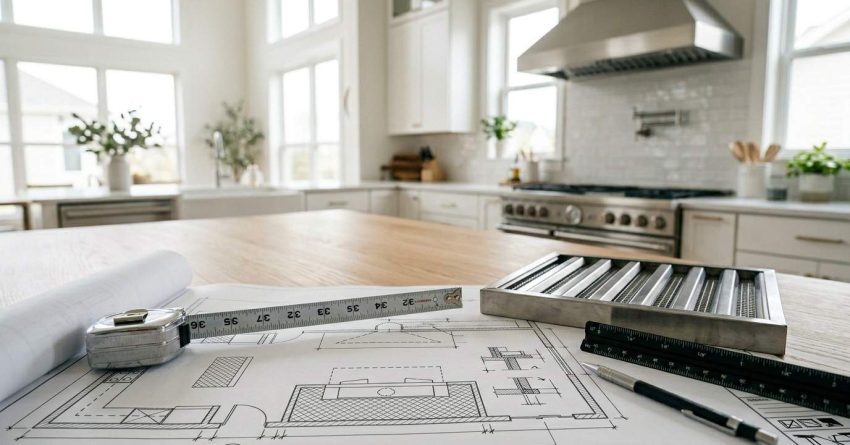
Sizing a kitchen range hood correctly means matching the hood’s width, mounting height, and CFM airflow capacity to your specific cooktop, kitchen layout, and cooking habits. Get any one of these measurements wrong and you end up with a hood that either fails to clear smoke and grease or creates noise and energy waste without improving air quality. The right size protects your kitchen, your health, and your home’s long-term value.
Most homeowners underestimate how much sizing affects performance. A hood that looks right visually may still be too small, too high, or too underpowered to do its job.
This guide covers every sizing dimension you need — width, height, CFM, and duct requirements — so you can choose, install, and use a range hood that actually works for your kitchen.
What Is a Range Hood and Why Does Size Matter?
A range hood is a ventilation appliance installed above a cooktop or range that captures smoke, grease, steam, and cooking odors before they spread through your home. It works by drawing air upward through filters and either exhausting it outside through ductwork or recirculating it through carbon filters back into the kitchen.
Size matters because ventilation is a physics problem. A hood that is too narrow misses the edges of your cooktop where most smoke and grease escape. A hood mounted too high loses suction efficiency before air reaches the capture zone. A hood with insufficient CFM simply cannot move enough air to keep up with your cooking output.
For homeowners, landlords, and property managers, getting the size right from the start prevents costly reinstallation, persistent odor problems, and potential grease buildup in ductwork that creates fire hazards over time. Choosing the right range hood is one part of a broader set of kitchen appliance decisions — our appliance installation services cover everything from hood installation to full kitchen appliance setup, helping homeowners get every unit properly fitted and functioning.
How to Measure Your Cooktop for the Right Hood Size
The most important measurement is width. Your range hood should be at least as wide as your cooktop — and ideally 3 to 6 inches wider on each side to capture rising air that spreads outward as it heats.
Start by measuring the full width of your cooktop or range in inches. If your cooktop is 30 inches wide, your minimum hood width is 30 inches. A 36-inch hood on a 30-inch cooktop provides better capture coverage and is the preferred choice for most residential kitchens.
Depth follows the same logic. The hood should extend far enough front-to-back to cover the front burners, which produce the most direct cooking exhaust. Most standard hoods are 18 to 24 inches deep, which covers the majority of residential cooktop configurations.
Proper hood sizing connects directly to how well your kitchen ventilation system performs overall — our kitchen ventilation systems explains how ductwork, airflow, and appliance sizing work together to keep indoor air quality safe and cooking spaces comfortable.
Width Sizing Rules for Gas vs. Electric Cooktops
Gas cooktops burn hotter and produce more combustion byproducts than electric models, which means they generate more smoke, carbon monoxide, and grease-laden air per cooking session. For gas ranges, adding 6 inches of hood width beyond the cooktop width — 3 inches per side — is the standard recommendation.
Electric cooktops and induction ranges produce less combustion exhaust, so a hood that matches the cooktop width exactly is acceptable, though adding 3 inches per side still improves capture efficiency and is worth the investment if space allows.
Island Cooktops vs. Wall-Mounted Cooktops
Wall-mounted cooktops benefit from the wall acting as a natural barrier that helps direct rising air toward the hood. Island cooktops have no such barrier — air escapes in all four directions — which means island range hoods need to be larger, typically 6 inches wider and deeper than the cooktop on all sides, to compensate for the open airflow environment.
Island hoods also require ceiling-mounted ductwork, which adds complexity to installation and makes professional sizing and fitting especially important.
Range Hood Height: How High Should It Be Mounted?
Mounting height is the second critical sizing variable. Mount a hood too low and it becomes a hazard near open flames. Mount it too high and it loses the ability to capture rising air effectively before it disperses into the room.
The standard mounting height guidelines are:
- Gas ranges: 24 to 30 inches above the cooking surface
- Electric ranges: 20 to 24 inches above the cooking surface
- High-output professional-style gas ranges: 30 to 36 inches above the cooking surface
These ranges exist because gas flames produce more radiant heat, requiring more clearance for safety, while electric and induction surfaces generate less upward heat and allow the hood to sit closer to the cooking zone for better capture.
Always check the manufacturer’s specifications for your specific hood model. Some hoods are engineered for a narrower height range, and installing outside that range voids the warranty and reduces performance. Local building codes may also specify minimum clearance requirements, particularly for gas appliances.
CFM Requirements: Matching Airflow to Your Cooking Style
CFM — cubic feet per minute — measures how much air a range hood can move in one minute. It is the single most important performance specification and must be matched to both your cooktop type and your cooking habits.
The general rule is that a range hood needs at least 100 CFM for every 10,000 BTUs of gas burner output, or 1 CFM per 100 BTUs. For electric ranges, the standard baseline is 100 CFM per linear foot of cooktop width.
Airflow management matters throughout your home, not just in the kitchen — our home ventilation maintenance resource explains how proper duct care across all appliances, including dryer vents, contributes to a healthier, safer indoor environment.
How to Calculate CFM for Gas Ranges
Add up the total BTU output of all burners on your gas range. A standard residential gas range typically produces between 40,000 and 60,000 BTUs total. Divide that number by 100 to get your minimum CFM requirement.
For example: a 48,000 BTU gas range requires a minimum of 480 CFM. For heavy cooking — frequent frying, high-heat searing, or wok cooking — add 20 to 30 percent to that baseline to ensure the hood keeps up during peak use.
How to Calculate CFM for Electric Ranges
For electric ranges, multiply the cooktop width in feet by 100. A standard 30-inch (2.5-foot) electric range requires a minimum of 250 CFM. A 36-inch (3-foot) electric range requires at least 300 CFM.
If you cook frequently at high heat or use multiple burners simultaneously, increase your CFM target by 20 percent to maintain effective capture during intensive cooking sessions.
Duct Size and Ventilation Requirements
The duct connecting your range hood to the exterior of your home must be large enough to handle the CFM output of the hood without creating back pressure that reduces airflow efficiency. Undersized ductwork is one of the most common causes of poor range hood performance even when the hood itself is correctly sized.
Standard duct size recommendations by CFM output:
| CFM Range | Minimum Round Duct Diameter | Minimum Rectangular Duct Size |
| Up to 400 CFM | 6 inches | 3.25 x 10 inches |
| 400–600 CFM | 7 inches | 3.25 x 12 inches |
| 600–900 CFM | 8 inches | 6 x 10 inches |
| 900–1,200 CFM | 10 inches | 6 x 12 inches |
Duct runs should be as short and straight as possible. Every 90-degree elbow in the duct path reduces effective CFM by approximately 10 percent. Every additional foot of duct run beyond 10 feet reduces performance incrementally. If your kitchen layout requires a long or complex duct run, increase your hood’s CFM rating to compensate.
If your current ductwork cannot support a new range hood, a broader kitchen upgrade may be the right solution — our kitchen remodeling planning outlines how structural changes, ventilation upgrades, and appliance installations can be coordinated into a single, efficient project.
Common Range Hood Sizing Mistakes to Avoid
Even homeowners who research sizing carefully make avoidable errors. The most common mistakes include:
Choosing a hood that matches the cooktop width exactly. A hood that is the same width as the cooktop captures only the air rising directly upward. Cooking exhaust spreads outward as it rises, and a hood with no overhang misses a significant portion of that exhaust. Always add at least 3 inches per side.
Ignoring duct size when selecting CFM. A 600 CFM hood connected to a 6-inch duct will never deliver 600 CFM. The duct creates a bottleneck that limits actual airflow regardless of what the hood is rated for. Size the duct first, then select the hood.
Mounting the hood too high to avoid the look of a low ceiling. Aesthetic preferences should not override functional requirements. A hood mounted 6 inches above the recommended height can lose 30 to 40 percent of its capture efficiency.
Selecting a recirculating hood for a high-output gas range. Recirculating hoods filter air and return it to the kitchen rather than exhausting it outside. They are suitable for light cooking on electric ranges but are not adequate for gas ranges producing significant combustion byproducts. High-output cooking requires true exhaust ventilation.
Forgetting makeup air requirements. Hoods rated above 400 CFM can depressurize a tightly sealed home, pulling combustion gases back down through gas appliances and fireplaces. Homes with high-CFM hoods may require a makeup air system to replace the air being exhausted
When to Call a Professional for Range Hood Installation
Range hood installation is not a straightforward DIY project for most homeowners. It involves electrical wiring, duct routing through walls or ceilings, precise mounting to support the hood’s weight, and in some cases, structural modifications to accommodate ductwork.
Situations that require professional installation include:
- Any installation involving new ductwork or rerouting existing ducts
- Island hood installations requiring ceiling penetration
- Hoods requiring dedicated electrical circuits or hardwired connections
- Installations in older homes where existing ductwork may not meet current code
- High-CFM installations requiring makeup air system integration
- Any situation where the hood weight exceeds what standard cabinet mounting can support
Attempting to install a range hood without the right skills and tools risks improper duct sealing, inadequate mounting, and electrical hazards — all of which create ongoing safety risks and may require expensive corrections later. Range hood installation involves electrical connections, duct routing, and precise mounting — our professional hood installation team handles every step safely and correctly, so homeowners avoid the risks that come with improper fitting or inadequate ventilation.
Conclusion
Range hood sizing comes down to four measurements working together: width, mounting height, CFM airflow, and duct diameter. Each one affects the others, and getting all four right is what separates a hood that genuinely clears your kitchen from one that runs constantly without making a difference.
For homeowners and property managers, proper sizing protects indoor air quality, prevents grease buildup in ductwork, and reduces long-term maintenance costs across the kitchen and ventilation system.
At Mr. Local Services, our team handles range hood sizing assessments, installation, and ventilation upgrades — so you get a system that fits your kitchen correctly and performs reliably from day one.
Frequently Asked Questions
What size range hood do I need for a 30-inch stove?
For a 30-inch stove, a 36-inch range hood is the recommended size. The extra 3 inches on each side improves capture coverage by catching cooking exhaust that spreads outward as it rises from the burners.
How many CFM do I need for a gas range?
Divide your gas range’s total BTU output by 100 to get your minimum CFM requirement. A 48,000 BTU range needs at least 480 CFM. Add 20 to 30 percent for heavy or high-heat cooking.
How high should a range hood be above the stove?
Gas ranges require 24 to 30 inches of clearance between the cooking surface and the bottom of the hood. Electric ranges require 20 to 24 inches. Always check your hood manufacturer’s specifications and local building codes.
Can a range hood be too powerful for my kitchen?
Yes. A hood rated above 400 CFM can depressurize a tightly sealed home, pulling combustion gases back through gas appliances and fireplaces. High-CFM installations may require a makeup air system to replace exhausted air safely.
What duct size do I need for a 600 CFM range hood?
A 600 CFM range hood requires a minimum 7-inch round duct or a 3.25 x 12-inch rectangular duct. Using an undersized duct creates back pressure that reduces actual airflow and hood performance significantly.
Does a range hood need to be vented outside?
Ducted range hoods that exhaust air outside are strongly preferred, especially for gas ranges. Recirculating hoods filter and return air to the kitchen and are only suitable for light cooking on electric ranges where combustion byproducts are not a concern.
What happens if my range hood is too small?
A range hood that is too small — in width, CFM, or both — fails to capture cooking exhaust effectively. This leads to grease buildup on surfaces and in ductwork, persistent cooking odors, reduced indoor air quality, and potential fire hazards from accumulated grease over time.