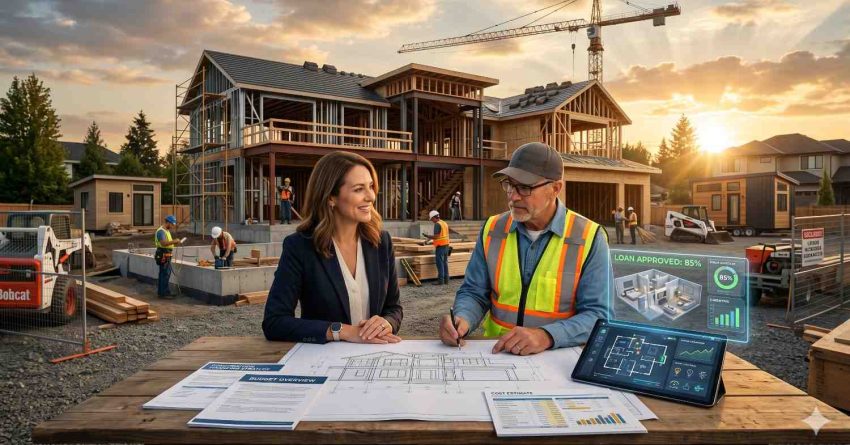
Home construction financing is a specialized short-term lending product that funds a new home’s construction in scheduled draws and then converts into a long-term mortgage once the property is complete. For homeowners, landlords, and property managers building rather than buying, it is the financial backbone of the entire project.
In a U.S. housing market where new build costs have climbed sharply since 2020, understanding how financing, costs, and post-build services connect protects both your budget and your long-term property value.
This guide covers construction loan structure, loan types, average and regional costs, phase budgets, qualification rules, planning frameworks, custom versus production builds, hidden expenses, and the post-construction services every new home requires.
What Is Home Construction Financing?
Home construction financing is a short-term loan structured around a draw schedule, where lenders release funds in stages tied to construction milestones rather than disbursing a single lump sum at closing. Unlike a traditional mortgage that funds an existing, appraised home, construction financing funds something that does not yet exist, which makes it inherently higher risk and more tightly supervised by the lender.
Most construction loans run for 12 to 24 months during the build itself and carry interest-only payments on the funds drawn so far. Once the home is complete and a final certificate of occupancy is issued, the loan either pays off through a separate permanent mortgage or automatically converts into one.
How construction financing differs from a traditional mortgage
Traditional mortgages disburse all funds at closing, base the loan on an existing appraisal, and amortize from day one. Construction loans disburse incrementally, base the loan on projected post-build value, require detailed construction documents, and typically demand a vetted builder and signed fixed-price or cost-plus contract before approval.
Who construction financing is for
Buyers building custom homes, families purchasing a tear-down lot, investors developing rental property, and homeowners undertaking major renovations all rely on construction-stage financing. The right product depends on your timeline, builder relationship, and whether you intend to refinance separately or convert automatically.
Construction financing follows a draw schedule, releases funds in stages, and converts into a long-term mortgage once the home is complete — our construction loans explained guide walks through every disbursement stage, lender requirement, and conversion option so you understand exactly how the money flows from approval to move-in.
Types of Home Construction Loans
Construction lending is not a single product. Four distinct loan structures dominate the U.S. market, and each fits a different builder relationship, timeline, and risk profile. Choosing the wrong type can lock you into two closings, two appraisals, and two sets of fees when one would have done the job.
Construction-to-permanent loans
A construction-to-permanent loan, sometimes called a single-close loan, funds the build and then converts automatically into a 15- or 30-year mortgage once construction finishes. You pay closing costs once, lock the permanent rate up front (or float it through completion), and avoid requalifying mid-project. This is the most popular structure for owner-occupied custom builds because it removes the financing uncertainty between construction and move-in.
Construction-only loans
Construction-only loans cover the build period and then must be paid off in full, usually by refinancing into a separate permanent mortgage. Two closings means two sets of fees, but the structure can make sense when you expect rates to drop, plan to sell, or want flexibility on the permanent loan terms.
Renovation construction loans
Renovation loans such as the FHA 203(k) and Fannie Mae HomeStyle program let buyers finance both the purchase price of an existing home and a documented renovation budget into a single mortgage. These are ideal when the renovation scope is significant enough to require staged disbursements and inspections.
Owner-builder loans
Owner-builder loans are rare and underwritten more strictly because the borrower acts as their own general contractor. Most lenders require documented construction experience, contractor licensing, or a partnership with a vetted builder of record before approving this structure.
The right loan structure depends on your timeline, credit profile, and whether you’re hiring a builder or managing the project yourself — our types of construction loans breakdown covers in full detail construction-to-permanent, construction-only, renovation, and owner-builder options with side-by-side qualification criteria.
Average Home Construction Costs in the USA
National benchmarks give you a starting point, but no construction budget should ever be built on a national average alone. Per-square-foot costs vary dramatically by region, finish level, lot conditions, and the speed of the local labor market.
National average cost per square foot
According to the National Association of Home Builders 2024 Cost of Constructing a Home study, the average cost to build a new single-family home in the USA is approximately $162 per square foot on the structure itself, with total project costs averaging around $428,000 when lot, financing, and overhead are included. A typical 2,500-square-foot home falls between $350,000 and $500,000 for mid-range finishes.
Regional cost variation
Regional differences are sharp. Per U.S. Census Bureau new construction data, the West and Northeast routinely run 25–40% higher than the Midwest and parts of the South due to land scarcity, labor cost, and stricter building codes. California, Washington, and the New York metro region commonly exceed $300 per square foot on mid-range builds, while parts of Texas, Tennessee, and Ohio still come in below $150 per square foot.
National averages tell you the ballpark, but your actual build depends on lot, region, and finish level — our home construction cost calculator breaks down all the per-square-foot benchmarks by state, ZIP code, and home tier so you can model your budget before you ever speak to a builder.
Cost Breakdown by Construction Phase
A typical new build divides into four major cost phases, and lenders structure their draw schedules around these milestones. Understanding which phase consumes which share of your budget helps you anticipate cash flow pressure and spot overruns before they spiral.
Site work and foundation
Site preparation, excavation, grading, utility hookups, and the foundation pour typically consume 8–12% of total budget. Lots with rock, slope, or poor drainage push this percentage higher quickly. Permits, soil testing, and septic or well systems also fall in this phase and are frequently underestimated.
Framing and structural shell
Framing, sheathing, roof structure, windows, and exterior doors generally account for 15–20% of the budget. This is the most visible progress phase and the one most affected by lumber price swings. Random Lengths Framing Lumber Composite prices have fluctuated by more than 40% year over year in recent cycles, making timing and material lock-ins meaningful budget decisions.
Mechanical, electrical, and plumbing rough-in
MEP rough-in covers HVAC ductwork, electrical wiring, plumbing supply and drain lines, and gas connections, usually consuming 13–17% of budget. Code compliance, energy efficiency standards, and smart-home pre-wiring all influence this number. Decisions made at rough-in are expensive to reverse after drywall.
Interior finishes and exterior completion
Interior finishes (cabinetry, flooring, countertops, fixtures, paint) plus exterior completion (siding, landscaping, driveway) together represent the largest single share at 30–40% of total budget. This phase is where allowance line items most often blow past the contract estimate.
Each construction phase carries its own cost profile, labor requirements, and inspection milestones — our construction phase cost breakdown walks through every line item from site prep to final punch list so you know what to expect at each draw.

Factors That Influence Home Construction Costs
Two identical floor plans built 300 miles apart can finish 30% apart on final cost. The variables that drive the spread fall into five categories: lot characteristics, regional labor markets, material price cycles, permitting and code requirements, and design complexity.
Lot cost alone can swing a project by six figures. A buildable infill lot in a major metro may exceed $200,000 before a single foundation stake is set, while comparable acreage in a rural market can come in under $50,000. Labor markets matter just as much: trades shortages in fast-growing Sun Belt metros have pushed framing and finish carpentry rates up significantly since 2021.
Design complexity (multiple roof planes, custom millwork, structural steel, large window openings) compounds cost across every phase because it raises both material and labor hours. Climate zone adds requirements such as hurricane straps, snow-load engineering, or extra insulation, each adding measurable cost.
Material prices, labor markets, climate zones, and design complexity all push your final number up or down — our factors affecting build cost guide explains the complete process of identifying which variables are negotiable and which are fixed by your region.
How to Qualify for a Home Construction Loan
Construction lenders evaluate borrowers more strictly than traditional mortgage underwriters because the collateral, the finished home, does not yet exist. Approval rests on five pillars: credit, income, equity, documentation, and builder vetting.
Credit score thresholds typically start at 680 for conventional construction loans and 620 for FHA-backed construction programs, though most competitive rates require 720 or higher. Debt-to-income ratio caps usually sit between 43% and 45%, and lenders calculate DTI using the projected permanent mortgage payment, not the interest-only construction payment.
Down payment and equity requirements run higher than traditional mortgages — 20–25% is standard, though lot equity can count toward the down payment if the borrower already owns the land. Documentation packages include detailed construction plans, a fixed-price or cost-plus contract, a line-item budget, builder licensure and insurance, a sworn statement of work, and an as-completed appraisal.
Builder vetting is non-negotiable. Lenders independently approve the builder, review their financial stability, past project history, lien record, and licensing status. A borrower with strong credit can still be denied if the builder fails underwriting.
Lenders evaluate construction borrowers more strictly than traditional mortgage applicants because the collateral does not yet exist — our construction loan qualification guide goes deeper into credit score thresholds, DTI limits, documentation packages, and builder vetting requirements.
Budgeting and Financial Planning for a New Build
The single most common reason new home builds run over budget is missing or undersized contingency reserves. Industry guidance from the National Association of Home Builders recommends a contingency reserve of 10–20% of hard construction cost, layered on top of the contract budget, with the upper end reserved for custom builds, sloped lots, and unfamiliar markets.
A complete construction budget covers eight categories: lot acquisition, site work, hard construction cost, soft costs (architect, engineer, permits), financing costs (interest, fees, points), allowances (fixtures, finishes), contingency, and post-construction reserve (furniture, landscaping, immediate service needs).
Contract type matters as much as the budget itself. Fixed-price contracts transfer cost risk to the builder but typically include higher margins to absorb that risk. Cost-plus contracts offer transparency and lower base pricing but expose the buyer to overruns. Guaranteed maximum price (GMP) contracts blend both, capping the buyer’s exposure while sharing savings if the project comes in under cap.
Change orders are the silent budget killer. Even small in-flight design changes can trigger material reorders, schedule slips, and stacked subcontractor fees. A disciplined change-order protocol — written authorization, documented cost impact, schedule impact, and signed acceptance — keeps a build on plan.
Smart budgeting separates the homeowners who finish on plan from those who run out of cash before the drywall goes up — our home build budget planner walks through every cost category, contingency calculation, and change-order safeguard so your numbers hold from groundbreaking to closeout.
Custom Home vs. Production Home Financing
Custom and production builds sit at opposite ends of the financing and cost spectrum. Custom homes offer full control of lot, plan, materials, and finishes but require the borrower to coordinate financing, design, and construction independently. Production homes (built by national or regional builders in planned communities) bundle financing through the builder’s preferred lender, lock prices earlier, and compress timelines.
On cost, custom builds typically run 15–30% higher per square foot than comparable production homes due to one-off design, shorter material runs, and longer build cycles. On financing, custom builds usually require true construction-to-permanent loans, while production builds frequently use simpler standard mortgages with a deposit and progress payments through the builder.
Custom builds offer total control but higher cost and longer timelines, while production homes trade flexibility for speed and predictability — our custom vs production home guide breaks down all the financing implications, design trade-offs, and resale considerations side by side.
Hidden Costs and Contingency Planning
The gap between a quoted contract price and a final move-in cost is often 15–25% for buyers who did not plan for the categories that fall outside the construction contract itself. The most commonly missed costs are permits and impact fees, utility connections (water, sewer, gas, electric, fiber), driveway and final grading, landscaping and irrigation, window treatments, appliances above builder allowance, and immediate post-occupancy service needs.
Builder allowances are another quiet trap. Allowance line items for flooring, cabinetry, lighting, and plumbing fixtures often reflect builder-grade pricing, and buyers selecting mid- or high-tier finishes routinely exceed allowance by 30–50%, with the overage billed as a change order.
Contingency reserves protect against all of these. A disciplined buyer carries one reserve for hard construction overruns, one for finishes and allowance overages, and one for post-construction setup. Together they convert a stressful, reactive build into a planned one.
The gap between your contract price and your final spend is usually filled with permits, change orders, utility hookups, and landscaping — our home construction hidden costs guide covers in full detail every overlooked expense and how to reserve for it before signing.
Once the home is built, what services do I need to protect my investment?

Post-Construction Services Every New Home Needs
The certificate of occupancy is not the finish line; it is the beginning of the home’s operational life. The first 12 to 24 months after move-in are when warranty defects surface, system calibrations are validated, and the difference between a well-maintained home and a deferred-maintenance home is set.
Mechanical systems
Heating and cooling systems require commissioning, balancing, and seasonal tune-ups within the first year of operation, which is why coordinating professional HVAC services early protects both your warranty coverage and your monthly energy costs.
New plumbing systems benefit from a post-build inspection to verify pressure, drainage, and fixture seating — booking residential plumbing services within the first six months catches small issues before they turn into warranty disputes.
Electrical systems should be load-tested, GFCI/AFCI verified, and panel-balanced once the home is fully occupied and real load patterns are established. Smart-home device commissioning and surge protection also belong in the first-year service plan.
Roofing, exterior, and weatherproofing
Roofs, gutters, and flashing should be inspected after the first full weather cycle to validate installation quality and preserve manufacturer warranties — our certified roofing services handle that first-year inspection along with any sealant or shingle corrections needed.
Exterior services extend to caulking, siding sealants, dryer vent termination checks, and pressure washing of newly cured concrete and exterior cladding. Each protects finish life and warranty coverage.
Interior finishing and maintenance services
Year-one interior services include drywall touch-ups after settling, hardwood and tile grout sealing, paint touch-up kits, and final punch-list closeout with the builder. Coordinating these through a single trusted home service provider eliminates the friction of finding, vetting, and scheduling multiple trades during what should be a celebratory first year in the home.
Long-Term Maintenance Costs and Service Planning
A widely cited industry rule of thumb suggests budgeting 1–4% of a home’s value annually for ongoing maintenance and repairs, with newer homes trending toward the lower end of the range and older homes toward the higher end. For a $500,000 home, that translates to $5,000–$20,000 per year in maintenance reserves.
The most cost-effective maintenance strategy is preventive: seasonal HVAC service, annual roof and gutter inspections, quarterly handyman walkthroughs, and proactive plumbing and electrical checks. Reactive repair after failure routinely costs 3–5x what scheduled maintenance would have cost.
Industry rule of thumb suggests setting aside 1–4% of your home’s value annually for upkeep, but real costs depend on systems, climate, and age — our home maintenance cost guide explains the complete process of building a maintenance reserve and prioritizing the services that protect long-term value.
Most year-one and year-two punch-list items are small enough for a single skilled technician to resolve in a few visits, which is why scheduling trusted handyman services on a quarterly basis keeps minor repairs from snowballing into major expenses.
Conclusion
Home construction financing connects loan structure, regional cost benchmarks, phase budgets, qualification requirements, and contingency reserves into one disciplined plan that protects both the build and the long-term asset.
A complete strategy does not end at closing. It extends into commissioning, inspection, and maintenance services that preserve warranty value, system performance, and resale strength for decades after move-in.
We help you plan, build, and protect your home from groundbreaking through generational ownership. Talk to Mr. Local Services today and connect with trusted professionals across every service your new home will ever need.
Frequently Asked Questions
What is a home construction loan?
A home construction loan is a short-term loan that funds a new build in scheduled draws tied to construction milestones. It converts to a permanent mortgage when the home is complete.
How much does it cost to build a house in the USA?
The national average is roughly $162 per square foot on the structure, with total project costs near $428,000 when lot and soft costs are included. Regional variation can shift this by 25–40%.
What credit score do I need for a construction loan?
Most conventional construction lenders require a minimum credit score of 680, with the most competitive rates reserved for borrowers at 720 or higher. FHA construction options start near 620.
What is the difference between a construction-to-permanent and a construction-only loan?
A construction-to-permanent loan converts automatically into your long-term mortgage with one closing. A construction-only loan must be paid off through a separate permanent mortgage, requiring two closings.
Is it cheaper to build or buy a home?
Building typically costs more upfront and takes longer than buying an existing home, but offers control over design, energy efficiency, and warranty coverage that can lower long-term costs significantly.
What are the most commonly overlooked costs of building a new home?
Permits, utility hookups, driveway and landscaping, allowance overages, change orders, window treatments, and immediate post-occupancy services together commonly add 15–25% to the original contract price.
What services should I schedule after a new home is built?
Plan HVAC commissioning, plumbing and electrical inspections, roof and exterior weatherproofing checks, and a year-one handyman walkthrough to validate warranty items and protect long-term property value.