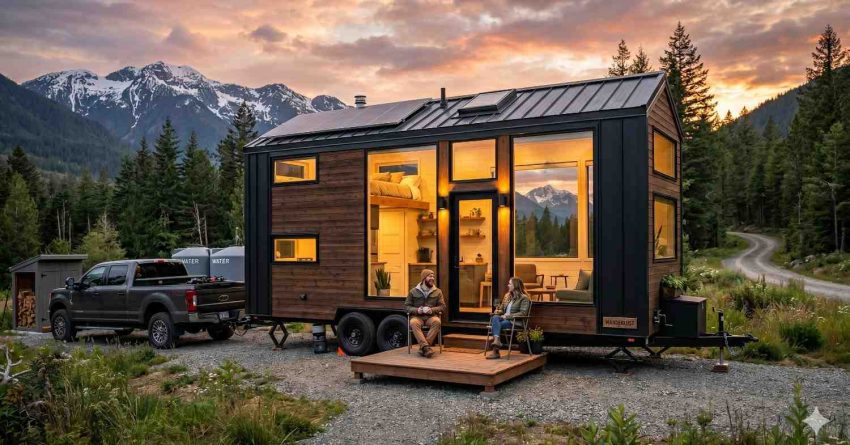
A tiny home on wheels (THOW) is a custom-built residential structure constructed on a road-legal trailer frame, combining the quality and personalization of a built home with the mobility and flexibility of a towable vehicle.
Rising housing costs have made THOWs a serious option for a growing segment of the population, with the US tiny home market estimated to have reached $4 billion in annual value by 2024 and double-digit annual growth continuing into 2025.
This guide covers everything you need to evaluate, build, or buy a THOW: how THOWs are defined and classified, the certification landscape, trailer and framing decisions, off-grid systems, cost and financing, towing requirements, where to park legally, the real-world lifestyle trade-offs, common problems, and how THOWs compare to alternatives.
What Is a Tiny Home on Wheels?
A tiny home on wheels is a small, purpose-built dwelling constructed on a steel trailer frame rather than a permanent foundation. Unlike manufactured homes, which are classified under HUD code and intended for semi-permanent placement, THOWs are designed to be towed on public roads using a standard hitch setup while meeting residential-grade construction standards inside.
Most THOWs range from 16 to 40 feet in length and offer between 150 and 400 square feet of livable space. They are built using residential-grade insulation, framing, and interior finishes—often to the same quality level as a site-built home—while remaining technically classified as recreational vehicles or personal property in most US jurisdictions.

THOW vs. RV vs. Park Model vs. Tiny House on Foundation
The THOW occupies a specific position in the alternative housing spectrum. An RV is manufactured for recreational travel using lighter construction standards; a THOW is handcrafted for dwelling using residential materials. A park model is RVIA-certified and trailer-based like a THOW, but is limited to 400 square feet and designed for semi-permanent placement rather than regular towing. A tiny house on a foundation offers the legal permanence and financing access of a conventional home but gives up mobility entirely.
| Feature | THOW | RV/Travel Trailer | Park Model | Tiny House (Foundation) |
| Construction standard | Residential | RV/recreational | RVIA (limited) | IRC |
| Road-legal | Yes | Yes | Limited | No |
| Full-time legal habitation | Jurisdiction-dependent | Jurisdiction-dependent | Jurisdiction-dependent | Generally yes |
| Appreciates with land | No | No | No | Yes |
| Traditional mortgage | No | No | No | Yes |
Before committing to a THOW, it’s worth understanding how it compares to closely related structures, and our comprehensive THOW vs. RV vs. Park Model comparison walks through construction standards, legal classification, mobility capability, and cost per square foot across all three categories.
Understanding whether you want mobility or permanence is the first fork in this decision, and our dedicated THOW vs. foundation house differences guide breaks down every structural, legal, and financial distinction across these two housing types so you can make a fully informed choice.
THOW Certifications and Legal Classifications
One of the most consequential—and most confusing—aspects of THOW ownership is certification. The certification your THOW carries determines how it is legally classified in every state you park or travel through, and that classification affects your insurance eligibility, financing options, and ability to legally inhabit the unit full-time.
RVIA Certification
The Recreational Vehicle Industry Association is the most widely recognized certifying body for towable recreational structures. RVIA certification requires compliance with ANSI A119.2 recreational vehicle standards. The certification mark is recognized by RV insurers and lenders nationwide, making RVIA the most accessible path to standard financing and insurance coverage. The trade-off: RVIA-certified THOWs are classified as recreational vehicles, which restricts full-time habitation in many jurisdictions that require residential permitting.
RVIA certification is the most widely recognized classification for towable tiny homes, and our complete RVIA certification for THOWs guide explains exactly what the certification covers, what the inspection process involves, and how it affects your ability to finance and insure your unit.
ANSI A119.5 Certification
The American National Standards Institute developed A119.5 specifically as a construction standard for Park Model Recreational Vehicles and THOWs—a recognition that the earlier RV standards were inadequate for residential-quality builds. ANSI A119.5 requires more stringent construction and systems standards than basic RVIA certification and is increasingly accepted by jurisdictions that differentiate between recreational and residential use structures.
NOAH Certification
The National Organization for Alternative Housing provides a third-party inspection and certification program for THOWs built to International Residential Code (IRC) standards—the same code applied to site-built homes. NOAH certification is the strongest available endorsement of a THOW’s residential construction quality and is often required when a THOW owner seeks full-time habitation approval in jurisdictions that regulate dwelling classification.
Choosing between the three major certification bodies is one of the most consequential decisions a THOW owner makes, and our RVIA vs. ANSI vs. NOAH decision guide provides a state-by-state recommendation framework based on your primary use case—full-time habitation, vacation use, or investment rental.

THOW Design and Build: Trailers, Framing, and Floor Plans
Building or purchasing a THOW requires decisions across five major design dimensions: trailer configuration, framing method, insulation strategy, roof design, and interior floor plan. Each decision cascades into others—and errors at the structural level are extremely costly to fix after the fact.
Trailer Selection: Bumper Pull vs. Gooseneck
The trailer is the structural and legal foundation of every THOW. Two primary configurations exist:
Bumper-pull trailers attach to a standard ball hitch and work with a wider range of tow vehicles. They are the most common choice for builds under 28 feet. Gooseneck trailers attach via a fifth-wheel hitch in the truck bed and are preferred for builds 28–40 feet in length, offering superior weight distribution and stability at highway speeds.
Beyond hitch type, critical trailer specifications include deck height (low-profile decks allow more headroom within legal road height limits), axle count (most residential-weight builds require triple axles), steel gauge, and tongue length. The trailer is the most structurally critical decision in any THOW build, and our THOW trailer selection guide covers axle count, deck height, steel gauge, weight ratings, and hitch configuration across every major trailer manufacturer serving the tiny home market.
Framing Methods: Wood, Steel, and SIPs
| Framing Method | Weight | Moisture Risk | Cost | Insulation Compatibility |
| Wood stick frame | Higher | Moderate-high | Lower | Excellent |
| Cold-formed steel | Lower | Low | Higher | Good (thermal break needed) |
| SIP panels | Moderate | Low | Higher | Excellent |
Steel framing has gained significant adoption in professional THOW builds over the past five years because it reduces total weight (critical for staying within road weight limits) and eliminates the moisture-wicking properties of wood that contribute to mold. SIP construction offers outstanding thermal performance in a slim profile but requires precision installation.
Insulation and Roof Design
Insulation choices in a THOW involve a constant trade-off between R-value, thickness, and weight. Closed-cell spray foam at 2 inches provides approximately R-13 in a fraction of the thickness of fiberglass batt, while simultaneously serving as an air and vapor barrier—eliminating the primary mechanism by which wall-cavity condensation causes mold.
Insulation strategy is the most consequential single decision in preventing THOW moisture problems, and our dedicated THOW insulation for all climates guide covers R-value targets by climate zone, closed-cell vs. open-cell spray foam trade-offs, rigid foam applications, and the specific wall and roof assemblies that field-tested THOW builders rely on.
Roof design options include shed (single pitch—simplest, most waterproof), gable (more loft headroom, traditional aesthetic), and butterfly or curved configurations (modern look, more complex sealing requirements). Roof pitch significantly affects loft headroom and the risk of ice damming in cold climates.
Floor Plans and Interior Layout
THOW interior design must solve for sleeping, cooking, bathing, living, and storage within a footprint typically 8.5 feet wide and 16–34 feet long. The dominant design pattern places sleeping in an overhead loft accessed by stairs or a ladder, with kitchen, bath, and living space on the main floor.
Compact builds under 200 square feet require highly intentional design to remain livable, and our curated THOW floor plans under 200 square feet resource includes downloadable layouts with furniture dimensions, storage placement, and loft configurations used in real-world builds.
For builds in the 200–400 square foot range—where most full-time residents land, Our THOW layouts 200 to 400 square feet guide covers first-floor bedroom configurations, dual-loft designs, open-concept living zones, and dedicated workspace integration.
THOW Systems: Off-Grid Power, Plumbing, and Climate Control
A THOW must handle all the functional needs of a permanent residence within a fraction of the space, with materials light enough to comply with road weight limits, and systems flexible enough to operate off-grid when a utility hookup is unavailable.
Electrical Systems and Solar Power
Most THOWs are engineered to operate across three power modes without rewiring: shore power (utility hookup), solar plus battery, and generator backup. Shore power functions identically to a standard RV hookup at a campground or private land with electrical service. Solar plus battery is the primary off-grid power solution for the majority of full-time THOW residents.
A typical full-time THOW solar system includes:
- 600–2,000W of roof-mounted photovoltaic panels (limited by roof area and weight)
- 100–400Ah of lithium battery storage (lithium preferred over lead-acid for weight savings and depth of discharge)
- 2,000–4,000W pure sine wave inverter-charger
- Shore power transfer and charge integration
Every mode a THOW operates in—shore power, solar, or generator—has distinct wiring and panel requirements, and our THOW electrical system design guide covers panel sizing, shore power hookups, inverter-charger selection, and the complete solar integration process from panel to battery to load.
Solar is the backbone of off-grid THOW operation, and our THOW solar setup complete guide walks through panel wattage calculations, battery chemistry selection, inverter sizing, charge controller configuration, and real-world energy budgets from full-time THOW residents across different climates.
Water Supply and Waste Solutions
THOWs face a challenge that conventional homes never encounter: you can’t always connect to municipal water or sewer. Common solutions include:
Water supply: Fresh water tanks (50–100 gallons) with a 12V pump, or direct connection to a host property’s water supply via a standard RV hose hookup.
Waste management:
- Composting toilets (brands: Nature’s Head, Airhead, OGO) eliminate black water entirely and are legal in most states with a gray water disposal plan
- Incinerating toilets convert waste to sterile ash without water—useful in off-grid situations where composting is impractical
- Black water tanks + gray water tanks, functioning like an RV, requiring periodic pump-out
Gray water disposal—sink, shower, and dishwater—is a separate and equally important regulatory question. Options include direct connection to a host property’s sewer, gray water filtration systems, or approved composting of treated gray water where local code permits.
Heating, Ventilation, and Moisture Control
THOWs heat up and cool down faster than site-built homes due to their high surface-area-to-volume ratio and thinner thermal mass. Common heating solutions by climate:
- Mini-split heat pumps: Most energy-efficient for climates rarely below 15°F; doubles as AC in summer
- Propane wall heaters or radiant heaters: Reliable in cold climates; requires propane tank management
- Wood pellet stoves: Off-grid appeal; requires ceiling clearance and proper flue installation
- Diesel-fired hydronic systems: Popular in extreme cold environments; highly efficient but expensive
Ventilation is arguably the most overlooked and most critical systems decision in THOW construction. A single person generates approximately 1 pint of moisture vapor per day through breathing, cooking, and bathing. Without an Energy Recovery Ventilator (ERV) or Heat Recovery Ventilator (HRV) continuously exchanging stale humid interior air with fresh dry exterior air, that moisture accumulates in wall cavities, causing mold within months.
Moisture is the most common cause of serious THOW structural damage, and our THOW ventilation and moisture control guide explains the physics of condensation in small spaces, ERV and HRV selection for THOW applications, and the building envelope strategies that prevent mold before it starts.
THOW Cost and Financing
THOW costs span a wide range depending on the path to ownership and the level of finish and systems included. Understanding the full cost picture—including often-overlooked ownership costs beyond the purchase price—is essential for realistic financial planning.
Cost to Build vs. Buy in 2025
| Ownership Path | Typical Cost Range (2025) |
| DIY shell-only completion | $15,000–$40,000 |
| DIY full build (materials only) | $30,000–$80,000 |
| Professional builder, entry-level | $65,000–$100,000 |
| Professional builder, mid-range custom | $100,000–$160,000 |
| Professional builder, luxury custom | $150,000–$300,000+ |
Build length is the primary cost driver. A 20-foot professionally built THOW typically runs $65,000–$90,000; a 34-foot luxury build can exceed $250,000. Beyond the build or purchase price, owners should budget for tow vehicle acquisition or upgrade ($30,000–$80,000 for a capable truck), THOW insurance ($900–$2,400/year for full-time coverage), and ongoing site or land costs ($300–$1,500/month depending on location).
Material and labor costs for THOWs have shifted significantly in recent years, and our comprehensive THOW build cost guide provides line-item cost breakdowns by component across DIY, semi-custom, and fully custom professional builds at 20-, 24-, 28-, and 34-foot lengths.
Financing Options for THOWs
THOWs are classified as personal property—not real property—in nearly all US jurisdictions, which means traditional mortgage financing is not available. The primary financing paths are:
- RV loans: Available for RVIA-certified THOWs from RV-specific lenders and some credit unions. Current rates range 7–13% with terms up to 15 years.
- Personal loans: Available regardless of certification type. Rates range 8–18% in 2025; terms 3–7 years. Higher rates but broader accessibility.
- HELOC or cash-out refinance: For existing homeowners with equity. Lowest rates available (prime-linked) but requires pledging existing real property.
- Manufacturer financing: Offered by some THOW builders directly, often with competitive rates for qualified buyers.
Because THOWs are classified as personal property rather than real estate, your financing path looks very different from a traditional mortgage, and our THOW financing options guide compares personal loans, RV loans, manufacturer financing, and HELOC strategies with current rate ranges and qualification criteria for each.
Towing, Mobility, and DOT Regulations
A THOW is a vehicle on public roads, and that means compliance with Department of Transportation regulations in every state it travels through—not just where it parks.
DOT Width, Height, and Length Limits
Most US states allow towing a structure within these standard parameters without a special permit:
- Width: Maximum 8.5 feet (102 inches)
- Height: Maximum 13.5 feet from road surface
- Combined length: 48–65 feet total (truck plus trailer combined; varies by state)
THOWs exceeding 8.5 feet wide require an oversize load permit in most states, adding significant cost and planning complexity for each move. This constraint is why the overwhelming majority of professional THOW builders design to 8.5 feet or narrower.
Tow Vehicle Requirements
A residential-quality 24-foot THOW fully loaded with occupants and possessions commonly weighs 12,000–18,000 pounds. Safe towing requires:
- A truck with a manufacturer-rated tow capacity exceeding the THOW’s loaded weight by at least 20%
- For most 20–28 foot THOWs: a minimum of a Ford F-250, RAM 2500, or Chevy 2500 with a 3/4-ton axle rating
- For builds over 28 feet: F-350, RAM 3500, or Chevy 3500-class minimum
- Proper weight distribution hitch (bumper-pull) or fifth-wheel/gooseneck setup
- Brake controller synchronized with trailer electric brakes
Matching your tow vehicle to your THOW’s weight is a safety-critical calculation, and our tow vehicle requirements for THOWs guide covers GVWR ratings, payload calculations, hitch class requirements, and specific truck recommendations by THOW length and weight for the most popular builds on the road today.
Even a legally compliant THOW may need special permits when crossing state lines with oversize dimensions, and our THOW travel permits by state guide covers permit requirements, restricted travel windows, and permit application processes for all 50 states.
Where to Park a THOW: Legal Paths and Community Options
Finding a long-term, legally compliant place to park a THOW is the most persistent challenge in the THOW lifestyle. Options exist across a wide spectrum of formality, cost, and regulatory complexity.
RV Parks and Campgrounds
RV parks and campgrounds are the most universally available option, accepting all RVIA-certified THOWs. Monthly rates range from $300 in rural areas to $1,500+ in popular coastal or urban locations. Quality varies from basic utility hookups with minimal amenities to resort-style communities with pools, fitness centers, and organized activities.
The main limitation of RV parks for full-time THOW residents is transience: most RV parks are designed for short stays and may have maximum stay limits that require periodic relocation—even if the park is willing to host you indefinitely.
Tiny Home Communities
A growing number of purpose-built tiny home communities across the US are designed specifically for THOW and small-footprint living. These communities provide dedicated long-term infrastructure, shared amenity buildings, and a peer support network of fellow tiny home residents. Purpose-built tiny home communities offer the most THOW-friendly infrastructure and a ready peer support network, and our tiny home communities by state directory lists over 150 established communities with location, amenity, and acceptance criteria details current through 2026.
Backyard Placement and Private Land
Many THOW residents pursue placement on a host family member’s or friend’s property through a private agreement. This arrangement’s legality depends entirely on local zoning. Some municipalities have created explicit “backyard cottage” or “secondary dwelling unit” zoning categories that accommodate THOW placement; most have not. Backyard THOW placement depends entirely on local zoning ordinances, and our THOW backyard placement legal path guide explains the specific zoning language to look for, how to approach a variance application, and which states have created explicit permitting pathways for this arrangement. “THOW zoning by county” is one of the most frequently searched questions in this space, and our upcoming THOW zoning by county guide will map the specific ordinance language to look for and the variance process in jurisdictions that allow case-by-case THOW parking approval.
Regulatory friendliness, climate, and cost of living vary enormously across the US, and our best states for full-time THOW living guide ranks every state by THOW habitability regulations, parking availability, climate suitability, and monthly cost of site fees to help you decide where to land.

THOW Lifestyle: Real-World Realities
Living in a THOW full-time is genuinely different from conventional housing in ways that both novices and well-researched prospective residents commonly underestimate.
Minimalism and Downsizing
THOW living requires a fundamental reckoning with possessions. Most full-time THOW residents report purging 70–90% of their belongings before their first move-in—not by philosophical conviction alone, but because the physical constraints of 200–400 square feet with minimal storage make accumulation impossible. Long-term THOW residents frequently describe this constraint as unexpectedly liberating: reduced decision fatigue, sharply lower discretionary spending, and a recalibrated sense of what “enough” actually means.
Climate Challenges: Cold, Hot, and Humid Environments
A THOW’s performance varies dramatically by climate. Three scenarios represent the most common challenges:
Cold climates (below 20°F): Exposed pipes in uninsulated under-chassis space are the most common cold-weather failure. Heat tape, heavy skirting, and a properly sized heating system are non-negotiable for northern climates. Cold-climate THOW living requires specific build decisions and winterization protocols that warm-climate owners never think about, and our THOW cold weather living guide covers pipe insulation, skirting strategies, heating system sizing, and real-world temperature performance data from residents in northern US climates.
Hot and sunny climates: The small thermal mass of a THOW means interior temperatures track exterior temperatures closely. Roof ventilation, shade structures, light roof colors, and appropriately sized mini-split AC units are essential in desert and subtropical regions.
High humidity environments: Condensation on interior surfaces during humidity swings is a year-round moisture management challenge in the Southeast and Pacific Northwest. ERV systems are arguably more important in high-humidity climates than in cold climates.
Who Lives in a THOW? Audience Profiles
The THOW demographic is more varied than popular culture suggests:
- Digital nomads and remote workers prioritizing location flexibility without sacrificing home quality
- Retirees seeking dramatically reduced housing costs and maintenance obligations
- Young couples and singles in high-cost markets who choose to own their housing rather than rent
- Families of 3–4 who have consciously chosen to prioritize experiences and financial freedom over space
Families considering a THOW face unique challenges around shared space, privacy, children’s sleep arrangements, and schooling logistics, and our family THOW living guide covers floor plan selection, real-world accounts from THOW families, and practical strategies for making small-space family living sustainable long-term.
Remote workers face specific infrastructure challenges in a THOW—reliable internet, comfortable workspace, and climate control for long work sessions, and our working remotely from a THOW guide addresses connectivity solutions, desk and ergonomic configurations, and power management for all-day laptop and video call use.
THOW Builders, Brands, and DIY Options
The THOW builder market has matured since 2015 from a handful of craftspeople into a structured industry with national builders, regional specialists, and professional certification programs.
Professional Builders vs. DIY Builds
Professional THOW builds range from shell-only (structural frame, sheathing, roof, and windows complete—interior unfinished) to fully turnkey custom builds with professional interior finish work. Buyers should evaluate builders across four dimensions: portfolio of completed builds and verifiable owner testimonials, certification capabilities (RVIA, ANSI, or NOAH), post-sale warranty coverage, and construction timeline reliability.
DIY builds—estimated to represent 30–40% of THOWs on the road—can save $20,000–$60,000 compared to professional builds but demand substantial construction skill, 1,000–3,000 hours of labor over 12–24 months, and reliable access to specialized tools and materials. The most common DIY failure mode is moisture intrusion caused by improper building envelope execution.
Not all THOW builders are equal in quality, certification capability, or post-sale support, and our annually updated best THOW builders in 2026 rankings cover the top builders by region, price tier, certification type, and specialization—including builders who offer DIY shell programs and used THOW resale networks.
Shell-Only Purchase and Used Market
A productive middle path: purchase a professionally constructed shell (trailer, framing, roof, windows, and exterior complete), then finish the interior yourself. This approach ensures structural integrity at the highest-risk stage while preserving the personalization and cost savings of DIY interior finishing.
The used THOW market offers another cost-reduction path. Purchasing a used unit can save $20,000–$50,000 compared to a new build, but moisture damage, trailer wear, and system failures are hidden risks that require a professional pre-purchase inspection. Understanding how long the build process takes—from deposit to delivery—is one of the first questions a prospective THOW buyer asks, and our THOW build timeline guide will cover the full sequence from design approval through certification inspection and final delivery for both custom professional builds and semi-custom programs.
Purchasing a used THOW can save $20,000–$50,000 compared to a new build, but moisture damage, trailer wear, and system failures are hidden risks, and our used THOW buying guide includes a pre-purchase inspection checklist, common red flags by build age, and pricing benchmarks by size and builder.
Common THOW Problems and How to Avoid Them
Understanding the most frequently reported THOW problems before building or buying allows you to make build decisions that prevent them rather than remediate them at great expense.
Mold and Moisture Damage
Mold is the single most reported serious THOW problem, and it is almost universally rooted in inadequate moisture management during construction. The combination of high occupancy density in a small volume, cooking, showering, and insufficient air exchange creates condensation—especially on cold wall surfaces in under-insulated cavities.
Prevention is the only effective strategy: closed-cell spray foam throughout, ERV ventilation, and moisture-resistant substrate materials. Remediation after mold takes hold typically requires stripping interior walls completely, which can cost $15,000–$40,000 depending on build size and extent of infestation. Mold is almost entirely preventable with the right build decisions, and our THOW mold prevention strategies guide explains the specific insulation, ventilation, and substrate choices that eliminate condensation inside wall cavities before it ever becomes a problem.
Trailer Frame Rust
Road salt, moisture, and road debris attack unpainted or inadequately coated trailer steel over time. Annual inspection of the trailer undercarriage, spot treatment of any surface rust beginnings, and regular application of rust-inhibiting coatings are essential maintenance tasks. Trailer frame integrity is not a cosmetic concern—it is the primary structural safety issue in THOW ownership. The trailer frame is the structural foundation of a THOW, and rust is its primary long-term threat, so our THOW trailer rust prevention guide covers inspection schedules, treatment protocols, coating products, and the warning signs that indicate a used trailer’s frame integrity may be compromised.
Depreciation and Resale Challenges
Unlike site-built homes that appreciate with land value, THOWs generally depreciate over time—similar to RVs. The rate of depreciation correlates strongly with build quality, maintenance documentation, and the reputation of the original builder. High-quality builds by well-regarded builders with documented maintenance histories hold value substantially better than DIY builds or builds from unknown producers.
Unlike conventional real estate, THOWs do not appreciate with land value and face a more limited buyer pool at resale, and our THOW resale market guide covers depreciation curves by build quality, the best sale channels for THOW sellers, and the documentation that maximizes a unit’s resale value. Every buyer considering a THOW as a long-term investment should read our THOW depreciation reality guide before committing, which covers financial modeling of THOW ownership costs vs. renting and the build characteristics that minimize value loss over a 10-year ownership window.

THOW vs. Alternative Housing Paths
THOWs occupy a specific position in the housing alternatives landscape. Comparing them to adjacent options clarifies who they serve well—and who would be better served by a different path.
THOW vs. ADU
An accessory dwelling unit is a permanent additional dwelling built on an existing residential property. ADUs appreciate with the land, qualify for traditional financing in most cases (including construction loans and HELOCs), and face a simpler long-term regulatory environment than THOWs. The trade-off: no mobility, higher construction cost ($120,000–$300,000 depending on type and location), and a permitting process that takes months in most jurisdictions.
For homeowners with equity who want to add income-generating or family housing to their property, our complete ADU build guide walks through every type, cost structure, permitting path, and investment ROI scenario. For a direct financial comparison of the two paths, our THOW vs. ADU housing comparison breaks down the 10-year cost and lifestyle trade-off by ownership scenario.
THOW vs. Park Model
Park models share THOW’s trailer-based foundation and RVIA certification framework, but differ in two fundamental ways: they are limited to 400 square feet by RVIA definition, and they are not designed for regular over-road travel. Park models are placed in an RV resort or community and rarely moved thereafter.
For buyers who want RVIA-certified tiny living without the towing requirements or the full build scope of a THOW, our park model homes complete guide covers all the design, legal, and financing dimensions that differentiate park models from true THOWs.
THOW vs. Prefab Home
Prefab homes—modular, panelized, or manufactured—offer more living space, traditional mortgage financing, greater long-term financial stability, and the ability to purchase on a permanent lot. The trade-off is complete loss of mobility. For buyers with land access and a long-term housing horizon, our broader Prefab Homes master guide provides a comprehensive framework for evaluating all prefab housing types.
THOW vs. Van Life
Van conversions appeal to a similar demographic as THOWs but involve dramatically different trade-offs: lower total cost ($15,000–$80,000 all-in vs. $70,000–$200,000 for a professional THOW), but dramatically less living space (60–100 square feet vs. 200–400) and greater daily operational complexity. Van conversions also avoid most of the legal parking challenges that THOWs face. Van conversions appeal to a similar demographic as THOWs but involve dramatically different trade-offs in living space, cost, and regulatory simplicity, and our THOW vs. van life full comparison breaks down the decision across 12 dimensions—from daily living comfort to social acceptance and financial commitment.
THOW Services: Finding Builders, Financing, and Specialized Support
For those ready to move from research to action, Mr. Local Services connects THOW buyers, builders, and owners with vetted professionals across every stage of the THOW journey.
Every THOW buyer’s financial situation is different—and the right financing path depends on your credit profile, whether you own other property, and which certification your THOW will carry, so our THOW financing consultation service connects you with specialists who work exclusively in the THOW and RV lending space and can identify the best available loan product for your specific situation.
Finding a vetted local builder who understands your region’s towing regulations, climate considerations, and certification requirements is the most important early step in your build process, and our THOW builder near you directory connects you with verified builders organized by state, certification type, and specialty. We also connect owners with inspection services, solar installers, and delivery specialists through our national network. Every buyer who is evaluating a used unit should request a professional inspection before committing; our upcoming THOW pre-purchase inspection checklist details every structural, systems, and certification check that a qualified THOW inspector should perform.
THOW Insurance, Tax, and Legal Framework
Navigating the insurance, tax, and legal landscape of THOW ownership requires clear understanding of how your specific structure is classified in the jurisdiction where it’s registered and where it’s parked.
Insurance Classification and Coverage Types
THOW insurance falls into two primary categories based on certification:
RV insurance (for RVIA-certified units): Available from major RV insurers including Good Sam, National General, and Progressive RV. Coverage includes collision, comprehensive, liability, and personal property. Full-time coverage rates typically run $900–$2,400 per year depending on THOW value, location, and coverage limits.
Specialty THOW/dwelling insurance: Required for NOAH-certified or uncertified builds. Underwriters treat the structure more like a dwelling than a vehicle. Coverage is similar in scope but priced differently and requires specialized brokers.
Standard homeowners insurance does not cover THOWs, and a lapse in coverage during a major claim is among the most costly mistakes THOW owners make. THOW insurance is underwritten differently than homeowners insurance and requires matching your certification type to the right policy type, and our THOW insurance coverage guide compares RV insurance, specialty dwelling insurance, and full-time coverage options with current rate ranges and the coverage gaps owners frequently discover after a claim.
Property Tax vs. Vehicle Registration
THOWs are classified as personal property (titled as vehicles) in most US states. This means they are subject to annual registration fees—typically $200–$1,500 depending on the state and the THOW’s assessed value—rather than recurring property taxes. Some states use a depreciated value schedule for registration assessments; others assess a flat fee. This distinction generally results in a lower annual tax burden than equivalent square footage in real property.
Full-Time Habitation Laws by State
Full-time THOW habitation laws vary enormously by state, county, and municipality. Some jurisdictions—particularly states with strong ADU-friendly legislation or rural counties with minimal zoning enforcement—provide relatively clear legal pathways for THOW residents. Others explicitly prohibit non-permitted dwellings or require RV habitation only in designated zones.
The legality of full-time THOW habitation is regulated differently in every state, and our THOW legal status by state guide maps the current habitability regulatory landscape across all 50 states so you know exactly what legal framework applies before you commit to parking in a given location.
For the broader legal and tax framework surrounding non-conventional housing structures, our home building insurance and legal guide addresses builder risk insurance, property tax classification, construction contract law, and legal protections relevant to every type of alternative housing including THOWs.
Conclusion
Tiny homes on wheels represent one of the most flexible, customizable, and increasingly mainstream housing alternatives available in the United States—combining residential-quality design and finish with the mobility of a towable vehicle and a dramatically lower cost of entry than conventional real estate.
Succeeding with a THOW requires more than enthusiasm for small-space living. It demands clear decisions at the build stage—certification, insulation, framing, and systems—that prevent the moisture, rust, and structural problems that compromise poorly built units, along with a realistic understanding of the legal landscape where you intend to park and travel.
Mr. Local Services connects THOW buyers, builders, and owners with vetted specialists across every dimension of this housing path—from certified builder referrals and financing consultation to solar installation, pre-purchase inspections, and delivery logistics. Contact us today to connect with a THOW specialist in your region who understands the specific regulations, climate considerations, and market conditions where you plan to live.
Frequently Asked Questions
What makes a THOW different from a regular RV or travel trailer?
A tiny home on wheels is built to residential construction standards—using real insulation, structural framing, and finish materials—while an RV or travel trailer uses lighter recreational-grade construction designed for short-term use. THOWs are designed for full-time habitation; standard RVs are not.
Do I need a special license to tow a tiny home on wheels?
Most states do not require a special driver’s license to tow a THOW under 26,000 lbs combined vehicle weight. However, your tow vehicle must be rated for the loaded weight of the THOW, and you may need an oversize load permit if the structure exceeds 8.5 feet wide or 13.5 feet tall.
Can I park a THOW permanently in a residential neighborhood?
In most US jurisdictions, the answer is no without a specific zoning variance or permit. Residential neighborhoods are typically zoned for permanent foundation structures. Some municipalities have created pathways for THOW placement as accessory dwellings, but these are the exception rather than the rule.
What certification is best if I plan to live in my THOW full-time?
NOAH certification—which certifies the THOW to International Residential Code standards—is generally strongest for full-time habitation because it is the standard regulators are most likely to recognize as evidence of residential-quality construction. RVIA certification is better for financing and insurance access if you prefer RV loan products.
How long does it take to build a custom THOW professionally?
Most professional THOW builders have lead times of 3–8 months from deposit to delivery, depending on complexity, custom finish level, and builder backlog. Highly customized builds with specialty features can take 9–14 months. Builder timelines should be confirmed in the contract with milestone dates and penalty provisions for significant delays.
Can I use a THOW as a rental property?
Yes, and it’s increasingly common—particularly as a short-term rental on platforms like Hipcamp or as a long-term rental on private land. Legal ability to rent depends on local zoning (some areas prohibit STR use even in RV-friendly zones), platform policies, and insurance coverage (short-term rental use must be disclosed to and covered by your policy).
What is the biggest financial mistake THOW buyers make?
Underestimating total cost of ownership. Most buyers focus on the THOW purchase or build cost but underestimate the combined cost of a capable tow vehicle, insurance, land or site fees, maintenance, and eventual depreciation at resale. Buyers who run a complete 5-year cost model before committing consistently report better financial outcomes than those who focus only on the sticker price.