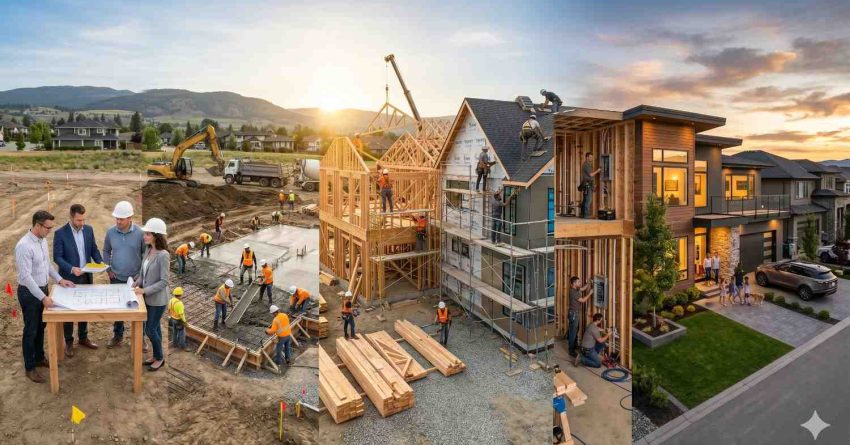
Building a home from the ground up involves nine distinct construction phases, each with its own team, timeline, inspection requirements, and decision points — and understanding how they connect is what separates confident owners from overwhelmed ones.
Getting a clear map of the entire process before breaking ground is not optional. Owners who understand what happens in each phase — and in what sequence — make better decisions, catch problems earlier, and avoid the cost overruns and delays that derail so many builds.
This guide walks through every stage of new home construction in the order it occurs — from assembling your team and securing permits through foundation, framing, rough-ins, finishes, final inspection, and move-in. Each phase includes what to expect, what to verify, and where to go for deeper resources.
What Is the Home Building Process?
The home building process is the structured sequence of construction activities required to transform a vacant lot — or a cleared site — into a finished, permitted, and occupied residential structure. It is not a single continuous activity but a series of interdependent phases, each of which must be completed, inspected, and approved before the next begins.
A standard site-built single-family home involves nine primary construction phases: pre-construction planning, site work, foundation, framing, rough-in systems, insulation and drywall, finishes, mechanical trim-out, and final inspection leading to a Certificate of Occupancy.
How Many Phases Does a Home Build Have?
Most construction professionals organize the build into 7 to 12 phases depending on how granularly they define the work. This guide uses nine phases because it maps cleanly onto the typical municipal inspection schedule and matches the draw structure most construction lenders use to fund the project in stages.
Who Manages Each Phase?
The general contractor (GC) or builder orchestrates each phase, scheduling and supervising subcontractors who specialize in site work, concrete, framing, electrical, plumbing, HVAC, insulation, drywall, finish carpentry, and landscaping. As the property owner, your role is to make timely decisions, verify work against your plans, conduct walkthroughs at critical milestones, and approve each phase before the next begins.
Phase 1: Pre-Construction — Planning, Design, Permits, and Financing
Pre-construction is the longest and most decision-intensive phase of the entire project. It begins the moment you decide to build and ends the day your builder breaks ground. Nothing about this phase is visible yet — no concrete, no lumber — but every decision made here determines how the construction phases unfold.
Assembling Your Build Team
The first priority is hiring your builder or general contractor. Many owners also engage an architect or residential designer first, particularly for custom builds where the plans drive the builder selection. Other team members — a lender for the construction loan, a civil engineer for site work, and a soils engineer for challenging lots — come together during this phase as well.
The sequence matters: hire your architect first if the design drives the project; hire your builder first if you’re working from stock plans or a builder’s plan library. Either way, both must be under contract before permit applications are submitted.
Design, Plans, and Approval
Once the architect or designer produces a complete set of construction documents — including architectural, structural, mechanical, electrical, and plumbing drawings — the builder reviews them for constructability and the owner reviews them for alignment with expectations. Design revisions happen here, not during framing.
Plan approval by the local building department triggers the permit process. Plan review periods vary enormously by jurisdiction — from a few days in rural counties to several months in high-density metro areas.
Permits and Financing
The building permit, along with subpermits for electrical, plumbing, mechanical, and sometimes grading and demolition, must be in hand before any construction activity begins. A full accounting of every permit type, timeline by jurisdiction, and application strategy is covered in our building permits and code compliance guide, which explains what to expect in every major US market.
Construction financing — whether a construction-to-permanent loan, a stand-alone construction loan, or a cash-funded build — must also be fully approved and ready to fund draws before the builder mobilizes. Interest-only payments during construction are standard, with conversion to a permanent mortgage at completion.
Working through a pre-construction planning checklist before the first shovel hits the ground ensures every decision — from plan approval to permit submission to material allowances — is locked in before the schedule starts, preventing the costly changes that derail most first-time builds.
Phase 2: Site Work — Land Clearing, Excavation, and Grading
Site work is often underestimated in scope and cost. It encompasses everything that must happen to the land before a foundation can be poured — and its complexity depends heavily on the existing site conditions, topography, soil type, and proximity to utilities.
Land Clearing and Tree Removal
If the lot is wooded, clearing comes first. Trees are felled, stumps are ground or extracted depending on proximity to the foundation, and debris is hauled off-site. Erosion control measures — silt fencing, hay bales, or inlet protection — are installed per local requirements to prevent runoff violations during the disturbed-soil phase.
Excavation and Foundation Layout
A surveyor stakes the building footprint precisely on the lot according to the site plan’s setback dimensions. The excavator then removes topsoil and excavates to bearing depth — typically 18 to 48 inches below finish grade for slab foundations, and significantly deeper for basements and crawlspaces.
Footing trenches, utility rough-ins, and underslab plumbing and conduit are installed during this window — before any concrete is placed. This is also when drainage systems, including footing drains and any retaining walls required by the grading plan, are roughed in.
Temporary Utilities During Construction
Before construction begins in earnest, the utility company installs a temporary electrical panel at the property line. This powers construction equipment, lighting, and tools throughout the project. Water access for concrete curing and dust control is also established at this stage.
Every detail of what happens on site from first equipment arrival through sub-base compaction and drainage rough-in is covered in the excavation phase walkthrough, which helps owners verify work is progressing to spec before the foundation forms are set.
Phase 3: Foundation
The foundation is the most consequential structural component of the entire home. It transfers every load — dead load, live load, wind, and seismic — to the bearing soil, and it must be designed for the specific soil conditions, climate zone, and building loads documented in the structural drawings.
Foundation Type Selection
The three primary residential foundation types are slab-on-grade, crawlspace, and full basement. Climate, soil type, lot topography, and local convention drive the selection. Slabs dominate warm, low-frost-depth climates. Crawlspaces are common in the Southeast and areas with problematic soil. Full basements are standard in the northern US where frost depth demands deep footings regardless.
The structural and cost considerations behind each foundation type — including ICF options, pier-and-beam systems, and frost-protected shallow foundations — are fully examined in our guide on foundation types and structural systems.
Concrete Pour and Curing
Footings are poured first and must pass inspection before stem walls or slabs proceed. Rebar schedules, anchor bolt placement, and concrete mix design are all verified before the pour. Concrete slump tests confirm proper water-cement ratios on-site. Curing time is non-negotiable — standard concrete reaches adequate strength in approximately 7 days under normal temperature conditions, though full design strength requires 28 days.
Foundation Inspection and Waterproofing
A foundation inspection by the local building inspector confirms rebar installation, anchor bolt placement, and footing dimensions meet plan specifications. After inspection, waterproofing or damp-proofing membranes are applied to exterior foundation walls, drainage boards are installed, and footing drains are connected to daylight or a sump system before backfill covers them permanently.
Our foundation pour and inspection walkthrough covers the complete sequence from pre-pour rebar verification to anchor bolt placement, concrete slump testing, and the curing window — giving you a clear standard against which to evaluate the work before the forms are stripped.
Phase 4: Framing
Framing is the most visually dramatic phase of construction — the moment your home goes from a concrete pad to a three-dimensional structure you can walk through and envision. It is also the last phase during which every structural element is fully visible and accessible for inspection.
Wall and Floor Framing
Platform framing — the dominant method in US residential construction — proceeds from the sill plate anchored to the foundation through first-floor framing, exterior and interior wall framing, second-floor framing, and bearing walls at each level. Engineered lumber (LVL beams, I-joists, PSL posts) handles longer spans where dimensional lumber reaches its limits.
Window and door openings are headed with properly sized beams calculated from the structural drawings. Shear walls — designated on the structural plans to resist lateral (wind and seismic) loads — are framed and sheathed with structural panels per the engineer’s specifications.
Roof Trusses and Sheathing
Pre-engineered roof trusses are set by crane and fastened to the top plates according to the truss engineering drawings. Hurricane clips or structural screws connect every truss to the bearing wall below, creating the continuous load path required in high-wind zones. Roof decking (typically 7/16″ or 5/8″ OSB or CDX plywood) is then applied, followed by felt or synthetic underlayment.
Wall sheathing and a water-resistive barrier (housewrap or a ZIP System panel that integrates sheathing and WRB) are applied to complete the structural skin and protect the building cavity from weather during subsequent phases.
Dry-In: The Critical Milestone
Dry-in is the point at which the building is enclosed against weather — roof underlayment on, housewrap applied, windows and exterior doors set. This milestone matters because it allows interior rough-in work to begin regardless of weather, protects any installed materials, and satisfies the dry-in inspection required by most lenders before releasing the next construction draw.
The framing phase detailed walkthrough explains every milestone from plate layout to ridge beam installation — including what to check during the framing inspection before sheathing covers the structural members.
Phase 5: Rough-In Systems — Electrical, Plumbing, HVAC, and Low-Voltage
Once the building is dried in, all mechanical, electrical, and plumbing (MEP) systems are installed inside the wall cavities, floor systems, and ceiling plenum spaces — before any insulation or drywall closes them in permanently. This phase, collectively called rough-in, is followed by the most important owner-conducted inspection of the entire build.
Electrical Rough-In
The electrical contractor runs service entrance conductors, installs the main panel, and distributes branch circuit wiring throughout the home — stubbing out boxes for every outlet, switch, light, and appliance connection per the electrical plan. AFCI and GFCI circuit locations are determined by code and must match the electrical drawing.
The complete specifications and system-sizing decisions behind residential electrical design are covered in our guide on MEP systems for new construction, which addresses service size decisions, subpanel placement, EV charger circuits, and generator interconnection.
Plumbing Rough-In
The plumbing contractor installs supply lines (typically PEX-A or copper), drain-waste-vent (DWV) piping, and water heater rough-in. Pressure testing of supply lines and an air or water test of the DWV system precede the rough-in inspection. Locations for every fixture, appliance water connection, and hose bib are established at this stage.
HVAC Rough-In
The mechanical contractor installs all supply and return ductwork, air handler or furnace platform, exhaust fan runs, range hood ductwork, and any energy recovery ventilator (ERV or HRV) distribution. Proper duct design — sizing, sealing, and balancing — significantly affects the finished home’s comfort, energy efficiency, and IAQ.
Low-Voltage and Smart Home Pre-Wiring
Data, audio, security, doorbell, camera, structured wiring, and any smart home infrastructure is roughed in during this window — before the walls close. This is the lowest-cost opportunity to install conduit runs, Cat6A data cables, speaker wire, and security system wiring throughout the home.
Coordinating low-voltage rough-in with your electrician while walls are open is far less expensive than retrofitting after drywall — our pillar on smart home pre-wiring for new builds covers every conduit run, structured wiring panel location, and technology decision that must happen before insulation inspection.
The pre-drywall inspection checklist is the single most important owner-conducted inspection of the entire build — covering every MEP system, every penetration seal, every blocking location, and every low-voltage rough-in that will be permanently sealed behind drywall once you approve the next phase.
Phase 6: Insulation and Drywall
Insulation and drywall represent the transition from mechanical systems to interior architecture. Once drywall is taped and finished, the character of each room becomes tangible — and every system behind the walls becomes inaccessible without invasive work.
Insulation Type and R-Value by Climate
Insulation selection depends on the climate zone, the wall and ceiling assembly, and the performance targets specified in the energy compliance documentation. Common options include fiberglass batt, blown cellulose, open-cell or closed-cell spray foam, mineral wool, and rigid foam as a thermal break layer. R-value minimums are established by the adopted version of the International Energy Conservation Code (IECC) in your jurisdiction.
Air sealing — caulking, foam, and taping at all penetrations — is as important as insulation R-value for achieving both energy performance and indoor air quality targets. A blower door test, either required by code or voluntarily commissioned, quantifies air leakage after this phase is complete.
Air Sealing Before Drywall
Every penetration through the building envelope — wiring holes, plumbing penetrations, top plates, bottom plates, and rim joists — must be sealed before insulation inspection. Most jurisdictions require insulation inspection before drywall installation can begin.
Drywall Hanging and Finishing Levels
Standard residential drywall is 1/2″ gypite for walls and 5/8″ Type X for fire-rated assemblies between attached garages and living spaces. Once hung, drywall is taped, bedded, and sanded to one of five finish levels (Level 0 through Level 5) — with Level 4 being standard for flat or eggshell painted walls, and Level 5 required for any wall receiving a gloss or semi-gloss paint in high-light conditions.
The insulation phase inspection walkthrough explains which R-values and assembly types apply in each climate zone, what the insulation inspection covers by jurisdiction, and how to evaluate workmanship quality before the inspector arrives.
Phase 7: Interior and Exterior Finishes
The finish phase transforms a drywalled shell into a home. It is the most labor-intensive and decision-dense phase in terms of owner-visible detail, and it runs concurrently across multiple trades — cabinet installers, tile setters, flooring contractors, painters, trim carpenters, and exterior finish crews — with the sequencing managed by the GC.
Cabinetry, Countertops, and Trim
Cabinetry is installed first among the interior finish trades — before trim carpentry, appliances, and backsplash. Lead times for semi-custom and custom cabinetry typically run 6 to 14 weeks from order, requiring selection decisions long before this phase begins. Countertop templates are cut after cabinets are set, with fabrication and installation following 1 to 2 weeks later.
Trim carpentry — baseboards, door casings, window trim, crown molding, stair railings, and built-ins — follows cabinetry. Interior doors are hung on pre-installed frames and hardware is installed last, after paint is complete.
Flooring and Tile Installation
Tile work in bathrooms, kitchens, and laundry rooms is installed after rough plumbing is complete and after backer board or uncoupling membrane is in place. Hardwood flooring — solid or engineered — is installed after the HVAC system has been running for a full acclimation period, typically 5 to 14 days.
LVP (luxury vinyl plank) flooring can be installed in virtually any climate and moisture condition, making it a popular choice for basement levels and climates with high humidity variation.
Every material selection decision — from flooring type to cabinet style to countertop material — must be made before the finish phase begins, and our interior finishes selection guide covers every category with decision frameworks, lead time requirements, and upgrade trade-off analysis.
Paint Phase
Paint typically occurs in two passes: a primer coat before trim is installed, followed by finish coats after trim is complete. Low-VOC and zero-VOC formulations are standard in new construction for indoor air quality reasons and are often code-required in California and several other states.
Exterior Cladding and Final Roofing
While interior finishes progress, exterior finish work runs concurrently. Final roofing — installing shingles, metal standing-seam panels, or tile over the completed underlayment — is completed. Siding, stucco, brick veneer, or board and batten cladding is installed with proper flashing integration at windows, doors, and transitions.
The cabinetry trim and finish carpentry phase guide explains the correct installation sequence, countertop template scheduling, door hanging, and baseboard installation — and identifies what punch list defects to look for before the builder moves to mechanical trim-out.
Phase 8: Final Mechanical and Electrical Trim-Out
Trim-out is the installation of all visible fixtures, devices, and terminals — the parts you will interact with every day. It follows finish work because paint, tile, and flooring must be complete before fixtures are installed and sealed.
Plumbing Fixture Installation
Every faucet, sink, toilet, shower valve trim kit, tub, dishwasher connection, water heater, and hose bib is installed and tested during plumbing trim-out. Water supply is activated, all joints are checked for leaks, and the water heater is commissioned and set to temperature.
Electrical Trim-Out
Switches, outlets, light fixtures, exhaust fans, panel breakers, smoke detectors, carbon monoxide detectors, and appliance connections are all completed. The electrical panel is fully labeled. GFCI and AFCI devices are tested. The service entrance is connected by the utility company through a separate process (meter set) that must be coordinated with the final inspection.
HVAC Commissioning
The HVAC system is started, balanced, and verified against the Manual J load calculation. Airflow at every register is measured. The thermostat is programmed, and the system is tested in both heating and cooling mode. ERV or HRV systems are balanced to deliver specified fresh air rates.
Phase 9: Inspections, Punch List, and Certificate of Occupancy
Final inspections and punch list resolution are the gateway between a finished construction project and a legally occupied home. No one moves in without a Certificate of Occupancy — and no CO is issued without a passing final inspection.
Pre-Final Walkthrough
Before the municipal final inspection, the builder and owner conduct a pre-final walkthrough together. This is a systematic room-by-room review to identify incomplete work, defects, and missing items. Every item identified is documented on the punch list with a target completion date.
Our complete pillar on new construction inspections and quality control covers every phase inspection from foundation through final — including the strong case for hiring a third-party inspector alongside municipal inspectors to catch defects that code inspections alone typically miss.
Punch List Process
A punch list is a written, dated, and signed document itemizing every unfinished or defective item that must be resolved before final payment is released. Effective punch lists categorize items by trade, assign completion deadlines, and are tied to contract retainage provisions. Items found on the punch list carry more legal weight and are more reliably resolved than verbal reports.
A working punch list creation and resolution guide covers how to categorize defects, what resolution timelines to negotiate, and how to use retainage as leverage to ensure items are completed before the builder receives final payment.
Certificate of Occupancy Issuance
The Certificate of Occupancy is a municipal document confirming the home has been inspected, meets the adopted building code, and is legally safe for occupancy. It is required to trigger conversion of a construction loan to a permanent mortgage, to activate homeowner’s insurance coverage, and to close any sale involving a new build. The final inspection and certificate of occupancy guide explains exactly what municipal inspectors evaluate, what a complete pre-CO checklist must cover, and what your options are if a CO is delayed or withheld.
Home Building Timeline: How Long Does Each Phase Take?
A standard single-family home built with a production or semi-custom builder typically takes 10 to 16 months from land closing to Certificate of Occupancy. Custom homes from ground-up design can take 18 to 24 months or more.
Here is a representative phase-by-phase duration guide for a 2,000–3,000 square foot single-family home:
| Phase | Typical Duration |
| Pre-construction (design, permits, financing) | 3–6 months |
| Site work (clearing, excavation, grading) | 1–3 weeks |
| Foundation | 2–4 weeks |
| Framing | 4–8 weeks |
| Rough-in systems (MEP) | 4–8 weeks |
| Insulation and drywall | 3–6 weeks |
| Interior and exterior finishes | 6–12 weeks |
| Final trim-out | 2–4 weeks |
| Inspections and punch list | 2–4 weeks |
Weather, permit delays, material backorders, and subcontractor availability affect every phase. The pre-construction phase is the most variable — permit approval alone can add weeks to months depending on the jurisdiction.
Our average home build timeline by phase provides granular duration ranges for every construction stage, compares timelines by build type and region, and includes a downloadable schedule template you can use to track your own build and hold your builder accountable.

Home Building Costs: What to Budget for Each Phase
The cost of building a home in the United States ranges from approximately $150 to $500+ per square foot for site-built construction, depending on location, specification level, and market conditions. According to the National Association of Home Builders, the average cost to build a new single-family home reached approximately $392,000 in 2023, though costs vary substantially by region.
Construction costs divide into two categories: hard costs (physical construction labor and materials) and soft costs (design fees, permits, financing costs, engineering, and project management). Soft costs typically represent 15 to 25% of total project budget and are frequently underbudgeted by first-time builders.
The largest hard cost categories by phase are:
- Foundation: 8–12% of total construction budget
- Framing: 15–25% of total construction budget
- MEP rough-ins: 10–18% of total construction budget
- Interior finishes: 20–30% of total construction budget
- Exterior envelope (roofing, siding, windows): 10–15% of total construction budget
A 10 to 15% contingency reserve above the contracted build cost is standard practice for managing material price changes, change orders, and unforeseen site conditions.
Our home construction financing and cost guide covers every cost category from site acquisition through final landscaping — with national cost-per-square-foot data by region, a complete soft cost and hard cost breakdown, and a comprehensive overview of every construction loan type available to US borrowers.
Common Problems During the Build Process
Nearly every build encounters at least one significant problem. The difference between a manageable problem and a costly crisis is usually how early it is identified and how proactively the owner and builder respond.
The most frequent problems by category:
- Permit delays: Plan review periods can extend build timelines by months in high-demand jurisdictions. Engaging a permit expediter for complex or large projects is often cost-effective.
- Material backorders: Long-lead items — windows, custom cabinets, specialty roofing, specific appliance packages — must be ordered 8 to 20 weeks in advance of installation. Failure to order on time pushes every downstream phase.
- Weather delays: Concrete pours cannot proceed in freezing temperatures without mitigation. Framing delays during sustained rain increase moisture exposure risk. Winter construction in cold climates requires heating plans for concrete curing.
- Subcontractor scheduling conflicts: GCs manage a network of subcontractors across multiple simultaneous projects. When one trade runs long, the cascade effect can push subsequent trades by days or weeks.
- Change orders: Owner-initiated changes after a phase is complete are the most common cause of cost overruns and schedule disruptions in residential construction. Locking selections and approving plans fully before ground-breaking is the most effective mitigation.
- Foundation and soil surprises: Unexpected rock, high water table, or soil conditions requiring engineered fill can add significant cost and schedule impact. A geotechnical investigation before contract reduces this risk substantially.
Our guide on common construction delays and prevention strategies identifies the 12 most frequent causes of build schedule overruns — with specific, actionable approaches for preventing each one before it happens.
How to Choose and Work With Your Builder
The builder you choose shapes every aspect of your project experience — from how change orders are priced to how responsive the site superintendent is to how your punch list is handled. Builder selection deserves the same rigor you apply to selecting any other high-value service provider.
Key vetting criteria include:
- License and insurance verification: Confirm the contractor’s license is active with your state licensing board. Verify that general liability insurance and workers’ compensation coverage are current and name you as an additional insured.
- Reference checks: Contact three to five recent clients whose projects are similar in type, size, and specification level to yours. Ask specifically about schedule adherence, communication, change order handling, and punch list resolution.
- Financial stability: Builder bankruptcy mid-project is more common than most homeowners realize. Request trade references and financial information from your lender as part of loan underwriting.
- Contract structure: Understand whether your contract is fixed-price, cost-plus, or cost-plus with a guaranteed maximum price (GMP). Each structure allocates risk differently between the owner and builder.
- Site visits to completed work: Visit homes the builder has completed within the past two to three years. Inspect the quality of trim carpentry, paint, tile work, and exterior finishes firsthand before making a selection.
Our complete pillar on hiring and working with home builders covers every dimension of the selection process — from license verification and insurance review to contract type comparison, change order management, and communication best practices that protect your interests throughout the entire build.

Move-In, Warranty, and First-Year Maintenance
Receiving your Certificate of Occupancy and picking up the keys does not mark the end of the home building process. It marks the beginning of the warranty period — and the first year in a newly constructed home comes with a specific set of expectations and maintenance responsibilities.
Builder warranty basics: Most new construction carries a 1-year workmanship warranty, a 2-year systems warranty (electrical, plumbing, HVAC), and a 10-year structural warranty. Some builders offer third-party warranty programs (2-10 HBW, RWC, StrucSure) that provide transferable coverage in addition to the builder’s own warranty.
What to expect in year one: New homes experience normal settling — minor cracks at corners, nail pops in drywall, and seasonal wood movement in trim and flooring. These are generally cosmetic and covered under the workmanship warranty if reported within the warranty period. Mechanical systems benefit from professional commissioning verification 3 to 6 months after move-in.
The 11-month inspection: Many experienced owner-builders schedule a third-party inspection at 11 months — just before the 1-year workmanship warranty expires — to document any defects that need attention before coverage lapses.
Our home warranty and move-in guide explains the 1-2-10 warranty structure in detail, how to prepare for your builder orientation, what to check during your first 30 days, and how to document and submit warranty claims before coverage windows expire.
Conclusion
The home building process is a well-defined sequence — nine phases, each building on the last, with clear inspection milestones and decision points that give informed owners meaningful opportunities to verify quality and manage risk.
Understanding what happens in each phase, in what order, and at what cost puts you in a position to make better decisions, catch problems earlier, and build a stronger working relationship with your builder from pre-construction through final walkthrough.
When you are ready to move forward — whether you are at the planning stage or already mid-build — the team at Mr. Local Services connects you with experienced, vetted construction professionals who bring the transparency, craftsmanship, and accountability your project deserves.
Frequently Asked Questions
What is the first step in the home building process?
The first step is pre-construction planning — hiring your architect or builder, finalizing your design, securing your construction financing, and obtaining the necessary permits before any site work begins. This phase typically takes 3 to 6 months.
How long does it take to build a house from start to finish?
A production or semi-custom home typically takes 10 to 16 months from land closing to Certificate of Occupancy. Custom homes designed from scratch can take 18 to 24 months or longer depending on design complexity and permit processing times in your jurisdiction.
What is the most important inspection during the home building process?
The pre-drywall inspection — conducted before insulation is installed and walls are closed — is the most consequential. It is the last opportunity to visually verify every MEP rough-in, structural member, and low-voltage installation before they are permanently concealed behind drywall.
What does “dry-in” mean in home construction?
Dry-in is the milestone when the home is fully enclosed against weather — roof underlayment installed, housewrap applied, and windows and exterior doors set. It allows interior rough-in work to proceed regardless of weather and is required by most construction lenders before releasing an interior rough-in draw.
How much does it cost to build a home per square foot?
Site-built new construction in the United States ranges from approximately $150 to $500+ per square foot, depending on location, finish level, and market conditions. According to the National Association of Home Builders, the average cost to build a new single-family home was approximately $392,000 in 2023, which includes hard and soft costs.
What is a Certificate of Occupancy and when is it issued?
A Certificate of Occupancy (CO) is a municipal document confirming that the home meets applicable building codes and is legally safe for occupancy. It is issued by the local building department after a passing final inspection and is required to convert a construction loan to a permanent mortgage.
What is a construction punch list?
A punch list is a written, dated document itemizing every unfinished or defective item that must be corrected before the builder receives final payment. Items are identified during the pre-final walkthrough, assigned to specific trades, and resolved with verification before the project is formally closed out.