Rockwool and fiberglass are the two most widely used insulation materials in American homes — and choosing between them affects your energy bills, comfort, fire safety, and long-term maintenance costs. Both materials insulate effectively, but they perform differently depending on where they are installed, what your budget allows, and what performance priorities matter most to your household.
Picking the wrong insulation type can mean higher heating and cooling costs, moisture problems, or inadequate soundproofing for years after installation.
This guide compares both materials across every key performance category so you can make a confident, informed decision before your next insulation project.
What Is Rockwool Insulation?
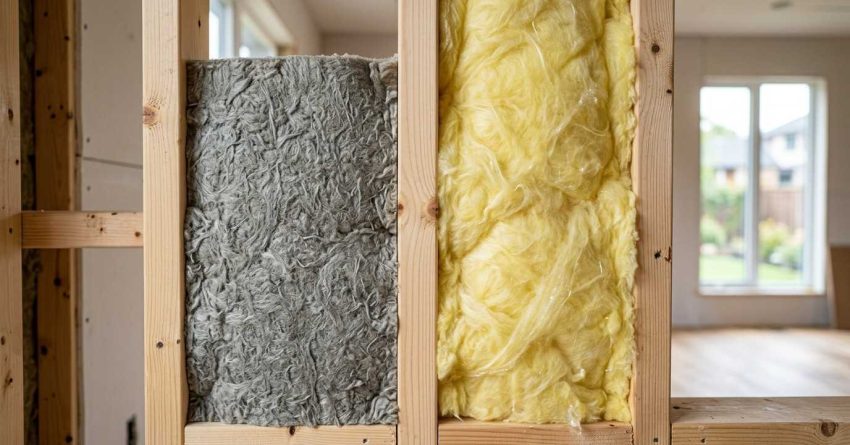
Rockwool insulation — also called mineral wool or stone wool — is made from natural volcanic rock and recycled steel slag that is melted and spun into dense, fibrous batts or boards. It is manufactured to resist fire, repel water, and absorb sound more effectively than many competing materials.
Rockwool has been used in commercial and industrial construction for decades and has grown significantly in residential applications across the USA over the past ten years. Its density gives it a firm, rigid structure that holds its shape without sagging over time, making it a reliable long-term insulation solution for walls, floors, and ceilings.
Understanding how insulation materials interact with your heating and cooling system is essential — our HVAC services guide explains how proper insulation directly affects energy efficiency, system load, and year-round comfort in your home.
How Rockwool Is Made
Basalt rock and recycled slag are melted together at temperatures exceeding 2,900 degrees Fahrenheit. The molten material is then spun at high speed into fine fibers, which are compressed into batts, boards, or loose-fill products. A binding agent holds the fibers together, and the finished product is cut to standard stud-bay dimensions for residential installation.
What Is Fiberglass Insulation?
Fiberglass insulation is made from extremely fine glass fibers produced by melting sand and recycled glass, then spinning or blowing the material into batts, rolls, or loose-fill form. It is the most widely installed insulation type in the United States and has been the residential standard for more than 70 years.
Fiberglass is lightweight, widely available at every home improvement retailer, and significantly less expensive per square foot than rockwool. It comes in pre-cut batts sized for standard 16-inch and 24-inch stud spacing, making it straightforward to handle for both professional installers and experienced DIYers.
How Fiberglass Is Made
Silica sand and recycled glass cullet are melted in a furnace and extruded through tiny holes to form continuous glass filaments. Those filaments are chopped, blown, or spun into a wool-like mass and bonded with a resin binder. The finished material is rolled or cut into batts and wrapped for retail or contractor distribution.
Rockwool vs Fiberglass: Side-by-Side Comparison
Both materials insulate through the same basic principle — trapping air within a fibrous matrix to slow heat transfer. Where they differ is in density, composition, and the secondary performance characteristics that matter most to homeowners making long-term decisions.
R-Value and Thermal Performance
R-value measures how effectively an insulation material resists heat flow. Higher R-values mean better thermal resistance per inch of thickness.
Rockwool batts typically deliver an R-value of R-3.0 to R-3.3 per inch. Fiberglass batts deliver R-2.9 to R-3.8 per inch depending on density and product grade, with high-density fiberglass batts reaching the upper end of that range. In practical terms, both materials perform comparably for standard wall cavities, though rockwool maintains its R-value more consistently over time because its rigid structure does not compress or settle the way fiberglass can.
Soundproofing Capability
Rockwool significantly outperforms fiberglass for sound absorption. Its higher density — typically 2.5 to 8 pounds per cubic foot compared to fiberglass at 0.5 to 1.0 pounds per cubic foot — allows it to absorb a broader range of sound frequencies. Rockwool is the preferred choice for interior walls between bedrooms, home offices, media rooms, and any space where noise control is a priority.
Fiberglass provides some acoustic benefit but is primarily a thermal product. Homeowners who need meaningful sound reduction between rooms should treat rockwool as the clear choice for those specific applications.
Fire Resistance
Rockwool is non-combustible and can withstand temperatures up to approximately 2,150 degrees Fahrenheit without melting or contributing to flame spread. This makes it a strong choice for fire-rated wall assemblies, around mechanical equipment, and in areas where building codes require non-combustible insulation.
Fiberglass is also non-combustible in its glass fiber form, but the resin binders and facing materials used in standard batts can melt or off-gas at high temperatures. Unfaced fiberglass performs better in fire scenarios than faced products, but neither type matches rockwool’s fire resistance rating in demanding applications.
Moisture and Mold Resistance
Rockwool fibers are hydrophobic — they naturally repel water rather than absorbing it. When exposed to moisture, rockwool drains and dries without losing structural integrity or R-value. It does not support mold growth because it provides no organic material for mold to feed on.
Fiberglass does not absorb water in its fiber form, but the paper or kraft facing used on standard batts can absorb moisture and become a surface for mold growth if the insulation is exposed to persistent humidity or condensation. Unfaced fiberglass performs better in damp environments, but rockwool remains the more moisture-tolerant option overall.
Cost Comparison
Fiberglass is consistently less expensive than rockwool. Standard fiberglass batts typically cost $0.30 to $0.60 per square foot, while rockwool batts range from $0.80 to $1.50 per square foot depending on thickness and density. For a full home insulation project, that cost difference can be significant.
Homeowners who need to insulate a large area on a tight budget will find fiberglass the more practical choice. Those prioritizing fire resistance, soundproofing, or moisture performance in specific areas may find rockwool’s higher upfront cost justified by its long-term performance advantages.
If you want a detailed breakdown of total project costs, our home insulation cost guide covers material pricing, labor rates, and what to expect for different home sizes and insulation zones.
Which Insulation Is Easier to Install?
Fiberglass batts are lighter, more flexible, and easier to cut with a utility knife, making them the more forgiving material for DIY installation. They compress to fit irregular spaces and are available in pre-cut lengths that fit standard stud bays without adjustment.
Rockwool is denser and heavier, which makes it slightly more effort to handle and cut. A serrated bread knife or insulation saw cuts it cleanly, and its rigidity means it holds its position in wall cavities without stapling or additional support. Many professional installers prefer rockwool for this reason — it stays exactly where it is placed.
For homeowners who prefer professional installation over DIY, our handyman installation help connects you with skilled technicians who handle insulation fitting, cutting, and placement correctly the first time.
Where Each Type Works Best in Your Home
The right insulation material often depends on the specific location in your home and what performance you need from that space.
Rockwool is the stronger choice for interior partition walls where soundproofing matters, around mechanical rooms and utility areas where fire resistance is a priority, in basement walls and crawl spaces where moisture exposure is likely, and in any application where building codes require non-combustible insulation.
Fiberglass is the practical choice for large-area thermal insulation in attics and exterior walls where budget is the primary concern, in new construction where standard stud spacing makes batt installation straightforward, and in climate-controlled spaces where moisture and fire exposure are minimal.
Many homeowners use both materials strategically — fiberglass for broad thermal coverage in attics and exterior walls, rockwool in specific interior walls and mechanical areas where its secondary performance characteristics justify the higher cost.
Choosing the right insulation is often part of a larger renovation decision — our home remodeling services cover how insulation upgrades fit into wall, attic, and basement remodeling projects to improve both comfort and property value.
Health and Safety Considerations
Both rockwool and fiberglass release airborne fibers during cutting and installation that can irritate the skin, eyes, and respiratory tract. Proper protective equipment — including gloves, safety glasses, and an N95 respirator — is essential during any insulation work.
Fiberglass fibers are thinner and lighter than rockwool fibers, which means they remain airborne longer after disturbance. Rockwool fibers are coarser and settle more quickly, though both materials require the same protective precautions during handling.
Once installed and covered by drywall or other finish materials, both types are considered safe for occupied spaces. Neither material contains asbestos, and both are manufactured under standards that limit hazardous chemical content in residential products.
Insulation materials that affect indoor air quality connect directly to broader home safety concerns — our home safety services help homeowners identify and address health risks across all areas of the property.
Which Insulation Should You Choose?
The right choice depends on what you are trying to accomplish and where the insulation is going.
Choose rockwool if soundproofing is a priority, if the installation area is exposed to moisture or humidity, if fire resistance is required by code or by your own safety standards, or if you are insulating a smaller area where the higher cost per square foot is manageable.
Choose fiberglass if you are insulating a large area and budget is the primary constraint, if the installation location is a standard attic or exterior wall with minimal moisture or fire exposure, or if you are completing a DIY project and want a lighter, more flexible material to work with.
For most homeowners, the answer is not one or the other — it is using each material where it performs best. A professional assessment of your home’s specific insulation needs will give you the clearest guidance on which material belongs where.
The insulation material you choose affects how hard your HVAC system works year-round — our insulation and HVAC guide walks through how to match insulation performance to your climate zone and system type for maximum efficiency.
Conclusion
Rockwool and fiberglass each bring distinct strengths to residential insulation — rockwool leads on fire resistance, soundproofing, and moisture tolerance, while fiberglass leads on cost and ease of installation.
The best insulation strategy for most homes combines both materials, placing each where its performance characteristics align with the specific demands of that space and application.
At Mr. Local Services, we connect homeowners with skilled insulation professionals who assess your home’s needs, recommend the right materials for each area, and complete the installation correctly — so your property stays comfortable, efficient, and well-protected year-round.
Frequently Asked Questions
Is rockwool worth the extra cost over fiberglass?
Rockwool is worth the higher cost in specific applications — particularly for soundproofing interior walls, insulating moisture-prone areas, and meeting fire-resistance requirements. For large-area thermal insulation in attics and exterior walls, fiberglass typically delivers comparable thermal performance at a significantly lower price.
Can you use rockwool and fiberglass together in the same home?
Yes. Many homeowners and contractors use both materials strategically — fiberglass for broad thermal coverage in attics and exterior walls, and rockwool in interior partition walls, mechanical rooms, and areas where moisture or fire resistance is a priority.
Which insulation has a higher R-value per inch?
Both materials perform similarly per inch. Rockwool delivers approximately R-3.0 to R-3.3 per inch, while fiberglass ranges from R-2.9 to R-3.8 per inch depending on product density. High-density fiberglass batts can match or slightly exceed rockwool’s per-inch R-value in some product lines.
Does rockwool actually block sound better than fiberglass?
Yes. Rockwool’s higher density — typically 2.5 to 8 pounds per cubic foot versus fiberglass at 0.5 to 1.0 pounds per cubic foot — allows it to absorb a wider range of sound frequencies. It is the preferred choice for interior walls where noise reduction between rooms is a goal.
Is fiberglass insulation safe once it is installed?
Yes. Once fiberglass insulation is installed and covered by drywall or other finish materials, it poses no health risk to occupants. The fiber irritation risk is limited to the cutting and installation phase, which requires gloves, eye protection, and respiratory protection.
How long does each type of insulation last?
Both rockwool and fiberglass are designed to last the lifetime of the building when properly installed and protected from physical damage. Rockwool maintains its shape and R-value more consistently over time because it does not compress or settle. Fiberglass can lose some R-value if it is compressed or exposed to persistent moisture.
Which insulation is better for a basement or crawl space?
Rockwool is the better choice for basements and crawl spaces because its hydrophobic fibers repel water and resist mold growth even in high-humidity environments. Fiberglass with kraft facing can absorb moisture at the facing material and become a surface for mold if humidity levels are consistently elevated.