
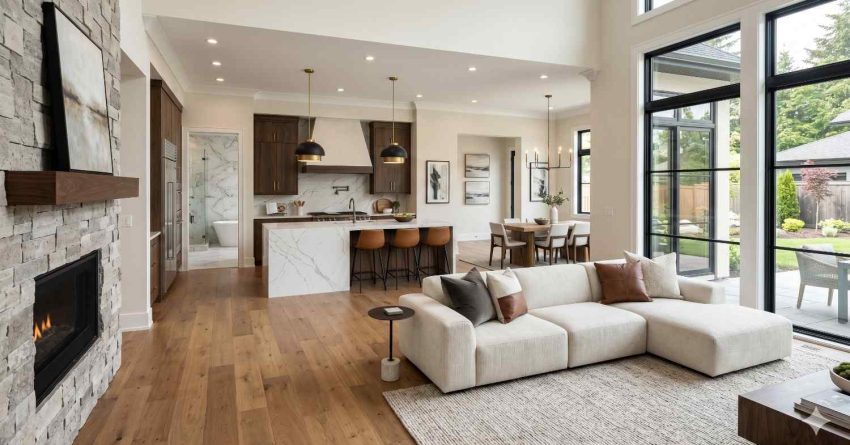
New construction interior design is the deliberate planning, selection, and installation of every interior surface, fixture, and finish material in a home being built from the ground up. Unlike renovation, new construction gives homeowners, landlords, and property managers a clean slate to align design intent with structure, mechanical systems, and finish selections from day one.
This decision-rich process directly determines property value, daily livability, and long-term maintenance costs for every owner, investor, and property manager involved.
This guide covers planning, structural impacts, walls, flooring, kitchens, bathrooms, lighting, cabinetry, windows, doors, HVAC integration, budgeting, contractor selection, and the costly mistakes worth avoiding.
What Is New Construction Interior Design and Finishes
New construction interior design is the comprehensive process of planning every interior element of a home before walls are framed and finishes are installed. Finishes refer to the visible, tactile materials applied to surfaces — drywall texture, paint, flooring, cabinetry, countertops, hardware, fixtures, and trim — that together define the look and feel of every room.
Unlike a remodel, new construction allows design decisions to influence the structure itself. Ceiling heights, window placement, electrical layouts, and HVAC routing can all be optimized for design intent rather than worked around. This unlocks significantly more creative range but also demands earlier, more coordinated decisions.
Design vs. Finishes — Understanding the Difference
Design is the strategic plan: spatial layout, sight lines, lighting concept, material palette, and how rooms connect functionally. Finishes are the tangible outcomes: the oak hardwood you walk on, the quartz counter you prep dinner on, the matte black faucet at every sink. Strong projects treat them as one integrated decision, not two separate budgets.
Interior design and finish selection together define how a finished home looks, feels, and functions — our interior design fundamentals guide breaks down every core principle, from spatial planning to material coordination, that homeowners need before building from scratch.
The Planning Phase: Design Decisions Before Construction Starts
The single biggest predictor of a successful new construction project is how early design decisions are locked in. Finishes selected during framing cost dramatically less to install correctly than finishes added after walls are closed. Industry data consistently shows that 70% to 90% of total project cost is committed during the first design phases, even though only a fraction of the money has been spent.
Planning begins with a complete inventory of every interior decision: room functions, traffic flow, storage needs, lighting goals, finish preferences, and lifestyle requirements. Specification sheets document every model number, color code, and finish detail before purchase orders are placed. This prevents the most common cost overrun in new construction: change orders mid-build.
Design Documents and Specification Sheets
A complete finish schedule lists every material in every room: flooring type and direction, wall paint with sheen, ceiling treatment, trim profile, baseboard height, door style, hardware finish, and fixture model. When this document is finalized before construction begins, contractors price accurately and substitutions become rare.
Decisions made during the planning phase shape every finish that follows, which is why our pre-construction design planning resource walks through every checklist, document, and timeline you need to lock in design intent before contractors break ground.
Structural and Architectural Foundations That Shape Interior Choices
Interior design freedom is bounded by structure. Load-bearing walls, beam locations, window sizing, ceiling height, and HVAC chase routing all influence what finishes are physically possible and visually effective. A nine-foot ceiling supports tall cabinetry and dramatic trim that an eight-foot ceiling cannot. A wide-open floor plan requires consistent flooring across rooms to feel cohesive.
Roof pitch, soffit depth, and exterior wall thickness all shape interior window casings, sill depths, and trim opportunities. Even staircase placement determines wall lengths available for art, built-ins, or furniture. Smart projects engage interior design thinking during the architectural phase, not after.
The bones of your home dictate what finishes are possible, and our architectural design services page explains how floor plans, ceiling heights, and load-bearing layouts directly influence interior design opportunities and finish placement.
Wall Finishes, Drywall, and Paint Selection
Walls account for the largest visible surface area in any home, which makes drywall finish quality and paint selection the highest-impact aesthetic decisions of any new build. Drywall finish levels range from Level 0 (unfinished, used in mechanical rooms) to Level 5 (skim-coated smooth, used for raking light walls and dark paints). Most homes use Level 4 in living areas, but Level 5 is recommended anywhere strong side lighting will reveal imperfections.
Selecting the right paint system requires balancing finish sheen, primer compatibility, and color theory for new drywall, which is exactly what our professional painting services team manages from primer selection through final coats.
Color Strategy for New Construction
Whole-home color palettes work best when limited to three to five wall colors total: a main neutral, a secondary tone for accent rooms, a trim white, a ceiling treatment, and an accent color for one or two feature walls. Sheen levels matter equally: flat for ceilings, eggshell or matte for living spaces, satin for kitchens and baths, semi-gloss for trim and doors.
Smooth, properly finished walls are the canvas every paint color, wallpaper, and accent treatment depends on, and our drywall and ceiling finishing services walk through every texture level, smoothing technique, and ceiling treatment option for new construction projects.
Flooring Choices and Installation for New Builds
Flooring is the single largest finish decision in most homes, both by square footage and by cost impact. Hardwood remains the highest-resale choice for living areas, with engineered hardwood offering similar appearance at lower cost and better moisture stability. Luxury vinyl plank has captured significant market share due to waterproof construction and realistic wood-look visuals. Tile dominates in wet areas, while carpet remains common in bedrooms.
New construction allows flooring to be installed before cabinetry in many layouts, which simplifies future replacement. Subfloor preparation, moisture barriers, and acoustic underlayments are easier and cheaper to install correctly during new construction than to retrofit later.
Flooring sets the foundation for every room’s design language, and our new construction flooring installation team covers hardwood, luxury vinyl, tile, and carpet selection plus full subfloor preparation and installation for new builds.
Kitchen Interior Design and Premium Finishes
The kitchen carries the highest finish density of any room in a home: cabinetry, countertops, backsplash, flooring, appliances, lighting, plumbing fixtures, and hardware all converge in a relatively small footprint. Every decision interacts with every other decision. A dark cabinet color demands brighter task lighting. A busy quartzite counter calls for a quieter backsplash. A pro-style range may require dedicated electrical and gas runs that must be roughed in before drywall.
Cabinetry, Countertops, and Backsplash Decisions
Kitchen cabinetry selection drives three downstream decisions: countertop overhang, backsplash height, and hardware proportions. Inset cabinets sit flush with the face frame and cost 15% to 30% more than overlay cabinets but deliver a high-end, custom appearance. Quartz countertops continue to dominate new construction selections due to durability and consistency, while natural stone like quartzite and marble remain premium options for showcase kitchens.
The kitchen carries more design weight than any other room, and our kitchen design and remodeling team breaks down cabinetry styles, countertop materials, backsplash patterns, and appliance integration so every finish choice supports the workflow you want.
Bathroom Interior Design and Finish Selection
Bathrooms combine the highest waterproofing demands with the most concentrated finish decisions per square foot. Tile selection alone often involves three different products in a single room: floor tile, shower tile, and accent or niche tile. Each must coordinate visually while serving different durability needs. Vanity selection determines counter depth, sink type, and faucet height. Shower glass type, hardware finish, and drain style all need to align with the overall hardware palette.
New construction is the right time to install higher-end mechanical features that are impossible to retrofit cleanly: heated floors, body sprays, steam showers, and properly vented exhaust fans tied into roof or sidewall terminations.
Bathrooms combine waterproofing demands with high-impact design moments, and our bathroom design and finishes guide covers tile selection, vanity configurations, shower systems, and fixture coordination for new construction bathrooms.
Lighting Design, Electrical Layout, and Smart Home Integration
Lighting design is one of the most under-prioritized decisions in new construction, yet it transforms how every finish reads. A perfectly selected paint color looks completely different under warm 2700K lighting versus cool 4000K lighting. A beautiful countertop falls flat without task lighting positioned correctly. Lighting plans should account for three layers in every room: ambient, task, and accent lighting, each controlled separately.
Modern construction increasingly integrates connected systems from day one, and our smart home installation services cover wiring infrastructure, hub placement, and device integration so technology disappears into the design.
Electrical rough-in is the stage where outlet placement, switch locations, dimmer compatibility, and low-voltage runs for shades, speakers, and security systems get locked in. Adding circuits after drywall is expensive. Adding them during framing is nearly free.
A finished space is only as good as the electrical layout supporting it, and our residential electrical installation team handles outlet planning, fixture rough-ins, and circuit design that lighting designers depend on.
Cabinetry, Millwork, and Custom Carpentry Finishes
Trim, built-ins, and architectural millwork separate basic builds from designer-quality homes. Crown molding, chair rails, wainscoting, coffered ceilings, and custom built-in shelving are all opportunities to layer architectural interest into otherwise plain rooms. Door casing width, baseboard height, and window casing profile should be coordinated as a system, not chosen room by room.
Built-in storage solves real functional problems in mudrooms, primary closets, home offices, and entertainment walls. The cost premium over freestanding furniture is often modest when planned during construction, and the resale impact is significant.
Built-ins, trim, and millwork separate a basic build from a designer-finish home, and our custom carpentry and millwork services cover crown molding, wainscoting, custom cabinetry, and architectural detailing for new construction.
Window and Door Selection for New Construction
Windows control natural light, ventilation, and exterior views while also shaping interior architecture. Window style (casement, double-hung, awning, picture), grille pattern, frame color, and trim profile all influence both exterior curb appeal and interior design impact. Energy ratings (U-factor, SHGC, and visible transmittance) determine both comfort and long-term utility costs.
Door selection is a finish decision as much as a hardware decision, which is why our interior and exterior door installation team coordinates styles, hardware finishes, and casing details across every opening in the home.
Interior door selection often gets minimized, but doors are touched and seen constantly. Solid-core doors feel substantially more premium than hollow-core doors and reduce sound transmission between rooms.
Windows shape both natural light and interior architecture, and our window installation services team walks through framing requirements, style selection, and energy ratings for new construction window packages.
HVAC Integration with Interior Design
HVAC system layout has more impact on interior design than most homeowners realize. Duct chases consume wall thickness. Soffits drop ceilings in specific locations. Return air vents need wall or ceiling space. Supply registers must be positioned to deliver comfort without disrupting furniture placement or feature walls.
Coordinating HVAC design with interior layouts during the planning phase prevents the most common new-construction frustrations: ductwork that drops a kitchen ceiling unexpectedly, a return vent that lands behind a planned built-in, or supply registers blowing directly onto seating areas.
Comfort systems shape ceiling lines, soffit locations, and register placement throughout the home, and our HVAC system installation team coordinates ductwork design with interior layouts so mechanicals never compromise finish quality.
Budgeting, Timelines, and Choosing the Right Contractors
New construction interior finish budgets typically run 15% to 30% of total project cost, with kitchen and bathroom finishes consuming the largest share. Establishing a per-room finish budget early prevents the common mistake of spending the full budget on the first few rooms and value-engineering the rest. Reserve 10% to 15% as a contingency for change orders, material upgrades, and unforeseen conditions.
Timeline matters as much as budget. Custom cabinetry lead times now run 12 to 20 weeks. Imported tile can take 6 to 12 weeks. Specialty fixtures occasionally exceed 16 weeks. Long-lead items must be ordered during framing, not finish, to avoid project delays.
The contractor you hire determines whether your design intent survives construction, and our choosing a general contractor guide covers vetting questions, contract red flags, and project management standards that separate trustworthy builders from costly mistakes.
Common Mistakes to Avoid in New Construction Interior Design
The most expensive new-construction mistakes are nearly always preventable. Selecting finishes one room at a time without a whole-home palette leads to disjointed results. Underestimating storage needs leads to expensive retrofits within the first year. Skipping the punch list walkthrough leaves dozens of minor defects unaddressed. Ordering long-lead items late delays move-in by weeks.
Other frequent mistakes include inadequate lighting plans, insufficient outlets in workspace zones, undersized electrical service for future EV charging or solar, and HVAC systems sized for the wrong square footage. Each compounds the longer it goes unaddressed.
Most post-construction punch list items are minor finish corrections that compound if left untreated, and our professional handyman services team handles touch-ups, adjustments, and trim corrections that keep new-build finishes looking flawless.
Conclusion
New construction interior design integrates planning, structure, walls, flooring, kitchens, bathrooms, lighting, cabinetry, windows, HVAC, and contractor coordination into one cohesive process that defines property value and livability.
Mastering these decisions early protects budgets, prevents costly change orders, and ensures every finish selection contributes to a home that performs beautifully for decades.
We connect homeowners and builders with vetted experts across every trade, and Mr. Local Services makes new construction interior finish coordination simple, transparent, and reliable.
Frequently Asked Questions
What is included in new construction interior design and finishes?
New construction interior design covers every interior decision: floor plans, lighting, paint, flooring, cabinetry, countertops, fixtures, hardware, trim, doors, and finish materials selected before and during construction.
When should I start planning interior finishes for a new build?
Begin finish planning before framing starts. Many decisions, including electrical layouts, HVAC chases, and structural details, depend on finish selections being locked in early.
How much does new construction interior design and finishes typically cost?
Interior finishes typically represent 15% to 30% of total construction cost. High-end finishes, custom millwork, and premium fixtures can push that share significantly higher.
What is the difference between design and finishes?
Design is the spatial and aesthetic plan covering layout, lighting, and material palette. Finishes are the physical materials installed, such as flooring, paint, countertops, and fixtures.
Can I change finishes after construction starts?
Yes, but every mid-build change typically triggers change order fees and timeline delays. Lock in selections during planning to avoid expensive substitutions.
Do I need an interior designer for new construction?
A designer is not required, but most homeowners benefit from professional guidance. Designers coordinate decisions, prevent costly mistakes, and ensure cohesive results across rooms.
How long does the interior finishing phase take?
Interior finishing typically runs 8 to 16 weeks depending on home size, finish complexity, and material lead times. Custom finishes and imported materials extend this timeline.


