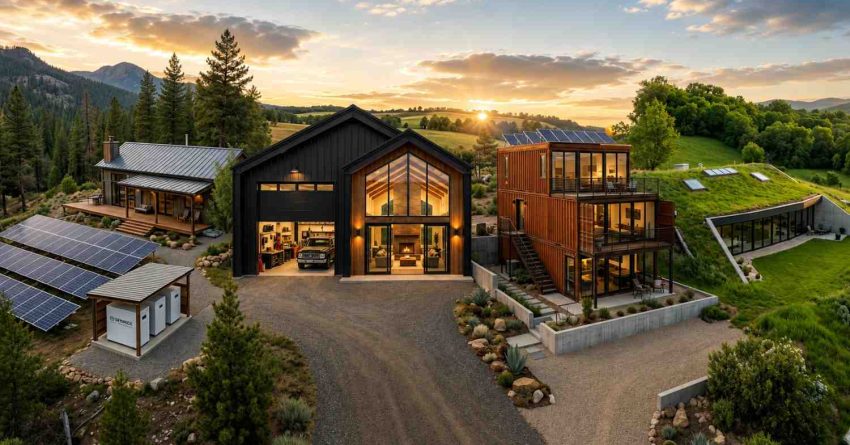
Specialty builds are non-conventional residential construction methods that fall outside standard stick-frame building, offering unique combinations of cost, sustainability, aesthetics, and self-sufficiency that no conventional home can replicate.
The surge in specialty build interest across the US reflects a fundamental shift in what homeowners want. Rising conventional construction costs, deteriorating grid reliability in some regions, the appeal of energy independence, and a growing desire for homes that express a genuinely distinct way of living are all pushing buyers toward off-grid properties, barndominiums, shipping container residences, and earth-sheltered homes at a pace that shows no signs of slowing.
This guide covers every major specialty build type in the US — off-grid homes, barndominiums, shipping container homes, earth-sheltered homes, dome homes, log homes, A-frames, yurts, floating homes, and hybrid combinations — explaining what each type is, what it costs, how financing works, what permits and codes apply, which climates suit each approach, how inspections differ, how to evaluate investment potential, and how to find a qualified builder for each category.
What Are Specialty Builds? Definition, Types, and Who They’re For
A specialty build is any residential construction method that departs significantly from conventional platform framing with wood-stud walls, a standard foundation, and municipal utility connections. The term covers a broad and growing spectrum — from barndominiums that use agricultural steel building systems as residential envelopes to earthships that integrate passive solar design, rammed earth tires, and constructed wetlands into a completely self-sufficient living system.
The Spectrum of Non-Conventional Residential Construction
Specialty builds range from moderately unconventional to deeply alternative, and the practical implications differ at each level:
Moderately unconventional — Barndominiums, shipping container homes, and A-frames are widely recognized and increasingly financed by specialty lenders. They still require additional due diligence and often encounter code challenges, but they have established build communities, well-documented construction methods, and a growing precedent base in permit offices across the country.
Significantly alternative — Off-grid homes, earth-sheltered homes, log homes, and timber frame homes involve specialized engineering, unique code pathways, and often require portfolio lenders or owner-builder financing structures. Builders with genuine experience are less common, and mistakes in design or execution are harder to remedy.
Deeply alternative — Earthships, cob homes, rammed earth homes, and geodesic dome homes typically require custom engineering analysis, local variance processes, and owner-builder-level engagement to successfully permit and build. These approaches attract deeply committed buyers for whom the build method is inseparable from their lifestyle or values.
Why Specialty Builds Are Growing in the US
According to the National Association of Home Builders, conventional construction costs rose more than 40% between 2019 and 2024, pushing buyers toward build types that deliver either lower shell costs or dramatically reduced long-term operating expenses. The barndominium market in particular exploded in Texas, Oklahoma, Tennessee, and Georgia, where agricultural-zoned land, available metal building contractors, and relatively permissive rural building codes create a favorable environment.
Off-grid and earth-sheltered builds are being driven by both sustainability priorities and energy cost concerns. A 2024 Pew Research Center survey found that 79% of Americans support expanding solar panel use, reflecting the broader cultural shift toward energy independence that is fueling off-grid construction interest. Container homes have benefited from social media exposure and an active design community that has produced compelling architect-designed examples far removed from their “industrial box” origins.
Five Questions to Answer Before Choosing a Specialty Build
Before committing to any specialty build type, a buyer must honestly answer:
- Is this build legal on your land? Zoning, agricultural codes, and HOA restrictions vary enormously by jurisdiction.
- Can you finance it? Specialty builds face greater lender scrutiny and frequently require portfolio lenders rather than conventional conforming loans.
- Does your climate support it? Earth-sheltered and off-grid solar builds perform optimally in specific climate zones; others require adaptation.
- Can you find a qualified builder? Experience with the specific build type is essential — more so than for conventional construction.
- What does resale look like? Some specialty builds have limited buyer pools that directly affect holding period risk and exit strategy.
Off-Grid Homes: Building for Complete Energy Independence
An off-grid home is a residential structure that operates entirely without connection to municipal utilities — generating its own electricity, managing its own water supply, and processing its own waste entirely on-site. It is one of the fastest-growing specialty build categories in the US, driven by energy security concerns, sustainability values, and the practical appeal of owning land beyond the reach of existing grid infrastructure.
What Is an Off-Grid Home?
Off-grid does not mean primitive. A well-designed off-grid home can deliver every comfort of a conventionally connected house — high-speed satellite internet, whole-home climate control, modern appliances, hot showers on demand — while generating and managing all energy and water entirely independently.
The key systems defining an off-grid home are:
- Power: Solar photovoltaic panels with battery storage, supplemented by wind or propane generator backup
- Water: Drilled well, rainwater harvesting, or cistern-based water supply
- Waste: Composting toilets, traditional septic system, constructed wetlands, or permitted greywater recycling
- Heating and cooling: Propane, wood or pellet stoves, radiant hydronic heat, or ductless mini-split heat pumps
The important distinction between “off-grid” and “net-zero” is this: a net-zero home may still be connected to the electrical grid while producing as much energy as it consumes over a year. A true off-grid home has no grid connection at all — it must produce, store, and manage 100% of its own energy on-site.
Off-Grid Power Systems: Solar, Battery, and Backup
Power system design is typically the most capital-intensive off-grid investment. A solar-plus-battery system sized to power a 1,500–2,000 square foot home year-round in a region with moderate solar resources typically costs $30,000–$75,000 installed, depending on array size, battery bank capacity, inverter selection, and installation complexity.
Proper sizing depends on your daily energy load (measured in kilowatt-hours) and your site’s solar resource (measured in peak sun hours per day). An undersized system fails during winter or extended cloudy periods — a serious problem in an off-grid home with no grid fallback. Designing your off-grid power system requires calculating your full energy load before specifying a single panel or battery — our resource on solar sizing for off-grid homes walks through kilowatt-hour demand calculations, battery capacity requirements, and backup generator sizing in practical, site-specific terms.
Backup propane generators add $3,000–$8,000 to the system cost but provide essential insurance against prolonged cloudy periods or system failures in winter.
Off-Grid Water Supply: Wells, Rainwater, and Cisterns
Independent water supply is one of the most site-specific challenges in off-grid building, covering everything from rainwater harvesting to well drilling to cistern systems — our off-grid water supply options guide explains each approach, their costs, code status, and when each solution makes sense for different site conditions and climates.
Drilled wells are the most reliable option when groundwater is accessible, typically costing $15–$30 per linear foot plus pump, pressure tank, and electrical equipment — total costs range from $7,000 to over $30,000 depending on depth and geology.
Rainwater harvesting is legal in most but not all US states, and works well in regions with adequate annual precipitation (generally 25+ inches annually). Texas, for example, actively encourages rainwater collection with tax exemptions on collection equipment.
Cisterns — large tanks filled by rain, trucked water, or well — provide storage insurance in regions where neither well water nor reliable rainfall is consistently available.
Off-Grid Waste Management: Septic, Composting, and Greywater
Waste management is often the most legally complex component of an off-grid build, with composting toilets, incinerating toilets, and constructed wetlands each facing different regulatory approval paths by jurisdiction — our off-grid waste management systems guide explains every option, their code approval status by jurisdiction type, and key installation considerations that affect long-term function.
Many jurisdictions require a traditional septic system regardless of owner preference — meaning a composting toilet cannot serve as the sole waste management solution for a permitted, occupied home. Others permit alternative systems with proper health department approval. Early engagement with your local health department before land purchase is essential to determine what is actually approved for your specific site.
Best Land and Locations for Off-Grid Builds
Off-grid builds perform best on land offering adequate solar resource (generally 4.5+ peak sun hours per day), reliable groundwater or precipitation, no HOA restrictions on alternative systems, and rural or agricultural zoning permitting residential use.
The American Southwest — Arizona, New Mexico, Nevada, and parts of Colorado — provides exceptional solar resources. The Texas Hill Country has become a significant off-grid barndominium market. The Pacific Northwest offers abundant water resources despite lower solar availability.
Off-Grid Cost, Legality, and Process Overview
Off-grid builds carry highly variable costs depending on system complexity and site conditions, with solar, battery, water, and waste systems collectively adding $40,000 to $150,000 or more above a standard build budget — our off-grid build cost breakdown explains every cost category with realistic ranges for each system type and region.
The legality of off-grid living is not uniform across the US. The legality of full-time off-grid living varies dramatically by state, county, and municipality, with some jurisdictions prohibiting septic alternatives or requiring mandatory grid connection as a condition of occupancy — our off-grid living laws by state resource provides a state-by-state breakdown of what is permitted, restricted, and prohibited for off-grid residential use.
One practical note: some jurisdictions permit off-grid systems as alternative energy sources while still requiring the physical capability of grid connection. Others permit full disconnection. Knowing this before purchasing land is not optional — it is foundational.
Additionally, buyers planning to combine off-grid systems with a container home structure face a specific set of power and water placement constraints — our resource on off-grid container home systems covers solar integration, battery placement within container constraints, and code considerations unique to this hybrid approach.
Off-grid living encompasses far more than solar panels and a rainwater barrel — our complete off-grid home build guide covers every system, cost category, land selection criterion, and legal consideration you need to plan a fully self-sufficient residential property from the ground up in the US.
Barndominiums: The Steel-Frame Home Revolution
A barndominium — universally shortened to “barndo” — is a residential structure built using a steel or wood post-frame agricultural building as its primary structural shell, finished on the interior to full residential standards. The category exploded in popularity starting around 2015 and now represents one of the fastest-growing segments of residential construction in rural and semi-rural markets across the southern and central US.
What Is a Barndominium?
A barndominium takes advantage of the cost efficiency and long-span structural flexibility of agricultural metal buildings — which can cover large, open floor plans without interior load-bearing walls — and applies residential finishes to create a home that is simultaneously spacious, durable, and significantly less expensive per square foot than conventional framing for the shell alone.
The core appeal: a basic barndo shell can be erected for $20–$40 per square foot, compared to $85–$180+ per square foot for conventionally framed residential walls and roof, before interior finishing. This creates real potential for a 2,500–3,500 square foot home at a total construction budget well below equivalent conventional new construction.
Barndominiums are particularly prevalent in Texas, Oklahoma, Tennessee, Georgia, and Alabama — states with established rural land markets, abundant metal building contractors, and agricultural building code pathways that make the permitting process more accessible in rural counties.
Pole Barn vs. Steel Frame Barndominium Construction
Two primary structural systems define the barndominium market:
Pole barn (post-frame) construction embeds large pressure-treated wood or steel columns in the ground or on concrete piers at regular intervals, with horizontal girts and purlins connecting them to form the wall and roof structure. This is the traditional agricultural building method — fast to erect, economical, and supported by contractors in virtually every rural market.
Steel frame (rigid frame) construction uses pre-engineered red iron steel frames fabricated off-site and erected by crane. Steel frame barndominiums are 20–40% more expensive than pole barn but offer better longevity, cleaner engineering certification, and an easier path through residential permitting in jurisdictions that scrutinize structural systems.
The choice between them involves a cost-benefit tradeoff: pole barn builds are faster and cheaper to erect; steel frame builds carry stronger appraisable value and easier permitting in some markets.
Barndo Floor Plans, Insulation, and Finish Options
The open-span capability of barndominium construction is its defining design advantage. Without interior load-bearing walls, a barndo can accommodate enormous open great rooms, oversized integrated garage bays, high ceilings with exposed steel structure, and mezzanine lofts — all challenging or expensive to achieve in conventional framing.
Insulation is the most technically critical decision in barndominium construction. Closed-cell spray foam applied directly to the underside of the metal roof deck and interior face of the metal walls is the gold standard — it controls moisture condensation, eliminates thermal bridging at the metal structure, and provides both R-value and an air barrier simultaneously. An alternative approach builds a stud-frame interior wall inside the metal shell, insulated with conventional methods — this adds cost and reduces usable floor area but allows the use of more affordable insulation materials.
Getting a conventional mortgage on a barndominium is harder than most buyers expect, because many lenders can’t accurately appraise a structure that doesn’t fit standard residential comparables — our resource on barndominium financing options explains precisely why appraisers struggle, which specialty lenders actively finance barndos, and how to structure your application to maximize approval odds.
Barndominiums sit in a regulatory gray zone in many counties — built on agricultural land using agricultural building codes, but intended as permanent residences that require residential occupancy classification — our barndominium permitting process resource explains how to navigate the agricultural vs. residential zoning tension and what to do when your building department has never permitted a barndo before.
Also note: the insulation system for your barndo is one of the highest-impact decisions in the entire build — our spoke resource on barndominium insulation strategies covers every approach from spray foam to rigid insulation with installation details and R-value comparisons specific to metal building envelopes.
Before you finalize your floor plan, understanding the principles behind barn-form residential layout is essential — our barndominium floor plans best practices resource covers open-span layout optimization, bedroom wing separation, garage bay integration, and mezzanine loft design for the barndo format.
From shell construction selection to final interior finish-out, the barndominium category has more variation in cost, quality, and approach than most buyers realize — our barndominium complete guide walks through every decision from pole barn vs. steel frame to floor plan best practices to what a fully finished barndo actually costs in 2025 across different US regions.
Shipping Container Homes: Repurposed Steel as Living Space
A shipping container home is a residential structure built primarily from ISO-standard intermodal shipping containers — the same corrugated steel boxes used to transport goods globally by ship, rail, and truck. Container homes range from single-container minimal cabins to multi-container, architect-designed primary residences exceeding 2,000 square feet.
What Is a Shipping Container Home?
Standard shipping containers come in two primary sizes: 20-foot TEU containers measuring 8 feet wide by 8 feet 6 inches tall by 20 feet long, and 40-foot containers measuring 8 feet wide by 8 feet 6 inches tall by 40 feet long. High-cube containers add an extra foot of height at 9 feet 6 inches — a meaningful improvement for residential use.
A single 40-foot container provides approximately 320 square feet of floor area. Most residential container projects use multiple containers arranged in stacked, side-by-side, or offset configurations to achieve the desired square footage and spatial variety. Used container purchase prices range from $2,000–$8,000 depending on condition, size, and regional availability — though “one trip” containers (used only once) command premiums for their structural integrity and freedom from chemical residues.
Single vs. Multi-Container Configurations
Single container projects are the simplest and most affordable entry point — typically used as vacation cabins, guest houses, backyard studios, or accessory dwelling units. A finished single 40-foot container in good condition can provide a functional studio or one-bedroom space at significantly lower cost than conventional construction of equivalent size.
Multi-container configurations unlock the design flexibility that distinguishes compelling container homes from simple conversions:
- Side-by-side: Two or more containers placed adjacently with shared walls opened to create wider spaces — the most common residential configuration
- Stacked: Containers placed vertically to create two-story or multi-story structures — requires engineering analysis for connection design and load transfer
- Offset: Deliberate horizontal or vertical offsets creating cantilevers, covered outdoor spaces, and architectural interest — requires structural engineering for all cantilevered sections
Every wall opening, container-to-container connection, and stacking interface requires stamped structural engineering drawings. In virtually all US jurisdictions, this is a non-negotiable permit requirement.
Container Insulation, Foundation, and Cut-Opening Challenges
Steel corrugated walls create severe thermal bridging and active condensation risk in humid or cold climates unless the insulation strategy is specifically engineered for the container envelope — our resource on insulating a shipping container home covers closed-cell spray foam, exterior rigid foam assemblies, and interior stud-wall approaches by climate zone, including the cost and R-value tradeoffs of each.
The critical principle: closed-cell spray foam applied to the interior of the container walls simultaneously provides R-value, air sealing, and vapor control — making it the most effective single-step solution. However, it reduces the already-constrained 8-foot interior width. Exterior insulation with cladding preserves interior width but requires a full rainscreen assembly and adds project complexity.
Container homes require foundations designed around corner casting point loads rather than distributed wall loads, which means standard perimeter stem wall foundations often need modification — our resource on shipping container foundation types walks through concrete pier, steel beam, and slab-on-grade options with structural reasoning, cost ranges, and code considerations for each approach.
Most IRC-based building jurisdictions have no specific code category for repurposed steel shipping containers used as residential structures, which means permit approval relies heavily on engineer certification and inspector discretion — our container home permitting process resource details the most effective approval path, required documentation, and which states and counties have established the most permissive precedents.
Container home cost is a primary research question for every buyer considering this build type — our dedicated resource on shipping container home costs covers purchase price, modification costs, foundation, insulation, interior finish, and shipping costs by region, with completed project cost ranges for single and multi-container builds.
Shipping container homes involve a unique set of structural, insulation, permitting, and resale considerations that differ substantially from all other specialty build types — our shipping container home guide covers every step from sourcing and inspecting containers to completing the build, navigating inspections, and addressing the appraisal challenges that affect long-term ownership.
Earth-Sheltered Homes: Building Into the Earth
Earth-sheltered construction places living spaces partially or fully below grade, using the earth’s thermal mass to moderate interior temperatures throughout the year. It is one of the most energy-efficient residential strategies available anywhere in the world, with heating and cooling loads dramatically reduced by the thermally stable environment of the surrounding earth.
What Is an Earth-Sheltered Home?
Earth-sheltered homes fall into three primary configurations:
Berm homes are built at or partially below grade with earth bermed against the walls on three sides, retaining above-grade views and natural light on the south (or optimal solar) elevation. They achieve the greatest mainstream acceptance because they look and function most like conventional homes while capturing significant thermal mass benefits.
Underground homes are fully subterranean, typically accessed through a covered entry, atrium, or courtyard. These achieve the maximum thermal stability possible in residential construction but require careful design for natural lighting, cross-ventilation, drainage, and psychological comfort.
Earth-integrated hillside designs combine partial earth contact with deliberate passive solar orientation, maximizing both thermal mass benefit and daylight access. This is the most livable and most commonly constructed earth-sheltered approach.
According to the US Department of Energy’s Office of Energy Efficiency and Renewable Energy, underground earth temperatures across most of the continental US remain relatively stable at 50–60°F year-round, dramatically reducing both heating and cooling demand compared to above-grade construction exposed to temperature extremes.
Earthships, Berm Homes, and Underground Homes Explained
Earthships are a specific earth-sheltered design system developed by architect Michael Reynolds, using automobile tires packed with rammed earth as the primary structural and thermal mass wall element. Earthship designs integrate passive solar heating through south-facing glass, cooling through an earth tube system, rooftop rainwater collection, constructed wetlands for greywater treatment, and greenhouse food production into a completely self-sufficient living system.
The Earthship construction guide explains the thermal mass wall system, the Phoenix model layout evolution, and the highly variable permitting reality builders face — Taos County, New Mexico has permitted Earthships for decades and has established clear processes, while most other US jurisdictions require substantial variance efforts and engineer certification to approve tire wall construction.
Berm homes offer the most accessible entry point into earth-sheltered construction. A typical berm home uses poured concrete or concrete masonry unit walls on the bermed sides, with conventional wood or steel framing on the front (south-facing) elevation. The structural and waterproofing challenges are significant but well-understood, and experienced contractors in regions with natural hillside sites are more readily available.
Earthen Wall Construction: Cob, Adobe, and Rammed Earth
Beyond earth-sheltered siting, several earthen wall systems use natural materials as their primary structural element:
Cob mixes clay, sand, and straw into a monolithic sculpted wall system. It offers extraordinary thermal mass and sculptural freedom, but builds slowly, is highly labor-intensive, and is most appropriate for very dry climates. Code approval for cob construction typically requires engineer-certified compressive strength testing and is most established in southwestern states.
Adobe uses sun-dried clay-and-straw bricks stacked into load-bearing walls — a construction tradition used in the American Southwest for centuries. New Mexico and Arizona have formal adobe construction provisions in their state building codes.
Rammed earth compresses moistened subsoil into permanent, dense walls using reusable formwork — similar to concrete forming but without the cement. The result is a beautiful, stratified wall of extraordinary compressive strength, thermal mass, and durability. Rammed earth walls are most practically built in dry climates but have been successfully constructed in humid climates with proper engineering.
Earthen wall systems including cob, adobe, and rammed earth each carry distinct structural properties, thermal mass profiles, and moisture behaviors — our resource on cob, adobe, and rammed earth construction explains compressive strength requirements, moisture management best practices, and the code approval pathways available for each method in US jurisdictions.
Thermal Performance and Moisture Management
Earth-sheltered construction’s defining challenge is moisture. Persistent hydrostatic pressure from surrounding earth creates conditions for water infiltration at any discontinuity in the waterproofing system, and failures are difficult and expensive to remediate once the structure is backfilled.
Effective moisture management requires a continuous waterproofing membrane on all below-grade surfaces, drainage board to relieve hydrostatic pressure, perimeter drain pipe directing groundwater away from the structure, properly graded positive-drainage topography, and interior ventilation design managing relative humidity.
Earth-sheltered construction is one of the most energy-efficient residential strategies available, but it demands specific site evaluation, drainage engineering, and waterproofing systems that most conventional builders are not equipped to provide — our earth-sheltered home design guide covers berm homes, underground homes, and integrated hillside designs with full engineering, moisture management, and natural lighting context.
Other Specialty Build Types Worth Knowing
Beyond the four primary categories, several other approaches attract dedicated followers for specific aesthetic, lifestyle, performance, or value reasons.
Geodesic Dome Homes
A geodesic dome home uses the triangulated geometry that Buckminster Fuller refined in the mid-20th century to create a spherical structure of extraordinary structural efficiency. Geodesic domes enclose more volume with less surface area than any other form — directly reducing heat loss, material consumption, and structural loads under wind and snow.
Modern residential domes use aluminum or wood hub-and-strut systems covered with insulated triangular panels or sprayed foam and conventional exterior cladding. The primary challenges are the curved interior geometry (challenging for furniture placement and space division), roof detailing at panel joints (potential leak points requiring ongoing maintenance), and the limited pool of dome-experienced builders.
Our geodesic dome home guide introduces the geometry, panel and hub connection systems, interior layout strategies, and permitting challenges of residential dome construction.
Log Homes and Timber Frame Homes
Log homes use full-diameter logs as the primary wall material, stacked horizontally with notched corners. They produce thermally massive, visually distinctive homes with inherent character — but the challenges are real. Settling (logs compress and dry over the first 2–5 years, requiring adjustable supports around windows, doors, and interior partitions), energy performance (full log walls deliver R-values well below modern code minimums in most climate zones without supplemental insulation strategies), and maintenance (exterior chinking and stain systems require periodic renewal) are all factors to understand before committing.
Our log home build process and costs guide covers hand-hewn vs. milled log systems, foundation design for settling accommodation, and long-term maintenance expectations.
Timber frame homes use large-dimension structural lumber in a post-and-beam system, with the enclosure provided separately by structural insulated panels or conventional framing. This separation of structure from envelope allows exposed timber on the interior — a dramatic aesthetic — while achieving high R-value exterior walls that log homes cannot match without compromise. Our timber frame home construction guide explains joinery systems, raising day logistics, and SIP enclosure options.
A-Frames and Cabins
A-frames extend the roof structure all the way to grade or near-grade level, forming the characteristic triangular profile that has made them a cultural icon across mountain, lake, and coastal markets. A-frames shed snow efficiently, create dramatic loft-level sleeping spaces under the ridge, and have a strong design identity that commands premium prices in recreational property markets.
Our A-frame home building guide covers structural systems, thermal envelope challenges at the roof-wall junction, interior planning, and site considerations.
Cabins encompass everything from rough hunting shelters to fully finished year-round primary residences, and the right construction strategy depends entirely on intended use, site access, code jurisdiction, and budget. Our cabin build process and costs guide covers all variables with realistic cost ranges.
Yurts as Permanent Residences
Yurts — circular tensioned structures using lattice-frame walls and fabric outer covers — are increasingly being used as year-round residences with full plumbing, electrical, and insulation systems. They offer lower entry cost than most conventional structures, quick erection timelines, and a distinctive living environment.
The regulatory landscape is complex. Yurts are often classified as portable or temporary structures, which affects permitted use, financing, and Certificate of Occupancy pathways. Some jurisdictions refuse permanent occupancy permits for yurt structures; others have developed clear approval pathways for residential yurt use with appropriate permits.
Our resource on yurts as permanent residences explains the legal landscape, code approval pathways, structural upgrades required for year-round use, and the practical design approaches that make full-time yurt living viable.
Floating Homes and Houseboats
Floating homes are residential structures built on buoyant hulls or pontoon systems, designed for permanent moorage as primary residences. They range from converted boats to architect-designed custom residences built on engineering-grade composite hulls with full residential finishes and utilities.
Key challenges include limited moorage availability (marina slips for permanent residences are scarce in most markets), financing complexity (most conventional lenders don’t finance floating homes as real property; chattel or marine financing is typically required), hull and dock maintenance, and the complex regulatory intersection between marine law and residential building code.
Our floating home construction guide introduces hull types, build approaches, regulatory frameworks, and the specific states and marina markets where residential floating homes have the strongest precedent and buyer pool.
Hybrid Specialty Builds: Combining Two or More Approaches
Some of the most innovative specialty builds combine two or more alternative construction approaches into a single project, leveraging the distinct advantages of each while managing their respective limitations.
Barndominium Plus ADU: The Most Popular Hybrid
Adding a detached or integrated accessory dwelling unit to a barndominium project creates income potential and multi-generational flexibility that neither structure achieves independently. The large roof spans and generous footprints of barndominiums make them natural candidates for integrated ADU spaces — a mother-in-law suite within the barndo envelope, a separate apartment above a detached workshop bay, or a standalone bunkhouse on the same agricultural parcel.
Combining a barndominium shell with an integrated or detached accessory dwelling unit creates income potential and multi-generational flexibility that neither structure achieves independently — our resource on barndominium plus ADU design covers the zoning requirements, structural approaches, financing strategies, and income modeling for this increasingly popular hybrid specialty build configuration.
Container Plus Site-Built Hybrid
Using shipping containers as the structural cores of smaller rooms — bedrooms, bathrooms, utility cores — while connecting them with conventional stick-frame construction for larger living areas exploits the strengths of each system. Containers provide structural efficiency and pre-built box integrity for smaller, defined spaces; conventional framing provides spatial flexibility for kitchens, living areas, and any space where the 8-foot container width creates unwanted constraint.
Earth-Sheltered Plus Solarium and Other Combinations
Pairing below-grade construction with an attached glass solarium on the south-facing elevation addresses one of earth-sheltered construction’s primary limitations: limited natural light in underground spaces. The solarium provides passive solar heat gain, abundant daylight, and a greenhouse growing space while the earth-sheltered main structure maintains its thermal stability advantages. This combination appears frequently in both Earthship designs and more conventional berm home layouts.
Other viable hybrid combinations include off-grid cabin with detached bunkie bunkhouse on the same property, rammed earth walls combined with conventional timber-frame upper stories, and container foundation platforms supporting site-built cabin superstructures.
Climate Zone Considerations for Specialty Builds
Climate zone is one of the most consequential variables in specialty build design — affecting insulation requirements, HVAC selection, vapor control strategy, passive solar orientation, and system sizing. Climate zone is one of the most consequential variables in specialty build design, affecting insulation requirements, HVAC selection, vapor control strategy, and passive solar orientation — our sustainable building strategies by climate pillar provides the comprehensive framework for matching your specialty build approach to the specific thermal, moisture, and solar challenges of your climate zone.
Cold-Climate Specialty Builds (Zones 5–8)
Cold climates demand exceptional insulation, careful air sealing, and moisture management strategies that account for vapor drive from interior warm air toward exterior cold surfaces. Earth-sheltered homes perform exceptionally well in cold climates — stable below-grade temperatures eliminate peak heating loads, and good south-facing passive solar orientation supplements the thermal mass effect.
Barndominiums in cold climates require spray foam insulation directly on the metal building envelope to prevent the condensation that occurs when warm interior air contacts cold metal surfaces. This is not optional in cold-climate barndo builds — it is a fundamental performance requirement. Off-grid solar systems in cold climates must be significantly oversized to account for lower winter solar angles and reduced daily sun hours, typically requiring 30–50% more panel capacity than equivalent systems in the Southwest.
Log homes in cold climates benefit from their natural thermal mass but typically need supplemental insulation strategies — particularly at the roof level — to achieve modern energy code compliance in Climate Zones 6 and above.
Desert and Hot-Climate Specialty Builds (Zones 2B–3B)
Hot-dry climates favor thermal mass, passive cooling, and high solar reflectance roofing. Adobe, rammed earth, and cob construction have been used in the American Southwest for this reason for thousands of years — their dense earthen walls absorb daytime heat and release it at night, maintaining stable interior temperatures with minimal mechanical cooling.
Off-grid solar systems perform optimally in desert climates, where the continental US’s highest solar resources exist. Container homes in desert climates require specific attention to rooftop solar reflectance and shading — unprotected steel containers in direct intense sun become heat sinks without appropriate cool roofing and shade structure treatment.
Earth-sheltered homes in desert climates combine thermal mass with the earth’s natural cooling to create among the most comfortable and energy-efficient residences possible in hot-dry conditions.
Coastal and Hurricane-Zone Specialty Builds
Coastal and hurricane-prone jurisdictions — the southeastern US, Gulf Coast, and Atlantic Coast — impose specific wind resistance requirements on all construction types, and specialty builds must meet the same standards as conventional homes. Steel-frame barndominiums and container homes carry inherent structural advantages in high-wind environments due to their steel frames, but must be properly anchored to hurricane-compliant foundations.
Earth-sheltered homes have minimal wind exposure above grade, making them inherently strong performers in coastal wind environments. However, below-grade construction in coastal areas requires careful assessment of the water table and salt air effects on concrete and waterproofing systems.
Wildfire-Zone Specialty Builds
Western US Wildfire Urban Interface codes impose ignition-resistant construction requirements that favor certain specialty build types. Metal-clad barndominiums and container homes carry natural advantages — steel exterior cladding provides Class A fire resistance. Earth-sheltered and earthen wall homes are inherently non-combustible. Log homes face the most challenging regulatory pathway in WUI zones, as exposed combustible wood surfaces require more significant treatment to meet ignition-resistant construction requirements.
Foundations, Framing, and Structural Systems for Specialty Builds
Every specialty build type places unique demands on the foundation and framing system — from the earth-load pressures on underground homes to the point-load requirements of container corner castings to the adjustable foundations needed for settling log walls — our specialty build foundation and framing guide pillar covers every foundation type, framing system, and structural engineering requirement by build category.
Unique Foundation Requirements by Build Type
Each specialty build type has foundation requirements that deviate from conventional residential practice:
Container homes require foundations with bearing points at corner castings rather than distributed wall loads — typically concrete piers, steel beam systems, or slab designs with reinforced pad supports at container corners.
Earth-sheltered homes require continuous below-grade concrete or CMU walls with complete waterproofing systems, drainage planes, and perimeter drainage infrastructure. Foundation design must account for both vertical building loads and lateral earth pressure.
Barndominiums with post-frame construction embed columns at 8–12 foot intervals and may not require a continuous perimeter foundation under agricultural code — but residential permitting often mandates a full perimeter foundation for occupancy classification.
Log homes require foundation systems that can accommodate vertical settling of 1–2 inches per story over the first 2–5 years, typically through adjustable steel post systems under interior columns and careful detailing at window and door openings.
Structural Engineering Considerations for Non-Standard Builds
Structural engineering involvement is more significant for specialty builds than for conventional construction:
Container cut-outs and stacking configurations require stamped structural drawings for header reinforcement, stacking connections, and cantilevered sections. Dome homes use proprietary connection hardware that must be installed precisely per manufacturer specification to achieve rated structural performance. Timber frame homes use mortise-and-tenon or steel-plate joinery that requires builders specifically trained in the joinery tradition being used. Earth-sheltered homes require both geotechnical analysis of soil bearing capacity and hydrogeological assessment of groundwater conditions before any design work.
Financing a Specialty Build: What’s Different
Specialty build financing follows the same fundamental structure as conventional construction lending — construction loan, draw schedule, conversion to permanent financing — but faces additional layers of complexity that buyers must understand before selecting a build type.
Why Conventional Lenders Hesitate on Non-Standard Builds
Lenders care primarily about collateral value. Their essential question is: if we must foreclose, can we sell this property at a price that recovers our loan balance? For specialty builds, this question introduces genuine uncertainty:
Barndominiums lack comparable sales in many rural markets, preventing standard appraisal methodology. Container homes have limited buyer pools and no standardized appraisal approach. Off-grid homes may not qualify for FHA, VA, or USDA programs that require connection to sanitary sewer or public water systems. Earthships and rammed earth homes are so uncommon that appraisers in most markets have no basis for comparable valuation.
None of this means specialty builds cannot be financed — it means buyers typically must work with portfolio lenders (banks and credit unions that retain loans on their own books rather than selling to the secondary market) rather than conventional conforming lenders.
Loan Types That Work for Specialty Construction
Owner-builder construction loans are often the most accessible pathway for specialty build owners who are actively managing the construction process. They typically require 20–35% down payments and strong personal financial profiles, but they don’t require a licensed general contractor.
USDA rural development programs can work for off-grid homes when the property meets location requirements and basic habitability standards — including functional water, waste, and electrical systems, even if provided through off-grid means.
Hard money and private money lenders provide a last-resort option for builds with clear completion paths and refinance strategies, but carry interest rates of 8–15%+ and short terms of 12–24 months.
Portfolio lenders — typically regional banks, credit unions, and community banks familiar with the local real estate market — are most commonly the best option for barndo, container, and earth-sheltered builds with no strong conventional comparables.
The financing path for every specialty build begins with the same construction loan fundamentals that govern all new residential construction — our construction financing for specialty builds master guide covers every loan type and strategy available for unconventional residential projects.
Permits, Zoning, and Code for Specialty Builds
Permits and zoning represent the single greatest administrative challenge for most specialty build projects. Every specialty build must navigate local permits, zoning classifications, and building codes that were written primarily for conventional residential construction and often require creative compliance strategies or formal variances to accommodate alternative methods — our permits and zoning for specialty builds comprehensive guide explains the full regulatory framework, variance application process, and jurisdiction-specific strategies that specialty builders use to successfully reach Certificate of Occupancy.
Code Compliance Challenges for Non-Standard Construction
The International Residential Code, adopted in some form by most US jurisdictions, was written for conventional wood-frame residential construction. When a building inspector encounters a container home, an Earthship, or a rammed earth structure, they must either apply IRC requirements by analogy, reference alternative compliance pathways within the code, or require engineer certification that the structure meets the code’s intent.
Common IRC challenges by build type:
- Container homes: No specific code category; structural equivalence must be demonstrated through engineering analysis
- Barndominiums: The residential vs. agricultural classification conflict drives the most permit denials and delays
- Earth-sheltered homes: Below-grade occupancy triggers waterproofing, egress, emergency exit, and moisture management requirements with no standard IRC prescriptive path
- Earthships: Tire wall systems require engineer certification and typically formal variances
- Cob, adobe, rammed earth: Most jurisdictions lack approved wall system designations for earthen construction; engineer testing and approval is required
Off-Grid Legality and Zoning Issues
Off-grid builds face a regulatory challenge that surprises many buyers: numerous jurisdictions require utility connections as a condition of Certificate of Occupancy, regardless of owner preference. An off-grid home in such a jurisdiction cannot legally be occupied even with a fully functional independent system.
The legal landscape varies by state and county. California generally supports off-grid systems but individual county ordinances vary. Texas has limited county regulations in rural areas but municipalities impose connection requirements. Understanding off-grid living laws by state before purchasing land is essential — not recommended, essential.
Inspections and Quality Control for Specialty Builds
Specialty builds face heightened inspection challenges because many municipal inspectors have limited experience with container structural systems, earthen wall assemblies, or off-grid utility configurations — our specialty build inspection strategies pillar explains how to plan phase inspections for non-conventional builds, use third-party inspectors to supplement municipal review, and navigate Certificate of Occupancy requirements when working with unfamiliar construction methods.
Pre-permit meetings with your local building department — before finalizing plans — are more important for specialty builds than for any other construction type. Walking inspectors through your construction approach early, establishing what documentation they need, and identifying potential barriers before design commitment prevents costly mid-project surprises.
Third-party inspection by an independent structural engineer or specialty inspector provides the technical certification that municipal inspectors may lack and need to approve non-standard systems. For container homes, this means engineering sign-off on all structural modifications. For earthen wall construction, it means compressive strength testing of wall samples. For off-grid systems, it may mean certification by a licensed electrical engineer.
Phased inspection planning must account for specialty-specific milestones: container structural reinforcement must be inspected before spray foam conceals it; earth-sheltered waterproofing systems must be inspected before backfill covers them; off-grid electrical systems require inspection against applicable NEC provisions before walls are closed.
Specialty Builds as Investment: STR, Resale, and ROI
Specialty builds present both unique income opportunities and genuine resale challenges that conventional new construction does not face — our specialty build investment and resale analysis guide covers short-term rental performance data, cap rate considerations, appraisal challenges by build type, and the exit strategy frameworks that specialty build investors rely on.
Short-Term Rental Performance
Many specialty builds achieve exceptional short-term vacation rental performance because their distinctive aesthetics command premium nightly rates. A well-designed container home in a scenic mountain location, a barndominium with an impressive great room on recreational acreage, or a geodesic dome with panoramic views can generate nightly rates substantially above conventional rental properties in the same market.
According to AirDNA’s 2024 US Vacation Rental Market Research, uniquely designed properties — classified in the platform’s “unique stays” category — achieve 25–40% higher average daily rates than conventionally designed properties in comparable locations. This STR premium is the strongest investment argument for many specialty build types and can compensate meaningfully for conventional resale limitations.
Resale Considerations
Resale value is where specialty builds face their greatest investment risk. Smaller buyer pools, limited comparable sales, and financing access constraints for future purchasers all affect resale price, marketing time, and exit strategy flexibility.
The best specialty build investments for long-term resale value share these characteristics: located in markets with established precedent for the build type (barndominiums in Texas rural markets, container homes in Pacific Northwest or Mountain West recreational markets); designed to maximize visual appeal and conventional livability within the specialty format; and thoroughly documented with engineer-stamped plans, structural certifications, and Certificate of Occupancy records that support future financing.
Finding and Hiring a Specialty Builder
Finding a qualified contractor for a non-conventional project requires portfolio-level scrutiny that standard license and insurance verification cannot replace — our guide on finding and vetting a specialty builder covers how to identify contractors with verified experience in your specific build type, what questions to ask during interviews, and the red flags that distinguish genuinely experienced specialty builders from contractors who are improvising on unfamiliar territory.
The most effective sourcing channels for specialty builders:
Manufacturer networks: Container home suppliers, barndominium kit manufacturers, geodesic dome system companies, and SIP panel manufacturers maintain installer networks of certified contractors with demonstrated experience in their respective systems.
Owner-builder communities: Online communities focused on specific build types — barndominium Facebook groups, container home forums, Earthship network connections, off-grid homesteading communities — are rich sources of builder referrals verified by owners who have completed projects.
Local building departments: Ask permit staff which contractors have successfully permitted and built this type of structure in your jurisdiction. Permit staff see every project in their area and know which contractors deliver complete, approvable documentation.
Key red flags when hiring for specialty builds: no completed projects of the same build type; inability to provide references from comparable specialty builds; unfamiliarity with the specific engineering requirements of the build type; vague answers about which subcontractors will handle specialized work such as waterproofing, container structural modification, or off-grid system installation.
Specialty Build vs. Conventional Home: Is It Right for You?
The decision to pursue a specialty build over a conventional custom home is a five-variable analysis: cost, timeline, financing access, resale depth, and lifestyle alignment.
Cost: Specialty builds offer real advantages in specific areas — barndominium shells are cheaper per square foot than conventional framing; off-grid builds eliminate ongoing utility costs; earth-sheltered homes have dramatically lower HVAC operating expenses. These advantages are frequently offset by higher system costs, specialty engineering fees, and the inefficiency premium that comes with working outside established construction supply chains and labor pools.
Timeline: Specialty builds consistently take longer than comparable conventional construction — extended permit approval timelines, difficulty finding qualified specialty subcontractors, and the learning curve inherent in non-standard methods all contribute to schedule extension.
Financing: Specialty builds typically require more effort to finance, sometimes with less favorable terms from portfolio lenders than a conventional home buyer would obtain from conforming lenders.
Resale: Most specialty builds have meaningfully smaller buyer pools than conventional homes, which creates holding period risk and limits exit strategy flexibility.
Lifestyle alignment: For the right buyer — one who genuinely values the specific benefits of their chosen build type and intends to hold the property long-term — a specialty build delivers satisfaction that no conventional home can replicate.
For buyers weighing specialty construction against a conventional custom home, understanding the full scope of what each path involves is essential before committing — our custom home vs specialty build decision guide provides the comprehensive framework for making this comparison with complete information on both sides.
Conclusion
Specialty builds represent the full range of what non-conventional residential construction can achieve: the energy independence of an off-grid solar home, the affordable open-span living of a barndominium, the architectural creativity of a multi-container residence, and the extraordinary thermal stability of an earth-sheltered home. Each specialty build type offers something genuinely distinct that the conventional housing market cannot deliver.
Success in any specialty build category requires more preparation than conventional construction — more research into local permitting, more targeted sourcing of experienced builders, more realistic assessment of financing pathways, and clearer thinking about resale and investment strategy before any commitment is made.
When you’re ready to move from research to action on your specialty build project, Mr. Local Services connects you with experienced professionals for permitting guidance, builder referrals, and specialty construction consultation across the US — giving you reliable support for every step of an unconventional building journey.
Frequently Asked Questions
What is the cheapest type of specialty build to construct?
Barndominiums typically offer the lowest shell construction cost of any recognized specialty build, with post-frame shells running $20–$40 per square foot before interior finish. Total completed costs vary significantly based on finish level and system complexity, but the shell cost advantage is real and substantial compared to conventional framing.
Can I get an FHA or VA loan on an off-grid home?
FHA and VA loans have minimum property standards that typically require connection to a functioning public water supply or an approved well, and a functioning sewer system or approved septic system. A fully off-grid home may satisfy these requirements if the off-grid systems meet habitability standards — but grid electricity connection is often a separate conditional requirement that conflicts with true off-grid design.
Do I need a building permit for a shipping container home?
Yes, in virtually all US jurisdictions. Container homes go through standard residential permitting and require stamped structural engineering drawings for any container modifications, openings, or stacking configurations. Jurisdictions vary in familiarity with container construction, so early pre-permit meetings with the local building department are strongly recommended.
Are barndominiums considered real property for financing purposes?
Only if they are permitted and built to residential occupancy code standards. A barndominium constructed under agricultural exemptions may not qualify as residential real property, which affects both financing eligibility and resale value. Working within the residential permitting framework from the start — not taking agricultural shortcuts — is essential for a barndo intended as a primary residence or financeable investment property.
What US climate zone is best suited for earth-sheltered construction?
Earth-sheltered homes perform best in climates with hot summers and cold winters — where stable below-grade temperatures significantly reduce both peak cooling and heating loads. The American Midwest, mid-Atlantic, and southwestern US are particularly well-suited. Very humid climates require more intensive moisture management engineering but are not excluded.
Why do specialty builds take longer to permit than conventional homes?
Most building codes and inspector training are based on conventional residential construction. Specialty builds require additional review time, often including external engineer review, plan check by multiple departments, potential variance hearings, and back-and-forth clarification between applicants and reviewers who are encountering unfamiliar methods. Pre-permit meetings can significantly compress this timeline by establishing expectations before the formal application is submitted.
Is it legal to build and live in an Earthship in the US?
In some jurisdictions, yes — Taos County, New Mexico has a well-established Earthship approval pathway. In most other US counties, an Earthship requires formal engineer certification of the tire wall system and may require a variance from standard residential construction provisions. Researching your specific county’s position before purchasing land is essential; Earthship approvals have been granted across the US but require significantly more permitting effort than conventional construction.