Universal design and aging-in-place remodeling transform conventional homes into environments that support independence, safety, and usability for people of all ages and abilities. Whether planning for retirement, accommodating a disability, or future-proofing a property, these strategies make homes work better for everyone who lives in them.
Without intentional accessible design, existing homes become obstacles that limit mobility, increase fall risk, and force disruptive and expensive last-minute modifications that compromise quality of life and long-term property value.
This guide covers universal design principles, standards and certifications, room-by-room accessibility strategies, vertical mobility options, smart home integration, contractor selection, realistic project cost breakdowns, and long-term residential property value considerations.
What Is Universal Design? Core Principles and Philosophy
Universal design is a design philosophy that creates built environments usable by all people, regardless of age, ability, or body size, to the greatest possible extent without requiring specialized adaptation or separate design solutions. First formalized in 1997 by architect Ronald Mace at North Carolina State University, the framework emerged from the disability rights movement and has since expanded far beyond accommodation into mainstream residential architecture and remodeling.
The framework rests on seven core principles: equitable use, flexibility in use, simple and intuitive operation, perceptible information, tolerance for error, low physical effort, and appropriate size and space for approach and use. These are not compliance checklists. They are design goals that shape decisions about door widths, hardware choices, countertop heights, floor material selection, and spatial relationships throughout a home.
What makes universal design particularly powerful is that it benefits everyone, not just people with disabilities or limited mobility. A curbless shower entry serves a wheelchair user, a parent bathing a toddler, a person carrying laundry, and anyone who will age in the home over the next twenty to thirty years. A lever door handle serves a person with arthritis, a person with full hand strength carrying groceries, and a child who has not yet mastered round knobs. This is not accommodation. It is better design by any standard.
According to AARP’s 2021 Home and Community Preferences Survey, 77% of adults age 50 and older want to remain in their current home as they age, a finding that underscores how essential universal design principles are becoming across the residential remodeling industry. Universal design is a framework with seven core principles governing how built environments serve all users, and our complete resource on universal design principles walks through each principle with specific residential application examples across every room type, from flooring material decisions to hardware selection to spatial clearances.
Universal Design vs. Aging in Place vs. Accessible Design: Key Differences
Three terms appear throughout every conversation about accessibility and home remodeling, and they are used interchangeably often enough to cause real confusion: universal design, aging in place, and accessible design. Each describes a different scope and intent.
Accessible design is a compliance-based approach. It refers to specific dimensional standards and construction requirements defined by codes such as the Americans with Disabilities Act and ANSI A117.1. Accessible design addresses the needs of people with disabilities and typically applies to commercial buildings and certain multi-family residential properties under specific legal thresholds. It is reactive: it responds to legal requirements.
Aging in place is a goal, not a design standard. It describes the ability to live safely and independently in one’s own home as physical capabilities change over time. Aging-in-place remodeling may incorporate universal design elements, but it is often driven by the specific mobility limitations, health trajectories, or caregiving needs of an individual or family. It is frequently applied in phases in response to changing needs.
Universal design is the broadest framework, a design ideology that benefits all users from the outset without the visual or social signals of accommodation. It works proactively rather than reactively. For homeowners, the practical implication is this: aging-in-place remodeling often applies targeted modifications in response to current needs, while universal design integrates accessibility thinking from the planning phase in ways that serve everyone permanently. Because these terms carry meaningfully different legal and design implications, our detailed breakdown of aging in place vs universal design clarifies each framework’s scope, construction requirements, and intended audience so homeowners can choose the right approach before committing to a remodeling plan.
Standards and Certifications: ADA, ANSI A117.1, Fair Housing and CAPS
Several standards govern or inform accessible and universal design in residential remodeling. Understanding them helps homeowners set realistic expectations for what a project legally requires and what goes beyond code to serve long-term quality of life.
ADA (Americans with Disabilities Act) applies primarily to commercial facilities and places of public accommodation. Single-family homes are generally not subject to ADA requirements, but the ADA’s dimensional standards are widely used as references in residential accessibility design because they are well-defined, nationally recognized, and developed with extensive research backing.
ANSI A117.1 (Accessible and Usable Buildings and Facilities) provides the technical dimensional criteria for accessible design, including reach ranges, fixture heights, clearance spaces, and hardware types. Building codes in many jurisdictions reference ANSI A117.1 for accessible dwelling unit requirements in multi-family residential construction, and its specifications translate well to single-family aging-in-place work.
The Fair Housing Act requires that multi-family residential buildings constructed after 1991 include certain accessibility features in ground-floor units and all units in buildings with elevators. Single-family homes are excluded, but the Fair Housing Act’s requirements, including 32-inch clear door widths, accessible routes through common spaces, and accessible controls, serve as useful benchmarks for aging-in-place modification planning.
CAPS (Certified Aging in Place Specialist) is a professional designation from the National Association of Home Builders that certifies contractors, designers, and other professionals in the technical and human aspects of aging-in-place remodeling. CAPS-certified professionals understand both the dimensional standards and the personal dynamics of helping homeowners plan modifications that match their health trajectories and budgets. When hiring professionals for aging-in-place or universal design remodeling, the credential to prioritize is the CAPS designation, and our guide to CAPS certification for contractors explains what the program covers, how contractors earn it, what the coursework includes, and what the designation signals about their technical competence and client-centered approach.
Entry and Circulation: Creating Accessible Pathways Through Your Home
The first barrier in any home is the entry. Traditional residential construction creates raised thresholds between exterior and interior — edges that range from a minor inconvenience to an impassable obstacle depending on mobility level. Universal design eliminates these barriers entirely with zero-threshold or step-free entry designs that allow level transition from outside to inside.
No-Step and Zero-Threshold Entry Designs
A no-step entry requires that the finished floor elevation at the interior matches the exterior landing or approach. This can be achieved by grading the exterior approach to match the interior floor level, by installing a ramp sloped at 1:12 for wheelchair use or 1:20 for easier ambulation, or by reconfiguring the front entry platform. The right solution depends on foundation type, whether the home has a crawl space, slab, or basement, and how much site grading is feasible.
Doorway Widths and Hallway Clearances
A standard interior door provides 29 to 30 inches of clear width, which is insufficient for a standard wheelchair, which requires 32 inches minimum and 36 inches as the preferred dimension. Widening doorways is one of the most common aging-in-place modifications and one of the most structurally consequential. Interior walls may be load-bearing, and widening openings may require engineered header replacement.
Hallway widths in existing homes typically measure 36 inches, which is the IRC minimum. A more usable standard for walkers and wheelchairs is 42 inches, and a full wheelchair turning radius requires 60 inches of space. Understanding exactly which dimensions are required for walkers, wheelchairs, and turning radius at intersections is covered in our reference on accessible hallway width standards, which also explains framing strategies for widening existing corridors without triggering full structural work or requiring permits beyond the direct modification scope.
Lever Hardware and Threshold Treatments
Lever door handles replace round knobs throughout a universally designed home. A lever requires only a horizontal push or pull, with no grip, pinch, or twist needed. This benefits people with arthritis, hand weakness, or limited fine motor control, and it also benefits everyone carrying boxes, navigating in the dark, or simply moving through the home efficiently. Interior threshold treatments at doorways can reduce or eliminate trip hazards while maintaining visual and material continuity between flooring zones.
The complete range of site conditions, slope scenarios, foundation types, and aesthetic treatments that influence which no-step entry approach works for a specific home is covered in depth in our guide to no-step entry design options, including ramp configurations, grade-change strategies, and code-compliant threshold treatments for homes of every construction type.
Accessible Bathroom Remodeling: Safety Meets Comfort
The bathroom is the highest-priority room in any aging-in-place plan. According to the CDC, falls are the leading cause of injury-related death among adults 65 and older, with more than 36 million falls reported among older adults each year in the United States. The bathroom, with its wet surfaces, tight clearances, and constant transitions from seated to standing positions, is a primary fall environment. Thoughtful accessible bathroom design reduces risk substantially without creating a clinical or institutional appearance.
Curbless and Roll-In Shower Design
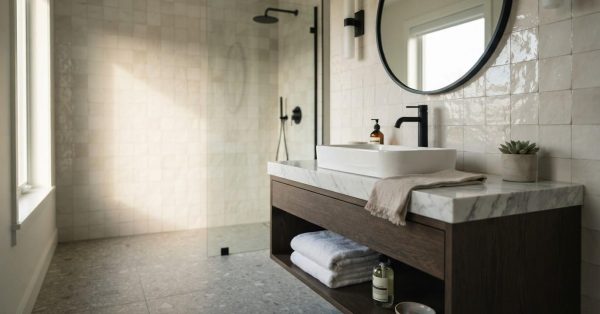
Replacing a curbed shower pan or a bathtub-shower combination with a curbless, barrier-free shower entry is the single most impactful bathroom modification for aging in place. Curbless showers eliminate the threshold that requires stepping over an edge. They accommodate wheelchair access, facilitate caregiver assistance, and integrate seated shower benches or fold-down seats for users who prefer or require a seated bathing position.
A properly designed curbless shower requires either a linear drain running the full width of the shower entry or a sloped floor that pitches toward a centrally placed drain. The entire wet area floor must slope correctly toward drainage without creating pathways for water to escape. Adequate space for wheelchair access requires at minimum a 36-by-36 inch floor area, with 60 by 36 inches recommended for a roll-in design.
Grab Bar Placement and Blocking
Grab bars provide critical support at the toilet approach, shower entry, shower interior, and bathtub surround. The challenge in existing homes is that most bathroom walls lack structural reinforcement behind the drywall sufficient to anchor a grab bar that must support a 250-pound applied load. Installing grab bars in an unblocked wall requires either opening the wall to add solid wood or plywood blocking, or using specialized toggle-anchor grab bar mounts rated for the required load.
Installing grab bars that can support a 250-pound load in the correct positions requires wall blocking, precise dimensional placement, and fastening methods that exceed what standard drywall anchors provide, and our complete guide to grab bar placement standards covers ADA positioning specifications, retrofit blocking options for walls without existing reinforcement, and the weight-bearing hardware classifications that matter most.
Comfort-Height Toilets and Bidet Options
Standard toilets measure 15 to 17 inches from floor to seat. Comfort-height or ADA-height toilets measure 17 to 19 inches, closer to chair seat height, making sit-to-stand transitions substantially easier for individuals with limited hip or knee flexibility. Wall-hung toilets, which are mounted directly to a reinforced in-wall carrier frame, can be set at any height and provide floor clearance that simplifies cleaning and allows close wheelchair approach.
Bidet seats and combination bidet-toilets reduce the physical demands of personal hygiene and are an increasingly standard feature in aging-in-place bathroom planning. They are addressed in full in the dedicated cluster resource on accessible bathroom fixtures.
Walk-In Tubs vs. Curbless Showers
Walk-in tubs incorporate a watertight door in the side panel that allows entry without stepping over a threshold. They serve users who want a bathing experience without the challenge of stepping into a conventional tub. The inherent trade-off is that the user must enter and sit in the tub before filling it, then wait for it to drain completely before exiting, which introduces its own safety risk window. Occupational therapists and aging-in-place design specialists generally recommend curbless showers with integrated seating for daily use over walk-in tubs. The single most impactful bathroom modification for aging in place is the barrier-free shower entry, and our complete guide to curbless shower design for aging covers slope requirements, drain placement options, glass and frameless enclosure configurations, tile selection for wet-area traction, and the full range of size options that work in bathrooms from compact 5-by-7 configurations to expansive primary suites.
Accessible Kitchen Design: Function for Every Ability Level
The kitchen presents a distinct accessibility challenge. Where the bathroom focuses primarily on fall prevention and hygiene access, the kitchen focuses on reach, clearance, control, and the ability to sustain productive activity while standing or seated. Universal kitchen design addresses these dimensions through systematic modification of work surfaces, storage, controls, and appliances.
Roll-Under Clearances and Knee Space
Standard kitchen base cabinetry runs to a toe kick at floor level with full-height lower storage, leaving no space for a wheelchair user to position directly at a countertop or sink. Universal kitchen design incorporates open or removable-base cabinet sections at primary work areas — typically the main sink, cooktop, and a designated prep counter — allowing seated users to work at counter height comfortably. Knee clearance standards require a minimum of 27 inches of height, 30 inches of width, and 19 inches of depth at any roll-under location. These dimensions accommodate most manual and power wheelchairs and create a comfortable standing work position for shorter users as well.
Adjustable-Height Countertops
Countertops fixed at the standard 36-inch height are too high for wheelchair users and many shorter users, and too low for taller users. Electrically motorized or manually adjustable countertop sections allow a single work surface to serve users across a full range of heights and postures. These systems require careful integration with the countertop material, the structural support beneath the counter, and any plumbing connections if a sink is included in the adjustable section.
Pull-Out Storage and Touchless Controls
Traditional upper cabinets are frequently out of reach for seated users or those with limited overhead reach. Universal kitchen design shifts storage emphasis to deep pull-out shelves in base cabinets, drawer-based lower storage replacing fixed shelving, and appliances positioned at counter height rather than in overhead locations. Microwave drawers pull out at counter height rather than requiring overhead reach. Dishwasher drawers eliminate the need to bend to a floor-level opening.
Touchless or motion-activated faucets remove the need to grip and turn a handle, which benefits users with limited hand strength, arthritis, or fine motor control. Induction cooktops with touch controls replace rotary knob mechanisms and eliminate exposed flames or heated coil surfaces. The full range of accessible kitchen modifications — from roll-under cooktop clearances and adjustable countertop mechanisms to touchless faucet integration and drawer-based appliance placement — is covered in our dedicated resource on accessible kitchen modifications, which includes dimensional standards, product categories, sequencing guidance, and how to coordinate these changes within an existing kitchen remodel. Bedrooms and Living Spaces: First-Floor Independence
The central goal of aging-in-place bedroom design is ensuring that primary sleeping and dressing functions operate safely and independently as mobility changes. The most consequential strategic decision is whether the primary bedroom and bathroom are located on, or can be relocated to, the first floor.
First-Floor Master Suite Conversions
In two-story homes where the primary bedroom is on the upper floor, creating a first-floor master suite is often the single most impactful aging-in-place investment available. The conversion typically involves repurposing an existing ground-floor room — a formal dining room, a study, a portion of an oversized family room — into a bedroom with adjacent bathroom access. Required work may include framing a new closet, adding a bathroom or extending plumbing to an adjacent half-bath, rerouting or adding HVAC supply and return, and potentially adding a second exterior door to meet egress requirements.
Converting an existing formal dining room, study, or ground-floor family room wing into a primary bedroom suite is one of the most common aging-in-place remodeling projects, and our guide to first-floor bedroom conversion walks through layout options, bathroom tie-in strategies, egress considerations, and what to expect from the permitting and structural review process.
Bedroom Layout for Mobility Aids
A bedroom that functions well for a wheelchair user requires a clear pathway of at least 36 inches on all sides of the bed and a 60-inch turning radius available somewhere in the room. Closet access needs to accommodate roll-in clearance or generous swing-door clearance. Standard electrical outlets positioned near the floor may need to be relocated to 18 to 24 inches above the finished floor for comfortable reach from a wheelchair or while seated in bed. Flooring transitions from the hallway into the bedroom should be flush or reduced to an absolute minimum to eliminate trip hazards.
Closet design for aging in place emphasizes lowered clothing rod heights of 42 to 44 inches rather than the standard 66 to 72 inches, pull-out bins and drawer units replacing static shelving, and lighting that activates automatically on entry.
Stairs, Lifts and Vertical Mobility Solutions
For homeowners in multi-story homes who intend to remain in place as physical capabilities change, vertical circulation becomes a critical planning challenge. Stairs present increasing fall risk and physical demand with age, and three primary solutions address vertical mobility without relocating to a single-story home: stairlifts, residential elevators, and through-floor platform lifts.
Stairlifts: Installation and Limitations
A stairlift is a motorized chair that travels along a track mounted to the stair stringer, carrying a seated user up or down a flight of stairs. Stairlifts require minimal structural modification — they attach to the stairs rather than to wall framing or floor structure — and can be installed in most straight or curved staircases within a few days. The primary limitations are that the user must be able to transfer independently into and out of the seat, the stairlift occupies stair width during use, and it does not accommodate wheelchairs or mobility scooters.
Residential Elevators and Elevator-Ready Planning
A residential elevator provides wheelchair-accessible vertical transportation between floors. It requires a dedicated shaft — typically 4 by 5 feet minimum — passing through all served floors, with appropriate structural support at each floor opening and a pit at the lowest landing. A residential elevator adds significant cost compared to a stairlift but provides a permanent, ability-neutral solution that serves any future mobility circumstance. A key planning consideration for current remodeling projects is the elevator-ready closet: stacking closets on each floor in a directly aligned vertical position so they can be converted into an elevator shaft at a future date without major structural disruption.
Choosing between a stairlift and a full residential elevator involves cost, structural, usability, and long-term planning trade-offs that are rarely obvious at first consideration, and our side-by-side comparison of stairlift vs residential elevator examines installation requirements, weight capacities, shaft specifications, maintenance expectations, and how each option affects resale scenarios.
Smart Home Technology as an Aging-in-Place Enabler
Technology has substantially expanded what it means to age in place successfully. Smart home systems can automate, simplify, or monitor many daily tasks that become challenging with reduced mobility, diminished vision, hearing loss, or changes in cognitive function, extending meaningful independence in ways that were not possible even a decade ago.
Voice-activated controls allow lighting, thermostats, locks, and appliances to respond to spoken commands without requiring any physical interaction with switches, controls, or handles. Motion-triggered lighting eliminates the risk of navigating a dark room to reach a switch. Smart locks allow family members or professional caregivers remote access without requiring key management. Video doorbells allow occupants to see and communicate with visitors from any room in the house without moving to the door. Voice-controlled lighting, automated door hardware, remote fall detection, and whole-house leak monitoring represent just a portion of what connected systems now offer homeowners aging in place, and our guide to smart home technology for aging evaluates the most impactful device categories, integration requirements across platforms, and how to determine which systems deliver genuine daily safety value versus novelty.
Fall detection technology represents a more advanced category of aging-in-place smart home integration. Systems now available include floor vibration sensors, motion-pattern AI that recognizes falls versus normal movement, and wearable devices that automatically notify caregivers or emergency contacts. Whole-house water leak sensors protect homeowners who may not hear or immediately notice a pipe failure or appliance leak. For homeowners who want a comprehensive view of smart home infrastructure across all systems — including lighting automation, security, climate, water monitoring, audio-visual, and network pre-wiring — our complete smart home remodeling guide covers every layer from rough-in planning and low-voltage pre-wire through final device configuration at any project scale or budget.
Designing for Multi-Generational Households
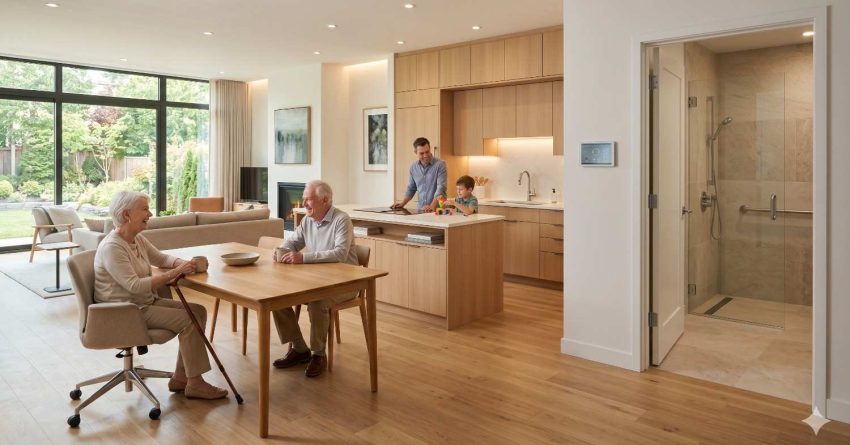
Multi-generational living, defined as two or more adult generations sharing a single residence, is growing consistently across the United States. According to Pew Research, more than one in five Americans now lives in a multi-generational household, a figure that has roughly doubled since the 1970s and continues to grow in response to housing costs, caregiving demands, and demographic shifts.
Multi-generational home design is distinct from both standard remodeling and single-purpose aging-in-place modification. The goal is a home that serves multiple generations simultaneously — accommodating the independence and safety needs of an aging parent alongside the activity needs of children and the privacy needs of middle-generation adults — rather than optimizing for a single user profile.
This requires design decisions layered across the entire home: a main-floor accessible bedroom suite and bathroom for an elderly family member, wide hallways and lever hardware throughout, visual privacy between household zones, acoustic separation between suites to allow independent sleep schedules, and potentially a semi-independent secondary unit with its own entrance. Homes shared by grandparents, parents, and children simultaneously require layered design decisions that balance universal accessibility at the structural level with visual privacy, acoustic separation, and independent-entry options for each generation, all of which are addressed in full in our guide to multi-generational home design strategies.
Permits, Codes and Professional Standards for Accessible Remodeling
Most aging-in-place and universal design modifications require building permits. Work that affects structural elements (widening doorways in load-bearing walls, adding elevator shafts, reinforcing floors for lift systems), plumbing systems (rerouting supply or drain lines for roll-under clearances, adding grab bar blocking that opens walls), or electrical systems (adding circuits, relocating outlet heights, installing powered lift systems) typically triggers the permit and inspection process.
The specific code requirements vary significantly by jurisdiction. Some municipalities have adopted accessibility provisions for single-family residential remodeling that exceed the standard IRC baseline. Others follow the IRC alone. Some jurisdictions have adopted recent code cycles; others are several cycles behind. Homeowners planning meaningful accessibility remodeling should verify which code version their jurisdiction enforces, which inspections will be scheduled during the project, and whether the project’s scope triggers any whole-home compliance upgrade requirements.
Understanding which accessibility modifications require permits, which trigger structural or egress compliance reviews, and how ADA and ANSI standards interact with local residential building codes in your jurisdiction is covered systematically in our guide to remodeling permits and code compliance.
Hiring a Universal Design Specialist
Not all remodeling contractors possess the knowledge necessary to execute aging-in-place and universal design work correctly. Grab bars installed in walls without adequate blocking fail under load. Curbless shower floors that are not properly sloped flood adjacent bathroom areas. Ramps built at incorrect slope angles are unsafe for wheelchair use. The technical precision required by accessible remodeling demands both design knowledge and construction accuracy.
What CAPS Certification Means
The CAPS designation from the National Association of Home Builders is the primary professional credential to seek when hiring for aging-in-place and universal design projects. CAPS professionals complete coursework covering technical standards for accessible design, the business practices of working with aging-in-place clients, and the human factors involved in modifying homes for older adults or people with disabilities. CAPS contractors are searchable through the NAHB contractor directory and can be verified through the organization.
The Role of Occupational Therapists
Certified Occupational Therapists who specialize in home modification assessment are a valuable complementary resource. An OT performs a functional assessment of the specific individual who will use the space, identifying which modifications will have the greatest functional impact for that person’s particular mobility profile, grip strength, vision, or cognitive needs. For complex aging-in-place projects, an OT assessment before design begins can focus the project on modifications that deliver the most meaningful outcomes and avoid spending on modifications that do not address the actual barriers present.
Evaluating Contractors Without CAPS Credentials
When evaluating general remodeling contractors who do not hold CAPS certification, request specifically to see past accessible remodeling projects, ask for references from clients for whom aging-in-place work was completed, and ask to see photographs of completed curbless shower installations, doorway widening projects in load-bearing walls, and grab bar installations. Choosing the right contractor for aging-in-place and universal design work means looking beyond general remodeling credentials to verify specific accessibility expertise, and our guide to universal design contractor selection explains what CAPS certification requires, what interview questions expose real-world accessibility experience, and how to evaluate past project portfolios for technical accuracy.
Cost, Financing and Tax Incentives for Accessible Remodeling
The cost of aging-in-place and universal design remodeling spans a wide range depending on project scope, existing home conditions, regional labor markets, and material selections. Understanding realistic project cost ranges before engaging contractors helps homeowners prioritize modifications, plan phased budgets, and evaluate the financial mechanisms available to offset costs.
Project Cost Ranges
Entry modifications (no-step entry grading, ramp installation, threshold treatment): $1,500 to $8,000, depending on site slope, ramp material, and whether any structural work is required at the door platform.
Bathroom accessibility remodel (curbless shower conversion, grab bar installation with blocking, comfort-height toilet, accessible vanity): $8,000 to $28,000, depending on tile selections, shower dimensions, extent of plumbing relocation, and fixture quality.
Doorway widening (per opening, including framing, drywall repair, and finish): $700 to $2,500 for non-load-bearing walls; up to $4,500 or more for load-bearing openings requiring engineered header replacement.
First-floor master suite conversion (existing space, standard finishes, adjacent bathroom): $40,000 to $120,000, depending on the scope of the bathroom, any required HVAC modifications, and whether an egress door must be added.
Residential elevator installation (standard two-stop): $20,000 to $50,000, depending on drive type, number of stops, and whether a new shaft must be built or an existing stacked closet can be converted.
Federal Tax Deductions for Medical Modifications
Medical expenses for accessibility modifications prescribed by a physician as medically necessary for a documented disability or condition may be deductible as medical expenses on federal income taxes, to the extent they exceed 7.5% of adjusted gross income. The deduction applies to the incremental cost of accessibility, not to modifications that also add general property value. IRS Publication 502 addresses these deductions in detail.
Grant and Loan Programs
Federal programs that help fund accessibility modifications include the USDA Rural Development Section 504 Home Repair Program, which provides grants to homeowners over 62 in qualifying rural areas, and VA Specially Adapted Housing (SAH) and Special Housing Adaptation (SHA) grants for qualifying veterans with service-connected disabilities. HUD’s Community Development Block Grant program, administered at the local level, often funds home modification assistance for low-income elderly and disabled homeowners. Whether you are planning a targeted modification budget or a phased whole-home accessibility transformation, understanding realistic project costs, tax deduction eligibility, and grant program availability is essential before any contractor conversations begin, and our detailed aging-in-place remodeling cost breakdown covers national and regional cost ranges for every modification type with current labor and material pricing.
ROI and Long-Term Property Value of Accessible Modifications
The relationship between aging-in-place modifications and residential resale value is nuanced and increasingly favorable. Some modifications — curbless showers, lever hardware throughout, wide doorways, no-step entries — are indistinguishable from quality remodeling choices to most buyers. These modifications tend to be neutral in resale scenarios and often read as premium features rather than accommodations.
More visible modifications, including grab bars, external ramps, and exposed elevator components, can affect buyer perception in markets where accessibility needs are not widely present among the buyer pool. However, demographic reality is shifting this dynamic meaningfully. As Baby Boomers represent a growing share of active home buyers and sellers, accessibility features are becoming genuine market differentiators in more neighborhoods each year.
The most reliable principle for maintaining resale value while remodeling for accessibility is to apply universal design wherever possible — integrating accessibility in ways that read as design quality rather than clinical accommodation to the broadest buyer population. A beautifully tiled curbless shower with a frameless glass enclosure is a luxury feature to most buyers. An institutional-appearing roll-in shower with hospital-style fixtures may signal clinical need to some. The quality of execution matters as much as the nature of the modification itself. Accessibility modifications vary significantly in how buyers perceive them based on neighborhood demographics, the aesthetics of the implementation, and whether universal design or targeted accommodation principles guided the work, and our guide to remodeling for long-term property value examines which accessible upgrades consistently support or maintain resale pricing across different market contexts.
Planning Your Aging-in-Place Remodeling Timeline
Aging-in-place remodeling delivers its greatest value when planned proactively, before mobility limitations create urgent, reactive modification needs, and when sequenced strategically from the highest-priority barriers inward.
A rational planning sequence begins with exterior and entry access — eliminating grade changes, threshold obstacles, and doorway barriers at the primary entry point. It then addresses main interior circulation pathways, including hallway widths, flooring transitions throughout the main floor, and door hardware. From there, it focuses on high-priority rooms: the bathroom first, then the primary bedroom and its closet access. Secondary spaces, including the kitchen, laundry area, and outdoor patios, follow in later phases.
Phasing also serves as a practical financial management strategy. A comprehensive whole-home accessible remodel can cost $80,000 to $150,000 or more. Breaking it into planned phases distributes cost over time while ensuring that the most urgent safety modifications are completed first. Each phase should build on the preceding one so that no modification creates a barrier to a subsequent project.
Sequencing an aging-in-place remodeling plan correctly — addressing entry barriers before interior circulation, and circulation before room-specific modifications — requires the same structured planning discipline as any major remodel, and our guide to the remodeling planning and design process provides the frameworks, decision checklists, and phase-ordering guidance to build an effective multi-year accessibility plan.
Conclusion
Universal design and aging-in-place remodeling deliver homes that support independence, safety, and comfort for occupants at every stage of life and ability.
The strategies in this guide connect to bathroom renovations, kitchen upgrades, structural planning, smart home integration, and whole-home remodeling decisions explored throughout this cluster.
When you are ready to plan or execute your accessibility remodel, Mr. Local Services connects you with certified specialists who deliver expert results.
Frequently Asked Questions
What is the difference between universal design and accessible design?
Universal design proactively creates spaces usable by all people regardless of ability. Accessible design is a compliance-based framework applying specific legal standards, primarily to commercial and multi-family buildings.
Which room should I prioritize first in an aging-in-place remodel?
The bathroom is the highest priority due to fall risk from wet surfaces and tight clearances. After the bathroom, focus on entry access and main-floor circulation pathways connecting sleeping and bathing areas.
Do aging-in-place modifications require a building permit?
Most modifications involving structural work — widening doorways, adding elevator shafts, or rerouting plumbing — require building permits. Cosmetic changes like grab bar installation may not, but local codes vary significantly by jurisdiction.
What does CAPS certification mean for a remodeling contractor?
CAPS (Certified Aging in Place Specialist) is an NAHB designation covering technical standards, business practices, and human aspects of aging-in-place remodeling. CAPS contractors can be verified directly through the NAHB contractor directory.
How much does a curbless shower conversion typically cost?
A curbless shower conversion ranges from approximately $4,000 to $15,000 depending on tile selection, drain type, and whether existing plumbing requires relocation. Larger or more complex conversions with custom tile work can reach $20,000 or beyond.
Can accessibility modifications reduce my home’s resale value?
Modifications following universal design principles — curbless showers, lever hardware, wide doorways — are generally neutral or positive for resale. More clinical-appearing modifications may affect buyer perception in some markets not specifically seeking accessible features.
Is financial assistance available for aging-in-place remodeling?
Yes. Federal programs include the USDA Section 504 Home Repair Program and VA grants for qualifying veterans. Physician-prescribed modifications for documented medical conditions may also qualify as deductible medical expenses on federal tax returns.