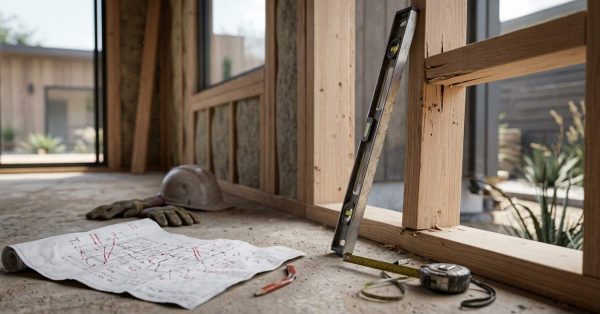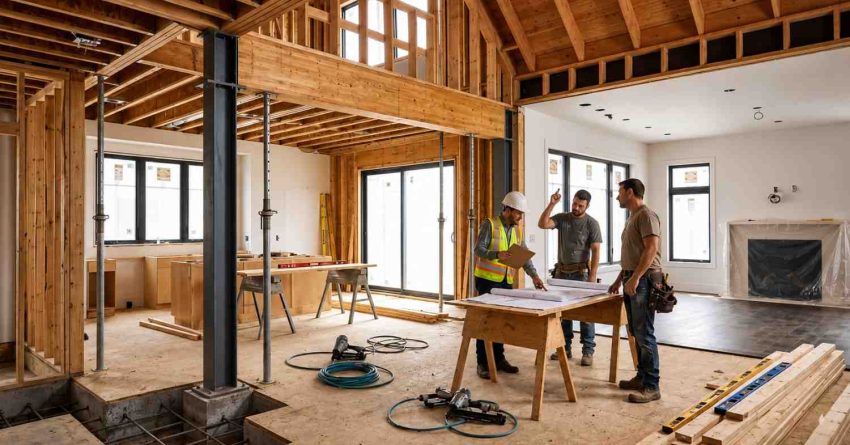
Structural work in remodeling is any modification that affects the load-bearing, stability, or weather-resistive elements of a building, including foundations, framing, roof structure, subfloor systems, and shear walls. It is the framework beneath everything visible in your finished home.
Getting structural work wrong during a remodel creates safety risks, failed inspections, hidden damage, and costs that multiply, making early, clear understanding of these critical systems essential for every project.
This guide covers everything structural: foundations, framing, subfloor systems, roof structure, structural engineering, damage repair, specialty scenarios, permits, MEP coordination, project budgeting, and choosing the right contractor for the job.
What Is Structural Work in Remodeling?
Structural work in remodeling encompasses every modification that touches the load-bearing skeleton of a home. When a homeowner removes a wall to open a floor plan, extends a foundation to build an addition, raises the roof to vault a ceiling, or repairs wood rot discovered behind drywall, they are doing structural work. Understanding what falls into this category, and what does not, is the first step toward planning any remodeling project responsibly.
Structural vs. Cosmetic Work: The Core Distinction
The fundamental distinction between structural and cosmetic remodeling is load transfer. Structural elements carry weight from above and transfer it safely to the ground through a continuous pathway. Cosmetic elements, such as paint, flooring, tile, trim, and cabinetry, do not carry load. The moment a project touches load-bearing walls, floor systems, roof structure, or foundations, it crosses into structural territory and requires engineering awareness, permit scrutiny, and in many cases, licensed professional involvement.
Structural scope is not always visible from the outside. A cosmetic kitchen remodel that involves removing a single wall may conceal a load-bearing modification requiring a structural engineer’s stamp and a framing permit. A bathroom addition may require foundation extension. A simple ceiling fan installation in a bedroom may reveal an undersized joist system. Structural issues do not announce themselves until they are exposed, which is one reason why pre-construction assessment matters so much.
The Load Path Concept
Every structure transfers forces along a defined load path: from roof loads through rafters or trusses, to bearing walls or beams, through posts and columns, to the floor system, through bearing walls or columns on lower floors, and ultimately to the foundation and the ground. Gravity loads, wind loads, snow loads, and seismic forces all travel through this path simultaneously.
When any element of the load path is removed, altered, or compromised during a remodel, the loads it was carrying must be redirected through an alternate, properly engineered path. This is why removing a load-bearing wall without installing a properly sized beam is dangerous: the load has nowhere to go except into progressive structural distress. Headers, beams, posts, and footings are all components of the load path that must be sized to carry the specific loads imposed at each point.
Where Structural Work Fits in the Project Sequence
In virtually every remodeling project, structural work happens first. Foundation modifications, if any, precede framing. Framing modifications (removing walls, installing beams, reinforcing joists) happen after demolition and before any MEP rough-in. This sequencing is not arbitrary: MEP trades route pipes, ducts, and wires through and around the structural framing, so the structural framing must be in its final configuration before MEP systems are installed and inspected.
Structural inspections by the local building department occur at multiple points: a foundation inspection before concrete is poured, a framing inspection after all structural framing is complete and all rough-in penetrations are made but before walls are closed, and a final inspection at project completion. Each inspection must be passed before the next phase of work proceeds.
For homeowners planning a comprehensive project where structural systems interact at every stage, our pillar on whole home remodeling structural scope explains how structural decisions cascade across foundations, framing, MEP rough-in, and finish work, and how to sequence the structural phase so it does not create delays for every trade that follows.
Foundations: The Base of Every Remodel
Every structure transfers its weight to the ground through its foundation. In residential remodeling across the United States, foundations come in four primary types, each presenting different challenges and opportunities when remodeling work is planned.
Foundation Types Encountered in Remodels
A slab-on-grade foundation is a concrete pad poured directly on prepared subgrade. Slabs are common in warm climate regions such as the South and Southwest and are efficient to build, but they complicate plumbing modifications because supply and drain pipes run beneath the concrete rather than through an accessible space above grade. Cutting through a slab to relocate plumbing is possible but adds significant labor and cost.
Crawl space foundations raise the home’s floor system above grade on perimeter stem walls or piers, creating a shallow accessible space beneath the living area. Crawl spaces provide access to plumbing, wiring, and structural framing members, but they are prone to moisture accumulation, mold, and pest infiltration when not properly sealed and conditioned. Crawl space foundations are common in the Southeast and Mid-Atlantic regions.
Crawl space foundations are particularly prone to moisture accumulation and structural wood damage from poor drainage and inadequate ventilation, and our dedicated resource on crawl space encapsulation covers every vapor barrier system, drainage mat option, and dehumidification strategy that protects the structural wood members resting on crawl space foundations from the rot, mold, and pest damage that most homeowners do not discover until a remodel opens the floor system.
Full basements provide the most structural accessibility and livable square footage potential, but they are the most expensive foundation type to build and modify. Pier-and-beam foundations, common in older homes and coastal or soft-soil regions, support the structure on individual columns and are highly adaptable, but they can settle and shift over time, creating floor slopes and structural misalignment.
Foundation Repair, Reinforcement, and Tie-Ins
Not every remodeling project touches the foundation, but larger projects, particularly additions, second-storey conversions, and gut remodels of older homes, frequently require foundation evaluation before design is finalized. Foundation issues discovered during remodeling range from minor crack repair to full underpinning.
When adding square footage to an existing home, the new addition’s foundation must tie into the existing foundation in a way that transfers loads properly and resists differential settlement. Poorly executed foundation tie-ins result in cracking, door and window misalignment, and over time, structural separation between old and new construction. Matching foundation depth, frost footing depth, and concrete strength between new and existing foundations is critical to a durable tie-in.
From slab-on-grade to full basement, understanding which foundation type your home has, and whether it needs repair, extension, or underpinning before your project begins, is the subject of our deep-dive guide on foundation types in remodeling, which covers every repair method, tie-in strategy, and warning sign you need to evaluate before a shovel hits the ground.
Framing Fundamentals for Remodelers
Framing is the structural skeleton of a home. It transfers loads from the roof and upper floors down through walls and beams to the foundation. In residential construction, wood platform framing, also called Western framing, is the dominant system, where each floor is framed independently and walls rise from each platform. Older homes built before the 1940s may use balloon framing, where studs run continuously from foundation sill to roof plate, a configuration that requires different approaches to fire blocking and structural modification.
Identifying Load-Bearing Walls
The most consequential structural question in any layout-changing remodel is whether a wall carries load. Load-bearing walls are structural: they transfer the weight of floor systems, roof systems, or other walls above to the foundation below. Non-load-bearing (partition) walls divide space without carrying vertical loads. Removing a partition wall is typically straightforward. Removing a load-bearing wall requires a properly sized beam or header to take over the load the wall was carrying.
Common indicators of a load-bearing wall include placement perpendicular to floor joists, location directly above a beam or wall on the floor below, presence of structural posts within or at the ends of the wall, and location along the home’s perimeter. Interior walls that run parallel to the ridge line and bisect the home’s width are often load-bearing. However, appearances can deceive, and only a structural engineer or highly experienced contractor can provide reliable confirmation of bearing status in older or non-standard framing configurations.
Because removing a load-bearing wall is one of the most frequently requested and most consequential structural changes in residential remodeling, our dedicated guide to removing a load-bearing wall walks through the complete process, from confirming structural status and engaging an engineer to sizing the replacement beam, installing temporary shoring, completing demolition, and passing framing inspection, with real cost ranges and common mistakes that cause failed inspections and budget overruns.
Headers, Beams, and Engineered Lumber
When a load-bearing wall is removed, a beam or header spans the opening and transfers the load previously carried by the wall to posts or columns at each end. Beam sizing is not guesswork. The required dimensions depend on the span length, the load being carried (which depends on what sits above), and the beam material.
Traditional dimensional lumber, laminated veneer lumber (LVL), and steel beams are the most common choices. LVL offers high strength-to-depth ratios and predictable, consistent performance that is not subject to the knots and defects found in sawn lumber. LVL is the most common beam material in residential remodeling for spans up to approximately 20 feet. Steel beams allow longer spans with shallower profiles, which matters when ceiling height is critical, but they require crane or heavy equipment assistance for installation and specialized connections at the bearing points. Undersized beams deflect under load, crack adjacent finish materials, and in severe cases, fail progressively.
Shear Walls and Lateral Loads
Remodeling discussions focus primarily on gravity loads, but lateral loads from wind and seismic activity also require structural accommodation. Shear walls are specially framed and sheathed wall panels designed to resist horizontal forces. The sheathing nailing schedule on a shear wall panel is prescribed by engineering calculations and must match the approved structural drawings exactly. In seismic design zones (including California, the Pacific Northwest, and parts of the Mountain West and Alaska), removing or modifying walls sometimes requires shear wall upgrades elsewhere in the structure to maintain adequate lateral resistance.
Because framing decisions are often the most consequential and least reversible choices in a remodel, our complete guide to load-bearing wall removal and framing walks through every technique, from identifying structural walls to sizing headers, choosing between LVL and steel beams, and reinforcing joists, so you can approach structural framing work with full knowledge of the process and its risks.
Subfloor and Sheathing Systems
The subfloor is the structural deck installed directly on top of floor joists. It is the platform on which all finish flooring, cabinets, fixtures, and walls rest, and it contributes significantly to the overall stiffness of the floor system. Wall and roof sheathing serve analogous functions: they provide structural rigidity to framed assemblies by creating diaphragm action that resists racking, lateral forces, and out-of-plane wind loads.
Subfloor Types and Span Requirements
Plywood and oriented strand board (OSB) are the two dominant subfloor materials in residential construction. Both are rated by the APA, the Engineered Wood Association, for specific span and load conditions. Tongue-and-groove (T&G) edge configurations prevent vertical deflection at panel edges and are standard in modern subfloor installations. Thickness requirements depend on joist spacing: 3/4-inch T&G plywood or OSB is the standard over 16-inch-on-center joist framing.
Stiffness is a particularly critical subfloor consideration when tile or natural stone finishes are planned. Large-format porcelain and natural stone require floor systems that deflect no more than L/360 under design loads (span in inches divided by 360). Many older floor systems do not meet this threshold, requiring sistering of existing joists, addition of blocking, or a second layer of subfloor during the remodel.
Squeaky floors are a structural symptom of subfloor or joist issues that are easiest to correct during a remodel, when the subfloor is accessible from below or during finish floor installation. Face-nailing or screwing the subfloor panel to joists and applying construction adhesive at contact surfaces eliminates most subfloor-induced squeaks.
Sheathing for Walls and Roofs
Wall sheathing covers the exterior face of framing and provides structural rigidity, a nailing base for siding, and the substrate for the weather-resistive barrier. In high-wind and seismic zones, the thickness, span rating, and nailing schedule of wall sheathing are critical structural parameters specified by the engineer’s drawings. Roof sheathing performs the same structural function for the roof framing system, providing the rigid diaphragm to which roofing materials attach.
For a detailed look at span tables, OSB vs. plywood trade-offs, stiffness requirements for tile floors, and how to address squeaky subfloors during a remodel without full replacement, our guide to subfloor types and sheathing choices covers every material decision and installation consideration at the depth a remodeling project demands.
Roof Structure in Remodeling
The roof structure bears multiple simultaneous loads: dead loads from roofing materials and the framing itself, live loads from snow accumulation and maintenance personnel, wind uplift forces, and in seismic zones, inertial forces from ground motion. Remodeling projects that touch the roof structure, including adding dormers, converting flat to vaulted ceilings, adding a second storey, or tying a new addition’s roof into an existing roof plane, require careful structural analysis.
Truss vs. Stick-Framed Roofs
Roofs are framed using one of two primary systems: prefabricated trusses or site-built (stick-framed) rafters and ridge members. Understanding which system your home has is essential before any roof modification is considered.
Prefabricated trusses are engineered wood assemblies manufactured off-site under controlled conditions. They arrive and are lifted into place with crane assistance. Trusses are structurally efficient, but they are proprietary engineered designs. Cutting, notching, or removing any truss member without engineering approval voids the truss design and can cause immediate or progressive structural failure. Trusses can be modified for dormers or conversion to vaulted spaces, but doing so requires a new engineered design from the original truss manufacturer or a structural engineer.
Stick-framed roofs use individual site-cut rafters, ridge members, collar ties, and ceiling joists. They are far more adaptable than trusses because individual members can be modified with proper engineering input. When a homeowner wants to vault a ceiling beneath a stick-framed roof, the process involves removing ceiling joists and collar ties and substituting a structural ridge beam capable of carrying the roof loads without horizontal ties.
Vaulting a ceiling from flat to cathedral involves structural modifications that are considerably more complex than the finished product suggests, and our dedicated guide to vaulting a ceiling in a remodel covers ridge beam sizing, structural post requirements, the critical importance of ceiling ventilation in cathedral configurations, and the permits and inspections that govern this high-visibility structural transformation.
Modifying Ceiling Heights and Adding Dormers
A ridge beam supporting a vaulted ceiling must be properly sized based on roof span, slope, and snow loads, then supported at each end by a structural post carrying load through the floor system to the foundation. This chain of support is the load path for the roof modification, and every element of it must be engineered. The structural post at each end of a new ridge beam must land on a beam, wall, or column below that carries to a bearing point in the foundation, not between joists in midspan.
Dormers, whether shed, gable, or shed-roof style, require cutting through the existing roof structure to create an opening, framing a new structural assembly around that opening with proper headers at the top, and tying the dormer’s valley and ridge framing back into the main roof structure. Valley framing at the intersection of dormer and main roof is a particular area of craftsmanship and structural detail that is frequently done incorrectly by contractors without specific dormer experience.
Whether you are vaulting a ceiling, adding dormers, or tying a new addition’s roof into an existing structure, our guide to roof structure and ceiling modifications explains the engineering distinctions between ridge beams and ridge boards, how truss modifications require engineering sign-off, and what cathedral ceiling ventilation strategies prevent long-term moisture damage.
When You Need a Structural Engineer
A structural engineer is a licensed professional who analyzes the forces acting on a structure and designs the framing members, connections, beams, and foundation elements required to carry those forces safely. In remodeling, structural engineers are not just a bureaucratic requirement. They are the mechanism by which complex structural decisions are made with mathematical confidence rather than guesswork.
Projects That Always Require Engineering
Certain project types nearly always trigger a structural engineering requirement, either by local code, as a practical necessity, or both.
Removing any load-bearing wall where a new beam must span the opening requires engineering calculations to size the beam, posts, and footings correctly. Second-storey additions require the existing foundation and first-floor wall structure to be assessed for their capacity to carry additional loads. Foundation modifications and underpinning require geotechnical input and structural design. Vaulted ceiling conversions, as described above, require ridge beam calculations. Any project in a high-wind zone (ASCE 7 Exposure Category B or higher), seismic design category C or above, or a jurisdiction with stringent structural code interpretation will likely require stamped structural drawings regardless of scope.
According to the International Code Council, the International Residential Code (IRC) requires engineer-designed solutions for any structural application that falls outside prescriptive code tables, which covers the majority of the structural modifications discussed in this guide.
What a Structural Engineer Provides
When a structural engineer is engaged, they typically perform a site visit or review existing plans, conduct load calculations using applicable code standards, specify beam sizes and connection hardware, and produce stamped drawings. Stamped drawings bear the engineer’s professional seal, signifying that the calculations and design conform to applicable codes and engineering standards. These drawings are what building departments review to issue structural permits, and what inspectors reference during framing inspections.
Structural engineer fees for residential remodeling work typically range from $500 to $5,000 depending on project scope, with simple beam calculations at the lower end and full addition or second-storey structural packages at the higher end. Engineering fees are among the most cost-effective investments in a remodeling project: they are far less expensive than the cost of failed inspections, structural repairs, or liability exposure from unpermitted structural work.
From calculating load paths to producing permit-ready stamped drawings, our complete resource on hiring a structural engineer explains exactly when engineering is legally required versus recommended, what fees and timelines to expect, and how to read the stamped drawings your contractor and building department will rely on throughout the project.
Structural Repairs and Damage Recovery
One of the most budget-disruptive aspects of remodeling, particularly in older homes, is the discovery of structural damage after walls are opened. According to NAHB research on remodeling cost drivers, unexpected structural conditions are consistently cited among the leading causes of project scope expansion and cost overrun. Understanding the most common types of hidden structural damage, and how they are assessed and addressed, allows homeowners to plan contingencies and respond to discoveries without derailing the project.
Common Hidden Structural Damage
Termite damage ranges from surface wood degradation to complete member destruction. Termites consume wood from the inside, leaving an intact-looking exterior surface that collapses under pressure. During demolition, contractors may encounter termite-damaged plates, studs, joists, or posts that require full replacement before any other work proceeds. Treatment of active infestations and structural repairs must be completed and documented before other trades can work in the affected area.
Wood rot results from prolonged moisture contact with untreated or inadequately protected wood. It is particularly common in areas with historical leaks: around windows and doors, at roof-to-wall intersections, in crawl spaces with drainage problems, and in bathroom walls adjacent to plumbing fixtures. Rot softens and progressively destroys the structural capacity of wood members. Affected members must be cut out entirely and replaced with new, properly sized, and appropriately treated wood. Partial repairs of heavily rotted members are not structurally reliable.
Sagging floors and settling foundations are visible symptoms of deeper structural problems. A floor that sags perceptibly over its span typically indicates joist deflection from undersizing, overloading, notching damage, or biological deterioration. Settling foundations cause differential movement between structural supports, manifesting as sloping floors, sticking or racking doors and windows, and diagonal cracking in drywall finishes above door and window corners.
Structural Diagnostics Before and During a Remodel
The best approach to hidden structural damage is a pre-construction diagnostic phase, where a structural engineer or experienced contractor inspects all accessible areas of the structure (attic, crawl space, basement) before design is finalized and budgets are committed. A pre-remodel structural report establishes a baseline condition, flags high-risk areas, and allows the project budget to include appropriate contingencies before the homeowner has committed to a contract scope.
Because hidden damage is one of the most budget-disrupting discoveries in any remodel, our dedicated guide to structural damage repair during remodels covers termite damage assessment, wood rot replacement protocols, sagging floor correction, cracked beam replacement, and how to use a diagnostic survey to get ahead of surprises before they become project-halting emergencies.
Specialty Structural Scenarios
Some remodeling projects involve structural complexity that goes well beyond standard framing and wall removal. These specialty scenarios require a structural engineer, a contractor with specific project experience, and in many cases, extended permitting timelines and special inspections. They represent the most consequential structural decisions a homeowner can make and deserve careful, early planning.
Second-Storey Additions
Adding a full second storey to a single-storey home is one of the most structurally intensive remodeling projects in residential construction. The structural process begins with a foundation assessment: many post-war single-storey homes were built on minimal foundations (stem walls or shallow slabs) designed to carry only one story of framing plus a roof. Adding a full second story may require foundation reinforcement or extension before any above-grade work begins.
The first-floor wall structure must also be evaluated. Walls designed to carry only a roof are not automatically capable of carrying an additional floor system and the walls and roof above it. In some cases, structural posts must be added within existing first-floor walls at specific locations dictated by the new second-storey framing layout. After foundation and first-floor adequacy are confirmed, the existing roof is removed to expose the first-floor wall top plates, and new second-storey framing begins.
Cantilevers, Garage Conversions, and House Lifting
Cantilevered additions, where floor space projects beyond its direct support without columns or walls below, require careful engineering to control deflection and ensure that the connection to the main structure can resist the moment forces created by the overhang. The IRC prescriptive code limits simple wood-joist cantilevers to specific fractions of joist depth, and larger cantilevers require engineered solutions.
Garage-to-ADU conversions involve removing the large garage door opening header, typically a doubled 2×10 or 2×12 designed only for the garage door’s weight, and replacing it with a structural wall or beam capable of carrying the loads of any space above and the lateral loads previously resisted by the garage door wall system. Lifting a house off its foundation is performed by specialized house-moving contractors using hydraulic jacks and temporary cribbing, requiring engineering oversight, specialty permits, and careful coordination with utility providers.
From lifting a house off its foundation to engineering a cantilevered addition on a sloped lot, our guide to specialty structural remodeling scenarios goes deeper into the structural approaches required for second-storey additions, garage conversions, and house lifting, each of which involves coordination between structural engineers, general contractors, and local building authorities that goes well beyond standard framing work.
Structural Work and Building Permits
Structural remodeling work triggers building permits in virtually every jurisdiction across the United States. This is not a technicality to be avoided. Structural permits exist because the consequences of structural failure, from deflected floors and cracked finishes to catastrophic collapse, are safety events that affect occupants, neighbors, and future buyers.
When a structural permit is submitted, building departments typically require construction drawings showing existing conditions, the proposed structural work, and the engineering calculations or prescriptive code references that support the design. In most jurisdictions, load-bearing wall removal, foundation modifications, and roof structure changes require engineer-stamped drawings. The permit holder is typically the licensed contractor performing the work, though owner-builder permits are available in most states with certain restrictions.
The inspection sequence for structural permits typically includes a foundation inspection before concrete is poured, a framing inspection after all structural framing is complete and all rough-in penetrations are made but before walls are closed, and a final inspection at project completion. Each passed inspection is recorded in the public building permit record, which becomes part of the home’s history and is reviewed by buyers, lenders, and appraisers.
Structural remodeling also frequently triggers the “50% rule,” or its jurisdictional equivalent: if the value of remodeling work exceeds 50% of the structure’s assessed value, the building department may require the entire structure to be brought into current code compliance, including areas not touched by the current project. This is a particularly significant consideration for owners of older homes contemplating substantial structural upgrades.
Structural work almost always triggers permits, and our comprehensive pillar on remodeling permits and building codes explains the full permit process, from application through inspection, including the specific framing, plumbing, and electrical inspections that structural rough-in work must pass before walls can be closed.
How Structural Work Affects MEP and HVAC Systems
Structural changes and mechanical, electrical, and plumbing (MEP) systems are deeply interdependent in any remodeling project. The sequence in which structural and MEP work occurs is carefully choreographed, and structural decisions made without MEP coordination create costly conflicts during rough-in that can only be resolved by rework, altered layouts, or oversized mechanical systems.
When a load-bearing wall is removed and replaced by a beam, the framing space previously available for vertical pipe, duct, and wire routing disappears. MEP trades must re-route their systems around the new beam, often requiring longer runs, additional fittings, and in the case of ductwork, potentially increased duct cross-sections to compensate for added length and friction losses. Pre-construction coordination between the structural engineer and the MEP trades ensures that beam locations are chosen with routing needs in mind, not just structural efficiency.
Structural changes, particularly wall removal and framing modifications, directly affect where pipes, ducts, and wiring can run, which is why our guide to MEP systems in remodeling is the essential companion to this one, detailing how mechanical, electrical, and plumbing rough-in work must be coordinated with the structural framing sequence to avoid conflicts, failed inspections, and costly rework.
Moving plumbing stacks, the vertical vent pipes that connect the drain-waste-vent system to the exterior, sometimes requires structural modifications to accommodate new routing through floor joists or walls. The IRC and IPC codes strictly limit the size of holes and notches that can be cut in joists and studs for pipe penetrations. Exceeding these limits weakens the structural member and requires sister reinforcement.
Structural modifications that change ceiling heights, open floor plans, or add conditioned space require HVAC recalculation, and our detailed resource on HVAC planning in remodels covers how to properly size equipment for changed load conditions, a step that is too often skipped when structural changes outpace mechanical system updates.
Structural Considerations Across Project Types
Every major remodeling project type involves structural work at a different scale and complexity level. Understanding how structural considerations vary by project helps homeowners scope projects accurately, budget appropriately, and engage the right professionals early.
Whole Home Remodels and Gut Remodels
A gut remodel of an existing home exposes the structural frame from foundation to roof. This is the most comprehensive opportunity to address hidden damage, upgrade undersized framing, add shear panels for seismic or wind resistance, improve subfloor stiffness, and coordinate structural changes with new MEP rough-in. The structural phase in a gut remodel typically precedes all other work, and any structural discoveries (termite damage, undersized joists, deteriorated sill plates) must be resolved before framing can progress to inspection.
Home Additions
Additions introduce new structural elements: a new foundation, new wall and floor framing, a new roof assembly, and the complex structural connection between old and new construction at the tie-in wall. The roof tie-in at the addition junction is often the most technically demanding structural detail: new roof framing must integrate seamlessly with the existing roof without creating water intrusion points, thermal bridging, or structural discontinuities. The floor tie-in must match heights exactly to avoid a tripping hazard and floor level transition.
Home additions require structural tie-ins that are often more complex than new construction because the new work must integrate with an existing structure that may be decades old, and our complete pillar on structural planning for home additions covers foundation matching, roof tie-in design, cantilevered approaches, and the specific structural engineering that turns a well-designed addition into a seamlessly integrated part of your home.
Second-Storey Additions and High-Complexity Projects
Second-storey conversions, historic home structural upgrades, and garage-to-ADU conversions all demand structural expertise that exceeds what standard single-room remodeling requires. The structural scope in these projects often represents the largest budget line item and the longest critical-path schedule item. Insufficient engineering, inadequate contractor experience, and incomplete permit documentation in these project types create risks that manifest for decades after the project is complete.
Adding a full second storey is among the most structurally intensive remodeling projects possible, and our dedicated pillar on second-storey addition structural requirements covers foundation analysis, first-floor wall reinforcement, seismic and wind load considerations, and the step-by-step structural process that transforms a single-storey home into a two-storey residence safely and to code.
Budgeting for Structural Work
Structural work is consistently among the least predictable and most variable cost categories in any remodel. Unlike finish work, where material and labor costs are well-established before demolition begins, structural work frequently involves unknowns that only reveal themselves after walls are opened, foundations are exposed, or existing conditions are compared to original drawings.
Where Structural Costs Come From
Structural costs in remodeling include labor (typically the dominant component), materials (dimensional and engineered lumber, concrete, steel, fasteners, joist hangers, hold-down hardware, and beam connectors), structural engineer fees, and special inspection fees in jurisdictions that require third-party structural observation.
For a straightforward load-bearing wall removal with a single LVL beam and two posts, total structural costs in most U.S. markets range from $2,000 to $8,000 depending on span, beam depth, and whether the bearing points require additional reinforcement below the new posts. A second-storey addition carries structural costs that can reach $40,000 to $100,000 and above as a combined foundation, framing, and engineering line item, representing a substantial portion of the total project budget.
Contingency Planning for Structural Surprises
Experienced remodeling professionals recommend a structural contingency reserve of 10 to 20% of the estimated structural scope. On projects involving pre-1980 construction, homes with known deferred maintenance, or properties in regions with high termite or moisture risk, a 20% structural contingency is prudent. On newer construction where accessible structural members have been inspected prior to construction, 10% may be adequate.
The structural contingency should be budgeted separately from the overall project contingency. Homeowners who set a general 10% project contingency but do not specifically plan for structural surprises often find that a single significant structural discovery, such as a fully rotted sill plate running the length of one exterior wall, exhausts the entire reserve and forces difficult decisions about scope reduction.
Because structural surprises are among the most common causes of remodeling cost overruns, our comprehensive guide to budgeting for structural remodeling work explains how to set realistic contingency reserves, understand the difference between hard costs and soft costs, and evaluate financing options for structural scopes that expand mid-project when hidden damage is discovered.
Hiring the Right Contractor for Structural Work
Not every general contractor has the structural experience that larger-scale structural remodeling demands. A GC does not need to be a licensed structural engineer, but they must be capable of reading and executing from stamped structural drawings, coordinating MEP trades around structural constraints, sequencing work so structural inspections occur at the correct stages, and recognizing when field conditions deviate from the approved plan in ways that require engineering review before proceeding.
Specific red flags include contractors who suggest removing a wall “because it probably isn’t load-bearing” without verifying with an engineer, who express discomfort with structural drawings or engineering coordination, who cannot provide references from projects of similar structural scope, or who give vague or inconsistent explanations of how beam and post sizing was determined for their proposed work.
For structural projects, the general contractor’s experience with the specific project type is more critical than for cosmetic scopes. A GC with a strong kitchen remodeling portfolio but no second-storey addition projects is taking on structurally unfamiliar scope when accepting such a project. The vetting questions that matter include: “How many load-bearing wall removals have you completed and can you provide references?” and “Who is your preferred structural engineer and can I speak with them before the project begins?” These are entirely appropriate questions for any homeowner managing a structural scope.
Structural work demands specialized expertise, and not every general contractor has the experience to manage the engineering coordination, permit compliance, and trade sequencing that structural scopes require, so our guide to hiring structural remodeling contractors covers every vetting question, red flag, and contract clause that protects you when the work involves load-bearing walls, foundation repairs, or second-storey additions.
Conclusion
Structural work spans foundations, framing, subfloor systems, roof structure, load-bearing walls, and repairs, each system connecting directly to the safety and longevity of your remodel.
Every cluster guide linked throughout goes deeper into its specific system, giving you the full technical detail needed for informed decisions at each structural stage.
For structural remodeling expertise you can trust, contact Mr. Local Services. We connect you with qualified structural specialists who deliver safe, code-compliant results.
Frequently Asked Questions
What counts as structural work in a remodeling project?
Structural work includes any modification to load-bearing elements such as foundations, framing, roof structure, subfloor systems, and shear walls. It excludes cosmetic changes like flooring, tile, paint, and trim that carry no load.
Do I always need a permit for structural remodeling work?
Yes. Structural work almost always requires a building permit across the USA. Unpermitted structural modifications create serious resale, insurance, and safety problems that become far more expensive to correct after the project is complete.
How do I know if a wall in my home is load-bearing?
Load-bearing walls usually run perpendicular to floor joists, sit above beams or bearing walls below, or align with foundation support points. A structural engineer provides the only fully reliable confirmation.
How much does structural work add to a remodeling budget?
Structural surprises are common in older homes. Industry data shows structural scope changes add an average of 10 to 20% to project costs. Always maintain a contingency budget specifically earmarked for structural discoveries.
Can I remove a load-bearing wall without a structural engineer?
No. Removing a load-bearing wall without a structural engineer’s stamped drawings and properly sized beam installation puts your home at risk of progressive structural failure and will fail any building department framing inspection.
What is a load path, and why does it matter in remodeling?
A load path is the route structural forces travel from roof through walls and floors to the foundation. Interrupting it without proper beam sizing causes structural failure and will result in failed inspections and required demolition of completed work.
How long does a structural framing inspection take during a remodel?
Framing inspections typically take one to three business days to schedule and complete, though timelines vary by jurisdiction and workload. All structural rough-in must pass inspection before walls are closed and finish work begins.