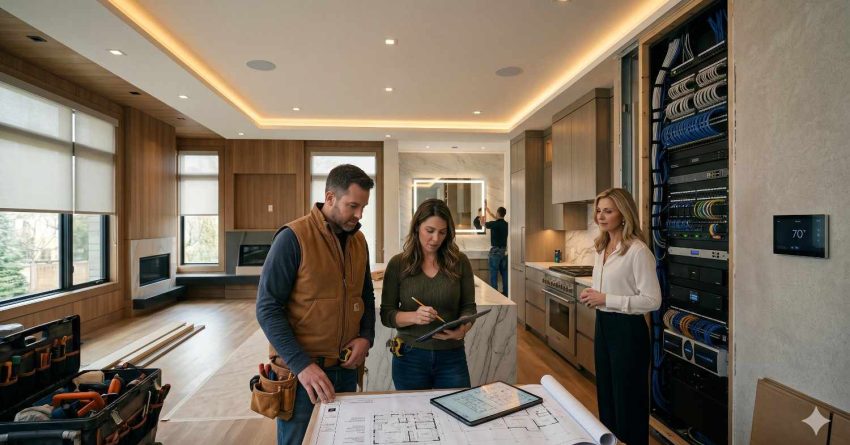
Smart home remodeling is the process of integrating connected technology (automated lighting, climate control, security systems, and high-speed networking) into a home during construction or renovation, building a living environment that responds intelligently to your needs, routines, and energy goals.
Without a smart home strategy built into your remodel, you risk costly retrofits, limited functionality, and a home that falls short of modern buyer expectations in today’s highly connected market.
This complete guide covers smart home infrastructure and pre-wiring, lighting and shades, climate control, security systems, water management, audio and video, home networking, budgeting, installation decisions, permits, and resale value.
What Is Smart Home Remodeling?
Smart home remodeling is the practice of embedding connected technology into a home’s structure during construction or renovation, before walls are closed, ceilings are finished, and fixtures are installed. It is fundamentally different from purchasing smart devices at a retail store and adding them to an existing home.
The core distinction is infrastructure. True smart home remodeling places dedicated network drops at every meaningful location, runs speaker wire inside walls before drywall, pre-wires for motorized window shades during rough-in, installs a structured wiring panel with proper conduit access, and designs conduit routes that can accommodate technology that does not yet exist. These infrastructure investments cost far less during a remodel than they do in any retrofit scenario, and the cost gap widens as the home ages and walls become more finished, insulated, and difficult to access without destructive work.
Infrastructure vs. Gadgets: The Core Distinction
A smart bulb purchased at a hardware store and screwed into an existing socket is not smart home remodeling. A Lutron RadioRA3 system with hardwired keypads, programmed lighting scenes, and integration with motorized shades (installed during the rough-in phase of a kitchen and living room renovation) is. The difference is permanence, reliability, and integration depth.
Smart home decisions fall into two clear categories: infrastructure (what goes in the walls and where it terminates) and devices (what connects to that infrastructure). Infrastructure decisions are made during design and rough-in. Device decisions can be made later, after move-in, as needs and preferences evolve. The costliest smart home mistake made during remodeling is deferring infrastructure decisions until after walls are closed, when every cable run requires invasive, expensive remediation.
Who Benefits From This Guide
This guide is written for homeowners planning a whole home remodel, a kitchen renovation, a room addition, or any renovation project that will open walls and ceilings. It is also relevant to landlords and property managers evaluating smart home upgrades for rental properties, and real estate professionals advising clients on technology-focused pre-listing improvements. Each section of this guide introduces one major smart home category at orientation depth and points to dedicated spoke resources for the detailed specifications and product comparisons that deeper decision-making requires.
Smart Home Infrastructure: Pre-Wire, Protocols, and Hubs
Every smart home remodel begins with infrastructure, and infrastructure decisions must be made before framing walls are closed. Changing them afterward is expensive. Changing them after drywall, paint, and trim are complete is often cost-prohibitive. The three foundational infrastructure decisions are what gets wired in the walls, which wireless protocols will govern device communication, and which hub will serve as the system’s central brain.
Why Infrastructure Decisions Must Come First
The cost of running a Cat6a Ethernet cable to a future access point location during rough-in is negligible: a few dollars in materials and minutes in labor. The cost of fishing that same cable through a finished wall, around insulation, through fire blocking, and under flooring is substantial, often $200 to $600 per run in labor alone. This economic argument applies equally to speaker wire, camera conduit, shade motor wiring, and structured wiring panel placement. Smart home remodeling is fundamentally a timing optimization: doing the right infrastructure work at the right construction phase captures maximum long-term value at minimum immediate cost.
Wireless Protocols: Matter, Thread, Zigbee, and Z-Wave
Modern smart home devices communicate using one of several wireless protocols, and understanding the differences is critical before committing to an ecosystem. Matter is the newest industry-level interoperability standard, designed to allow devices from Apple Home, Google Home, and Amazon Alexa to operate within the same unified network without proprietary hub dependencies. Thread is the low-power mesh networking protocol that Matter runs on top of: it is ideal for sensors, switches, and always-on devices that cannot afford the power draw of Wi-Fi radios. Zigbee and Z-Wave are older and well-proven mesh protocols with extensive device libraries and strong track records in security and lighting applications.
Choosing a wireless protocol is not just a product preference. It determines which devices interoperate natively, whether the hub requires an active cloud subscription to function, and how resilient the system will be as manufacturers update firmware and platforms evolve. Most professional integrators recommend a hybrid approach today: Matter for general IoT devices like sensors, plugs, and locks, paired with a dedicated lighting protocol (typically Lutron’s proprietary Clear Connect RF) for the latency-sensitive lighting system where reliability is non-negotiable.
Wired vs. Wireless Tradeoffs at Scale
A common homeowner misconception is that wireless smart home technology eliminates the need for wired infrastructure. It does not. Wi-Fi access points still require hardwired Ethernet for maximum performance through wired backhaul. Security cameras perform measurably better with Power over Ethernet hardwiring that eliminates batteries and Wi-Fi dependency. Lutron RadioRA3 keypads and dimmers, despite using wireless RF for device communication across rooms, are still hardwired at every switch location for reliable power delivery. The most resilient smart home remodels combine a wired infrastructure backbone (Ethernet homerun cable runs, speaker wire, conduit) with wireless protocols for devices that genuinely benefit from placement flexibility, such as sensors and handheld remotes.
Your smart home pre-wiring plan is the foundational document of your entire integration project; our smart home pre-wire guide [URL TBD] walks through every infrastructure decision from conduit routing strategies to structured wiring panel layout, with room-by-room rough-in specifications and trade coordination checklists.
Smart Lighting and Automated Window Shades
Lighting is the most visible and most immediately appreciated smart home upgrade in any remodel. A well-designed smart lighting plan transforms how a home feels at different times of day, meaningfully improves energy efficiency through occupancy and daylight sensing, and consistently draws positive attention from buyers during showings and appraisals. The remodel window is the optimal moment to make these investments, because walls are open and the incremental cost of proper pre-wiring is minimal.
Smart Bulbs vs. Smart Switches: The Foundational Choice
Smart bulbs replace individual light sources. Smart switches replace the control point at the wall plate. Each approach carries significantly different infrastructure implications and different long-term performance outcomes. Smart bulbs require a continuous power supply to maintain their wireless radio: physically toggling a wall switch cuts power and disconnects the bulb from the network, breaking automations and requiring a reset. Smart switches operate at the wall and work with any connected fixture, including standard replaceable bulbs, halogen, or LED. For whole-home remodels, smart switches are almost universally the more reliable, scalable, and maintenance-friendly choice. They integrate cleanly with multi-location switch configurations (3-way and 4-way circuits), allow full scene control from any location in the home, and avoid the fixture-specific limitations inherent in smart bulb systems.
Lighting Control Systems: Key Players
At the professional installation level, Lutron dominates the reliable segment of the residential market. The Caseta Wireless line is the accessible entry point, using Lutron’s proprietary Clear Connect RF protocol that offers excellent wireless range, extremely low latency, and broad compatibility with Apple HomeKit, Google Home, and Amazon Alexa. The RadioRA3 system is Lutron’s flagship whole-home lighting platform, supporting an unlimited number of devices, hardwired keypad control at any location, and deep integration with virtually every major smart home control platform. Leviton Decora Smart and Legrand Adorne are capable alternatives at lower price points for homeowners who prioritize ecosystem flexibility over system reliability at scale. For homeowners committed to a specific voice assistant or smart home hub ecosystem, compatibility verification before specifying any lighting system is essential: not all smart switches work equally well with all hubs.
Motorized Window Shades: Hardwired vs. Wireless
Motorized window shades represent one of the highest-return smart home investments available during a remodel. Running low-voltage wiring to each window location during rough-in costs very little in materials and labor, but it enables hardwired motorized shades that are significantly more powerful, reliable, and durable than battery-operated alternatives that require periodic battery changes and have limited torque for large or heavy shades. Motorized shades integrate with lighting scenes, time-of-day automations, and whole-home energy management, reducing solar heat gain in summer and convective heat loss through glass in winter. The hardwired versus wireless shade decision must be finalized before drywall is installed — it cannot be easily revisited afterward without opening wall cavities.
For a complete breakdown of every major smart lighting platform including Lutron Caseta and RadioRA3 side-by-side, our smart lighting systems comparison [URL TBD] covers device compatibility, installation requirements, scene programming options, and pricing tiers for every room type and budget level.
Smart Climate Control and Energy Management
Heating and cooling systems are the largest single energy consumers in most American homes, accounting for approximately 50% of total home energy use per U.S. Department of Energy data. Smart climate management, when properly integrated with the HVAC system during a remodel, can deliver meaningful efficiency gains alongside the comfort improvements homeowners most immediately feel.
Smart Thermostats and Zoning Integration
Smart thermostats (Ecobee, Google Nest Learning, Honeywell Home T10 Pro) learn occupancy patterns from motion sensors and scheduling inputs, integrate with local weather forecast data, and enable remote monitoring and system adjustments from any location. The Department of Energy reports that properly configured programmable thermostat systems can reduce heating and cooling energy use by 10–15% annually compared to constant-temperature operation. But the greatest remodel-specific value of smart thermostats comes from pairing them with multi-zone HVAC configurations: dedicated zone dampers, remote temperature and occupancy sensors in each zone, and thermostat wiring routed during rough-in cost a fraction of what post-construction zoning installation requires.
Smart thermostats and zoning controls perform best when the underlying HVAC system is properly sized and configured for the home, which is why the Complete Guide to HVAC in Remodeling [URL TBD] is essential reading before specifying any climate automation equipment for your project.
Smart Energy Panels and Circuit-Level Monitoring
Smart electrical panels (Span and Lumin are the leading residential options in the current market) replace traditional breaker panels with circuit-level intelligence. They display real-time energy consumption by individual circuit, allow remote load management and circuit control, and integrate with solar panel inverters, battery storage systems, and EV charging schedulers. Installed during a remodel or electrical service upgrade, a smart panel costs $4,000–$7,000 fully installed — a meaningful premium over a standard panel — but one that creates a permanent foundation for energy management, demand response participation, and automated load-shedding during grid stress events or time-of-use rate periods.
EV Charging Integration During Remodel
A Level 2 EV charger requires a dedicated 240-volt, 40–60 amp circuit. Installing that circuit during a remodel is a standard electrical rough-in task costing $300–$800 depending on panel location and run length. Installing the same circuit after construction is complete requires opening finished walls, running conduit through the garage, and often upgrading the main electrical panel capacity — a project that commonly costs three to five times more and causes significant disruption to finished spaces. Homeowners without an electric vehicle today should still consider pre-wiring for one during any garage-adjacent remodel; EV adoption rates are accelerating and the infrastructure cost is minimal when the walls are already open.
For a feature-by-feature evaluation of Ecobee, Nest, and Honeywell T10 Pro across integration depth, HVAC compatibility requirements, and zoning capability, our smart thermostats comparison guide [URL TBD] provides the specification-level detail you need to choose the right control point for your remodeled home.
Smart Security, Access Control, and Safety
Security represents the most immediate life-safety dimension of a smart home remodel. Done well during construction, it is unobtrusive, deeply integrated into the home’s infrastructure, and highly reliable under all conditions. Done as an afterthought after construction ends, it is visible hardware mounted to finished surfaces, running on consumer Wi-Fi that drops connectivity at inconvenient moments.
Smart Locks and Video Doorbells
Smart locks (August, Schlage Encode, Yale Assure, Kwikset Halo) replace the deadbolt cylinder while retaining existing door hardware, or replace the entire entry assembly for deeper integration with access control systems. They enable keyless entry via phone or keypad, guest access codes with time-limited permissions, auto-lock functions tied to departure routines, and integration with video doorbells and smart home hubs. Pre-wiring door locations for low-voltage power during the remodel dramatically improves smart lock performance compared to battery-only alternatives that require frequent battery management. Video doorbells (Ring Pro, Nest Doorbell Wired, Arlo Video Doorbell) capture visitor footage, trigger automations on arrival detection, and integrate with security monitoring systems. Hardwired video doorbells are consistently more reliable, image-quality, and feature-rich than battery-powered equivalents and should always be specified when the relevant wall cavity is already open during a remodel.
Security Cameras: Wired vs. Wireless
Hardwired Power over Ethernet cameras represent the professional standard for whole-home perimeter surveillance. A single Cat6 cable to each camera location provides both power delivery and data transmission through a single run, eliminating batteries, Wi-Fi dependency, and the connectivity failures that inevitably occur with wireless cameras during the moments when security matters most. Camera placement decisions — covering all entry points, driveways, garage approaches, and perimeter zones — must be made during the framing phase of construction. Running a homerun Cat6 cable to each planned camera location during rough-in adds negligible cost to the project. Wireless cameras (Arlo, Ring, Eufy) provide simpler installation and flexible repositioning but introduce battery maintenance cycles and intermittent Wi-Fi reliability issues that become apparent under real-world conditions.
Smart Smoke, CO, and Safety Detectors
Hardwired, interconnected smoke and carbon monoxide detectors are code-required in most US jurisdictions during any significant remodel that opens wall and ceiling cavities. Smart detectors (Nest Protect is the most capable residential option) add remote monitoring via mobile app, voice-specific location alerts identifying which room triggered the alarm, and integration with HVAC systems for automatic air handler shutoff and with smart lighting systems for visual guidance during an alarm event. These devices must be hardwired with proper interconnect wiring during the rough-in phase. Battery-only smart detectors are not code-compliant in most remodel scenarios where walls and ceilings are opened, and the interconnect wiring required for hardwiring cannot be added retroactively to finished spaces without reopening surfaces.
Our smart security systems comparison [URL TBD] evaluates every major monitoring platform (ADT, Ring Alarm, SimpliSafe, and professionally monitored systems) across monitoring contract terms, device compatibility, integration with smart home hubs, and total five-year cost of ownership.
Smart Water Management and Leak Detection
Water damage is among the most costly home insurance claims in the United States. According to the Insurance Information Institute, water damage and freezing account for approximately 24% of all homeowner insurance claims by frequency, making it the second most common claim category. Smart water management systems installed during a remodel address this exposure directly and at a cost that is dramatically lower than any post-damage remediation scenario.
Whole-House Leak Detection Approaches
Two primary technology approaches address whole-home water risk. Flow monitoring systems (Moen Flo, Phyn Plus) connect to the main water supply line and continuously detect abnormal flow patterns that indicate leaks, including slow drips behind finished walls that would otherwise go undetected for months. Sensor-based systems (Notion, Govee, LeakSmart) place wireless or wired sensors at every high-risk point: under sinks, near water heaters, behind washing machines, in mechanical rooms, in crawl spaces, and at basement floor drains. Combining both approaches provides layered protection appropriate for any home with significant finished space. Motorized shutoff valves installed on the main water supply enable automatic water shutoff when a flow anomaly is detected, limiting a minor pipe failure to a manageable inconvenience rather than a catastrophic loss event.
Smart Irrigation and Water Conservation
During any exterior remodel that involves landscaping, hardscape, or plumbing access, installing a smart irrigation controller (Rachio 3, RainBird Smart WiFi) integrates with local weather forecast and real-time rainfall data to skip or reduce irrigation cycles automatically during rain events. Per EPA WaterSense program data, smart irrigation controllers reduce outdoor water use by 30–50% compared to conventional timer-based controllers, a meaningful annual operating cost reduction in regions with warm, dry growing seasons and municipal water pricing that reflects true water scarcity.
For a complete walkthrough of every smart water system from main-line flow monitors to under-sink sensor arrays and automated shutoff valves, our whole-house leak detection guide [URL TBD] covers installation requirements, system costs, and integration with every major smart home platform currently on the market.
Whole-House Audio, Home Theater, and Outdoor Entertainment
Entertainment infrastructure is among the most frequently regretted omissions in finished remodels. Homeowners who choose not to pre-wire for speakers, televisions, and audio control systems during a remodel consistently face significantly higher costs to retrofit those capabilities afterward, or simply live without features they wanted from the beginning of the project. The in-wall wiring and conduit that enable these systems cost very little during rough-in compared to any post-construction alternative.
Distributed Audio Architecture Options
A distributed audio system enables independent music playback in every room of the home, managed from a smartphone, tablet, or voice assistant. Two primary architectures serve this function. A centralized amplifier approach uses a rack-mounted multi-channel amplifier (Sonos Amp, Denon HEOS Drive) with dedicated speaker wire runs to each listening zone, providing full amplification at the source. A distributed node approach places individual smart speakers or zone amplifiers in each room that stream audio independently (Sonos Era 100/300, Nuvo Players), relying on the home network rather than dedicated speaker wire for audio routing. Both architectures require pre-wired infrastructure during the remodel: the centralized approach needs homerun speaker wire runs to each zone, while the distributed approach needs Ethernet to each node location for wired network reliability. The architecture choice should be made before rough-in to ensure the correct wiring is installed.
Home Theater Pre-Wire Essentials
A dedicated home theater or media room requires several specific rough-in elements that must be specified before walls close: HDMI cable runs from the display location to a source equipment rack (or from a rear projector shelf to a front screen), conduit for future HDMI and power cable upgrades, speaker wire to all surround sound positions (5.1, 7.1, or Atmos height channels as appropriate), and subwoofer cable runs. A critical technical specification: 4K HDMI 2.1 signals degrade significantly over passive cable runs longer than 25 feet, requiring active HDMI cable or fiber optic HDMI for longer distances. This specification must be known during rough-in to ensure conduit sizing accommodates the correct cable diameter. Running conduit rather than naked cable at every run provides the flexibility to upgrade cables as display technology advances beyond current 8K and high-refresh-rate standards.
Outdoor Entertainment Infrastructure
Outdoor speakers, weatherproof display screens, and outdoor Wi-Fi access points all require specific wiring that must be installed during any exterior remodel or landscaping project. UV-rated direct burial speaker wire, PoE Ethernet runs to planned outdoor access point mounting locations, and weatherproof conduit for power and control wiring must be specified during the construction phase. Retroactively running these systems through finished exterior walls, around landscape plantings, and under hardscape is labor-intensive, often requires reopening significant sections of exterior finishes, and rarely produces a clean or professional result.
Our whole-house audio systems guide [URL TBD] covers every distributed audio architecture from basic Sonos multi-room configurations to professional whole-home amplification systems, with wiring specifications, amplifier sizing guidelines, and speaker placement principles for every room type and outdoor zone.
Home Networking, Structured Wiring, and Future-Proofing
Every system in a smart home depends on the network. A poorly planned home network is the single most common root cause of smart home underperformance. Dropped device connections, delayed scene execution, streaming failures, and dead wireless zones in specific rooms almost always trace back to inadequate networking infrastructure. Most of that infrastructure must be placed during the remodel, because retrofitting it through finished construction is difficult and expensive.
Cat6a vs. Fiber: Pre-Wire for Lasting Bandwidth
Cat6a is the current recommended standard for residential Ethernet pre-wiring. It supports 10 Gbps data speeds at cable runs up to 100 meters, far exceeding current consumer router capabilities but appropriately specified given the 10-to-20-year lifespan of in-wall wiring. Cat6 (without the “a” designation) remains acceptable for most runs under 55 meters but limits future bandwidth potential. For homerun runs over 100 meters or for homeowners who want to future-proof against 25+ Gbps networking standards that are beginning to emerge at the consumer level, single-mode fiber to the structured wiring panel is worth specifying, as fiber materials cost relatively little and the installation labor is the same as copper.
The physical infrastructure that carries data through your walls (cables, conduit, and structured wiring panels) is core MEP work, and the Complete Guide to MEP Systems in Remodeling [URL TBD] explains how electrical, low-voltage, and data systems must coordinate during a remodel to avoid costly trade conflicts and ensure proper code compliance at every inspection stage.
Wi-Fi Mesh vs. Wired Access Points
Consumer mesh systems (Eero Pro, Google Nest WiFi Pro, Netgear Orbi) are convenient and widely available, but they rely on wireless backhaul between mesh nodes unless specifically configured with wired Ethernet connections to each unit. Wireless backhaul introduces latency and reduces throughput for every node beyond the primary router. Wired access point systems (Ubiquiti UniFi, TP-Link Omada, Cisco Meraki for residential applications) use hardwired Ethernet backhaul to deliver full-rated wireless performance at every access point in the network, regardless of distance from the router or number of walls between nodes. The performance difference is meaningful and grows with home size, occupant density, and simultaneous device count. In any home over 2,500 square feet, running homerun Cat6a from the structured wiring closet to each planned access point location is one of the highest-return low-voltage infrastructure investments available during a remodel.
Structured Wiring Panel and Conduit Strategy
The structured wiring panel is the central termination point for every low-voltage system in the home: Ethernet, coaxial (satellite or cable distribution), speaker wire, alarm system wiring, and security camera cable runs. Properly sized (a 24-port panel is appropriate for a 3,000 square foot home; larger panels for larger homes) and positioned in a utility room, mechanical closet, or dedicated technology closet with conduit access to exterior building entry points, it enables any low-voltage system to be reconfigured, upgraded, or replaced without opening finished walls. Running conduit rather than naked cable from the panel to key future-expansion points (planned exterior camera mounting locations, potential EV parking stall positions, future room addition walls) is the most cost-effective future-proofing investment available during any remodel or new construction project, and it is nearly impossible to add retroactively without destructive renovation.
Our home networking pre-wire guide [URL TBD] provides room-by-room Ethernet port counts, access point placement standards, structured wiring panel sizing recommendations, and conduit routing diagrams for homes of every size, with specifications covering both current-generation Cat6a and future-ready single-mode fiber installations.
Planning, Phasing, and Budgeting a Smart Home Remodel
The most important strategic decision in a smart home remodel is deciding what to do at each phase of construction. Infrastructure (conduit routing, cable homerun runs, junction box locations, structured wiring panel placement) goes in during framing and rough-in. Device installation and system commissioning happen at the finish phase and after move-in. These two categories of work are separated by weeks or months, and treating them as the same decision creates both cost inefficiency and missed infrastructure opportunities.
When to Plan Smart Home Work in the Remodel Sequence
Smart home planning should begin during the design phase, concurrent with architectural drawings and before permits are submitted for plan review. The reason is practical: smart home infrastructure requires conduit routes, wall penetrations, panel locations, and rough-in electrical specifications that must appear on the electrical drawings submitted to the building department for review. Changes requested after framing is complete cost significantly more because they require moving structural elements and coordination with multiple trades. Changes made after drywall is installed often require wall opening. Changes made after paint and trim are done are always destructive and expensive.
Realistic Budget Ranges for Smart Home Systems
Smart home remodel budgets span an extremely wide range based on scope, specification level, home size, and regional labor rates. The following ranges represent typical installed costs in US metropolitan markets:
- Basic pre-wire infrastructure package (Ethernet to key rooms and exterior camera positions, speaker wire to main living areas, camera conduit runs, structured wiring panel installation): $3,000–$8,000 for a typical single-family home under 3,000 square feet
- Mid-range integrated system (smart lighting throughout, smart thermostat with zoning, hardwired security cameras and monitoring, whole-home Wi-Fi, two-zone distributed audio): $15,000–$35,000 fully installed and commissioned
- Comprehensive whole-home automation (Lutron RadioRA3 lighting control, full distributed audio with professional amplification, professional security with monitoring contract, smart panel with solar and battery integration, dedicated home theater AV): $50,000–$150,000 and above
For complete budgeting frameworks, financing options including HELOC and cash-out refinancing, and cost-by-category breakdowns appropriate for every project scale, the Complete Guide to Remodeling Budgets, Costs and Financing [URL TBD] provides the financial planning structure every homeowner needs before committing to any remodel scope.
DIY vs. Professional Smart Home Installation
Smart home work spans a wide spectrum of DIY accessibility, and the distinction between accessible and inaccessible tasks is not always obvious from the outside. Replacing a single smart switch, programming a smart thermostat, configuring a smart lock, or adding a smart bulb to an existing fixture are genuinely accessible to a competent homeowner with basic tools and patience for the configuration process. Programming a Lutron RadioRA3 system with dozens of keypads and scenes, configuring a UniFi enterprise wireless network with access point placement optimization, calibrating a 7.1 surround sound system, or commissioning a structured wiring panel with proper cable management are professional-level tasks that require specialized tools, software, and trained experience that most homeowners and general contractors simply do not have.
The most expensive smart home mistakes happen when homeowners or general contractors attempt professional-level programming without the correct tools and training. A misconfigured whole-home lighting system requires a Lutron-certified dealer to diagnose and reprogram. An improperly configured wireless network creates months of intermittent failures that are difficult to isolate and require professional network analysis tools to resolve. The most cost-effective approach for any whole-home smart remodel is clear: hire a licensed low-voltage integrator or AV professional for infrastructure installation, system programming, and full commissioning. Self-manage device app configuration, automation rule adjustments, and accessory additions over time after the system is properly established.
Our DIY vs pro-installed cost guide [URL TBD] breaks down which smart home tasks are genuinely accessible to competent homeowners, where professional installation provides irreplaceable value that no amount of online research replaces, and how to structure a project so every professional installation dollar is directed toward work that matters most.
Permits and Code Compliance for Smart Home Work
Smart home remodeling intersects with electrical and low-voltage building code in ways that consistently surprise homeowners, property managers, and general contractors who do not specialize in this work category.
Line-voltage electrical work (installing smart switches, smart dimmers, a smart panel, an EV charging circuit, or hardwired security camera power) is permitted and inspected electrical work in virtually every US jurisdiction and requires a licensed electrician in most states. Low-voltage work (running Cat6 Ethernet cable, speaker wire, coaxial cable, or security sensor wiring) generally does not require a building permit in most jurisdictions, but requirements vary by municipality, project scope, and whether the work modifies an existing fire alarm system. Smart smoke and CO detectors installed as part of any remodel that opens wall and ceiling cavities must meet current hardwiring requirements under NEC Article 210 and local smoke detector interconnect code, which typically requires a minimum of one interconnected detector in each sleeping area, hallway, and floor level. NEC 2020 and NEC 2023 (adopted in most US states) impose AFCI (Arc Fault Circuit Interrupter) protection requirements that affect smart switch and dimmer installation in older wiring systems, requiring attention and coordination from the rough-in electrician before smart devices are specified.
Ignorance of these requirements creates inspection failures, homeowners insurance complications in the event of a claim, and legal liability exposure that no amount of cost savings justifies. The Complete Guide to Remodeling Permits, Codes and Inspections [URL TBD] provides a comprehensive framework for understanding which remodel activities require permits, how to work productively with local building departments, and what to expect at every rough and final inspection stage for both electrical and low-voltage smart home work.
Smart Home ROI and Resale Value
Smart home features are an increasingly meaningful factor in buyer decisions across the United States. According to the National Association of Realtors, smart home technology consistently ranks among the features that Millennial and Gen Z buyers rate as important during their home search, with a measurable positive influence on showing interest and offer price in competitive markets where these buyer cohorts dominate.
The smart home features that most reliably influence buyer behavior are practical, immediately verifiable, and professionally installed: smart thermostats demonstrating responsive climate control during a showing, hardwired security camera systems visible at perimeter and entry locations, whole-house Wi-Fi infrastructure confirmed during the inspection process, and smart video doorbells that buyers can test at the front door. These are features that buyers experience during the showing and verify during a home inspection, creating tangible perceived value rather than unverifiable sales promises.
Infrastructure investments, specifically pre-wired networks, structured wiring panels, and conduit runs, do not produce direct appraisal premiums because they are invisible during a showing and most buyers and appraisers do not know to evaluate them. However, visible and functioning smart systems built on that infrastructure do positively influence sale prices. The critical distinction for resale value is professional installation quality. Visible wire management failures, proprietary apps that buyers cannot navigate during a showing, and subscription-based services with unclear transfer terms create friction and raise buyer questions rather than adding value.
The Complete Guide to Remodeling for ROI and Resale [URL TBD] covers buyer behavior data, appraiser valuation methods, and prioritization frameworks for pre-sale investments, with a dedicated section analyzing which smart home features produce measurable and verifiable returns at closing.
Conclusion
Smart home remodeling connects every system: lighting, climate, security, networking, water, and entertainment into a unified environment that elevates daily living and property value.
Each spoke page in this cluster goes deeper into every system, giving you detailed comparisons and specifications to make confident, well-informed decisions.
Ready to build a smarter home? Contact Mr. Local Services to connect with experienced remodeling professionals who deliver quality results from infrastructure to final device.
Frequently Asked Questions
What is smart home remodeling?
Smart home remodeling integrates connected technology into a home’s structure during construction or renovation. It builds reliable systems into walls before they close, rather than adding devices to finished surfaces afterward.
When should you plan smart home integration during a remodel?
Smart home planning must begin during the design phase, before framing is complete. Infrastructure decisions (conduit routes, cable runs, panel locations) must be finalized before walls close.
What is the difference between smart bulbs and smart switches?
Smart bulbs replace individual light sources; smart switches replace the control point at the wall. For whole-home remodels, smart switches are generally the more reliable and scalable choice.
Do smart home systems require a permit?
Line-voltage work (smart switches, EV chargers, smart panels) requires an electrical permit in most jurisdictions. Low-voltage wiring (Cat6, speaker wire) generally does not, but rules vary by municipality.
How much does a smart home remodel cost?
Basic smart home pre-wiring runs $3,000–$8,000 for a typical home. A mid-range system including smart lighting, thermostat, security, and audio costs $15,000–$35,000 fully installed.
What smart home protocol should I choose?
Matter is the emerging interoperability standard supported by Apple, Google, and Amazon — the safest long-term choice. For lighting control, Lutron’s proprietary RF system offers unmatched reliability.
Does smart home technology increase resale value?
Visible, professionally installed features (smart thermostats, hardwired security, whole-house Wi-Fi, video doorbells) positively influence buyer decisions, particularly among Millennial and Gen Z buyers in active markets.