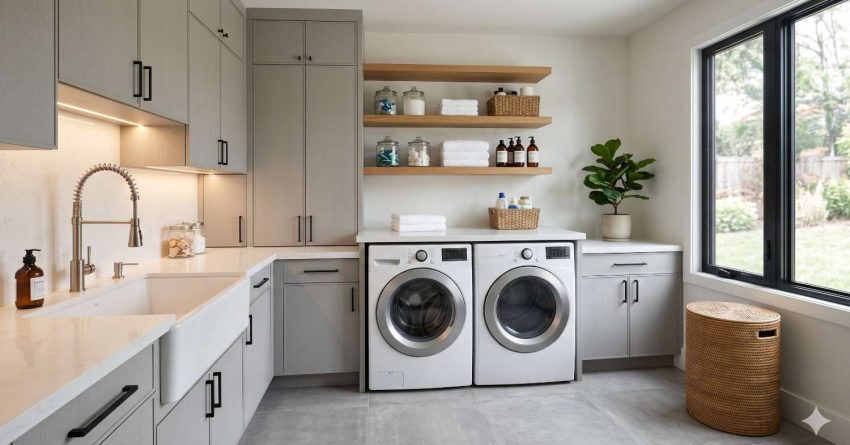
A laundry room remodel is the process of redesigning, relocating, or rebuilding a dedicated washer-and-dryer space to improve function, capacity, storage, safety, and home value. For most homeowners, landlords, and property managers, the laundry room is the most-used utility space in the house — yet it is usually the least planned, leading to wasted square footage, dryer vent hazards, and missed resale upside.
Skipping a thoughtful plan now usually means leaks, code violations, awkward layouts, and a costly second remodel within a decade — exactly the outcomes a clear strategy prevents.
This guide covers laundry room types and locations, layout principles, storage systems, plumbing and electrical, ventilation, finishes, costs, permits, common mistakes, ROI, and pointers to deeper resources at every step.
Understanding Laundry Room Types & Locations
Laundry spaces fall into three broad categories: laundry closets, dedicated laundry rooms, and combo rooms that share space with a mudroom, kitchen, or bathroom. The right choice depends on your home’s size, plumbing infrastructure, and how much laundry your household actually generates.
Location is the second big decision. Basement laundry is the most common and the cheapest to plumb but adds stair carries. Main-floor laundry sits close to where people live but eats valuable square footage. Upstairs laundry — now standard in new construction — places the appliances near bedrooms where most clothes originate, but requires waterproof pans, leak sensors, and reinforced floor framing to meet code and protect lower levels.
According to recent National Association of Home Builders research, upstairs laundry placement is one of the top three most-requested features among buyers under 45, while basement laundry consistently ranks lowest in buyer preference surveys. That gap matters for resale planning, especially if you live in a two-story home with an aging basement layout.
The combo approach — mudroom-laundry, kitchen-laundry, or bathroom-laundry — is increasingly popular in smaller homes and ADUs where dedicated rooms are not realistic. Each combo introduces its own ventilation and noise tradeoffs.
Choosing where your washer and dryer live is one of the highest-impact decisions in the entire project, and our complete laundry room location guide walks through the tradeoffs of basement, main floor, and upstairs placement so you can match the right location to your household.
Laundry Room Layout & Design Fundamentals
A well-designed laundry layout balances five things: appliance clearance, folding counter space, hanging storage, traffic flow, and access for repair technicians. Get any one wrong and the room becomes frustrating to use every single day.
Standard front-load washers and dryers need roughly 28 inches of width each plus 1 inch of side clearance, with at least 36 inches of clear floor space in front for door swing and loading. Top loaders require more vertical clearance — usually 24 to 30 inches above the lid — which often dictates whether upper cabinets will work in the space.
The four most common configurations are:
- One-wall layout — appliances, counter, and storage along a single run, ideal for closets and narrow rooms
- Galley layout — appliances on one wall, counter and storage opposite, with a 42- to 48-inch aisle
- L-shaped layout — adds a folding zone perpendicular to the appliance wall
- U-shaped layout — full wraparound found in large dedicated laundry rooms
Counter height for folding is typically 36 inches, matching kitchen counters. Add a 24-inch-deep counter directly over front-loading machines and you instantly gain a folding station without losing floor space. Hanging rods should sit 65 to 72 inches from the floor for adult clothing.
Stacked configurations save roughly 28 inches of floor width but require a dedicated stack kit and reduce future flexibility if you switch to top-load appliances later.
If you are working with limited square footage, our dedicated guide to small laundry room layouts breaks down clearance rules, stacked configurations, and proven floor plans that maximize every inch under 30 square feet.
Storage Systems That Make Laundry Easier
Storage is what separates a functional laundry room from a frustrating one. The most successful remodels include four storage zones: a sorting zone for hampers, a supply zone for detergent and household goods, a hanging zone for air-drying, and a retrieval zone where folded laundry waits to go upstairs.
Cabinets are the traditional solution and offer a clean look, hidden mess, and consistent visual lines with the rest of the home. Open shelving costs less, gives quick access, and works well in tight closets — but it shows dust, lint, and clutter quickly.
Pull-out hampers built into base cabinetry have become a defining feature of higher-end laundry remodels. A standard configuration uses two or three pull-outs labeled by color or family member, eliminating loose baskets on the floor. Built-in ironing boards, drying racks that fold into a cabinet face, and pull-down hanging rods are similarly worthwhile in mid-range and upscale builds.
Vertical storage matters most in narrow rooms. Tall cabinets to the ceiling, hooks on the back of the door, and over-appliance shelving turn dead air into usable space. Pet-owning households often add a built-in dog wash station — a low-curb shower or deep utility sink with a sprayer — which doubles as a mop-fill and rinse station for muddy boots.
For homeowners ready to compare specific built-ins and modular kits, our review of laundry room organization systems ranks the best hamper, shelving, and rod solutions by budget tier and room size.
Plumbing & Electrical Considerations
Plumbing and electrical work account for the largest hidden costs in any laundry remodel — especially if you are relocating. A typical washer needs hot and cold water supply lines, a 2-inch standpipe drain, a P-trap, and a vent stack tied into the main DWV system. A dryer needs either a dedicated 240-volt 30-amp circuit (electric) or a gas line plus a 120-volt 15-amp outlet (gas).
Modern code requires a few features that older homes often lack:
- A washer pan with a drain to catch supply hose failures
- A recessed washing machine outlet box (or “washer box”) for clean connections
- A leak sensor or automatic shutoff valve, especially on upper floors
- A dedicated 20-amp 120-volt circuit for the washer
- GFCI protection in most jurisdictions
- A floor drain or pan drain that ties into the DWV system on upper-floor installations
Because moving a washer and dryer crosses every major trade, our broader resource on MEP systems in remodeling explains how electrical loads, water lines, and venting decisions interact across a project.
Gas-versus-electric dryer choice deserves real attention. Gas dryers cost more upfront and require a gas line and ventilation, but they typically dry loads 20–30% faster and operate at lower energy cost in most regions. Heat-pump dryers — increasingly common in compact and apartment installations — run on standard 120-volt circuits, require no exterior venting, and qualify for federal energy rebates under current Inflation Reduction Act provisions, but cost roughly twice as much and dry more slowly.
Upstairs laundry rooms need particular attention to drainage. Code in most jurisdictions requires a waterproof pan with its own drain line routed to a floor drain or laundry standpipe, not to a sink trap. Cutting corners here is how thousand-dollar leaks become fifty-thousand-dollar ceiling repairs.
If relocation is on the table, our detailed breakdown of the moving a laundry room cost explains real-world plumbing rerouting, dedicated 240V circuits, and venting expenses you should budget for before committing.
Ventilation, Dryer Vents & Air Quality
Laundry rooms produce more moisture per square foot than almost any other space in the home except bathrooms. Without proper ventilation, that moisture leads to peeling paint, swollen trim, mildew behind drywall, and — in worst cases — structural rot in floor joists.
The dryer vent itself is the single highest-risk component in any laundry room. The U.S. Fire Administration attributes roughly 2,900 home fires annually to clothes dryers, with failure to clean and improper venting cited as the leading causes. Code requires rigid metal duct (never flexible foil), runs limited to 25 feet minus 5 feet per 90-degree elbow, and a backdraft-protected exterior termination — not into the attic, soffit, or crawl space.
Beyond the dryer vent, the room itself needs general ventilation. A small exhaust fan rated at 50 to 80 CFM, controlled by a humidity sensor, handles ambient moisture from wet clothes and the washer drum. Make-up air becomes important in tight, energy-efficient homes where exhaust fans can depressurize the space.
Heat-pump dryers change this calculation. Because they do not vent to the exterior, they release moisture and warm air into the room itself, making general room ventilation and a small dehumidifier far more important than they would be otherwise.
For step-by-step duct routing, makeup air sizing, and mold prevention, our complete reference on laundry room ventilation best practices covers everything code requires and several upgrades that go beyond minimum compliance.
Finishes, Flooring & Material Choices
Laundry room finishes need to do three things at once: resist water, hide wear, and look intentional. The room sees standing water risk, detergent spills, lint dust, and heavy appliance vibration — so material choices that work in a bathroom or kitchen do not always translate.
Flooring is the most consequential finish decision. Porcelain tile is the gold standard for durability and water resistance but feels cold underfoot and adds substantial weight on upper floors. Luxury vinyl plank (LVP) has become the most popular mid-range choice — fully waterproof, warm, quiet under appliances, and far less expensive than tile. Sealed concrete works well in basement installations. Hardwood and laminate should be avoided entirely; both swell and delaminate when exposed to even small leaks.
Wall finishes deserve more thought than they usually get. Semi-gloss or satin paint resists splashes and wipes clean. Wainscoting or beadboard adds visual interest and protects the lower wall from cart bumps. Some homeowners install a tile or LVP backsplash behind the washer to catch overspray.
Countertops over the appliances — typically quartz, butcher block, or laminate — should overhang the machines by at least 1 inch and resist heat from dryer surfaces. Quartz is the most popular choice for mid-range and upscale remodels because it handles spills, heat, and visual scrutiny equally well.
Color palettes have moved toward warm whites, sages, and muted blues, with brass or matte black hardware. Avoid trendy patterns that will date the room within five years — laundry rooms are difficult to refresh cosmetically without major work.
Because flooring choice directly affects leak resilience and resale appeal, our complete guide to the best flooring for laundry rooms compares porcelain tile, luxury vinyl plank, and sealed concrete on durability, water resistance, and long-term cost.
Cost, Timeline & Permits
Laundry room remodel cost varies more than almost any other room project because the scope ranges from a $1,500 paint-and-storage refresh to a $30,000 full relocation with new plumbing, dedicated circuits, custom cabinetry, and high-end finishes.
A realistic 2025 cost framework looks like this:
| Scope | Typical Cost | Timeline |
| Cosmetic refresh (paint, shelving, hardware) | $1,500 – $3,500 | 3–7 days |
| Pull-and-replace (same location, new finishes + appliances) | $5,000 – $12,000 | 1–2 weeks |
| Full remodel (cabinetry, counters, flooring, fixtures) | $10,000 – $20,000 | 2–4 weeks |
| Relocation or new build-out | $15,000 – $30,000+ | 3–6 weeks |
Permits are required for most work beyond cosmetic refresh. Adding a circuit, moving water lines, cutting a new dryer vent through exterior cladding, or relocating the entire room triggers plumbing, electrical, and sometimes building permits. Inspections typically occur at rough-in and final.
Because relocating fixtures almost always triggers inspections, our wider remodeling permits and codes guide explains the building, plumbing, and electrical permits you may need beyond a basic laundry refresh.
Hidden costs that surprise homeowners include subfloor reinforcement for upstairs installations, dedicated 240V circuit runs from distant panels, dryer vent rerouting through finished ceilings, and asbestos or lead paint abatement in pre-1980 homes. A 15% contingency is the minimum any laundry remodel budget should carry.
For a full pricing breakdown by scope, region, and finish level, our laundry room remodel cost in 2025 report details realistic ranges from $2,000 refreshes to $25,000 full builds.
Common Mistakes, ROI & Real-World Results
The most common — and most expensive — laundry room mistakes share a pattern: they prioritize aesthetics over function. Beautiful rooms with no folding counter, hidden hampers without ventilation behind them, and stunning tile floors with no drain become daily frustrations within months.
The top mistakes to avoid:
- Skipping the washer pan and leak sensor on upper floors
- Installing flexible foil dryer ducting (code violation and fire hazard)
- Choosing flooring that cannot handle a full washer flood
- Forgetting a folding counter or making it too narrow (under 18 inches)
- Underspecifying electrical, then needing a service upgrade later
- Putting the appliances behind a door swing
- Skipping ventilation entirely
ROI on laundry remodels is real but modest. National appraisal data places typical recovery at roughly 60% to 80% of cost at resale, with the highest returns coming from converting unused closets into laundry rooms, adding upstairs laundry in two-story homes, and modernizing 1980s-era basement laundry into bright, functional spaces. Luxury builds — heated floors, custom cabinetry, designer fixtures — recover less because most buyers do not pay a premium for those features.
If you are weighing this project against other upgrades before selling, our broader resource on remodeling for ROI and resale ranks return on investment across every common project type.
The biggest ROI lever is location change. Moving from a dim basement to a dedicated main-floor or upstairs space consistently moves home valuations, while a cosmetic refresh of an already well-placed laundry room mostly improves daily quality of life.
For appraisal-backed data on which features actually move offers, our analysis of laundry room ROI in home sales shows which upgrades buyers reward and which fail to recover their cost.
Conclusion
A well-planned laundry room remodel integrates layout, plumbing, electrical, ventilation, storage, and finishes into a single coordinated project that serves your household for decades.
Every decision — from location and appliance type to flooring and storage — sits within a broader topical map of remodeling choices, and the deeper resources linked throughout this guide expand each section further.
We help homeowners and property managers turn that plan into reality. Connect with a vetted laundry room specialist through Mr. Local Services and start your project with confidence.
Frequently Asked Questions
How much does a laundry room remodel cost in 2025?
Most homeowners spend between $5,000 and $20,000 on a laundry room remodel. Cosmetic refreshes start near $1,500, while full relocations with new plumbing exceed $25,000.
Do I need a permit to remodel my laundry room?
Cosmetic refreshes rarely need permits, but adding circuits, moving plumbing, cutting new dryer vents, or relocating the room almost always requires plumbing, electrical, or building permits and inspections.
Is upstairs laundry safe in a two-story home?
Yes, when properly built with a waterproof pan, dedicated drain, leak sensor or automatic shutoff valve, and reinforced floor framing. Cutting corners on any of these creates serious leak risk.
What is the best flooring for a laundry room?
Porcelain tile and luxury vinyl plank are the top choices because both are fully waterproof and durable. Avoid hardwood and laminate, which swell and delaminate when exposed to leaks.
Should I get a gas or electric dryer?
Gas dryers run faster and cheaper but need a gas line and venting. Electric is simpler and cheaper to install. Heat-pump electric dryers need no venting and qualify for rebates.
Can I combine my laundry with another room?
Yes — mudroom, kitchen, and bathroom combos work well in smaller homes. Each combo introduces ventilation and noise tradeoffs, so plan exhaust, sound insulation, and storage carefully.
How long does a laundry room remodel take?
A cosmetic refresh takes under a week. Pull-and-replace runs one to two weeks. A full remodel takes two to four weeks. Relocations or new build-outs typically take three to six weeks.