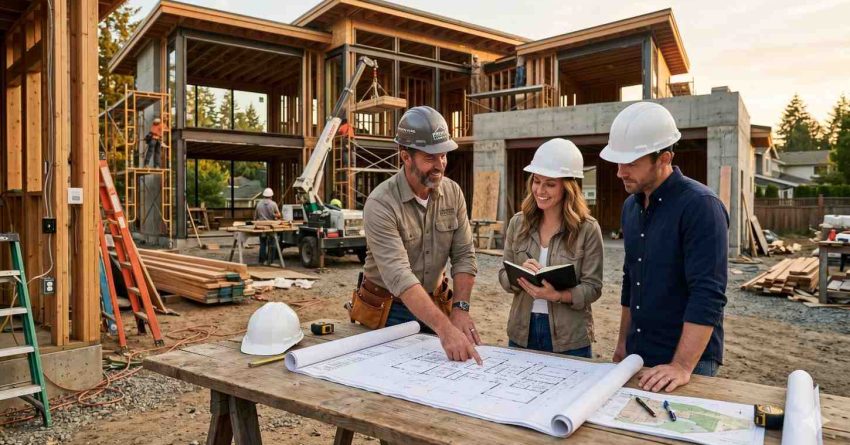
Hiring a home builder is one of the most consequential decisions in residential construction: the right builder executes your vision on time and within budget, while the wrong one causes delays, cost overruns, legal disputes, and lasting structural damage.
Choosing poorly costs homeowners tens of thousands in disputes, defects, and construction delays, risks that a structured and informed builder selection process can eliminate before a single permit is pulled.
This complete guide covers builder types, vetting checklists, contract structures, red flags, communication best practices, change order management, specialty builder comparisons, dispute resolution, and location-based builder resources across the USA.
What Is a Home Builder? Types, Roles, and Specialties
A home builder is a licensed contractor who manages the design coordination, permitting, subcontractor hiring, scheduling, and physical construction of a residential structure from site preparation through certificate of occupancy. Builders are not a monolithic category. Each builder type operates under a different business model, serves a different project profile, and comes with different tradeoffs in cost, control, and customization. Mismatching your project with the wrong builder type is one of the most common and costly hiring mistakes homeowners make.
The major home builder types:
- Custom home builders — Build from your unique plans on land you own; highest personalization, highest cost, longest timelines
- Production (spec/tract) builders — Construct standardized homes in planned communities; faster, lower cost, limited design flexibility
- Design-build firms — Handle both architecture and construction under one contract; single point of accountability for the entire project
- Semi-custom builders — Offer predefined plan libraries with limited structural modifications; midpoint between full custom and production
- General contractors — Manage subcontractors across various project types; may lack residential-specific systems compared to dedicated home builders
Your project type determines which builder category to target. A fully custom build on raw land requires a different builder than a production subdivision home, a prefab delivery, or an ADU addition behind an existing residence. Building on the wrong assumption about which category serves your project wastes time, money, and negotiating leverage before the first shovel breaks ground.
Understanding the distinction between a custom home builder and a general contractor — including how each is licensed, how each manages subcontractors, and how accountability is structured across the build — is foundational before you begin interviewing candidates; our detailed comparison of custom home builder vs general contractor walks through every dimension you need to know before signing anything.
How to Find a Qualified Home Builder
Finding strong builder candidates requires more than a Google search. The best residential builders are often discovered through professional referrals, trade associations, and direct portfolio verification rather than paid directories or advertising channels that reward visibility over performance.
Effective builder search channels:
- NAHB Member Directory — The National Association of Home Builders maintains a searchable database of member builders organized by state and specialty
- State home builder associations — Most states maintain local chapters with vetted member rosters and disciplinary oversight
- Architect and lender referrals — Design professionals and construction lenders work with builders regularly and know who actually delivers
- Real estate attorney referrals — Construction attorneys who handle disputes quickly learn which builders rarely generate them
- BuildZoom — Verifies license status and aggregates permit history for pattern recognition
- Completed home tours — Visiting homes a builder completed 2–3 years ago reveals long-term durability far better than a polished model home ever can
Once you have a shortlist, require that every candidate provide a minimum of five client references from projects completed within the last two years and call every reference. Ask specifically about communication responsiveness, change order handling, punchlist resolution time, and whether they would hire that builder again without hesitation.
When you are ready to move from research to direct contact, our home builder near me locator connects you with licensed, vetted builders active in your specific jurisdiction and ready to bid on your project.
Online ratings are easily manipulated and require careful interpretation; our guide to reading builder reviews between the lines shows you exactly which signals indicate genuine quality and which patterns reveal reputation management rather than real performance.

Vetting and Qualifying Your Builder
Vetting is the structured due-diligence process that separates qualified professionals from high-risk contractors. This step is never optional. According to the U.S. Federal Trade Commission, unlicensed contractor fraud costs American consumers an estimated $17 billion annually, with residential new construction among the highest-risk categories.
A thorough vetting process covers four pillars: licensure, insurance, financial stability, and track record.
License Verification by State
Every state requires residential contractors to hold a valid license. Requirements range from simple registration in some states to rigorous examination, bonding, and continuing education requirements in others. Verify every builder’s license status before the first meeting, and treat an inability to provide a license number immediately as a red flag.
Our state-by-state builder license lookup guide lists the specific verification portal for every state so you can confirm license status, bond requirements, and any active disciplinary history in under five minutes.
Your state licensing board also maintains builder state license disciplinary records that reveal past violations, license suspensions, consumer complaints, and enforcement actions that do not appear in a standard active-status check.
Insurance Requirements
At minimum, your builder must carry general liability insurance (minimum $1M per occurrence, $2M aggregate), workers’ compensation insurance covering all employees and subcontractors, and builder’s risk insurance covering the structure and materials under construction. Request certificates of insurance that name you as an additional insured — not merely a certificate holder. Verbal assurances are worthless; certificates must be issued directly by the insurer and verified for current policy dates.
The complete breakdown of every coverage type to require, how to read insurance certificates, and the legal consequences of each missing coverage is documented in our builder insurance verification guide.
The specific process for verifying builder workers comp coverage — including the certificate language that confirms genuine coverage versus paper-only compliance — is a step most homeowners skip entirely, creating direct liability exposure if a worker is injured on site.
Financial Stability Checks
A builder who cannot finance operations between construction loan draws is a bankruptcy risk that threatens your entire project. Run county lien searches in every jurisdiction where the builder has worked recently. Request bank references confirming the builder maintains adequate working capital. Search public court records for judgments, unsatisfied liens, or recent lawsuits from subcontractors or prior clients.
A complete builder background check process covers court record searches, BBB complaint history, surety bond verification, past client litigation, and how to interpret what you find before awarding a contract.
The Complete 50-Point Vetting Checklist
The full due-diligence process covers reference calls, site visits, licensing, insurance, court records, BBB status, warranty programs, subcontractor relationship depth, financial references, and more. Our comprehensive 50-point builder vetting checklist turns the entire process into a structured, repeatable evaluation covering every critical factor, so nothing falls through the cracks on a decision this consequential.
Builder Interview Questions and the Bid Process
Interviewing builders is a formal evaluation, not a casual conversation. Arriving prepared with specific questions surfaces how a builder actually operates rather than how they present themselves in a controlled sales environment.
Critical Questions to Ask Every Builder
Questions that reveal operational reality include: How many projects are you actively managing right now? Who is the on-site superintendent and what is their daily site presence? How do you handle a subcontractor who performs defective work? What is your standard markup on change orders? How do you communicate progress and draw requests to owners? Can you provide five references from clients whose projects you completed in the last 18 months? What happens when unforeseen site conditions increase cost beyond your original estimate?
The complete list of 50 critical builder interview questions covers every operational, financial, legal, and relational dimension of how a builder actually works, giving you a defensible framework for comparing candidates side by side rather than relying on first impressions.
How the Builder Bid Process Works
Competitive bidding requires at least three qualified builders. A legitimate bid includes a full scope of work referencing specific plans and specifications, an itemized cost breakdown by trade, a construction timeline with defined milestones, a complete allowance schedule, a payment schedule tied to milestones rather than calendar dates, and written clarifications on exclusions.
Our builder bid process guide explains how to structure bid invitations, what documentation to require in every response, and how to evaluate bids fairly even when builders use different formats, scope assumptions, and allowance structures.
Comparing Multiple Bids Fairly
Comparing bids is harder than it appears. Builders use different allowance structures, include or exclude different items, and quote labor using different unit assumptions. An apples-to-apples comparison requires a structured matrix that surfaces true cost differences rather than format differences; our guide to comparing multiple builder bids provides this framework with a step-by-step evaluation methodology used by professional owner’s representatives.

Red Flags When Hiring a Home Builder
Many red flags appear during the interview and bidding phase, before any contract is signed. Recognizing them early is far less expensive than discovering them once construction is underway.
Contract Red Flags
Watch for: large upfront deposit demands exceeding 10–15% of total contract value; vague or missing scope of work with no plan reference; allowances so low they are mathematically unrealistic; mandatory arbitration-only clauses that eliminate your right to litigate; and the complete absence of a written change order process.
Communication and Behavioral Red Flags
Watch for: slow response times during the bidding phase; evasive or inconsistent answers about subcontractor relationships; refusal to provide references for recently completed projects; active discouragement of third-party inspections during construction; and pressure to sign a contract without adequate time for independent review.
Financial and Operational Red Flags
Watch for: a bid significantly below all competing proposals (this typically signals missing scope or intent to recoup margin through change orders); inability to provide bank references or documentation of working capital; mechanic’s liens on past projects visible in county records; and an inability to identify the primary subcontractors they use for major trades.
Our full guide to red flags when hiring a builder covers each warning sign in detail, explaining what the signal reveals about how the builder actually operates and what consequence it tends to produce once construction is underway.
Understanding Home Builder Contracts
The contract is the legal foundation of your entire builder relationship. A weak contract creates disputes; a strong contract prevents them. Understanding contract types and critical clauses determines your rights, your remedies, and your budget exposure throughout the entire construction process.
Fixed-Price vs. Cost-Plus Contracts
Fixed-price (lump-sum) contracts establish total construction cost at signing. The builder absorbs cost risk if materials spike or labor overruns occur. Fixed-price contracts favor owners who want cost certainty, but they require completely specified plans and material selections upfront. Vague plans on a fixed-price contract are an invitation to scope disputes that erode the cost certainty you were trying to achieve.
Our in-depth fixed-price contract guide breaks down when lump-sum pricing is appropriate, what risks each party bears under fixed pricing, and how to negotiate protective provisions that benefit owners without deterring qualified builders from bidding competitively.
Cost-plus contracts reimburse the builder for actual construction costs plus a fee, structured as either a flat dollar amount or a percentage of total cost. Cost-plus contracts are more flexible for complex, evolving custom builds, but they expose owners to cost risk and require rigorous oversight. A Guaranteed Maximum Price (GMP) cap is a hybrid structure that limits total owner exposure while preserving design flexibility.
Our cost-plus contract guide covers when cost-plus pricing makes sense for complex evolving custom builds, how to structure owner oversight and site access rights, and what audit provisions you should require to maintain spending transparency throughout the project.
Essential Contract Clauses Every Owner Needs
Every builder contract must contain the following provisions:
| Clause | What It Covers |
| Scope of Work | Detailed specifications referencing plans, drawings, and material selections |
| Payment Schedule | Payments tied to construction milestones, never calendar dates |
| Allowance Schedule | Specific dollar amounts for every owner-selected item category |
| Change Order Process | Written authorization required before any out-of-scope work begins |
| Substantial Completion | Clear definition of when the builder’s primary obligations are fulfilled |
| Warranty Terms | Minimum 1-year workmanship, 2-year systems, 10-year structural defects |
| Dispute Resolution | Tiered mediation and arbitration process with defined timelines |
| Lien Waiver Requirements | Conditions under which you receive lien waivers from subcontractors at each draw |
Allowances, Change Orders, and the GMP
Allowances are budgeted amounts for owner-selected items such as flooring, plumbing fixtures, lighting, and cabinetry. Spending above the allowance creates a cost addition; spending below creates a credit. Change orders are written amendments to the original contract scope. Any change in materials, design, dimensions, or scope must be captured in a signed change order with itemized cost and timeline impact before any related work begins.
Understanding change order markup norms — typically 10–20% overhead and profit applied to direct costs — prevents overpaying for legitimate scope changes and gives you pricing leverage when a builder’s change order rates are unreasonably high.
Arbitration, Liens, and Warranty Provisions
Many builder contracts include mandatory arbitration clauses that waive your right to litigate in court. Whether this is acceptable depends on your jurisdiction, the arbitration forum specified, and the discovery rights preserved. Lien waivers — collected from subcontractors at each draw disbursement — protect your property title from subcontractor claims if your builder fails to pay them. Warranty terms define your remedies for defects and the notification procedures required to preserve your rights.
Every provision you must include, the specific language that protects you versus language that creates vulnerabilities, and the state law variations that affect enforceability are all documented in our guide to construction contract essential clauses.
Specialty Builder Types — Matching the Right Builder to Your Project
Not all projects are best served by a traditional custom home builder. Several specialty categories exist to serve distinct project types, and matching the right specialty to your project is as important as vetting credentials.
Custom vs. Production Builder
A custom home builder works exclusively from your plans and specifications on land you own or are purchasing. Build timelines are longer, costs are higher, and design freedom is complete. A production builder constructs homes from a predefined plan library within a planned development, offering faster timelines, lower per-square-foot cost, and significantly limited modification options.
The complete comparison of custom vs production builder walks through cost structure, timeline differences, quality control approaches, design flexibility boundaries, and warranty obligations so you can determine which builder model fits your specific project and site conditions.
Boutique vs. Volume Builder
A boutique builder typically constructs fewer than 15 homes annually. Owners receive direct access to the company principal, relationships with long-term subcontractors who understand that builder’s standards, and meaningful individual project attention. A volume builder constructs dozens or hundreds of homes per year using systemized processes, standardized subcontractor rotation, and high-throughput management. Volume builders offer process efficiency and pricing consistency. Boutique builders offer relationship depth and customization flexibility.
ADU Specialists and Prefab/Modular Dealers
ADU projects benefit from specialist builders familiar with local ADU regulations, setback and height restrictions, utility connection protocols, fire separation requirements, and the unique structural constraints of secondary dwelling construction. Prefab and modular projects require builders with factory-coordination experience that traditional site-built builders often lack, including module transportation logistics, crane set coordination, and the mate-line finish work that defines modular build quality.
Owner-Builder: Real Cost-Benefit Analysis
Taking the owner-builder role — acting as your own general contractor and hiring individual subcontractors — can theoretically reduce construction costs by 15–25%. The full picture is more complex. Construction loan eligibility often requires a licensed builder. Coordination failures between individual subcontractors create costly delays and warranty gaps. Code violations generate re-inspection fees and permit complications. Lien exposure without systematic lien waivers creates title risks. Workers compensation liability falls on you as the project owner.
Our honest assessment of owner-builder vs hiring a GC compares true total cost, risk profile, time commitment, lien exposure, construction loan complications, and the specific circumstances where taking the owner-builder role actually produces a net financial benefit.
Working With Your Builder Day-to-Day
Hiring a builder begins a months-long working relationship. How you communicate, visit the site, manage selections, and respond to decisions directly determines project quality, schedule performance, and your experience throughout construction.
Communication Protocols and Documentation
Establish your primary communication channel before construction begins. Email is the professional standard because it creates a dated, searchable record of every decision. Agree on response time expectations before work begins: 24 hours for field coordination questions, 48 hours for contract-related items. Copy the superintendent on all communications involving field decisions. Follow up every verbal conversation with a same-day email confirmation. Never rely on verbal agreements for anything that affects scope, materials, or cost.
Site Visit Best Practices
You have the right to visit your construction site, but visits require coordination. Unannounced visits disrupt active trades, create safety liability issues, and damage the collaborative relationship you depend on for the duration of the build. Agree on a regular site visit schedule of weekly or bi-weekly visits, and notify the superintendent 24 hours in advance for any additional visits outside the agreed schedule. Never direct subcontractors; all instructions and change requests flow through your builder.
Managing Allowances Through the Selection Process
Allowance overruns are among the most common sources of budget surprises in custom construction. Keep a running allowance tracker that updates every time you make a selection. Require written builder confirmation whenever a selection exceeds the contract allowance before the item is ordered. Never assume your builder is tracking allowances on your behalf; that responsibility is yours.
Decision Deadlines and Schedule Impact
Every selection carries a lead time that affects the build schedule. Cabinets typically have 12–16 week lead times; windows 8–12 weeks; custom tile and flooring 4–8 weeks. Missing your builder’s selection deadline extends the project timeline and can trigger subcontractor rescheduling costs that you are liable for under most cost-plus and some fixed-price contracts. Ask for the complete selection deadline schedule on Day 1 of construction and build every deadline into your personal calendar.
Our guide to communication best practices with your builder provides a complete protocol including email templates, escalation paths, documentation standards, and how to handle disagreements constructively without damaging a working relationship you depend on for months to come.

Change Orders and Dispute Management
Change orders are a normal part of custom construction. How you manage them determines whether they become budget disasters or routine administrative events that the project absorbs without consequence.
Change Order Decision Framework
Before approving any change order, evaluate three things: first, whether the scope change is genuinely necessary or results from a builder error or omission in the original plans, since builder-caused omissions may be the builder’s financial responsibility, not yours; second, whether the pricing reflects current market rates for the specific labor and materials involved; and third, whether the change creates downstream schedule or coordination impacts that generate additional costs.
Never approve a change order verbally. Every change order requires a written description of work, an itemized cost breakdown, a timeline impact statement, and signatures from both parties before any related work begins.
Handling Builder Mistakes Diplomatically
Construction mistakes occur in every project. When one occurs, document the deficiency immediately with date-stamped photographs and a written email to your builder that identifies the issue clearly and references the specific specification, plan sheet, or code provision that establishes the correct standard. Give the builder a reasonable cure period — typically 7–14 days for non-emergency items — before escalating. Maintain professionalism throughout; an antagonistic client-builder relationship consistently produces worse outcomes than a diplomatically managed one.
Our guide to handling builder mistakes diplomatically covers the full escalation path from initial deficiency documentation through dispute resolution, detailing how to protect your contractual rights while preserving the working relationship wherever possible.
Formal Dispute Resolution Options
When direct communication fails to resolve a dispute, formal process is the structured path forward. Most builder contracts establish a tiered sequence: direct negotiation first, then mediation with a neutral third-party facilitator, then arbitration (a binding decision by a neutral arbitrator) or litigation if no arbitration clause exists. Mediation resolves the majority of construction disputes at a fraction of the cost of arbitration or litigation, and most states require a good-faith mediation attempt before either party can proceed to binding resolution.
Our full guide to builder disputes resolution walks through each formal step, explains when to bring a construction attorney into the process, and covers the typical timeline and cost of mediation, arbitration, and litigation as sequential escalation options.
When Builders Go Wrong — Protection and Recovery
Despite thorough vetting and carefully negotiated contracts, some builder relationships deteriorate into crisis. Knowing your legal options before a problem occurs is the only way to respond effectively when one does.
Builder Bankruptcy Mid-Build
Builder bankruptcy during active construction creates compounding crises: subcontractors stop working, lien exposure accumulates, draw funds may be frozen by the lender, and project completion becomes uncertain. Protective strategies include collecting lien waivers from subcontractors at every draw disbursement, requiring a performance bond in the original contract, confirming your construction lender maintains a surety arrangement, and keeping meticulous records of every fund disbursed and every construction phase completed.
Our guide to protecting your build from builder bankruptcy covers the legal and financial steps to take immediately upon notice of a builder’s financial distress, as well as the pre-emptive contract provisions and bond requirements that protect you before any crisis occurs.
Builder Abandonment
If your builder stops work without formal notification or legal process, document the abandonment in writing immediately. Secure the site, photograph current conditions thoroughly, and notify your construction lender within 24 hours — most construction loan agreements include specific lender notification requirements when work stops. Consult a construction attorney before paying any subcontractors directly, because lien priority and direct payment mechanics are complex and state-specific.
Documenting Defects for Claims
When defects appear after delivery — water intrusion at window or roof penetrations, framing deviations from engineered drawings, HVAC performance failures, settlement cracks beyond normal tolerance, or finish defects not cured at punchlist — documentation is your most powerful tool. Photograph every defect with date stamps. Send written notice to your builder per the exact notification requirements specified in your contract. Reference the specific specification, code provision, or plan drawing that establishes the correct standard your builder failed to meet.
Our guide to documenting defects for builder claims provides a step-by-step protocol from dated photography through written notice requirements that preserves your legal rights under both builder warranty law and state construction defect statutes.
Suing a Builder — When and How
Litigation is a last resort, but it is sometimes the only effective remedy for significant construction defects or contract breaches that the builder refuses to cure. Construction defect litigation requires an attorney experienced in your state’s specific statutes of repose, right-to-repair requirements, and notice-and-cure periods. Many states require a formal pre-litigation notice period during which the builder has the right to inspect and propose a repair before any lawsuit can be filed.
Construction defect litigation basics — including state-by-state statutes of limitation, right-to-repair protocols, and the difference between implied and express warranty claims — are covered in the companion construction defect legal guide.
Finding Home Builders by Location
Builder availability, licensing requirements, local code knowledge, market pricing, and subcontractor ecosystems vary significantly by region and metropolitan market. Our dedicated location-specific guides cover every major metro area in the United States including Los Angeles, Houston, Phoenix, Denver, Atlanta, Nashville, Seattle, Miami, Austin, Charlotte, and dozens more.
Each guide covers active licensing requirements in that jurisdiction, typical cost ranges for the local market, builders with proven track records in that area, and local permitting nuances that affect every project. Whether you are building in a competitive coastal market, a high-growth Sun Belt city, or a rural county where builder options are limited, location-specific knowledge is essential to finding and hiring the right professional for your project.

Where This Guide Fits in Your Home Build Journey
Hiring your builder is one critical decision point within a larger construction sequence. Understanding where builder selection fits in the full process — and which companion guides cover the phases immediately before and after — helps you apply the right resources at the right time.
The full sequence of every phase from land acquisition through certificate of occupancy, including where builder selection falls within the broader timeline, is mapped in detail in our step-by-step home building process guide.
Builder contracts routinely reference permit requirements that vary significantly by jurisdiction; our building permits, zoning, and code compliance guide covers the full permitting process, which permits builders are responsible for pulling, and what conditions trigger municipal approval.
Construction loan draw schedules, budget management during the build, and cost overrun strategy are covered in depth in our home construction financing and cost master guide.
Once construction is underway, the full inspection schedule from pre-drywall walkthrough through certificate of occupancy is documented in our new construction inspections and walkthroughs guide.
After your builder delivers the home, understanding your warranty rights, defect notification protocols, and first-year maintenance obligations is covered in the home warranty and move-in guide.
Conclusion
Hiring the right home builder starts with understanding builder types, verifying credentials, comparing bids, and negotiating contracts that protect your interests through every phase.
Every step covered here, from the vetting checklist to dispute resolution, feeds directly into the quality of your build and your legal protection.
At Mr. Local Services, we connect homeowners and property managers with vetted construction professionals so you build with confidence, clear agreements, and expert support.
Frequently Asked Questions
What is the difference between a custom home builder and a general contractor?
A custom home builder specializes exclusively in residential new construction, managing design coordination, permits, and all subcontractors for single-family projects from the ground up. A general contractor manages construction projects across multiple types, including commercial, renovation, and new residential, but may lack the residential-specific subcontractor networks, warranty programs, and project systems of a dedicated home builder.
How many builder bids should I get before choosing one?
Request a minimum of three bids from comparably qualified builders. Three bids create a meaningful pricing baseline, allow you to evaluate communication quality and responsiveness across candidates, and create legitimate competitive leverage during contract negotiation without creating unrealistic bidding burdens that discourage serious candidates.
What should I look for in a home builder contract?
Every home builder contract must include a detailed scope of work referencing specific plans, a payment schedule tied to construction milestones, an allowance schedule with specific dollar amounts for each owner-selected category, a written change order process requiring signatures before work begins, defined warranty terms (minimum 1-2-10), and a formal tiered dispute resolution process.
Is a fixed-price or cost-plus contract better for a custom home?
Fixed-price contracts provide cost certainty but require completely specified plans and material selections before the contract is signed. Cost-plus contracts allow design flexibility but expose owners to cost risk. For fully specified custom homes, fixed-price is generally preferred. For complex, high-end builds with expected design evolution, cost-plus with a GMP cap provides the best balance between flexibility and financial protection.
What do I do if my builder is not performing as agreed?
Document the specific deficiency in writing with date-stamped photos and a reference to the contract provision or plan specification being violated. Send a written cure notice to your builder with a reasonable timeframe for correction. If the builder fails to cure within that period, escalate per the contract’s dispute resolution process, which typically moves from direct negotiation to mediation before formal arbitration or litigation.
How do I verify that a builder is properly licensed in my state?
Search your state’s contractor licensing board website, typically the Department of Consumer Affairs or Department of Labor, and enter the builder’s business name and license number. Confirm the license is current, the bond is active, and no disciplinary actions are listed. Require the builder to provide their license number before any contract discussion begins, and treat refusal or delay as an immediate red flag.
What happens if my builder files for bankruptcy during construction?
Notify your construction lender immediately and consult a construction attorney within 48 hours. Do not release remaining draw funds to the builder under any circumstances. Secure the site and document current construction conditions thoroughly. Your legal options — continuing work under a replacement builder, asserting claims through the bankruptcy proceedings, or invoking a performance bond — depend on the original contract terms, current lien positions, and applicable state and federal bankruptcy law.