Sizing a heat pump correctly for a new build determines whether your home stays comfortable year-round or struggles to meet heating and cooling demands from day one. Most new construction projects require a load calculation before any equipment is selected, and the results often surprise homeowners who assumed square footage alone was enough to guide the decision. Getting the size right from the start protects your investment, reduces energy costs, and ensures your system performs as designed for decades.
Undersized or oversized heat pumps create real problems that are expensive to fix after construction is complete, making early planning essential for any new build project.
This guide explains how heat pump sizing works, what factors matter most in new construction, and how to work with a qualified HVAC professional to get accurate results.
Why Heat Pump Sizing Matters in New Construction
Heat pump sizing in a new build is not a detail you can revisit easily after the walls are closed. Unlike a retrofit situation where you can compare the old system’s performance to the new one, a new construction project has no performance history to reference. Every sizing decision is made from calculations, blueprints, and projections.
An undersized heat pump runs continuously without reaching the target temperature during peak heating or cooling demand. An oversized unit short-cycles — turning on and off too frequently — which reduces efficiency, increases wear on components, and creates humidity problems in cooling mode. Both outcomes lead to higher utility bills, reduced comfort, and premature equipment failure.
Heat pump sizing is one of the most critical decisions in new construction HVAC planning — our HVAC services guide covers the full range of heating and cooling solutions available for residential and commercial properties, helping you understand where heat pump installation fits within a complete home comfort system.
The Cost of Getting It Wrong
An oversized heat pump in a new build typically costs 15–25% more upfront than a correctly sized unit, and the operational inefficiency compounds that cost over the system’s lifespan. Short-cycling causes compressor stress that shortens equipment life significantly. An undersized system, meanwhile, may require supplemental heating during cold snaps, adding both equipment cost and energy expense. Correcting a sizing error after construction often means replacing the entire system — a cost that proper planning eliminates entirely.
How Heat Pump Sizing Works — The Manual J Load Calculation
The industry standard for sizing any HVAC system in a new build is the Manual J residential load calculation, developed by the Air Conditioning Contractors of America (ACCA). Manual J determines the exact amount of heating and cooling capacity your home needs based on its specific physical characteristics and local climate data — not on rules of thumb or square footage estimates alone.
Manual J calculates two numbers: the heating load (measured in BTUs per hour) and the cooling load (also in BTUs per hour). These numbers tell you how much capacity your heat pump must deliver at the worst-case conditions for your location — the coldest winter day and the hottest summer day on record for your climate zone.
A properly sized unit is only as effective as the installation behind it — our heat pump installation process explains what a professional setup involves, from equipment selection through commissioning, so you know exactly what to expect when your new build is ready for HVAC work.
Key Inputs That Affect Your Load Calculation
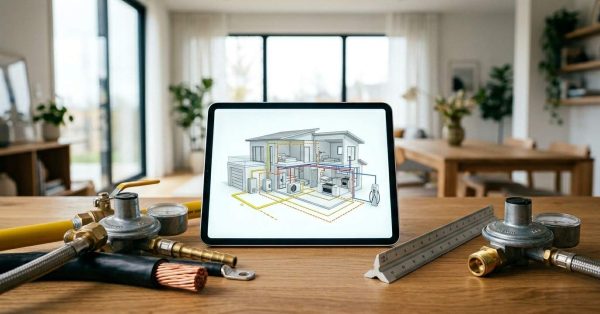
Manual J pulls data from multiple sources to produce an accurate result. The primary inputs include:
- Floor plan dimensions and ceiling heights — total conditioned square footage and volume
- Orientation of the structure — which walls and windows face south, east, west, and north
- Window area, type, and glazing — single, double, or triple pane; low-E coatings; frame material
- Insulation values (R-values) — walls, attic, floor, and foundation
- Air infiltration rate — how tightly the building envelope is sealed
- Local design temperatures — heating and cooling design temperatures for your specific ZIP code
- Internal heat gains — occupancy, appliances, and lighting
Each of these inputs changes the final load number. A new build with high-performance windows and dense-pack insulation will have a significantly lower load than an identically sized home built to minimum code standards.
What Size Heat Pump Do You Need for a New Build?
The only accurate answer to this question comes from a completed Manual J calculation. However, general sizing benchmarks help homeowners understand the range of equipment they are likely to need before that calculation is complete.
Heat pump capacity is measured in tons, where one ton equals 12,000 BTUs per hour of cooling capacity. Most residential heat pumps range from 1.5 tons to 5 tons, with 2-ton and 3-ton units covering the majority of single-family new builds in moderate U.S. climates.
Sizing by Square Footage — A Starting Point
Square footage provides a rough starting point, not a final answer. As a general benchmark, new construction homes in moderate climates typically require approximately 20–25 BTUs per square foot of conditioned space for cooling load estimation. This translates to the following approximate ranges:
| Conditioned Square Footage | Approximate Capacity Needed |
| 1,000–1,200 sq ft | 1.5–2 tons |
| 1,200–1,800 sq ft | 2–2.5 tons |
| 1,800–2,400 sq ft | 2.5–3 tons |
| 2,400–3,000 sq ft | 3–3.5 tons |
| 3,000–4,000 sq ft | 3.5–5 tons |
These ranges assume average insulation, standard window ratios, and moderate climate conditions. A Manual J calculation will adjust these numbers based on your home’s actual specifications.
Climate Zone Adjustments for U.S. Regions
The U.S. Department of Energy divides the country into eight climate zones, and your zone significantly affects heat pump sizing. Homes in Climate Zone 1 (hot-humid, such as South Florida) have high cooling loads and minimal heating loads. Homes in Climate Zone 6 or 7 (cold climates such as Minnesota or Maine) have high heating loads that may require a cold-climate heat pump rated for low ambient temperatures.
In cold climates, the heating load often drives the sizing decision rather than the cooling load. A heat pump sized purely for cooling in a northern new build may be undersized for heating demand during peak winter conditions. Your HVAC contractor must use the correct design temperatures for your specific location — not regional averages — to produce an accurate Manual J result.
Factors That Influence Heat Pump Sizing Beyond Square Footage
Square footage is the starting point, but several other characteristics of your new build will move the final sizing number up or down meaningfully.
Ceiling height increases the volume of conditioned air and raises the load proportionally. A 10-foot ceiling adds roughly 25% more volume compared to an 8-foot ceiling in the same footprint.
Roof and attic design affects solar heat gain in summer and heat loss in winter. Dark roofing materials and uninsulated attic spaces increase cooling loads significantly.
Window-to-wall ratio is one of the largest variables in new construction. Homes with large south- or west-facing window areas have substantially higher cooling loads than homes with smaller or better-shaded windows.
Number of occupants and internal heat sources contribute to cooling load. A home office with multiple computers and monitors adds measurable heat gain that a Manual J calculation accounts for.
Insulation quality directly determines how hard your heat pump must work to maintain comfort — if your new build’s thermal envelope needs attention, our home insulation services explains how proper insulation reduces heating and cooling loads and improves system efficiency year-round.
Insulation, Windows, and Air Sealing in New Builds
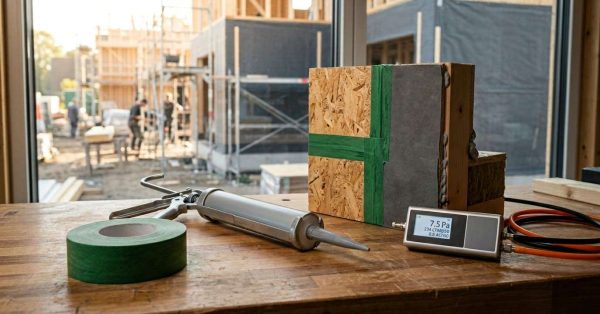
New construction gives you a rare opportunity to build a high-performance thermal envelope from the ground up. Upgrading from code-minimum insulation to higher R-values in walls and attic can reduce your heating and cooling load by 20–30%, which directly reduces the size and cost of the heat pump you need.
Air sealing is equally important. A new build that achieves a low air changes per hour (ACH) rating through careful sealing of penetrations, joints, and the building envelope will have a lower infiltration load than a loosely built home of the same size. Many high-performance new builds target 3 ACH or below at 50 pascals of pressure, which meaningfully reduces both heating and cooling demand.
Specifying better windows, higher insulation values, and thorough air sealing during the design phase is almost always more cost-effective than buying a larger heat pump to compensate for a leaky, under-insulated envelope.
Choosing the Right Heat Pump Type for Your New Build
Once you have a target capacity from your Manual J calculation, you need to select the right type of heat pump for your new build’s layout and design.
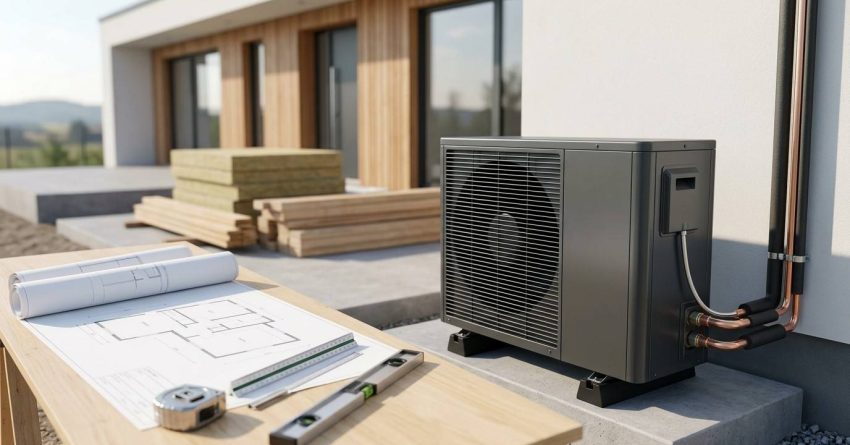
Air-source heat pumps are the most common choice for new residential construction in the U.S. They transfer heat between indoor and outdoor air and are available in ducted and ductless configurations. Modern cold-climate air-source heat pumps maintain efficiency at outdoor temperatures as low as -13°F, making them viable across most U.S. climate zones.
Ground-source (geothermal) heat pumps use the stable temperature of the earth as their heat exchange medium. They offer higher efficiency than air-source units but require significant upfront investment in ground loops. New construction is an ideal time to install ground loops because excavation can be coordinated with other site work.
Variable-speed (inverter-driven) heat pumps modulate their output to match the actual load rather than cycling on and off at full capacity. In a well-insulated new build with a low load, a variable-speed unit provides superior comfort, better humidity control, and lower operating costs compared to single-stage equipment.
For new builds without a planned duct network, ductless options offer flexible, zone-controlled comfort — our ductless mini-split systems covers how these units work, where they perform best, and how they compare to ducted heat pumps in new construction layouts.
Ducted vs. Ductless Systems — Which Fits Your Floor Plan?
The choice between ducted and ductless heat pumps in a new build depends primarily on your floor plan, budget, and comfort goals.
A ducted system uses a central air handler connected to a network of supply and return ducts. It provides whole-home conditioning from a single unit and integrates easily with ventilation systems. Ducted systems work best in new builds where duct routing can be planned into the design from the start, minimizing duct length and pressure losses.
A ductless multi-split system connects one outdoor unit to multiple indoor air handlers, each serving a separate zone. This approach eliminates duct losses entirely — which can account for 20–30% of energy waste in poorly designed duct systems — and allows independent temperature control in each zone. Ductless systems are particularly well-suited to open floor plans, additions, or new builds where duct installation would be difficult or costly.
Many new construction projects use a hybrid approach: a ducted system for the main living areas combined with ductless units for zones with unique comfort requirements, such as a finished basement, sunroom, or home office.
Once your heat pump is correctly sized and installed, keeping it running efficiently requires a consistent maintenance routine — our heat pump maintenance tips outlines the seasonal tasks and professional service intervals that protect your investment and extend system life in any U.S. climate.
Working With an HVAC Professional for New Build Sizing
Heat pump sizing for a new build is not a DIY calculation. Manual J requires licensed software, accurate building data, and local climate design values that only a trained HVAC professional can apply correctly. Most U.S. building codes now require a Manual J calculation as part of the permit process for new construction, which means your contractor must complete one regardless.
The best time to involve your HVAC contractor is during the design phase — before framing begins. Early involvement allows the contractor to review the floor plan, recommend envelope improvements that reduce load, plan duct routing for maximum efficiency, and select equipment that matches the final calculated load precisely.
When interviewing HVAC contractors for your new build, ask specifically whether they perform Manual J calculations in-house or outsource them, which software they use (ACCA-approved programs include Wrightsoft and Elite Software), and whether they will provide you with a copy of the completed calculation. A contractor who cannot answer these questions clearly is not the right choice for a new construction project.
Connecting with a qualified technician early in the build process ensures your sizing calculations are accurate and your system is matched to your home’s exact specifications — explore our professional HVAC services to find skilled technicians ready to support your new construction project from load calculation through final commissioning.
Conclusion
Correct heat pump sizing in a new build depends on a complete Manual J load calculation, not square footage estimates or rules of thumb. Climate zone, insulation values, window area, air sealing, and system type all shape the final equipment selection in ways that only a professional calculation can capture accurately.
Investing in proper sizing from the design phase protects your comfort, reduces long-term energy costs, and prevents the expensive corrections that come from oversized or undersized equipment in a finished home.
At Mr. Local Services, our skilled HVAC professionals handle new construction sizing from load calculation through installation — contact us today to connect with a technician who will get your new build’s heat pump right the first time.
Frequently Asked Questions
How many tons is a heat pump for a 2,000 sq ft new build?
A 2,000 sq ft new build in a moderate U.S. climate typically requires a 2.5- to 3-ton heat pump as a starting estimate. The final size depends on insulation quality, window area, ceiling height, and your specific climate zone, all determined through a Manual J load calculation.
Can I oversize a heat pump in a new construction home?
Oversizing a heat pump causes short-cycling, which reduces efficiency, increases wear on the compressor, and creates humidity problems during cooling season. An oversized unit also costs more upfront without delivering better comfort. Always size based on a completed Manual J calculation rather than rounding up for safety.
What is Manual J and why is it required for new builds?
Manual J is the ACCA-standard residential load calculation method that determines the exact heating and cooling capacity a home requires. Most U.S. building codes require a completed Manual J as part of the HVAC permit process for new construction because it ensures equipment is matched to the home’s actual thermal characteristics.
Does climate zone affect heat pump sizing in the USA?
Yes, significantly. Homes in cold climate zones (5–7) often have heating loads that exceed cooling loads, requiring larger capacity or cold-climate-rated equipment. Homes in hot-humid zones (1–2) are sized primarily for cooling. Your HVAC contractor must use the correct design temperatures for your specific ZIP code, not regional averages.
Should I choose a ducted or ductless heat pump for a new build?
Ducted systems work well when duct routing can be planned into the design from the start. Ductless multi-split systems eliminate duct losses and allow zone-by-zone temperature control, making them ideal for open floor plans or homes where duct installation would be inefficient. Many new builds use a combination of both approaches.
How does insulation quality affect heat pump size?
Higher insulation R-values and better air sealing reduce the heating and cooling load your heat pump must meet. Upgrading from code-minimum to high-performance insulation can reduce