
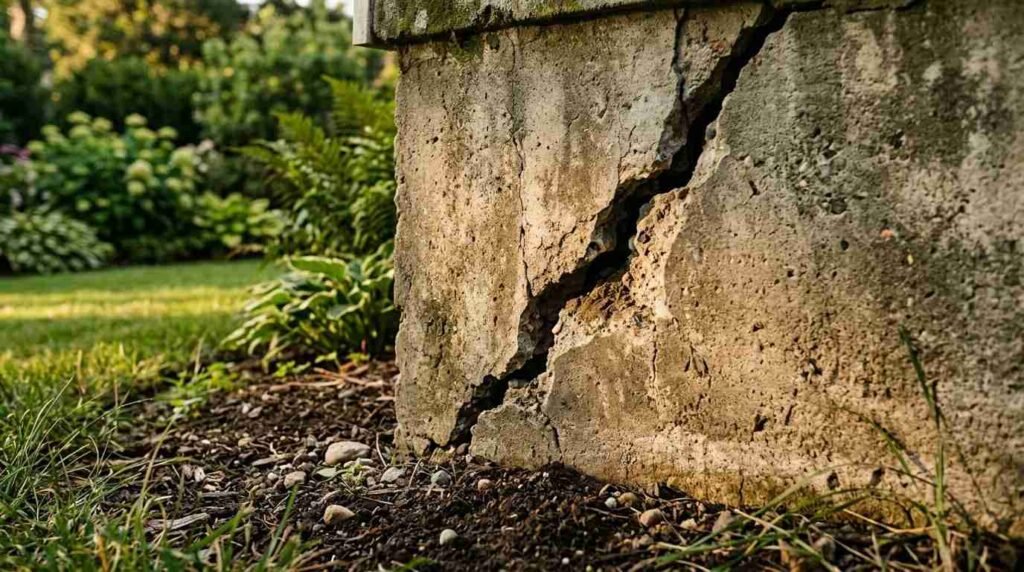
Foundation damage is any structural or material deterioration in the concrete, block, or pier system that carries your building’s weight into the soil. I see it in every market I work in, and it affects homeowners, landlords, and property managers equally.
Foundation problems rarely stay small. They spread into framing, plumbing, doors, and resale value, and I watch repair bills multiply every season an owner waits and hopes.
This guide covers damage anatomy, crack types, settlement, heaving, bowing walls, water damage, foundation-type risks, root causes, warning signs, repair methods, costs, prevention, and hiring professionals.
What Foundation Damage Is and Why It Happens
Foundation damage happens when the soil under a structure stops behaving the way the original builder assumed it would. Soil moves. Concrete does not bend with it.
I explain it to clients this way: your house is heavy, static, and rigid, while the ground beneath it swells, shrinks, washes away, and freezes on its own schedule. Damage is what that mismatch looks like in physical form.
How a Foundation Carries Load
Every foundation transfers building load into stable soil or bedrock through footings, walls, slabs, or piers. That load path stays intact only while the supporting soil stays uniform.
Lose support under one corner, and the load redistributes. Concrete has strong compressive strength and weak tensile strength, so it cracks where it gets pulled or bent instead of pressed.
The Soil-Moisture Cycle Behind Most Damage
Water drives the majority of foundation problems I encounter. Wet soil expands, dry soil contracts, and expansive clay soils change volume dramatically between those two states.
The U.S. Geological Survey documents expansive soils across large portions of the country, and the American Society of Civil Engineers has long estimated that expansive soils damage more buildings annually than floods, earthquakes, and tornadoes combined. That single fact reframes foundation care as a water-management job first.
Cosmetic Wear vs. Structural Failure
Not every crack means trouble. Concrete shrinks as it cures, and hairline shrinkage cracks show up in nearly new slabs without threatening anything.
Structural damage looks different. It widens over time, offsets on either side, moves horizontally, or shows up alongside sticking doors, sloped floors, and separating trim.
I tell owners to track change, not existence. A stable quarter-inch crack matters less than a hairline crack that doubled in six months.
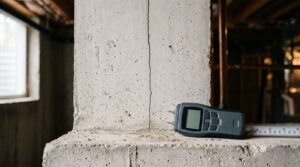
Foundation Crack Types: Vertical, Horizontal, Diagonal, and Stair-Step
Crack direction tells me more than crack size. Each orientation points toward a specific force acting on the concrete, and reading that pattern narrows the diagnosis fast.
I walk the full perimeter, then the interior walls, and I photograph everything with a date stamp and a coin for scale.
Vertical Cracks
Vertical cracks run straight up and down, usually from curing shrinkage or minor uniform settlement. These rank as the least alarming category in most inspections.
They still let water in. Sealing them with epoxy or polyurethane injection protects the rebar inside and keeps the basement dry.
Horizontal Cracks
Horizontal cracks are the ones that get my full attention. They signal lateral pressure pushing inward on a wall, and they frequently pair with bowing.
Block walls crack horizontally along a mortar joint near the mid-height of the wall. That pattern needs an engineer, not a caulk gun. Understanding the full range of foundation crack patterns helps owners separate a sealing job from a structural one.
Diagonal and Stair-Step Cracks
Diagonal cracks at roughly 45 degrees point to differential settlement, where one section drops faster than another. In concrete block or brick, that same force produces a stair-step pattern following the mortar joints.
Stair-step cracks wider than a quarter inch, or with visible offset between blocks, indicate active movement.
Hairline vs. Structural Crack Width
Width gives a rough triage scale. Under 1/16 inch reads as cosmetic, 1/16 to 1/4 inch warrants monitoring, and anything past 1/4 inch or showing displacement calls for professional evaluation.
Settlement Damage: Uniform, Differential, and Sinking Foundations
Settlement is downward foundation movement caused by soil consolidating, eroding, or losing bearing capacity. Every building settles somewhat during its first years. The type of settlement determines whether that movement is harmless or destructive.
Uniform Settlement
Uniform settlement drops the entire foundation evenly. The structure stays square, doors keep operating, and damage stays minimal.
I rarely see truly uniform settlement outside of well-engineered sites. Real soil varies too much across a footprint.
Differential Settlement
Differential settlement is the damaging version. One area sinks faster than another, twisting the structure and tearing it at its weakest points.
Causes include inconsistent soil, poorly compacted fill, plumbing leaks washing out soil, and tree roots drawing moisture from one side. Owners tracking foundation settlement warning signs catch this stage while repairs stay affordable.
Warning Signs Inside the Home
Interior symptoms often appear before exterior cracks widen. Doors that stick at the top corner, windows that resist opening, gaps above cabinets, and nail pops in drywall all point to frame distortion.
A marble that rolls consistently toward one wall confirms slope. I use a laser level to quantify it, because a half-inch drop across twenty feet reads very differently than two inches.
Heaving and Upward Movement Damage
Heaving is the opposite of settlement. Soil expands and pushes the foundation upward, often unevenly, and it damages slabs in ways that surprise homeowners who only watch for sinking.
Expansive Clay Soil Heave
Clay soils absorb water and swell with tremendous force. A slab sitting on saturated clay lifts in the center or along one edge, and interior floors dome noticeably.
This is why irrigation placement matters so much. Concentrated watering next to a slab creates a localized swell zone.
Frost Heave in Cold Climates
Frost heave occurs where water in the soil freezes and expands beneath shallow footings. Northern markets require footings placed below the local frost line for exactly this reason.
Unheated attached structures like porches, steps, and garage slabs heave first because they lack the ground warmth a conditioned building provides.
Slab Doming and Interior Floor Symptoms
Doming shows up as a high point in the middle of a slab with cracks radiating outward. Tile grout lines crack in a spiderweb, hardwood cups, and interior door bottoms scrape at the center of the room rather than the corners.
Bowing, Leaning, and Shearing Basement Walls
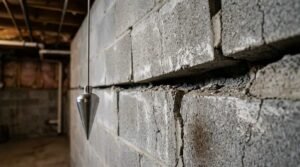
Bowing walls are basement or foundation walls that curve inward under horizontal soil pressure. I treat these as the most urgent damage category because the failure mode is sudden rather than gradual.
Lateral Soil Pressure
Saturated soil behaves like a heavy fluid pressing against the wall. Add clay expansion, frost, or heavy equipment parked near the foundation, and pressure climbs past what an unreinforced wall resists.
Concrete block walls fail first because mortar joints create planes of weakness. Poured concrete walls resist longer but crack horizontally when overloaded.
Bowing vs. Sheared Walls
A bowing wall curves inward across its height while staying connected top and bottom. A sheared wall has slid horizontally along a joint, leaving one section offset from the section above.
Shearing means the wall lost its structural continuity. That condition needs immediate professional stabilization. Owners noticing curvature should review basement wall repair options before deciding between carbon fiber, anchors, or full rebuild.
Measuring Wall Deflection
I hang a plumb line from the top of the wall and measure the gap at the maximum bulge. Under one inch of deflection generally allows reinforcement in place.
Past two inches, excavation and rebuilding enter the conversation. Documented measurements taken quarterly show whether movement is active or dormant.
Water, Moisture, and Drainage-Related Foundation Damage
Water damages foundations three ways: it moves soil, it pressures walls, and it degrades the concrete itself. I address drainage before any structural repair because unresolved water undoes the fix.
Hydrostatic Pressure and Seepage
Groundwater rising against a foundation exerts hydrostatic pressure that forces moisture through pores, joints, and cracks. The cove joint where the wall meets the floor leaks first in most basements.
Chronic seepage signals a drainage system that stopped working. Interior water problems often connect to broader water damage restoration needs once moisture reaches finished spaces.
Efflorescence, Spalling, and Concrete Degradation
Efflorescence is the white crystalline residue left when water carries salts through concrete and evaporates. It marks moisture movement rather than structural failure, but it confirms an active leak path.
Spalling goes further. Freeze-thaw cycles and salt exposure flake the concrete surface away, exposing rebar that then rusts and expands, cracking more concrete from the inside.
Gutter, Grading, and Downspout Failures
The cheapest foundation protection I know is functional gutters and correct grading. Soil should fall roughly six inches over the first ten feet away from the wall.
Downspouts need to discharge at least four to six feet out. Clogged gutters dump concentrated water directly against the footing, and I have traced serious settlement back to a single overflowing gutter corner. Scheduled gutter cleaning and maintenance prevents that failure entirely.
Foundation Damage by Foundation Type
Damage patterns depend heavily on how a foundation is built. A slab home and a pier-and-beam home in identical soil fail in completely different ways, and repair approaches diverge just as much.
Slab-on-Grade Foundations
Slab foundations sit directly on prepared soil with thickened edges carrying wall loads. They dominate warm-climate construction across the southern United States.
Slabs suffer from edge settlement, center doming, and under-slab plumbing leaks that erode supporting soil silently. Access is the core challenge, since repairs mean tunneling or breaking concrete. A hidden supply-line break under a slab usually calls for emergency plumbing repair before any foundation work begins.
Basement Foundations
Basements add usable space and deep footings but expose tall walls to lateral pressure and groundwater. Bowing, horizontal cracking, and seepage concentrate here.
They also offer inspection access most other types lack. I can see the full wall height and read damage directly.
Crawl Space and Pier-and-Beam Foundations
Pier-and-beam systems support the structure on posts and girders above open ground. Damage shows as rotted or crushed shims, sagging girders, settled piers, and moisture-driven wood decay.
The upside is repairability. Adjusting or replacing a pier costs far less than lifting a slab, and humidity control in the crawl space prevents most wood problems.
| Foundation Type | Most Common Damage | Typical Cause | Access for Repair |
| Slab-on-grade | Edge settlement, doming, cracks | Soil movement, under-slab leaks | Difficult |
| Basement | Bowing walls, horizontal cracks, seepage | Lateral pressure, groundwater | Good |
| Crawl space/pier-and-beam | Pier settlement, girder sag, wood rot | Moisture, pier displacement | Excellent |
Root Causes: Soil, Water, Trees, Construction, and Time
Damage types describe symptoms. Root causes explain why the symptom appeared, and fixing the cause is what makes a repair last.
Soil Composition and Expansive Clay
Soil type sets the baseline risk for a property. Clay swells and shrinks, sand drains well but erodes, silt holds water poorly, and organic fill compresses over decades.
Expansive clay dominates Texas, Colorado, Oklahoma, and large parts of the Midwest. Homes there need consistent perimeter moisture year-round.
Tree Roots and Vegetation
Mature trees pull enormous volumes of water from soil during dry months, shrinking clay on the side nearest the tree. That creates classic differential settlement.
I use the rule of planting large species at least as far from the foundation as their mature height. Existing trees close to a structure need root barriers rather than removal in many cases, and professional tree services handle that assessment properly.
Plumbing Leaks Under Slabs
A slow supply or sewer leak beneath a slab washes soil away and creates a void. The slab then drops into that void, producing sudden localized settlement in an otherwise stable home.
Unexplained water bill increases, warm floor spots, and the sound of running water with fixtures off all point here.
Poor Original Construction
Inadequate footing depth, uncompacted backfill, missing reinforcement, and building on unengineered fill produce damage that appears within the first five to ten years. Nothing about maintenance prevents a construction defect. It gets corrected structurally.
How to Identify Foundation Damage: Signs and Severity Levels
Early identification is the single highest-value habit a property owner develops. I run this inspection twice a year, spring and fall, and it takes about thirty minutes.
Exterior Warning Signs
Walk the full perimeter and look for stair-step brick cracks, gaps between the foundation and siding, chimney separation, and crumbling or flaking concrete. Check whether soil has pulled away from the wall, leaving an air gap.
Look up too. A roofline that dips or a chimney leaning away from the house both trace back to foundation movement, and roof inspection services often catch the first visible symptom.
Interior Warning Signs
Inside, test every door and window for binding. Look for drywall cracks radiating diagonally from door and window corners, gaps where walls meet ceilings, and separated crown molding.
Floors tell the truth. Sloping, bouncing, cupping hardwood, and cracked tile lines all indicate movement below.
Severity Scale: Monitor, Repair, Urgent
Monitor covers hairline cracks under 1/16 inch with no offset and no operational problems. Photograph and recheck in six months.
Repair covers cracks from 1/16 to 1/4 inch, minor door sticking, and visible but stable slope. Schedule an evaluation within the season.
Urgent covers horizontal cracks, wall bowing past one inch, offset shearing, sudden floor drops, or any crack that grew visibly within weeks. That gets a structural engineer immediately.
Foundation Repair Methods Matched to Damage Types
The right repair depends entirely on the damage type and its cause. I match method to diagnosis rather than defaulting to whatever a contractor sells most.
Piering and Underpinning
Piers transfer building load past unstable soil to bedrock or competent strata. Steel push piers, helical piers, and concrete pressed piles all serve settled foundations.
Helical piers work well in lighter structures and poor soil. Push piers suit heavier loads where solid bearing sits deeper.
Slabjacking and Polyurethane Foam Lifting
Slabjacking pumps material beneath a settled slab to lift it back to level. Polyurethane foam has largely replaced mud grout because it weighs less, cures in minutes, and resists washout.
This addresses voids and settled concrete. It does not fix a compromised footing.
Carbon Fiber, Steel Beams, and Wall Anchors
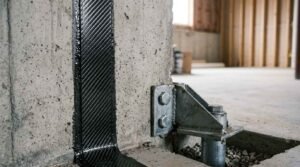
Bowing walls get reinforced rather than replaced when deflection stays modest. Carbon fiber straps bond to the wall face and stop further inward movement.
Steel I-beams brace against the joists above, and helical wall anchors pull the wall back toward plumb over time using exterior soil plates.
Waterproofing and Drainage Correction
Interior drain tile, exterior excavation and membrane, sump systems, and regraded landscaping remove the water pressure causing the damage. I pair these with structural work on nearly every basement project, and correcting site drainage often falls to landscaping and grading services.
Foundation Repair Costs and What Drives Them
Cost ranges vary widely by damage type and region. Minor crack injection typically runs a few hundred dollars, while full piering on a settled foundation reaches into the tens of thousands.
Four factors move the number most: the repair method required, the number of piers or linear feet involved, access difficulty, and soil conditions at the site. Slab tunneling costs more than open-yard pier installation for the same pier count.
I always recommend three written estimates with an engineer’s report in hand first. That report keeps every bid priced against the same scope, and it protects owners from unnecessary work.
Preventing Foundation Damage Year-Round
Prevention costs a fraction of repair. Every effective prevention strategy comes down to controlling moisture around the perimeter and keeping it consistent.
Moisture Management
Consistency beats quantity. Soil that stays evenly moist year-round moves far less than soil swinging between saturated and bone dry.
Soaker hoses set twelve to eighteen inches from the foundation help enormously in clay regions during drought. During wet seasons, the priority flips to moving water away fast.
Seasonal Inspection Habits
I inspect twice yearly and after any major weather event. Spring checks catch frost and thaw damage, fall checks catch drought stress and prepare drainage for winter.
Photograph the same crack locations each time from the same angle. Comparison photos reveal movement that memory misses.
Landscaping and Grading Discipline
Maintain positive slope away from the structure and rebuild it as soil settles. Avoid raised beds, heavy mulch piles, and impermeable borders that trap water against the wall.
Keep large shrubs and trees at a sensible distance, and repair irrigation leaks immediately. A broken sprinkler head next to a slab creates a saturation zone within days, and routine handyman maintenance services catch these small failures before they compound.

When to Call a Professional and How to Choose One
Call a structural engineer first whenever damage reaches the urgent tier. An independent engineer diagnoses the problem and specifies a fix without selling the repair, which removes the conflict of interest built into free contractor inspections.
Verify licensing, insurance, and workmanship warranties before signing. Ask specifically whether the warranty transfers to a future owner, since that matters enormously for resale.
Good contractors explain the cause, not just the crack. I trust the ones who talk about drainage, soil, and load paths before they talk about price, and property managers overseeing multiple buildings benefit from a single vetted property maintenance provider handling inspection and repair together.
Conclusion
We covered crack types, settlement, heaving, bowing walls, water damage, foundation-type risks, root causes, warning signs, repair methods, costs, and prevention across every major damage category.
Foundation health connects directly to plumbing, drainage, roofing, and landscaping, and each linked resource takes those relationships further than a single guide allows.
We match property owners with vetted foundation and structural specialists nationwide. Contact Mr. Local Services today and get your foundation evaluated properly.
Frequently Asked Questions
What are the most common types of foundation damage?
Cracking, settlement, heaving, and bowing walls account for most cases. Water intrusion and concrete deterioration follow closely, usually driven by drainage failures around the perimeter.
Which foundation cracks are actually dangerous?
Horizontal cracks and stair-step cracks with offset signal structural pressure and need immediate evaluation. Thin vertical cracks under 1/16 inch usually reflect normal concrete shrinkage.
How fast does foundation damage get worse?
Movement accelerates during drought and heavy rain cycles. Damage that stays stable for years sometimes progresses within a single season once soil conditions shift sharply.
Can I sell a house with foundation damage?
Yes, though disclosure laws apply in every state. Buyers typically request an engineer’s report, and repaired foundations with transferable warranties sell far more smoothly.
Does homeowners insurance cover foundation damage?
Standard policies exclude damage from soil movement, settling, and expansive clay. Coverage generally applies only to sudden events like a burst pipe washing out supporting soil.
How do I know whether damage needs a repair or just monitoring?
Measure crack width and recheck in six months with dated photos. Growth, offset, or new door and window binding moves the situation from monitoring to repair.
Who should inspect my foundation first?
Start with an independent structural engineer for an unbiased diagnosis. Bring that report to contractors so every bid prices the same defined scope of work.