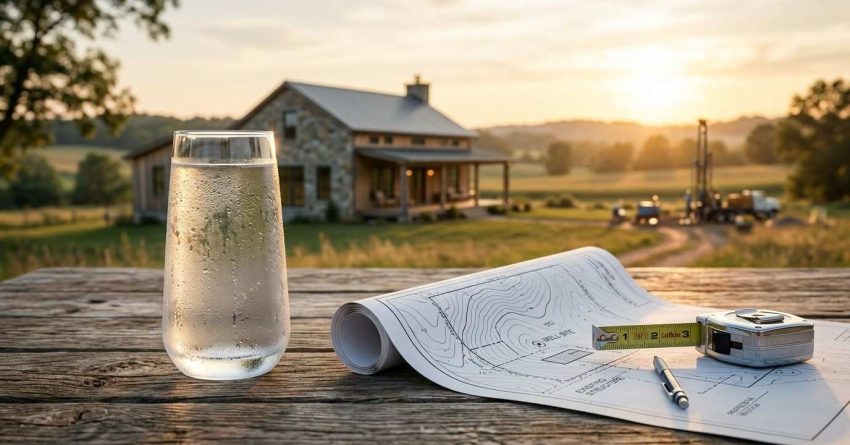
Drilling a well is the process of boring into the earth to access a reliable underground water supply, and for millions of homeowners across the USA, it represents one of the most significant property investments they will make. Understanding what the process involves, what it costs, and what factors drive those costs is essential before committing to any drilling project.
Without this knowledge, homeowners risk unexpected expenses, regulatory violations, and water systems that fail to meet household demands. The stakes are high, and the decisions made early in the process shape outcomes for decades.
This guide covers well types, site assessment, drilling methods, depth and geology, permitting, total costs, timelines, pump systems, water testing, and long-term maintenance.
What Is a Drilled Well and How Does It Work?
A drilled well is a bored shaft that penetrates through soil and rock layers to reach a saturated aquifer — an underground zone where water collects in permeable rock or sediment. Unlike dug wells, which are shallow and hand-excavated, drilled wells reach depths of 100 to 500 feet or more, accessing confined aquifers that are naturally protected from surface contamination.
The basic mechanics are straightforward. A drilling rig bores a cylindrical hole into the earth. A steel or PVC casing is inserted to prevent the borehole walls from collapsing and to seal out surface water. A well screen at the bottom filters sediment while allowing groundwater to enter. A pump then draws water up through the casing and into the home’s plumbing system.
Drilled wells are the dominant residential water source in rural and semi-rural areas where municipal water service is unavailable. According to the U.S. Geological Survey, approximately 43 million Americans rely on private wells as their primary drinking water source — a figure that underscores how critical proper well construction and maintenance are for property owners nationwide.
The well system has four primary components: the borehole and casing, the well cap and seal, the pump and pressure tank, and the distribution lines connecting to the home. Each component affects performance, water quality, and long-term cost. Understanding how they interact helps homeowners make informed decisions at every stage of the project.
Types of Wells: Which Option Is Right for Your Property?
Not every property requires the same well solution. The right well type depends on your land’s geology, the depth of the water table, local regulations, and your household’s water demand. The three main residential well types are drilled wells, driven wells, and dug wells — each suited to different conditions.
Drilled wells are the most common and most versatile. They reach depths of 100 to 500+ feet, access confined aquifers, and are suitable for nearly all soil and rock conditions when the right drilling method is used. They offer the best protection against surface contamination and the longest service life.
Driven wells are installed by driving a small-diameter pipe into the ground using a mechanical driver. They are limited to depths of 30 to 50 feet and work only in sandy, loose soils where a water table sits relatively close to the surface. They are faster and cheaper to install but carry higher contamination risk and are not suitable for all regions.
Dug wells are the oldest well type — hand-excavated to depths of 10 to 30 feet and lined with stone, brick, or concrete. They are rarely installed today due to shallow depth, high contamination vulnerability, and the tendency to go dry during drought conditions.
For most homeowners in the USA considering a new well installation, a drilled well is the appropriate choice. The depth, durability, and water quality protection it provides justify the higher upfront cost compared to shallower alternatives.
Site Assessment and Hydrogeological Evaluation
Before any drilling begins, a thorough site assessment determines whether your property can support a productive well and where the best drilling location is. Skipping this step is one of the most common and costly mistakes property owners make.
A hydrogeological evaluation examines the subsurface conditions of your land. A licensed hydrogeologist or well driller reviews geological survey data, local well logs from neighboring properties, topographic maps, and soil composition reports. This analysis identifies the most likely depth and yield of accessible aquifers beneath your specific parcel.
Site selection also involves practical surface-level considerations. Regulatory setback requirements mandate minimum distances between a well and potential contamination sources. In most states, wells must be located at least 50 feet from septic tanks, 100 feet from drain fields, and 25 feet from property lines — though these distances vary by jurisdiction. Proximity to fuel storage tanks, agricultural chemical storage, and surface water bodies also affects placement decisions.
Topography matters as well. Drilling on a slope or in a low-lying area that collects runoff increases contamination risk. Elevated, stable ground away from drainage paths is generally preferred.
The site assessment phase typically costs between $300 and $1,000 depending on the complexity of the evaluation and whether a formal hydrogeological report is required by your county. This investment can prevent a far more expensive outcome: drilling in the wrong location and finding either no water or contaminated water.
Well Drilling Methods: Rotary, Cable Tool, and Air Hammer
The method used to drill your well directly affects cost, timeline, and suitability for your property’s geology. Three primary drilling methods are used in residential well construction across the USA.
Rotary drilling is the most widely used method for residential wells. A rotating drill bit grinds through soil and rock while drilling fluid — either water-based mud or air — circulates through the borehole to carry cuttings to the surface and stabilize the hole walls. Rotary drilling is fast, effective in most geological conditions, and suitable for depths up to several hundred feet.
Cable tool drilling (also called percussion drilling) uses a heavy drill bit that is repeatedly lifted and dropped to break up rock and soil. It is slower than rotary drilling but highly effective in hard rock formations and in areas where rotary equipment cannot access. Cable tool rigs are smaller and can work in tight spaces, making them useful for properties with limited access.
Air rotary drilling (air hammer drilling) uses compressed air instead of drilling fluid to remove cuttings. It is particularly effective in consolidated rock formations and produces a clean borehole with minimal contamination risk from drilling fluids. Air rotary is common in areas with hard granite, limestone, or basalt geology.
The choice of method is typically made by the drilling contractor based on local geological conditions, equipment availability, and the target depth. Homeowners rarely need to specify a method — but understanding the options helps you ask informed questions and evaluate contractor proposals accurately.
Drilling costs are typically quoted per linear foot. Rotary drilling in soft formations runs $15 to $25 per foot, while hard rock drilling using air hammer methods can reach $30 to $50 per foot or more depending on the region and formation hardness.
Well Depth, Geology, and Aquifer Conditions
Well depth is one of the most significant cost variables in any drilling project, and it is largely determined by your property’s geology rather than by personal preference. Understanding the relationship between depth, geology, and aquifer type helps set realistic expectations before you receive contractor bids.
Aquifers exist in two primary forms. Unconfined aquifers sit near the surface, with the water table as their upper boundary. They are recharged directly by rainfall and are more susceptible to drought and surface contamination. Confined aquifers are sandwiched between impermeable rock or clay layers, which pressurize the water and protect it from surface pollutants. Confined aquifers are generally preferred for residential wells because of their superior water quality and more consistent yield.
Depth requirements vary dramatically by region. In parts of the Southeast and Midwest where sedimentary geology dominates, productive aquifers may be reached at 100 to 200 feet. In the Rocky Mountain West and New England, where granite and metamorphic rock formations are common, wells may need to reach 300 to 500 feet or deeper to find adequate water.
Geological formations also affect drilling speed and cost. Soft sedimentary formations like sand, gravel, and sandstone drill quickly and inexpensively. Hard crystalline rock formations like granite and quartzite require more time, more wear on drill bits, and higher per-foot costs.
Well yield — measured in gallons per minute (GPM) — is the other critical depth-related variable. A typical household requires a minimum yield of 3 to 5 GPM for reliable daily use. Drilling deeper into a more productive aquifer zone often increases yield, but there is no guarantee that greater depth always produces greater flow. Local well logs from your county’s geological survey office provide the most reliable yield expectations for your specific area.
Permits, Regulations, and Legal Requirements
Drilling a well without the proper permits is not just a regulatory violation — it can result in fines, mandatory well abandonment, and complications when selling your property. Every state in the USA regulates private well construction, and most counties add a second layer of local requirements on top of state rules.
The permitting process typically begins with an application to your county health department or state environmental agency. The application requires a site plan showing the proposed well location, setback distances from contamination sources, and the property’s legal description. Some jurisdictions also require a hydrogeological assessment before a permit is issued.
Permit fees range from $100 to $500 in most states, though complex applications in regulated areas can cost more. Processing times vary from a few days to several weeks depending on the jurisdiction and current application volume.
Licensed well drillers are required in all 50 states. Your contractor must hold a valid state drilling license and, in many jurisdictions, must pull the permit on your behalf as part of the project. Always verify your driller’s license status through your state’s licensing board before signing a contract.
After drilling is complete, most states require a well completion report — a formal document submitted by the driller that records the well’s depth, casing specifications, geological log, and initial yield test results. This report becomes part of the public record and is essential documentation for future property transactions.
Failing to obtain permits or using an unlicensed driller can void your homeowner’s insurance coverage for well-related claims and create title issues that complicate property sales for years after the fact.
How Much Does It Cost to Drill a Well? Full Cost Breakdown
The total cost of drilling a residential well in the USA ranges from $3,500 to $15,000 for most projects, with complex installations in hard rock geology or at significant depth reaching $20,000 to $30,000 or more. Understanding what drives these costs helps homeowners budget accurately and evaluate contractor proposals with confidence.
Drilling costs are the largest single expense. At an average of $15 to $50 per linear foot depending on geology and method, a 200-foot well in moderate conditions costs $3,000 to $10,000 for drilling alone. A 400-foot well in hard rock can reach $12,000 to $20,000 just for the borehole.
Casing and grouting add $600 to $2,000 depending on casing material (steel vs. PVC), diameter, and depth. Grouting — the cement seal placed around the casing to prevent surface water infiltration — is required by regulation in most states and is a non-negotiable cost.
Pump and pressure system installation adds $1,000 to $3,000 for a standard submersible pump, pressure tank, and electrical connections. High-demand households or deep wells requiring more powerful pumps push this cost higher.
Water testing at completion typically costs $100 to $400 for a standard panel covering bacteria, nitrates, pH, hardness, and common contaminants. Comprehensive testing for agricultural areas or properties near industrial sites costs more.
Permits and site assessment add $400 to $1,500 to the total project cost.
The table below summarizes typical cost ranges for each project component:
| Cost Component | Typical Range |
| Drilling (per linear foot) | $15 – $50/ft |
| Casing and grouting | $600 – $2,000 |
| Pump and pressure system | $1,000 – $3,000 |
| Electrical connection | $500 – $1,500 |
| Water testing | $100 – $400 |
| Permits and site assessment | $400 – $1,500 |
| Total project range | $3,500 – $30,000+ |
Regional labor rates, local geology, and well depth are the three variables that most significantly shift a project’s total cost. Getting three competitive bids from licensed drillers in your area is the most reliable way to establish an accurate budget for your specific property. Our complete well drilling cost guide breaks down every cost variable in detail, including regional price comparisons, contractor selection criteria, and a full checklist of questions to ask before signing a drilling contract.
The Well Drilling Process: Step-by-Step Timeline
Understanding the sequence of events in a well drilling project helps homeowners coordinate contractors, manage expectations, and avoid costly delays. A typical residential well project moves through six distinct phases from initial planning to first water use.
Phase 1 — Site Assessment and Permitting (1 to 4 weeks) The project begins with a hydrogeological evaluation and permit application. Timeline depends heavily on your county’s permit processing speed. Some jurisdictions issue permits within 3 to 5 business days; others take 3 to 4 weeks during busy seasons.
Phase 2 — Mobilization and Site Preparation (1 to 2 days) The drilling contractor mobilizes equipment to your property. A drilling rig requires adequate access — typically a cleared path at least 12 feet wide and overhead clearance of 20 to 30 feet. Site preparation may involve minor grading or tree trimming to accommodate the rig.
Phase 3 — Drilling and Casing Installation (1 to 5 days) Active drilling time depends on depth, geology, and method. A 200-foot well in soft sedimentary formation may be completed in a single day. A 400-foot well in hard granite can take 3 to 5 days. Casing is installed and grouted as drilling progresses.
Phase 4 — Well Development (1 day) After reaching target depth, the well is developed — a process of pumping or surging water through the well to remove drilling debris, fine sediment, and drilling fluid from the formation. Proper development is critical for long-term yield and water clarity.
Phase 5 — Pump Installation and Pressure System Setup (1 to 2 days) A licensed pump installer (sometimes the same contractor, sometimes a separate specialist) installs the submersible pump, drop pipe, electrical wiring, pressure tank, and control panel. The system is tested for pressure, flow rate, and electrical safety.
Phase 6 — Water Testing and Final Inspection (1 to 2 weeks) Water samples are collected and sent to a certified laboratory. Results typically return within 5 to 10 business days. If results are clean, the well is cleared for household use. If contaminants are detected, treatment options are evaluated before the system goes into service.
Total project timeline from permit application to first water use: 3 to 8 weeks under normal conditions. Complex geology, permit delays, or contractor scheduling can extend this to 10 to 12 weeks in some markets.
Well Casing, Grouting, and Wellhead Construction
The casing, grout seal, and wellhead are the structural and protective elements of your well system. They determine how well the borehole is protected from collapse and contamination over the life of the well — which, for a properly constructed drilled well, can exceed 40 to 50 years.
Well casing is the pipe inserted into the borehole to maintain the hole’s integrity and provide a clean conduit for water. Steel casing is the traditional standard — durable, resistant to collapse under soil pressure, and required by regulation in many states. PVC casing is lighter, corrosion-resistant, and increasingly common in residential applications where soil conditions allow. Casing diameter for residential wells is typically 4 to 6 inches.
Grouting is the cement or bentonite clay seal placed in the annular space between the casing and the borehole wall. Its purpose is to prevent surface water, agricultural runoff, and shallow groundwater from migrating down the outside of the casing and contaminating the aquifer. Most states require grouting to a minimum depth of 20 to 50 feet from the surface. Proper grouting is one of the most important contamination prevention measures in well construction.
The wellhead is the above-ground portion of the well system — the top of the casing, the well cap, and the sanitary seal. A properly constructed wellhead sits at least 12 inches above the finished ground surface to prevent surface water from pooling around the casing. The well cap must be vermin-proof and watertight. The sanitary seal prevents insects, rodents, and surface water from entering the casing.
Wellhead condition is one of the first things a home inspector examines during a property transaction. A damaged, sunken, or improperly sealed wellhead is a red flag that warrants further investigation before purchase.
Pump Systems, Pressure Tanks, and Water Delivery
The pump system is what transforms a drilled borehole into a functional water supply. Selecting the right pump type, sizing the pressure tank correctly, and ensuring proper electrical installation are all critical to reliable, long-term performance.
Submersible pumps are the standard for drilled wells. Installed at the bottom of the well casing, they push water up to the surface rather than pulling it — a more efficient and reliable mechanism for deep wells. Submersible pumps are rated by horsepower and GPM output. A typical residential submersible pump for a 200 to 400-foot well runs 0.5 to 1.5 horsepower and delivers 5 to 15 GPM depending on aquifer yield and pump sizing.
Jet pumps are used for shallow wells (under 25 feet for single-pipe jet pumps; up to 80 feet for deep-well jet pumps). They are installed above ground, making them easier to service, but they are less efficient and more susceptible to freezing in cold climates.
Pressure tanks store pressurized water between pump cycles, reducing pump wear and maintaining consistent water pressure throughout the home. Tank sizing is based on household demand and pump output. An undersized pressure tank causes the pump to cycle on and off excessively — a condition called short cycling that dramatically shortens pump life. A properly sized pressure tank for a typical household holds 20 to 44 gallons of drawdown capacity.
Electrical requirements for a submersible pump include a dedicated 240-volt circuit with appropriate wire gauge for the pump’s amperage draw and the depth of the well. Electrical installation must be performed by a licensed electrician and inspected before the system goes into service.
Pump systems require periodic maintenance — pressure tank inspection, pressure switch testing, and pump performance checks — to catch early signs of wear before they become emergency failures.
Water Testing, Quality Standards, and Treatment Options
A new well is not automatically safe to drink from. Water testing is a mandatory step before any drilled well enters household service, and ongoing periodic testing is essential for maintaining water safety throughout the well’s life.
Initial testing at completion should cover, at minimum: total coliform bacteria, E. coli, nitrates, pH, hardness, iron, manganese, and turbidity. The U.S. Environmental Protection Agency recommends that private well owners test their water at least once per year for bacteria and nitrates, and more frequently if land use near the well changes or if water quality changes are noticed.
Common contaminants in private wells vary by region and geology. Arsenic is naturally occurring in many rock formations across the Northeast, Midwest, and West. Radon is a concern in granite-heavy regions of New England and the Mid-Atlantic. Agricultural areas face elevated nitrate and pesticide risks. Industrial areas may have legacy contamination from solvents, heavy metals, or petroleum compounds.
Water treatment options depend entirely on what testing reveals. Common residential treatment systems include:
- Chlorination systems for bacterial contamination
- Reverse osmosis systems for arsenic, nitrates, and dissolved solids
- Iron filters and water softeners for high iron, manganese, and hardness
- UV disinfection systems for ongoing bacterial control
- Activated carbon filters for volatile organic compounds and taste/odor issues
Treatment system costs range from $500 for a basic UV system to $3,000 to $8,000 for a whole-house reverse osmosis or iron filtration system. Annual maintenance costs for filters, media replacement, and UV lamp replacement add $100 to $500 per year depending on the system.
Never assume well water is safe based on appearance, taste, or smell alone. Many serious contaminants — including arsenic, nitrates, and radon — are colorless, odorless, and tasteless at dangerous concentrations.
Long-Term Well Maintenance and Lifespan
A properly constructed drilled well is a long-term asset. With routine maintenance, a drilled well can provide reliable service for 40 to 50 years or more. Neglecting maintenance shortens that lifespan significantly and increases the risk of water quality failures.
Annual maintenance tasks include inspecting the wellhead for physical damage, verifying the well cap seal is intact, testing water quality for bacteria and nitrates, checking pressure tank air charge, and inspecting the pressure switch and electrical connections.
Every 3 to 5 years, a more comprehensive inspection is recommended: a professional well camera inspection to check casing integrity, a full water quality panel beyond the basic annual test, pump performance testing to verify output against original specifications, and a check of the grout seal condition.
Common maintenance issues include:
- Pump wear and failure — submersible pumps typically last 10 to 15 years before requiring replacement, at a cost of $800 to $2,500 including labor
- Pressure tank waterlogging — a failed bladder in the pressure tank causes short cycling; tank replacement costs $300 to $700
- Casing corrosion or damage — steel casing can corrode over decades; PVC casing can crack under soil movement
- Bacterial contamination — often introduced through a damaged wellhead or during pump service; treated with shock chlorination
- Declining yield — aquifer depletion or pump wear can reduce flow over time; a pump test identifies the cause
Well rehabilitation — cleaning, redeveloping, or deepening an existing well — is often more cost-effective than drilling a new well when yield or quality issues arise. A licensed well contractor can assess whether rehabilitation is viable before recommending replacement.
Keeping detailed records of all well maintenance, water test results, and service visits is essential for property management and for demonstrating well condition during real estate transactions.
Choosing a Well Drilling Contractor
Selecting the right drilling contractor is as important as any technical decision in the well installation process. The quality of the contractor’s work directly determines the well’s long-term performance, water quality, and regulatory compliance.
Licensing verification is the non-negotiable first step. Every state requires well drillers to hold a valid state license. Verify your contractor’s license status directly through your state’s licensing board — do not rely solely on the contractor’s claim. In many states, the driller must also carry a surety bond and general liability insurance with minimum coverage limits.
Experience with local geology matters enormously. A contractor who has drilled hundreds of wells in your county understands the local aquifer depths, formation challenges, and typical yield expectations better than a contractor new to the area. Ask for references from recent projects within 10 to 20 miles of your property.
Written contracts should specify: the drilling method, target depth and contingency plan if water is not found at that depth, casing material and diameter, grouting specifications, pump system details, water testing scope, permit responsibility, payment schedule, and warranty terms.
Red flags to watch for include contractors who request full payment upfront, cannot provide proof of licensing and insurance, offer unusually low bids without explaining why, or are unwilling to provide a written contract with detailed specifications.
Getting three competitive bids from licensed contractors is the industry standard recommendation. Bids should be compared on a like-for-like basis — same depth assumption, same casing specifications, same pump system — to make meaningful cost comparisons.
At Mr. Local Services, we connect homeowners and property managers with licensed, vetted well drilling professionals across the USA — combining transparent pricing, verified credentials, and dependable service to make the contractor selection process straightforward and stress-free.
Conclusion
Drilling a well involves interconnected decisions spanning site assessment, geology, permitting, drilling methods, pump systems, water quality, and long-term maintenance — each one affecting the project’s total cost, timeline, and performance outcome.
Understanding the full scope of the process positions homeowners and property managers to make confident decisions, evaluate contractor proposals accurately, and protect their investment over the decades a well remains in service.
When you are ready to move forward, Mr. Local Services connects you with licensed, experienced well drilling professionals who deliver quality workmanship, transparent pricing, and reliable results from the first assessment to final water testing.
Frequently Asked Questions
How much does it cost to drill a well in the USA?
Drilling a residential well in the USA typically costs between $3,500 and $15,000 for most projects. Complex installations in hard rock or at significant depth can reach $20,000 to $30,000 or more depending on geology and region.
How long does it take to drill a well?
Active drilling takes 1 to 5 days depending on depth and geology. The full project — including permitting, drilling, pump installation, and water testing — typically takes 3 to 8 weeks from start to first water use.
How deep does a residential well need to be?
Residential well depth varies by location and geology. Most drilled wells range from 100 to 500 feet deep. The required depth is determined by where productive aquifers exist beneath your specific property, not by a universal standard.
How often should a private well be tested?
The EPA recommends testing private well water at least once per year for bacteria and nitrates. More comprehensive testing every 3 to 5 years — or whenever land use near the well changes — is strongly advised for ongoing water safety.
What is the lifespan of a drilled well?
A properly constructed and maintained drilled well can last 40 to 50 years or more. Submersible pumps within the well typically require replacement every 10 to 15 years as a separate maintenance cost.
Do I need a permit to drill a well on my property?
Yes. Every state in the USA requires permits for private well construction, and most counties add local requirements. Drilling without a permit can result in fines, mandatory well abandonment, and complications during property sales.
What contaminants should I test for in a new well?
At minimum, test for total coliform bacteria, E. coli, nitrates, pH, hardness, iron, and manganese. Additional testing for arsenic, radon, pesticides, or heavy metals may be warranted depending on your region’s geology and nearby land use.