Deck design and planning is the structured process of converting an outdoor living vision into a site-assessed, code-aware, and structurally sound blueprint, covering layout, shape, style, materials, and functionality before construction begins or a permit is filed.
Skipping design and planning is among the most expensive mistakes in deck ownership, since homeowners who rush past this phase consistently face mid-project changes, permit failures, and decks that underdeliver.
This guide covers deck design fundamentals, shapes, style options, site-specific planning, functional zoning, planning software, 2025 design trends, working with professionals, and connecting design decisions to materials, permits, and construction.
Core Deck Design Principles
Deck design is more than selecting a shape and a wood species. It is a discipline governed by proportion, site logic, code parameters, and human behavior. Homeowners who approach design with a structured framework produce decks that function better, cost less to build, and hold their value over time.
The most foundational principle is scale and proportion. A deck that is too small for a home looks like an afterthought; one that is too large overwhelms the yard and the structure. Experienced designers use the home’s square footage, roofline, and existing landscaping as proportion guides. A 2,000-square-foot home typically supports a primary deck of 200 to 400 square feet before the visual balance shifts. Anything smaller tends to feel inadequate; anything larger tends to feel like it overtook the property.
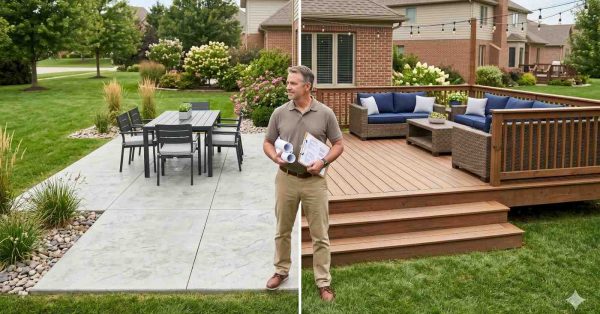
Color and material continuity form the second foundation of design. A deck’s finish, whether a natural wood tone, a composite hue, or a stained surface, should relate intentionally to the home’s exterior palette. A gray composite deck against a blue-gray clapboard home reads as purposeful. The same deck against warm red brick requires deliberate contrast logic to succeed. Getting this relationship wrong at the design stage means repainting, refinishing, or living with a visual mismatch for the life of the deck.
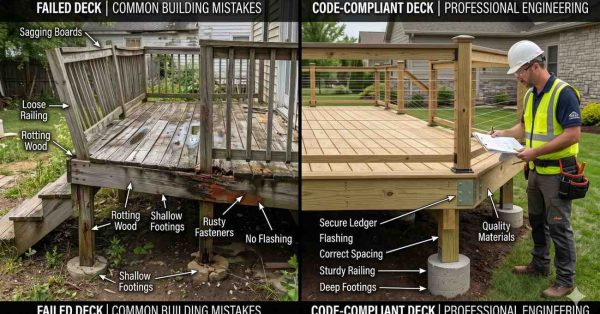
Common design mistakes are concentrated in the planning phase and compound through construction. The most cited include: underestimating depth (decks less than ten feet deep rarely accommodate outdoor furniture without crowding), ignoring door swing clearance, placing stairs in positions that interrupt natural traffic flow, and failing to account for drainage slope. A second category involves feature scope creep, where pergolas, outdoor kitchens, and built-in seating are added to a design without revisiting whether the structural substructure can support the combined loads. Design decisions and structural decisions are not separate tracks; they must be developed in parallel.
Whether you are refining your first concept or evaluating a contractor’s proposal, our complete resource on deck design principles and fundamentals explores scale rules, color theory, proportion guidelines, and the planning mistakes that lead to costly mid-project revisions, giving you the vocabulary and decision framework to assess any deck concept before committing to construction.
Deck Shapes and Layouts: Choosing the Right Footprint
The shape of a deck defines how the space functions, how much it costs to build, and how well it integrates with the property. Every configuration involves trade-offs, and the best choice depends on lot conditions, budget, door placement, and how the household plans to use the space.
Rectangular and square decks are the standard starting point. They are structurally efficient, straightforward to permit, and compatible with most composite and wood decking products. A 16-by-20-foot rectangular deck provides approximately 320 square feet and represents one of the most cost-effective footprints in residential construction. For most properties without unusual grade changes or site complications, this configuration delivers the best usable square footage per construction dollar.
L-shaped decks wrap around a corner of the home and create two distinct zones within a single structure. They perform well on homes where two exterior doors open from different rooms, such as a kitchen door and a living room door, or where the goal is a dedicated dining area on one arm and a lounge area on the other without relying on a purely large rectangular platform. The framing at the interior corner requires careful engineering but presents no unique structural challenge.
Multi-level decks stack platforms at different elevations, typically following natural grade changes or serving to differentiate functional zones. A main-level platform off the back door, a lower landing transitioning to the yard, and a separate upper-level section near a bedroom entrance are all common configurations. Multi-level designs add visual interest and flexibility, but the connection points between levels require careful structural detailing, and multi-level projects add meaningfully to both framing complexity and total cost.
Wraparound decks extend along two or more sides of the home, creating a continuous perimeter platform that maximizes access to sun, shade, and views at different times of day. They are especially common on craftsman bungalows, farmhouses, and vacation properties where the relationship to the surrounding landscape is part of the daily experience.
Floating and detached decks sit unattached to the home’s structure. They require no ledger board, often qualify for simplified footing systems, and offer location flexibility: placed near a pool, a garden feature, or a specimen tree rather than anchored to the house. Their structural independence also reduces or eliminates some of the more complex ledger attachment code requirements that govern attached decks.
Second-story decks arise naturally on homes with walk-out basements, split-level designs, or main living floors elevated significantly above grade. They require taller posts, more robust framing, and always require attention to fall protection requirements below the deck surface.
Every footprint decision carries structural, cost, and code implications that are easier to address at the design stage than after construction begins. Our in-depth resource on deck shapes and layouts walks through every configuration, from simple rectangular platforms to wraparound, L-shaped, multi-level, and floating designs, with framing considerations and real-world scenarios for each so you can match the right form to your property and lifestyle before any plans are drawn.
Style-Based Deck Design: Finding Your Aesthetic
A deck is an architectural extension of the home. Its visual language, the combination of materials, colors, railing profiles, lighting, and structural detailing, should speak the same design dialect as the structure it serves. Style decisions made at the planning stage determine every subsequent product and finish choice.
Modern and contemporary styles prioritize clean lines, minimal ornamentation, and deliberate material contrast. Cable railings or frameless glass panels replace traditional balusters, creating unobstructed sight lines. Wide-plank composite decking in cool gray, charcoal, or warm brown tones, combined with black powder-coated hardware and integrated LED strip lighting, defines the modern deck vocabulary. Pergola structures, when present, tend toward flat aluminum frames with motorized louvered roofs rather than traditional wood construction.
Traditional deck styles draw from classical architectural language: turned wood balusters, painted wood railings, composite or wood decking in warm cedar or redwood tones, and wood pergola structures with classical detailing. These designs age gracefully on colonial, craftsman, Tudor, and cape-cod-style homes. Their proportional language mirrors the home’s existing architectural rhythm rather than contrasting with it.
Farmhouse and rustic decks blend warmth with durability. Wide-plank composite decking in weathered gray or medium brown, black metal hardware, board-and-batten or lattice skirting, and robust square post profiles define this aesthetic. Built-in bench seating with below-seat storage is a recurring feature, reflecting the farmhouse priority of form following function.
Coastal and beach-style decks prioritize corrosion resistance and visual lightness. Capped composite decking in weathered gray, driftwood, or soft white tones performs reliably in marine environments where salt air degrades unprotected metal hardware and opens the grain of untreated wood. Horizontal cable railings maintain sight lines to water views, and materials are specified to resist the specific moisture and UV exposure coastal properties generate.
Japanese-inspired and minimalist designs use tight geometry, natural materials, and intentional negative space. Ipe or bamboo decking, simple square posts without decorative caps, no overhead structure, and deliberate integration with garden plantings form the vocabulary of this approach. Every element earns its presence; decoration for its own sake is absent.
Mediterranean and rustic European styles incorporate warm terracotta, clay, and warm stone tones, curved archway detailing where structurally feasible, wrought iron railing elements, and pergola structures draped with climbing plants to create the layered, lived-in quality of a European courtyard.
The style you select in the design phase ripples through every downstream decision. From our comprehensive guide to style-based deck design, you will find every major aesthetic category explored with real-world examples, material pairings, railing profiles, and the defining design decisions that make each approach architecturally intentional and visually cohesive on its specific home type.
Designing for Your Specific Site
No two properties present identical design conditions. Lot slope, tree placement, adjacent structures, sun orientation, prevailing wind direction, regional climate, and soil type all shape what a successful deck design looks like on any given parcel. Generic design templates fail for the same reason that generic prescriptions fail: they ignore the patient.
Sloped lots are among the most common site challenges in deck design. A deck on a lot that falls away from the home can either ride a raised platform supported by tall posts as grade drops, or it can follow the terrain with a cascading multi-level design that steps down with the slope. The choice between these approaches affects structural cost significantly, the aesthetics of the underside and post assembly, and code requirements for fall protection. Lots with slopes exceeding 30 percent typically require a structural engineering review before plans can be finalized.
Small yards demand ruthless prioritization. When a usable backyard is fewer than 500 square feet in total, the deck’s footprint must balance outdoor living quality with yard access, natural light, and visual breathing room. Ground-level decks in floating or freestanding configurations often perform well here, preserving flexibility without blocking yard access to one side of the home. Decks that are slightly smaller but well-proportioned almost always outperform larger decks that crowd the remaining green space.
Coastal properties introduce wind load, salt air corrosion, and material performance concerns that inland sites do not face. Hardware specifications shift from standard zinc-coated to stainless steel 316 grade. Composite and tropical hardwood decking options consistently outperform pressure-treated lumber in coastal humidity and UV exposure. Railing systems must be engineered for wind uplift specific to the coastal exposure category, which varies by jurisdiction and proximity to the waterfront.
Wooded lots create natural canopy and shade while introducing ongoing debris management challenges. Decks positioned beneath mature tree canopies accumulate leaves, pine needles, sap, and organic material that accelerates surface deterioration on open-grain wood. Smooth-capped composite decking cleans significantly more easily than natural wood in these conditions. Designing around existing trees also requires specific framing strategies at the foundation level to avoid root systems, and sometimes structural accommodation for trees that grow through or near the deck platform.
Urban and townhouse lots often have no conventional backyard but offer rooftop or courtyard opportunities instead. Privacy screen integration is nearly always a priority in dense residential neighborhoods, and construction site access for materials and equipment is frequently limited, affecting both design logistics and construction scheduling.
Mountain properties contend with snow load accumulation, freeze-thaw cycles, and high sustained winds that require structural overbuilding above what standard residential codes mandate in lower elevations. Decking materials in high-altitude environments must handle freeze-thaw without cracking, delaminating, or retaining ice dangerously.
Our guide to site-specific deck design provides dedicated frameworks for sloped lots, small yards, coastal properties, wooded settings, mountain locations, and urban spaces, so your design begins with an accurate read of what your land can support rather than a generic template that ignores your actual conditions.
Functional Deck Design: Planning for How You Live
The most visually compelling deck that fails to support how a household actually uses outdoor space is a design failure regardless of its aesthetics. Functional deck design begins not with shapes and materials but with user behavior: How many people typically gather? What activities overlap? What does this household value most in outdoor living?
Zoning a deck is the practice of organizing a single platform into distinct activity areas without physical walls or barriers. A dining zone positioned near the kitchen door, a lounge zone grouped around a fire feature at the far end, and a transition zone with built-in bench seating between them creates a functional outdoor room that accommodates multiple activities simultaneously without feeling chaotic.
Effective zoning requires minimum zone dimensions. A dining area for six to eight people requires approximately 10 by 12 feet of clear space to accommodate a table, chairs, and comfortable movement. A lounge zone with four chairs around a firepit requires a comparable footprint. Stacking two such zones on a single deck implies a minimum useful platform of approximately 300 square feet, not counting stair landings or transition space.
Traffic flow is the design element most frequently underestimated. The path from the kitchen door to the grill, from the seating area to the stairs, and from the dining table to the back of the yard must be navigable without requiring guests to step around furniture or through the cooking zone. Good functional design maps these movement patterns before furniture placement is ever considered.
Designing for entertaining means thinking about sightlines, social acoustics, and host workflow. A grill located at the far end of a 30-foot deck separates the cook from the conversation; positioning the cooking station within 8 to 10 feet of the indoor kitchen door and within conversational range of the primary seating zone creates a natural outdoor cooking and gathering environment. The specific features you integrate into each functional zone, from built-in seating and outdoor kitchen configurations to pergola covers, fire pits, and lighting systems, carry structural and code implications of their own, which our complete guide to deck features and accessories addresses in full detail, with design integration guidance and load considerations for every major add-on category.
Family-friendly decks require designing for children and adults simultaneously without compromising either experience. Self-closing gate systems, railing baluster spacing compliant with the four-inch clearance rule, slip-resistant stair treads, and clear sight lines from adult seating to any play area are all design-phase decisions. These features are straightforward to incorporate during planning and expensive to retrofit after construction.
Year-round use begins with orientation. Which direction does the deck face? A south-facing deck in northern climates receives maximum winter sun; the same deck in a hot southern climate may require aggressive shading strategies to remain comfortable in summer. Overhead structures reduce wind exposure; pergola-mounted infrared heaters extend the usable season; motorized louvered pergola roofs allow real-time adjustment of sun and rain exposure. All of these elements are most cost-effective when designed in from the beginning.
If your outdoor space needs to serve multiple household functions simultaneously, our guide to functional deck design planning breaks down how to zone your deck effectively, prioritize features for your specific lifestyle, manage traffic flow, and plan for year-round comfort before structural decisions lock in your options.
Deck Design Software and Planning Tools
Modern homeowners have access to digital planning tools that transform deck design from an abstract exercise into a concrete visual experience. Seeing a deck concept in three dimensions before breaking ground reduces the risk of costly mid-project changes and dramatically improves communication with contractors and permitting officials.
Manufacturer-specific design tools are the most accessible starting point for most homeowners. Trex Deck Designer, TimberTech’s online configurator, and similar browser-based tools allow users to drag and drop decking patterns, railing styles, color combinations, and feature elements into a top-down or three-dimensional view. These tools are optimized for their respective product lines and perform best in the middle stages of planning, when material selection is underway and broad layout decisions have already been made.
SketchUp is a free 3D modeling application used by both homeowners and design professionals. It requires a steeper learning curve than manufacturer tools but offers considerably greater flexibility: custom geometries, multi-level configurations, accurate representation of complex site topography, and the ability to model existing structures for reference. Many regional deck builders use SketchUp to present design concepts to clients before producing formal construction drawings.
AI-powered deck design platforms are advancing rapidly in 2025. Several services now allow homeowners to describe their yard and lifestyle preferences in natural language and receive AI-generated three-dimensional deck concepts within seconds. These tools are most valuable for early-stage inspiration and concept exploration rather than construction-grade planning, but they are closing the gap between visualization and specification faster than any other category of design software.
CAD-based planning tools, including AutoCAD, DeckingCode, and Smart Decks, produce the construction drawings and permit-ready plan sets that most jurisdictions require for a permit application. This level of documentation is typically produced by a design professional, design-build firm, or experienced contractor rather than a homeowner independently.
The right tool depends entirely on where you are in the planning process: manufacturer tools for material and color visualization, SketchUp for spatial exploration, AI platforms for early concept generation, and CAD-based software for permit submission. Before committing to a layout, seeing your concept in 3D can prevent costly surprises during construction, which is why our complete review of the best deck design software tools compares every major platform, from manufacturer-specific configurators and SketchUp to AI-powered concept generators and CAD-based permit drawing tools, helping you select the right tool for your current planning stage.
Deck Design Trends for 2025
The outdoor living category has sustained significant growth momentum for consecutive years as homeowners across all climate regions expand investment in usable exterior space. According to the American Institute of Architects’ 2024 Home Design Trends Survey, outdoor living features ranked among the most consistently requested additions for the fourth consecutive year, confirming that this is a structural preference shift rather than a temporary market cycle.
Biophilic design is moving from an emerging concept to a mainstream design expectation. Planters integrated into deck perimeters, living wall systems mounted on privacy screens, cascading water features incorporated into level transitions, and deliberate material choices that reference natural grain and organic tone are all expressions of this trend at the deck scale. The underlying goal is creating an outdoor environment that provides psychological restoration by increasing sensory contact with natural elements.
Sustainable and low-maintenance materials are gaining meaningful market share. Capped composite decking, thermally modified wood products like Accoya and Kebony, and PVC decking are all displacing untreated or minimally treated lumber in new residential deck construction. Grand View Research projects that the global composite decking market will surpass $11 billion by 2030, driven by a sustained preference for materials that require less annual maintenance and produce a lower environmental footprint over their service life.
Smart-home integration now appears regularly in new deck designs: automated lighting systems programmed to scheduled or motion-triggered scenes, motorized pergola louvers with weather sensors that close automatically in rain, weatherproof outdoor speakers integrated with whole-home audio systems, outdoor display screens with purpose-built weatherproofing, and deck-mounted environmental sensors feeding climate and air quality data to home automation platforms.
Indoor-outdoor color continuity is replacing the older convention of keeping deck tones deliberately neutral and separate from interior design. Homeowners in 2025 are selecting composite decking that harmonizes with interior hardwood or LVP flooring tones, extending interior paint colors to exterior trim, and treating the back deck as a room that begins at the back door rather than a separate functional zone with its own unrelated aesthetic.
Multi-functional built-in features reflect the continued compression of outdoor square footage alongside rising material costs. Bench seating with integrated storage, fire tables that double as occasional surfaces, bar tops extending from railing cap systems, and integrated planter boxes that also serve as privacy screens are all examples of the high-utility, low-footprint design approach that characterizes the current trend direction.
Our dedicated guide to 2025 deck design trends breaks down what is gaining momentum right now, from biophilic elements and sustainable material choices to smart-home integration and indoor-outdoor color continuity, with guidance on which trends hold long-term resale value and which are stylistic preferences that date quickly.
Working with Deck Design Professionals
Some homeowners design their own decks using digital tools and contractor input. Others benefit substantially from professional design expertise from the earliest planning stages. Understanding what each professional type provides, and when that expertise is worth the investment, produces better outcomes at every budget level.
A dedicated deck designer specializes exclusively in outdoor structures. They bring deep, current knowledge of decking materials, framing systems, structural requirements, and outdoor livability without the broader scope of a landscape architect or general contractor. For complex projects with custom features, unusual site conditions, or high design expectations, a dedicated deck designer typically delivers the highest value per engagement dollar.
A landscape architect approaches a deck as one element of a broader exterior environment. When the deck must integrate with hardscaping, water features, grading changes, planting plans, and outdoor lighting across the full property, a landscape architect provides the systems-level vision that deck-specific designers may not. Landscape architect fees are typically higher, and the engagement timeline is longer, making their involvement most justified on larger, more complex residential estates or properties where the deck is one element of a comprehensive exterior renovation.
A design-build firm combines design and construction under one contract. The same team that draws the plans builds the deck, reducing the risk of specification gaps between design intent and construction reality. This approach streamlines communication, consolidates accountability, and eliminates the coordination burden between a separate designer and separate contractor. Most established regional deck specialists operate as design-build firms.
The design-bid-build approach separates design from construction. A homeowner engages a designer to produce a complete set of drawings and specifications, then solicits competitive bids from multiple contractors. This approach typically produces the most competitive construction pricing and gives homeowners the most control over contractor selection, but it requires a more sophisticated project management role from the owner through both phases.
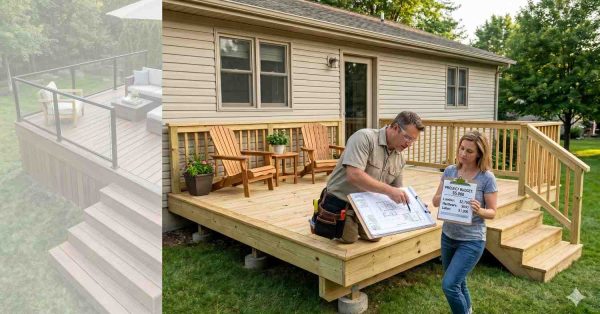
Design fee structures vary by professional type and regional market. Dedicated deck designers and design-build firms commonly charge between $500 and $3,500 for residential projects, with many design-build firms crediting design fees toward the construction contract once an agreement is signed. Landscape architects engaging on a full exterior design project typically bill hourly or on a percentage-of-project fee structure.
Our complete resource on hiring a deck design professional explains the differences between dedicated deck designers, landscape architects, and design-build firms, and details what to expect from fees, contracts, portfolio reviews, and first consultations, so you enter any professional engagement with a clear understanding of the process and realistic expectations for the outcome.
Connecting Design to Materials, Permits, and Construction
Deck design does not exist in isolation. Every design decision cascades into material specifications, structural requirements, permit applications, and construction methodology. Homeowners who treat design, engineering, and code compliance as separate sequential tasks consistently encounter the expensive rework that results when these three tracks fall out of alignment.
Materials and design are inseparable. The decking material you select during the design phase determines joist spacing, fastener specifications, color palette, maintenance obligations, and long-term cost trajectory. Capped composite decking from most manufacturers requires joists at 16 inches on center; some products require 12. Ipe hardwood demands stainless steel fasteners and pre-drilled pilot holes. Selecting a material after framing is roughed in frequently means rebuilding the substructure. The materials you choose in the design phase determine your joist spacing requirements, fastener specifications, color options, and long-term maintenance obligations, which is why our complete guide to deck materials and components should be consulted alongside every design decision, walking through every category from decking boards and substructure options to railings, fasteners, and specialty products.
A second consequence of late material selection is budget instability. Premium composite decking can cost three to four times as much as standard pressure-treated lumber per linear foot. If material cost is not integrated into the design-phase budget model, the discovery of actual material pricing mid-project creates scope reduction, material compromise, or budget overrun, none of which produce the intended outcome.
Building codes shape every design boundary. Setback requirements determine the minimum distance from property lines, easements, and structures. Lot coverage rules limit the combined footprint of all structures on a parcel. Railing height minimums and maximum baluster spacing are fixed by code regardless of aesthetic preference. Ledger attachment requirements dictate fastener type, spacing, and flashing specifications when a deck is attached to the home. Every deck design must align with local building regulations before a single board is purchased, since setbacks, lot coverage limits, railing height requirements, and load calculations all directly shape what is physically and legally buildable on your property, which is why our complete guide to deck permits, codes, and safety explains which regulations apply to your project and what to expect during inspections.
The path from design to construction. The final output of a thorough design and planning process is a set of construction-ready drawings: site plan, framing plan, elevation views, and detail callouts that a qualified builder can execute accurately. When the design is complete, code-reviewed, and permitted, construction begins, and the quality of every phase that follows depends entirely on the clarity and accuracy of the design that preceded it. Once your design is finalized, site-surveyed, code-reviewed, and permitted, the build phase begins, and our complete guide to the custom deck construction process covers every stage from footing installation and framing to board installation, railing systems, and finishing details, serving as the natural next step after this design and planning guide.
Conclusion
Deck design and planning bridges your outdoor living vision with buildable reality, integrating shape, style, site conditions, functionality, and code requirements into a cohesive plan.
Each section links to dedicated resources that go deeper on specific topics, from shapes and styles to software tools, current trends, and professional design guidance.
Ready to start your deck design? Contact Mr. Local Services to connect with qualified deck design and construction professionals in your area today.
Frequently Asked Questions
What is the difference between deck design and deck planning?
Deck design refers to aesthetic and functional decisions including shape, style, materials, and features. Deck planning encompasses the broader process, including site assessment, budgeting, permit requirements, and contractor coordination before construction begins.
How much does it cost to have a deck professionally designed?
Professional deck design fees typically range from $500 to $3,500 for residential projects, depending on complexity and the professional type engaged. Many design-build firms credit the design fee toward the construction contract once a build agreement is signed.
What deck shape works best in a small yard?
Rectangular or square ground-level decks tend to perform best in small yards, maximizing usable square footage while preserving yard flexibility. Floating or detached configurations also perform well where a conventional ledger-attached platform would feel disproportionate in a tight space.
Do I need a permit for a deck I designed myself?
Most U.S. jurisdictions require permits for decks attached to the home or built above 30 inches from grade, regardless of who designed them. Always verify local requirements with your building department before starting construction.
Should I choose a deck style or assess my site first?
Site assessment should always precede style selection. Your property’s slope, sun orientation, and neighboring structures create real constraints that must shape the design before aesthetic preferences are applied.
What is the best deck design software for homeowners in 2025?
Manufacturer tools like Trex Deck Designer offer the most accessible starting point for most homeowners. SketchUp provides greater flexibility for complex layouts at no cost, and AI-powered design platforms are improving rapidly and worth exploring for early-stage inspiration.
How far in advance should I begin planning a deck design?
Most homeowners should allow 4 to 12 weeks for a thorough design process, including site assessment, consultation, permitting, and contractor scheduling. Projects planned during peak construction seasons often require longer lead times given contractor availability.