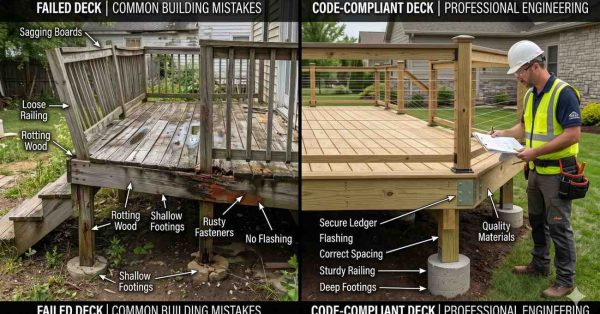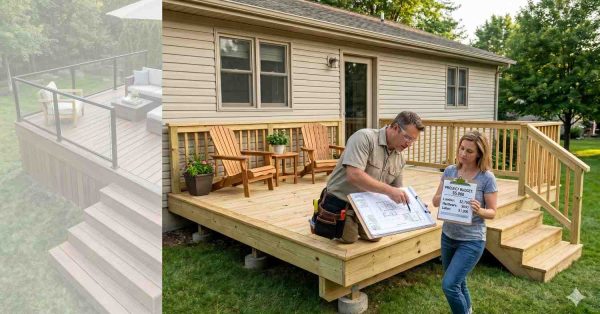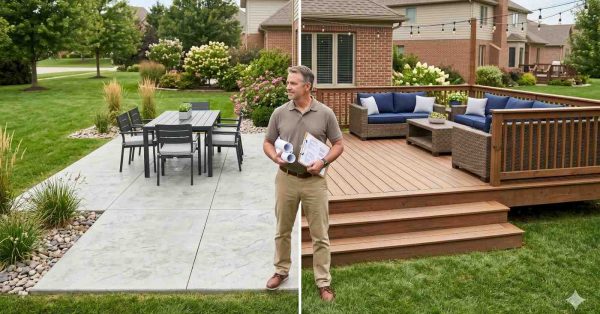
A deck is not one product — it is a layered assembly of nine distinct material categories, each making structural, aesthetic, and financial decisions that ripple through the next twenty-five years of ownership. From the joists hidden beneath your feet to the post caps that crown your railings, every component carries trade-offs in cost, lifespan, maintenance burden, and climate suitability that homeowners, landlords, and property managers need to understand before signing a contract.
Choosing wrong on a single layer — a thinner joist, a galvanized fastener in coastal air, a non-rated board near a fire-prone zone — can cut the deck’s useful life in half and trigger repair costs that eclipse the original savings.
This guide orients you across all nine material categories: selection frameworks, substructure, decking boards, fasteners, footings, railings, stairs, accessories, and specialty options, with linked deep-dives for every spoke.
How to Choose the Right Deck Materials
Material selection is the single highest-leverage decision in any deck project because it sets the ceiling on lifespan, the floor on maintenance cost, and the boundaries of what designs are even structurally possible. The right framework weighs four variables in order: climate exposure, budget envelope, maintenance tolerance, and aesthetic intent — anything that ignores those four delivers regret.
Climate alone narrows the field aggressively. Coastal homeowners need stainless 316 hardware and rot-resistant species or capped composites; desert builds demand UV-stabilized formulations and lighter colors; freeze-thaw zones require deeper footings and dimensionally stable boards that resist cupping. Budget then determines tier within those climate-appropriate options — pressure-treated pine at one end, mineral-based composites and tropical hardwoods at the other, with cedar, redwood, and mid-tier composites filling the middle.
Maintenance tolerance is the most underestimated variable. A wood deck demands roughly 12–16 hours of cleaning, sanding, and resealing every 2–3 years, while a quality capped composite asks for one annual wash. Over a 25-year horizon, that gap totals more than 100 maintenance hours and several thousand dollars in product cost. The right material decision balances climate, budget, maintenance tolerance, and aesthetic goals — our ultimate guide to choosing deck materials walks through every decision variable with a side-by-side comparison chart and a lifespan-by-material breakdown so you can shortlist confidently before requesting quotes.
Deck Substructure Materials Explained
The substructure is the skeleton — joists, beams, posts, ledger boards, and blocking — that carries every load above it. It is also the component homeowners see least and inspect least, which is why substructure failures account for a disproportionate share of catastrophic deck collapses tracked by code authorities and insurance carriers.
Pressure-treated southern yellow pine remains the dominant substructure material because its ground-contact treatment levels (ACQ, MCA, and CA-C) resist rot and insect damage at price points no alternative matches. Treatment chemistry matters: MCA leaves a cleaner appearance and lower corrosion risk to hardware than older ACQ formulations, while CA-C delivers strong performance in standard above-ground applications.
Steel and aluminum substructures are gaining share in premium and commercial builds. Steel framing systems from manufacturers like Fortress and Trex Elevations resist rot entirely, carry 50-year warranties, and allow longer joist spans, but they cost roughly two to three times pressure-treated equivalents. Aluminum joist systems weigh less, never corrode, and are ideal for rooftop and over-water installations where weight and moisture exposure punish wood.
Joist tape is the single cheapest substructure upgrade with the largest payoff. A peel-and-stick butyl or acrylic tape applied across the top of every joist prevents the trapped water that causes most rot — adding less than $300 to a typical build and often doubling joist life. Substructure material choice quietly determines whether your deck lasts fifteen years or fifty, and our deep dive on the best wood for deck substructure covers ground-contact ratings, treatment chemistries, steel and aluminum alternatives, and joist tape pairings in full detail.
Decking Board Materials and Profiles
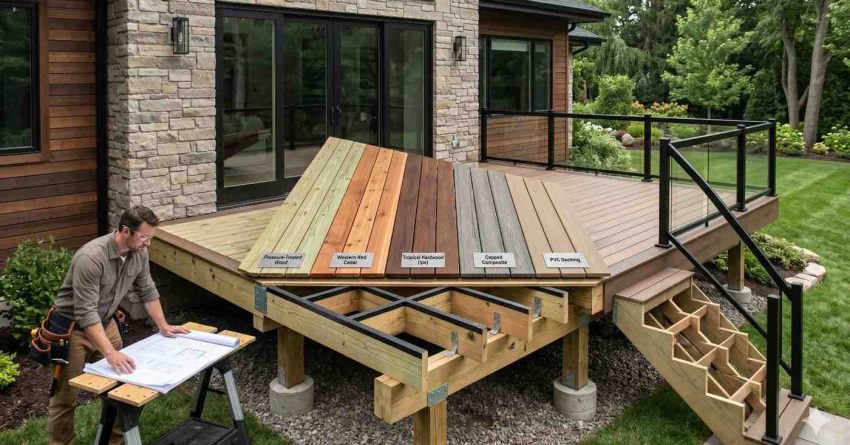
Decking boards are the visible surface, the part visitors touch, and the line item that drives the largest single share of material budget — typically 30–45% of total material cost. Eight distinct material families compete for that line: pressure-treated lumber, cedar, redwood, tropical hardwoods (ipe, cumaru, tigerwood), modified wood (Kebony, Accoya, thermally modified), composite, PVC, and aluminum.
Each family lives in a different cost-lifespan-maintenance band. Pressure-treated boards cost $2–$5 per square foot installed and last 15–25 years with annual maintenance; cedar and redwood run $5–$12 with 20–30 year life and biennial sealing; tropical hardwoods like ipe cost $15–$25 but routinely last 40+ years with minimal upkeep; capped composites run $8–$18 with 25–30 year warranties and almost no maintenance; PVC sits at $10–$20 with the lowest maintenance profile of any decking material.
Profile choices matter as much as material. Grooved boards accept hidden fasteners for a clean surface; square-edge boards require face-screwing or specialty clips. Standard 5.5-inch widths suit most builds; wide-plank 7- and 8-inch boards create a modern aesthetic but cost more per square foot and demand tighter joist spacing.
Pre-finished boards arrive ready to install and skip the staining step entirely, while site-finished options give homeowners control over final color but add days of weather-dependent labor. Decking boards are the visible surface you walk, entertain, and live on every season, so we built a complete guide that compares every decking board material type — pressure-treated, cedar, redwood, tropical hardwood, composite, PVC, aluminum, and modified wood — across cost, lifespan, and maintenance hours.
Fasteners and Hardware Selection
Fasteners are the smallest components in a deck and the most underestimated source of failure. The North American Deck and Railing Association attributes a meaningful share of inspected deck failures to fastener corrosion, undersized lag bolts at the ledger, or missing lateral load connectors — defects that hide invisibly until the deck moves.
Material grade is the first decision. Hot-dipped galvanized hardware works in standard inland applications but corrodes faster than expected when exposed to modern pressure-treatment chemistries. Stainless steel 304 handles most residential builds, while stainless 316 is the only acceptable specification within a few miles of saltwater — the molybdenum content resists chloride attack that destroys lesser grades within a few seasons.
Hidden fastener systems (clips from Camo, Tiger Claw, Cortex, and Trex Hideaway) deliver a screw-free surface that boosts aesthetics and resale appeal, but they tighten installation tolerances and add $1–$2 per square foot to material cost. Face-screwing with color-matched composite screws remains faster, cheaper, and easier to repair board-by-board.
Structural hardware deserves equal scrutiny. Joist hangers must match joist size and species; hurricane ties are required in high-wind zones; lateral load connectors per IRC R507 are mandatory at ledger connections; through-bolts (not lag screws) are the modern standard for attaching ledgers to rim joists. Fastener failure is one of the most common causes of deck collapse, which is why our complete guide to deck fasteners breaks down screw vs nail performance, stainless 304 vs 316, hidden fastener systems, hurricane ties, and through-bolting requirements section by section.
Footings and Foundation Materials
Footings transfer every load — the deck itself, the people on it, snow on top of it, the hot tub bolted to it — down into soil that can actually carry the weight. The wrong footing type or sizing produces the slow-motion failure homeowners describe as “my deck is sinking on one side.”
Poured concrete piers remain the most common solution because they are inexpensive, code-accepted everywhere, and adaptable to almost any soil. Standard piers use Sonotube forms, 12-inch diameter for typical loads and 16- to 18-inch for heavier applications, poured to bear below the local frost line — anywhere from 12 inches in southern climates to 48+ inches in the upper Midwest and Northeast.
Helical piles are the premium alternative. Steel shafts with helical plates are driven by hydraulic equipment to a torque-verified bearing depth, deliver guaranteed load capacities, and install in a single day without curing time. They cost roughly two to three times poured concrete but eliminate frost-heave risk, work in poor or expansive soils, and allow immediate framing.
Surface footings — Diamond Pier systems, pre-cast pier blocks, and adjustable post bases — work for floating ground-level decks and detached structures under specific code conditions. They skip excavation entirely but require careful soil prep and code verification. Footings carry every pound of dead and live load down into the soil, and our breakdown of deck footing options compares poured concrete piers, helical piles, Diamond Pier systems, and surface footings with sizing tables tied to soil bearing capacity and frost depth.
Railing Material Options
Railings serve two non-negotiable functions — fall protection that meets IRC R507.6 code (typically 36-inch minimum residential, 42-inch commercial) and the dominant visual element on the finished deck. Material choice determines maintenance cycle, sightline quality, and design vocabulary.
Wood railings (cedar, pressure-treated, or hardwood) match wood decking aesthetically and cost the least up front, but they demand the same biennial finishing as the deck surface. Composite railings (Trex, TimberTech, Fiberon) deliver low-maintenance performance with color matching to composite boards and post-cap lighting integration. Aluminum railings are powder-coated steel-grade systems that virtually never need maintenance and work in any climate.
Cable railings preserve sightlines on view-oriented decks — mountain, lake, or oceanfront — by replacing balusters with horizontal stainless cables tensioned between posts. Glass panel railings deliver the cleanest sightline of all but require thoughtful integration with structural posts and frequent cleaning.
Wrought iron and decorative metal railings remain popular in traditional and Mediterranean designs, while custom-designed railings (mixed materials, integrated planters, built-in lighting) allow personalization at premium price points. Railings deliver both safety and design impact, and our complete guide to deck railings walks through wood, composite, aluminum, cable, glass, and wrought iron systems with code requirements, brand comparisons, and installation considerations for each.
Stair Construction Materials
Stairs combine structural engineering with everyday ergonomics. Stringers carry the load, treads handle the foot traffic, and code-compliant handrails prevent falls — all three demand careful material selection because stairs are typically the highest-wear surface on any deck.
Stringer materials follow two paths: pressure-treated lumber cut on-site or steel manufactured stringer systems. Wood stringers are cheaper and faster for standard rise/run configurations but degrade fastest of any deck component because end-grain absorbs water. Steel stringers from Fortress, Pylex, and similar manufacturers carry decade-plus warranties, install in adjustable configurations, and never rot.
Tread materials should match the deck surface for visual continuity — same composite, same hardwood, same PVC — but builders sometimes upgrade tread material for slip resistance. Open vs closed risers is partly aesthetic, partly code-driven (some jurisdictions require closed risers in commercial applications), and partly safety-driven (closed risers prevent small children and pets from slipping through).
Code requires consistent rise and run within ⅜-inch tolerance, 7.75-inch maximum riser height, and 10-inch minimum tread depth in most jurisdictions. Handrails must run continuously, sit between 34 and 38 inches above tread nosing, and be graspable per ADA specifications even on residential builds. Stairs combine structural engineering with daily-use ergonomics, and our complete guide to deck stair construction explains stringer materials, rise and run calculations, tread options, code-compliant handrails, and floating stair designs in one resource.
Accessories, Trim, and Drainage Components
Accessories and trim transform a structurally complete deck into a finished outdoor space. Fascia boards conceal the rim joist, post caps protect end-grain and add lighting integration, picture-frame borders elevate aesthetics, and skirting closes off the under-deck space — each is small but visible.
Fascia material should match decking boards or coordinate intentionally. Composite fascia comes pre-shaped in matching colors, while wood fascia requires the same finish as the deck surface. Skirting options range from horizontal slats to lattice panels to solid panels with integrated ventilation — the choice depends on under-deck use (storage, mechanical access, pure aesthetics).
Drainage components are the invisible upgrade that protects the substructure and creates dry usable space below an elevated deck. Drainage membranes installed between joists and decking boards (Trex RainEscape, TimberTech DrySpace, Zip-UP) channel water to gutters, while under-deck ceiling systems (Color Guard, RDI) create a finished ceiling for the lower level.
Drip-edge flashing at the ledger, post-cap lighting transformers, breaker boards on long runs, and inlay patterns are the small details that signal craftsmanship. The finishing components transform a functional structure into a polished outdoor room, and our guide to deck fascia and skirting options covers material matching, drip-edge flashing, post caps, drainage membranes, and under-deck ceiling systems with installation sequencing.
Specialty and Performance-Rated Materials
Specialty materials solve specific environmental, regulatory, or performance problems that standard materials cannot address. They cost more, but in the contexts where they apply, they are the only acceptable choice.
Fire-rated decking is mandatory in California’s Wildland-Urban Interface zones and increasingly common in wildfire-prone regions of the West. Products like TimberTech AZEK with Class A flame spread rating, ipe with natural fire resistance, and mineral-based composites meet WUI compliance.
Cool-touch decking technology reduces surface temperature on pool decks and southern exposures where standard dark composites can exceed 160°F in direct summer sun. Manufacturers including Trex Transcend Lineage, TimberTech AZEK Vintage with CoolTrack, and Deckorators Voyage with mineral-based cores measurably lower surface temperatures by 15–30°F.
Slip-resistant decking with textured surfaces or coefficient-of-friction ratings above 0.6 wet works for pool surrounds, marina decks, and ADA-compliant commercial installations. Mold-resistant and insect-resistant formulations matter in humid southeastern climates and termite zones.
LEED-friendly and FSC-certified options serve sustainability-focused builds and commercial projects pursuing green certifications, while recycled-content composites and bio-based alternatives are gaining traction across the industry. Specialty materials solve specific environmental problems that standard decking cannot address, and our review of cool-touch decking technologies explains how heat-reflective capstocks, mineral-based composites, and light-color formulations measurably reduce surface temperature on pool decks and southern exposures.
Matching Materials to Your Project Type
The right material decision is never universal — it depends on what you are building, where you are building it, and who will use it. A starter family deck on a suburban lot has different priorities than a coastal vacation rental, a rooftop urban build, or a commercial restaurant patio, and the material spec should reflect those priorities at every layer.
Residential single-family builds typically prioritize the cost-to-lifespan ratio: pressure-treated substructure, mid-tier capped composite or cedar boards, stainless 304 hardware, and aluminum or composite railings. Coastal builds upgrade to stainless 316 throughout, PVC or capped composite boards, and concrete piers above grade. Rental properties (long-term and short-term) lean toward the lowest-maintenance combination: composite or PVC boards, aluminum railings, and steel substructure where budget allows.
Commercial builds add code layers — IBC requirements, ADA compliance, fire ratings, and bonding/insurance specifications — that often dictate material choices regardless of preference. Once you have shortlisted material categories, the next decision is product-line selection within each category — our complete guide to composite decking walks through every major brand, capping technology, and warranty structure to help you choose the right line for your build.
When you are ready to translate material choices into a finished project, working with vetted deck builders on the Mr. Local Services network connects you with contractors who carry the licensing, insurance, and material-specific certifications your build requires.
Conclusion
Deck materials and components form an interconnected system where every layer — substructure, boards, fasteners, footings, railings, stairs, accessories, and specialty options — affects the others over the deck’s lifetime.
Use this guide as your hub: shortlist material categories that match your climate, budget, and maintenance tolerance, then dive into each spoke resource for the specifications, brand comparisons, and installation details that turn decisions into a buildable plan.
When you are ready to move from research to quotes, we connect you with vetted, insured deck professionals nationwide — start your project with Mr. Local Services today.
Frequently Asked Questions
What is the longest-lasting deck material available in 2025?
Tropical hardwoods like ipe and cumaru lead with 40–75 year lifespans, followed by aluminum decking at 50+ years and capped PVC at 30–50 years. Capped composites typically deliver 25–30 years.
How much does a typical deck cost in materials alone?
Material costs range from $8–$15 per square foot for pressure-treated wood builds to $25–$50+ per square foot for premium composite or tropical hardwood projects, before labor or accessories.
Do I need different fasteners for coastal versus inland decks?
Yes — coastal decks within a few miles of saltwater require stainless 316 hardware throughout, while inland builds can use stainless 304 or hot-dipped galvanized fasteners rated for ACQ-treated lumber contact.
Can I mix composite and wood materials on the same deck?
Yes, builders frequently combine composite decking boards with wood substructure, composite fascia with wood railings, or wood accents with composite surfaces, but each combination needs compatible hardware and finishing.
How deep do deck footings need to go?
Footings must extend below your local frost line — typically 12 inches in southern states, 30–36 inches in the Midwest, and 48+ inches in the upper Northeast and Mountain West regions.
What is the difference between capped and uncapped composite decking?
Capped composites have a protective polymer shell that resists stains, fading, mold, and scratches; uncapped composites are first-generation products that lack the shell and show those issues much faster.
Are aluminum decking and railings worth the higher cost?
Aluminum decks deliver 50+ year lifespans with virtually zero maintenance and excel in coastal, rooftop, and over-water applications — the higher upfront cost typically pays back through avoided replacement and finishing labor.