
Building an energy-efficient and sustainable home is the practice of designing and constructing a residence that minimizes operating energy, water use, and embodied carbon while maximizing comfort, durability, and indoor health. For homeowners, landlords, and property managers planning a new build today, every assembly choice — from foundation insulation to electrical panel sizing — locks in decades of utility costs, resale value, and resilience.
Energy codes are tightening, electrification mandates are spreading, and federal incentives now offset major portions of efficiency upgrades, making informed early decisions more financially consequential than ever before today.
This guide maps every dimension: performance certifications, envelope design, HVAC and water heating, solar and storage, water and air quality, sustainable materials, climate-zone strategy, available incentives, and how to hire a qualified build team.
What Makes a New Home Energy-Efficient and Sustainable?
An energy-efficient home is one that delivers full comfort and function using dramatically less energy than a code-minimum equivalent — typically 30 to 70 percent less, depending on certification level. A sustainable home extends that definition by accounting for water conservation, indoor air quality, embodied carbon in materials, site impact, and long-term durability.
The two concepts overlap heavily but are not identical. A net-zero solar home that uses spray foam with high global warming potential may be efficient but not fully sustainable. A passive-solar timber-frame cabin with no mechanical cooling may be sustainable but poorly suited to a humid climate.
True hub-level performance comes from integrating four systems: a tight, well-insulated envelope; right-sized high-efficiency mechanical equipment; renewable generation and storage; and intentional material and water choices. The interplay of envelope, mechanical systems, renewables, and behavior is what separates a truly efficient home from one that merely meets code — our energy-efficient home construction guide walks through every performance lever and the order in which to specify them during design.

Performance Standards and Certifications That Define Quality
Certifications give buyers, lenders, and appraisers a verified yardstick for how a home actually performs. Choosing one early in design — rather than retrofitting toward it — saves significant cost and prevents incompatible specification.
HERS Index, Energy Star, and DOE Zero Energy Ready
The HERS Index, administered by RESNET, scores a home against a code-baseline reference. A score of 100 equals a 2006 code-built home; a score of 0 is net-zero. Production builders typically deliver HERS 60–75; Energy Star Certified Homes require HERS in the 50s; DOE Zero Energy Ready Home demands roughly HERS 40–55 plus EPA Indoor airPLUS verification.
Passive House Standard
Passive House — available in the U.S. through PHIUS and PHI pathways — caps annual heating and cooling demand at extremely low thresholds and requires air tightness of 0.6 air changes per hour at 50 pascals (PHI) or a climate-specific equivalent (PHIUS). Among the certifications available to new builds, Passive House sets the most aggressive energy and comfort targets in the industry — our complete breakdown of the Passive House standard explains the heating demand cap, air tightness threshold, and certification path step by step.
LEED for Homes and Living Building Challenge
LEED for Homes scores broadly across energy, water, materials, site, and indoor environmental quality. The Living Building Challenge is the most rigorous — requiring net-positive energy and water, red-list-free materials, and biophilic design integration.
The Building Envelope — Foundation of Every Efficient Home
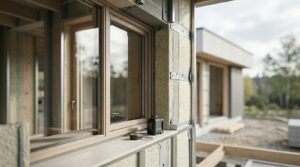
The envelope is every assembly that separates conditioned space from outside: foundation, walls, roof, windows, and doors. Investments here outperform mechanical upgrades because envelope improvements are permanent and require no maintenance.
Three envelope priorities drive performance:
- Continuous insulation wrapping the framing eliminates thermal bridges where heat short-circuits through studs and joists.
- Air tightness verified by blower door test (target: ≤3 ACH50 for Energy Star, ≤0.6 for Passive House) eliminates uncontrolled drafts and moisture transport.
- High-performance fenestration with low U-factor and climate-appropriate SHGC reduces both heat loss and unwanted solar gain.
Spray foam, dense-pack cellulose, mineral wool, and rigid exterior foam each serve different climate and assembly types. ZIP System sheathing with integrated tape, Tyvek with proper detailing, or housewrap behind rain-screen cladding all manage bulk water and air movement when properly installed.
A continuous insulation layer wrapping the framing — not just filling cavities — is the single highest-leverage envelope decision in cold or mixed climates, and our deep dive into continuous insulation strategies explains rigid foam, mineral wool, and assembly details that prevent thermal bridging.

High-Performance HVAC, Water Heating, and Ventilation
Once the envelope is tight, mechanical loads shrink dramatically — which means equipment should also shrink, not be sized to old assumptions. Oversized HVAC short-cycles, fails to dehumidify, and wastes capital.
Heat Pumps Replace Furnaces and Boilers
Cold-climate heat pumps from Mitsubishi Hyper-Heat, Daikin Aurora, and others now deliver full capacity at -13°F, making them viable in IECC zones 6 and 7 where they were once impractical. Geothermal heat pumps offer the highest efficiency where lot size and budget permit a ground loop.
Heat Pump Water Heaters
Heat pump water heaters (Rheem ProTerra, A.O. Smith Voltex) deliver Uniform Energy Factors above 3.5 — meaning more than three times the hot water per unit of electricity compared to resistance tanks. They require a conditioned-space install with ducting or a basement/garage location with adequate volume.
Balanced Ventilation
Tight homes need mechanical fresh air. ERVs (Energy Recovery Ventilators) transfer both heat and moisture and suit humid climates; HRVs (Heat Recovery Ventilators) transfer only heat and suit dry climates. Right-sizing a heat pump requires a proper Manual J load calculation rather than rules of thumb, and our guide to heat pump sizing for new builds covers load math, cold-climate model selection, and ducted-versus-ductless decision frameworks.
Solar PV, Battery Storage, and Whole-Home Electrification
Pairing an efficient envelope and mechanical systems with on-site generation moves a home toward net-zero or net-positive performance. Most new builds in 2026 should also be planned as all-electric from day one, even if some appliances start as gas — to avoid stranding fuel infrastructure.
Solar PV Sizing
Solar arrays should be sized against modeled annual electrical consumption, including projected EV charging, future heat pump conversion of any remaining gas appliances, and battery charging losses. A 6–10 kW system covers most efficient single-family homes; larger homes with EVs may need 12–18 kW.
Battery Storage vs. Generator Backup
Tesla Powerwall, Enphase IQ Battery, and LG Chem batteries paired with a smart electrical panel (Span, Lumin) enable load shedding during outages and time-of-use arbitrage. Standby generators remain useful for very long outages or off-grid scenarios but add fuel storage and emissions.
Panel and Service Sizing
200-amp service is the floor for an all-electric home with EV charging; 400-amp service is increasingly justified for larger homes or dual EV households. Solar should be sized against modeled annual usage — including future EV charging and electrification — and our solar PV sizing guide walks through array math, orientation, pitch, and how to coordinate with a smart electrical panel.
Water Conservation and Indoor Air Quality
Sustainable building extends beyond energy to the water and air systems serving daily life. WaterSense-labeled fixtures cut indoor water use by 20 percent or more at no comfort penalty. Greywater systems reuse laundry and bath water for irrigation; rainwater harvesting buffers landscape demand.
Indoor air quality matters more, not less, in tight homes. Whole-house filtration at MERV 13 or higher captures fine particulates; HEPA-grade options remove allergens and smoke. Radon-resistant construction — a passive vent stack tied to a sub-slab perforated pipe — costs little during construction and is required by code in many high-radon regions.
Tight, well-insulated homes demand intentional ventilation and filtration design to stay healthy, and our breakdown of indoor air quality best practices covers ERV/HRV sizing, MERV vs. HEPA filtration tiers, and radon mitigation built into the slab.
Sustainable Design Principles and Material Choices
Design decisions made before equipment is selected often produce the largest sustainability gains. Site orientation, window placement, overhang sizing, and floor plan compactness all shape lifetime energy use.
- Passive solar design harvests winter sun through south-facing glazing with summer shading from properly sized overhangs.
- Daylighting reduces lighting load and improves wellbeing.
- Cross-ventilation allows natural cooling in shoulder seasons.
- Embodied carbon — the carbon emitted to manufacture and transport materials — can rival 20 years of operational emissions; choosing cellulose over spray foam, FSC-certified lumber, low-carbon concrete mixes, and reclaimed materials cuts this footprint.
Low-VOC paints, finishes, and adhesives protect indoor air during the critical first year after move-in when off-gassing peaks. Orienting glazing, sizing overhangs, and placing thermal mass to harvest free winter sun while rejecting summer heat is among the oldest and most underused efficiency tools — our guide to passive solar design shows how to integrate it into modern floor plans.
Climate-Zone Strategy — Why One Approach Doesn’t Fit All
IECC divides the country into eight climate zones, and a wall assembly optimized for Minneapolis (Zone 6) will fail in Houston (Zone 2). Cold climates prioritize R-value and air tightness; hot-humid climates emphasize moisture control, cooling efficiency, and vapor strategy; hot-dry climates favor thermal mass, radiant barriers, and cool roofs.
Foundation type also follows climate: frost-protected shallow foundations and full basements in cold zones; slab-on-grade in southern zones; crawlspaces (ideally encapsulated) in humid mixed climates. Roof pitch follows snow load and solar latitude.
Insulation R-values, vapor strategy, HVAC type, and roof color all shift dramatically by climate zone, and our regional climate-zone energy strategies library translates IECC zones 1 through 8 into specific assembly and equipment recommendations.
Federal Tax Credits, IRA Rebates, and Utility Incentives
The Inflation Reduction Act dramatically expanded incentives for efficient and electrified new homes. Understanding which credits and rebates apply — and how they stack — can reduce net build cost by tens of thousands of dollars.
- 25C Energy Efficient Home Improvement Credit: Up to $3,200 annually for envelope improvements, audits, and select equipment (more applicable to retrofits but relevant for phased builds).
- 25D Residential Clean Energy Credit: 30% of cost for solar PV, battery storage (3 kWh+), geothermal heat pumps, and solar water heating, with no cap.
- 45L Energy-Efficient Home Tax Credit: Up to $5,000 per home for builders certifying Energy Star or DOE Zero Energy Ready homes — typically passed through in pricing.
- HEEHRA and HOMES Rebates: State-administered IRA rebates with point-of-sale discounts for heat pumps, panel upgrades, and whole-home retrofits, with eligibility tied to household income.
State programs (California TECH, Mass Save, NYSERDA, Oregon ETO) and utility rebates often stack with federal credits. Stacking federal credits with state programs and utility rebates can cut net cost by tens of thousands of dollars, and our walkthrough of IRA home energy rebates explains HEEHRA, HOMES, 25C, 25D, and 45L eligibility in plain terms.
Hiring the Right Team for an Energy-Efficient Build
Even the most ambitious efficiency plan fails without execution. Certified Passive House Consultants, LEED-AP residential professionals, HERS Raters, and BPI-certified contractors bring the verification and testing experience that production builders typically lack.
Before signing, verify:
- Active license and insurance in your state
- Project portfolio at your target certification level
- References from owners of completed, occupied projects (not just under-construction homes)
- Familiarity with IRA paperwork and 45L documentation
- Subcontractor relationships with mechanical installers experienced in heat pump and ERV commissioning
Verifying credentials before signing a contract protects both performance outcomes and rebate eligibility, and our directory of how to find a certified Passive House builder explains which designations — CPHC, LEED-AP, HERS Rater, BPI — actually matter for your project type.
When you’re ready to move from planning to execution, connecting with trusted home service professionals across insulation, HVAC, solar, and electrical trades through Mr. Local Services lets you assemble a vetted team without sourcing each contractor independently.
Conclusion
Energy-efficient and sustainable home building integrates envelope, mechanical systems, renewable generation, water and air quality, and material choices into one performance package backed by verified certifications.
Climate zone, certification target, and available federal and state incentives determine which specifications make financial and environmental sense for any specific lot or audience.
We help homeowners, landlords, and property managers connect with vetted efficiency builders, HVAC pros, solar installers, and inspection specialists through Mr. Local Services — one trusted source for the whole team.
Frequently Asked Questions
What is the most cost-effective first step toward an energy-efficient new home?
Investing in a tight, well-insulated envelope before specifying mechanical equipment delivers the largest lifetime return because it shrinks load forever and lets you buy smaller, cheaper HVAC.
How much more does an energy-efficient home cost to build?
A code-plus efficient home typically adds 2–5% to base cost; an Energy Star home 3–8%; a Passive House 8–15%. IRA credits and rebates often recover most of the premium.
Is solar required by code in new construction?
California requires solar on most new single-family homes under Title 24. Other states are following, but in most jurisdictions solar remains optional but heavily incentivized through the 30% federal ITC.
Do I need a HERS rater for an energy-efficient new home?
A HERS rater is required for Energy Star, DOE Zero Energy Ready, and 45L tax credit certification. Even outside those programs, third-party testing catches envelope and duct leakage early.
What is the difference between Energy Star and Passive House?
Energy Star is a moderate code-plus program (roughly HERS 50–60). Passive House is a far more rigorous standard with strict air tightness, heating demand caps, and verification — typically 70–80% more efficient than code.
Can I make a manufactured or modular home energy-efficient?
Yes. Several factories now offer Passive House and Energy Star certified modular homes. Manufactured homes built to the 2024 HUD energy code perform significantly better than older units.
Are heat pumps reliable in very cold climates?
Modern cold-climate heat pumps maintain rated capacity to -13°F and operate below -22°F with reduced output, making them viable across IECC zones 1 through 7 when properly sized.