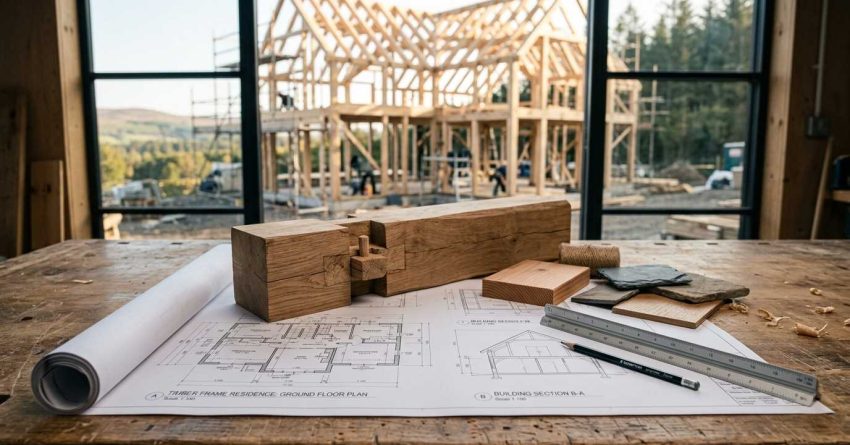
A timber frame home is a structure built around a skeleton of large, exposed wooden posts and beams connected through traditional joinery — creating open, cathedral-like interiors that are as structurally sound as they are visually striking. Unlike conventional stick-built homes, timber frame construction uses fewer, larger members to carry the entire structural load, freeing interior walls from bearing responsibilities and giving homeowners extraordinary design flexibility. This building method has been used for centuries and remains one of the most durable, energy-efficient, and architecturally distinctive ways to build a custom home.
Understanding the full scope of a timber frame build matters because the decisions made in the earliest planning stages — from site selection to structural system choice — directly determine your budget, timeline, and long-term satisfaction with the finished home.
This guide covers every major phase of a timber frame build: what timber framing is and how it works, cost planning, design and layout, site preparation, the construction process, insulation, roofing, interior finishing, mechanical systems, windows and doors, exterior finishing, permits, and how to assemble the right team of professionals.
What Is a Timber Frame Home?
A timber frame home is defined by its structural system: large-dimension timbers — typically 6×6 inches or larger — are cut, fitted, and joined using traditional woodworking techniques to form a rigid, self-supporting frame. The frame carries all structural loads, which means interior walls can be placed anywhere without concern for load-bearing requirements. This is what creates the open floor plans, soaring ceilings, and dramatic interior spaces that timber frame homes are known for.
The exposed wood itself is a defining aesthetic feature. Beams, posts, and rafters remain visible throughout the interior, giving the home a warmth and character that no other construction method replicates. Timber species commonly used include Douglas fir, white oak, eastern white pine, and western red cedar — each with distinct grain patterns, color tones, and structural properties.
How Timber Framing Differs from Conventional Stick Framing
Conventional stick-frame construction uses dozens of small-dimension lumber members — typically 2×4 or 2×6 studs — spaced closely together to distribute structural loads across many points. Timber framing concentrates those loads into fewer, larger members connected at precise joinery points. The result is a fundamentally different structural logic: fewer members, larger spans, and a frame that is visible rather than hidden inside walls.
Stick framing is faster and less expensive to build at scale. Timber framing requires more skilled labor, longer lead times for timber fabrication, and higher material costs — but delivers a structure with greater longevity, superior thermal mass, and a level of architectural character that stick framing cannot match.
Types of Timber Frame Construction
The three primary systems used today are traditional timber framing (hand-cut mortise and tenon joinery with wooden pegs), post-and-beam construction (similar structural logic but often using metal connectors rather than traditional joinery), and hybrid timber frame systems (a timber frame interior combined with a conventional or structural insulated panel exterior). Each system has different cost profiles, aesthetic outcomes, and insulation strategies.
How Much Does It Cost to Build a Timber Frame Home?
Cost is the first question most homeowners ask — and the answer depends on more variables than a single number can capture. According to industry estimates, timber frame homes in the United States typically cost between $150 and $350 per square foot for the complete build, with custom or high-end projects reaching $400 or more per square foot depending on timber species, joinery complexity, site conditions, and regional labor markets.
Average Cost Per Square Foot
A modest timber frame home in the 1,500–2,000 square foot range built with standard Douglas fir framing and a conventional foundation will generally fall in the $225,000–$525,000 range for total construction costs. Larger homes with premium timber species, complex roof geometries, or remote site locations can exceed $1 million before interior finishing.
These figures typically include the timber frame package (the fabricated frame itself), foundation, enclosure system, and rough mechanical systems. Interior finishing — flooring, cabinetry, fixtures, and trim — adds significantly to the total and varies based on specification level.
Factors That Affect Total Build Cost
The variables that most significantly affect total cost include timber species and grade, frame complexity (number of bents, roof pitch, cantilevers), enclosure system choice (SIPs panels vs. conventional framing), foundation type, site accessibility, regional labor costs, and the level of interior finish specified. Permit fees, engineering costs, and site work — including clearing, grading, and utility connections — are often underestimated in early budget planning and should be accounted for from the start.
Timber frame home costs vary widely in price depending on size, materials, and regional labor rates — our timber frame home cost breakdown covers average per-square-foot figures, full project budget ranges, and every cost variable you need to plan your build accurately.
Designing Your Timber Frame Home
Design is where a timber frame build truly begins. Before a single timber is cut, the structural layout, floor plan, and architectural character of the home must be resolved — because in timber frame construction, the structure and the aesthetics are the same thing. The placement of every post and beam is both a structural decision and a design decision.
Working with a Timber Frame Architect or Designer
Timber frame homes require a designer or architect with specific experience in post-and-beam structural systems. A general residential architect unfamiliar with timber framing may produce beautiful drawings that are structurally impractical or unnecessarily expensive to build. A timber frame specialist understands how to optimize the frame layout for both structural efficiency and visual impact — minimizing material waste while maximizing the drama of exposed wood in the interior.
Many timber frame companies offer in-house design services as part of a design-build package. This approach streamlines coordination between the designer and the fabrication team but limits your ability to shop the frame package competitively. Working with an independent architect gives you more control over the design process and allows you to solicit competitive bids from multiple frame fabricators.
Floor Plans and Layout Considerations
Timber frame floor plans are organized around the structural grid of the frame — the spacing between posts determines where walls, windows, and openings can be placed. Common bay spacings range from 12 to 20 feet, with wider bays creating more dramatic open spans but requiring larger, more expensive timbers. Single-story designs with steep cathedral roofs are among the most popular configurations because they maximize the visual impact of the exposed frame while keeping the structural system relatively simple.
Every successful timber frame build starts with a design that accounts for structural load paths, open-span requirements, and the visual character of exposed wood — our timber frame home design process walks through floor plan options, working with a timber frame architect, and the decisions that shape your home’s layout and long-term livability.
Site Preparation and Foundation Requirements
A timber frame home places concentrated structural loads at the base of each post rather than distributing weight evenly along a continuous wall plate as stick framing does. This means the foundation must be engineered to handle point loads at specific locations — a requirement that affects both foundation design and site preparation.
Choosing and Clearing Your Build Site
Site selection for a timber frame home involves evaluating soil bearing capacity, drainage patterns, slope, sun orientation, and access for the heavy equipment required during construction. Timber frame components are large and heavy — a single bent (a structural frame section) may weigh several thousand pounds and require a crane to raise. The site must accommodate crane access and staging areas for the frame components during the raising process.
Clearing and grading the site to establish a level building pad, manage stormwater runoff, and provide stable access for construction vehicles is typically one of the first line items in the construction budget. Sites with significant slope, dense vegetation, or poor soil conditions will require more extensive preparation and may add meaningfully to total project cost.
Foundation Types for Timber Frame Homes
The three most common foundation types used with timber frame homes are full basements, crawl spaces, and slab-on-grade foundations. Full basements add usable square footage and provide excellent access to mechanical systems but are the most expensive option and require careful waterproofing in areas with high water tables. Crawl spaces offer a cost-effective middle ground that keeps the structure elevated above grade while providing access to plumbing and electrical systems. Slab-on-grade foundations are the least expensive option and work well in mild climates but eliminate below-grade storage and limit mechanical system access.
The foundation you choose affects structural performance, moisture management, and long-term stability for the entire frame above it — our guide to foundation options for timber frame homes explains slab, crawl space, and full basement configurations, along with site grading and soil preparation requirements specific to timber frame construction.
The Timber Frame Construction Process
The construction of a timber frame home follows a sequence that differs significantly from conventional building. The frame is fabricated off-site — in a shop or mill — then transported to the building site and assembled in a single coordinated raising event. This off-site fabrication model requires precise planning and engineering before construction begins, but it compresses the on-site construction timeline dramatically compared to stick framing.
Timber Selection and Sourcing
Timber selection begins with species choice, which affects structural performance, appearance, cost, and availability. Douglas fir is the most widely used structural timber in the western United States due to its high strength-to-weight ratio and consistent availability. White oak and eastern white pine are popular in the eastern United States for their grain character and regional availability. Reclaimed timbers — salvaged from old barns, mills, and industrial buildings — are increasingly popular for their weathered character and sustainability credentials, though they require careful inspection for structural integrity.
Timber grade matters as much as species. Structural timbers are graded for allowable stress values that determine how much load they can safely carry. Your timber frame engineer will specify minimum grade requirements for each member based on the structural analysis of the frame.
Joinery Methods: Mortise and Tenon, Pegs, and Modern Connectors
Traditional timber frame joinery uses mortise and tenon connections — a projecting tenon cut on one timber fits precisely into a mortise (a rectangular pocket) cut in the receiving timber — secured with wooden pegs driven through offset holes that draw the joint tight as the peg is driven home. This system, refined over centuries, creates connections that are both structurally robust and visually beautiful.
Modern timber frame construction also uses engineered metal connectors — concealed within the timber or exposed as a design feature — that can achieve equivalent or superior structural performance with less precision required in the timber cutting. Hybrid approaches that combine traditional joinery at visible connections with concealed metal connectors at less visible locations are common in contemporary timber frame homes.
The Raising Day: Assembling the Frame
Raising day is the most dramatic moment in a timber frame build. Pre-cut and pre-fitted frame components are delivered to the site, and a crane lifts each bent into position while a crew of timber framers guides the connections and drives the pegs. A complete timber frame for a modest home can be raised in one to three days. The speed of the raising process — and the visual transformation of an empty foundation into a standing structural frame — is one of the most compelling aspects of timber frame construction.
The sequence of cutting, fitting, and raising a timber frame is one of the most technically precise stages of the entire build — our timber frame raising and assembly process covers joinery methods, timber sourcing, pre-assembly in the shop, and what happens on raising day from first post to completed bent.
Insulation and Energy Efficiency in Timber Frame Homes
Insulating a timber frame home presents a unique challenge: the exposed timber frame that defines the aesthetic of the interior must remain visible, which means insulation cannot be placed between the structural members the way batt insulation is placed between studs in a conventional wall. Instead, insulation must be applied to the exterior of the frame — or integrated into a panel system that wraps the frame from outside.
Structural Insulated Panels (SIPs) vs. Batt Insulation
Structural Insulated Panels — rigid foam insulation sandwiched between two structural facing panels — are the most common enclosure system for timber frame homes. SIPs attach directly to the exterior of the timber frame, providing both the structural skin of the building and its thermal envelope in a single assembly. A well-detailed SIPs enclosure can achieve R-values of R-24 to R-40 or higher depending on panel thickness, with minimal thermal bridging and excellent air tightness.
Batt insulation between conventionally framed walls built around the exterior of the timber frame is a less expensive alternative but typically achieves lower R-values and requires more careful air sealing to match the performance of a SIPs system. Spray foam applied to the interior of an exterior sheathing system is a third option that offers excellent air sealing and high R-values but at a higher material cost than batt insulation.
Meeting Energy Codes and Efficiency Standards
Timber frame homes must meet the same energy code requirements as any other residential construction — typically the International Energy Conservation Code (IECC) or state-specific equivalents. In cold climates, meeting code minimums often requires wall assemblies in the R-20 to R-30 range and roof assemblies in the R-49 to R-60 range. Many timber frame homeowners choose to exceed code minimums to reduce long-term energy costs and improve comfort in the large, open interior volumes that timber frame homes create.
Timber frame homes require insulation strategies that preserve the visual integrity of exposed beams while meeting modern energy codes — our guide to insulating a timber frame home compares SIPs panels, spray foam, and batt insulation approaches, with guidance on R-value targets and air sealing for open timber frame envelopes.
Roofing for Timber Frame Homes
The roof of a timber frame home is one of its most architecturally significant elements. Steep pitches, exposed rafter tails, and dramatic overhangs are hallmarks of timber frame roof design — and the roofing system must be selected to complement these features while providing reliable long-term weather protection.
Roof Styles That Complement Timber Frame Architecture
Gable roofs, hip roofs, and shed roofs are all common in timber frame construction, with gable roofs being the most traditional. Steep pitches — 8:12 to 12:12 or steeper — are characteristic of timber frame homes and create the dramatic interior volumes that define the style. Dormers, cupolas, and clerestory windows are frequently incorporated to bring natural light into the upper reaches of the interior and add visual complexity to the roofline.
Roofing Materials and Longevity
Metal roofing — standing seam steel or aluminum — is the most popular choice for timber frame homes because of its longevity (50+ years with proper installation), low maintenance requirements, and compatibility with steep pitches and complex roof geometries. Architectural asphalt shingles are a less expensive alternative with a 25–30 year lifespan. Cedar shakes and slate are premium options that complement the natural material palette of timber frame construction but require more maintenance and carry higher installation costs.
The roof structure on a timber frame home is both a functional weatherproofing system and a visible architectural feature — our overview of roofing systems for timber frame homes explains which materials and styles work best with exposed rafter tails, steep pitches, and the long-span roof assemblies common in timber frame construction
Interior Finishing: Flooring, Drywall, and Carpentry
Once the frame is raised, the enclosure system is installed, and the mechanical rough-in is complete, interior finishing transforms the structural shell into a livable home. In a timber frame home, interior finishing decisions are shaped by the presence of the exposed frame — every surface, material, and detail must work in harmony with the wood overhead and around it.
Flooring Options for Timber Frame Interiors
Hardwood flooring is the most natural complement to a timber frame interior — the warmth of wood underfoot reinforces the material character of the exposed frame above. Wide-plank hardwoods in species that match or complement the structural timbers are a popular choice. Engineered hardwood offers greater dimensional stability in environments with seasonal humidity fluctuations, which are common in timber frame homes due to the hygroscopic nature of large-dimension timbers. Stone tile, polished concrete, and cork are alternative options that provide visual contrast to the wood frame while maintaining the natural material palette.
Timber frame interiors pair naturally with warm, durable floor surfaces that complement exposed wood overhead — our resource on hardwood and engineered flooring options covers species selection, installation methods, and finish choices that work with the humidity fluctuations common in timber frame homes.
Drywall, Ceiling, and Wall Finishing Considerations
Finishing walls and ceilings in a timber frame home requires careful coordination between the drywall contractor and the timber frame design. Drywall is typically applied to the infill walls between timber posts, with the timber faces left exposed. Ceiling assemblies must accommodate the underside of the roof deck or SIPs panels while maintaining clean transitions at the beam faces. Tongue-and-groove wood paneling on ceilings and upper walls is a popular alternative to drywall that reinforces the natural material character of the interior.
Finishing walls and ceilings around exposed timber requires careful planning to maintain clean sight lines and structural access — our guide to drywall and ceiling finishing for timber frames explains how to detail around beams, manage thermal bridging at wall-to-frame connections, and achieve a polished interior finish without concealing the structural character of the wood.
Custom Carpentry and Built-Ins
The open, high-ceiling spaces in timber frame homes create exceptional opportunities for custom built-ins, architectural staircases, and finish carpentry details that would be impractical in a conventionally framed home. Custom bookshelves built into the space between timber posts, staircases with timber stringers and custom railings, and kitchen cabinetry designed around the structural grid of the frame are all common expressions of finish carpentry in timber frame interiors.
The open, high-ceiling spaces in timber frame homes create exceptional opportunities for built-in shelving, custom staircases, and architectural millwork — our custom carpentry for timber frame interiors resource covers the scope of finish carpentry work that transforms a framed shell into a fully detailed, livable home.
Plumbing, Electrical, and HVAC Rough-In
Routing mechanical systems through a timber frame structure requires more planning than in a conventional stick-framed home. The structural members are large, visible, and cannot be notched or drilled without engineering review. Mechanical systems must be routed through designated chases, concealed within partition walls, or run in exposed conduit as a deliberate design feature.
Routing Systems Through Timber Frame Structures
Plumbing supply and drain lines are typically routed through interior partition walls, floor assemblies, and utility chases that are planned into the design before framing begins. Drain lines require specific slope gradients that must be accommodated in the floor assembly depth — a consideration that affects floor-to-floor heights and must be coordinated with the structural engineer early in the design process.
Routing plumbing through a timber frame structure requires coordination between the framing layout and mechanical systems before walls are closed — our overview of plumbing rough-in for timber frame builds explains how supply and drain lines are planned around post-and-beam layouts and where coordination with your timber frame engineer is essential.
Exposed timber frames limit where conduit and wiring can run without disrupting the visual integrity of the structure — our guide to electrical wiring in timber frame homes covers concealment strategies, panel placement, and the coordination required between your electrician and timber frame contractor during rough-in.
HVAC Considerations for Open Timber Frame Spaces
The large open volumes and vaulted ceilings in timber frame homes create unique heating and cooling challenges. Warm air rises to the peak of a vaulted ceiling, creating temperature stratification that makes the living level cooler than the upper reaches of the space. Ceiling fans are an effective and low-cost tool for destratifying air in tall spaces. Radiant floor heating is particularly well-suited to timber frame homes because it heats the occupied zone at floor level without relying on forced air to overcome stratification. Mini-split heat pump systems offer flexible zoning without the ductwork challenges that vaulted ceilings create.
The large open volumes and vaulted ceilings in timber frame homes create unique heating and cooling challenges that standard HVAC sizing calculations do not fully address — our resource on HVAC systems for open timber frame spaces explains duct routing strategies, mini-split options, and how to size your system for the thermal dynamics of an exposed-beam interior.
Windows and Doors in Timber Frame Construction
Windows and doors in a timber frame home must be sized and positioned to work within the structural grid of the posts and beams. Unlike stick-framed construction, where openings can be cut almost anywhere with the addition of a header, timber frame openings are constrained by the location of structural members. This makes window and door placement a design decision that must be resolved during the structural design phase — not during construction.
Sizing and Placement for Structural Integrity
Windows in timber frame homes are typically placed within the bays defined by the structural posts — the space between two adjacent posts. Bay widths of 12 to 16 feet allow for large window groupings that flood the interior with natural light. Tall windows that extend from near the floor to the underside of the beam above are a signature feature of timber frame design and reinforce the vertical scale of the interior.
Door openings — particularly large entry doors and sliding glass doors — must be carefully detailed to transfer loads around the opening without relying on the door frame itself for structural support. This typically requires a timber header or engineered beam above the opening, sized by the structural engineer.
Energy-Efficient Window and Door Options
Large window areas are a defining feature of timber frame homes — and a significant source of heat loss in cold climates. Triple-pane glazing, low-emissivity coatings, and thermally broken frames are important specifications for timber frame homes in heating-dominated climates. Passive solar design principles — orienting the home to maximize south-facing glass and minimize north-facing glass — can meaningfully reduce heating loads and improve comfort in timber frame homes with large glazing areas.
Windows and doors in a timber frame home must be sized and positioned to work with the structural grid of the posts and beams rather than cut through load-bearing members — our guide to window and door installation for timber frames covers rough opening sizing, energy-efficient glazing options, and the detailing required to weatherproof large openings in a timber frame envelope.
Exterior Finishing and Landscaping
The exterior of a timber frame home must protect the structural system from moisture, UV exposure, and biological degradation while expressing the architectural character of the building. Exterior finishing decisions — siding material, stain or paint system, trim details, and landscape design — collectively determine how the home reads in its environment and how well it performs over decades of exposure.
Siding, Staining, and Exterior Wood Protection
Timber frame homes frequently use natural wood siding — cedar, redwood, or pine — that complements the exposed timber aesthetic. Board-and-batten, shiplap, and channel siding profiles are popular choices that reinforce the vertical and horizontal lines of the frame. Any exposed exterior wood — including timber ends, rafter tails, and decorative brackets — must be treated with a penetrating stain or sealant system that allows moisture vapor to escape while blocking liquid water infiltration.
Fiber cement siding, stone veneer, and metal panel systems are increasingly popular alternatives that offer lower maintenance requirements while maintaining the architectural character appropriate to timber frame construction. The choice of exterior cladding has a significant impact on long-term maintenance costs and should be evaluated alongside the initial installation cost.
Decks, Porches, and Outdoor Living Spaces
Outdoor living spaces are a natural extension of the timber frame home’s architectural language. Covered porches with exposed timber posts and beams, open decks built with matching wood species, and pergolas that echo the structural character of the main frame are all popular additions that extend the livable area of the home and reinforce its connection to the surrounding landscape.
Outdoor living spaces built to complement a timber frame home often use matching wood species and joinery details to create a seamless transition from interior to exterior — our resource on timber frame deck and porch construction covers material selection, structural attachment to the main frame, and design options that extend the architectural character of your home outdoors.
The site design surrounding a timber frame home shapes how the structure reads in its environment and how well drainage, grading, and outdoor access function over time — our overview of landscaping around a timber frame home explains grading priorities, planting strategies, and hardscape options that complement the natural materials and architectural scale of timber frame construction.
Permits, Codes, and Timeline for a Timber Frame Build
Building a timber frame home requires the same permits and code compliance as any residential construction project — but the permitting process for a custom timber frame build is typically more involved than for a production home because the structural system must be reviewed and approved by a licensed structural engineer before permits are issued.
Building Permits and Inspections
A complete permit application for a timber frame home typically includes architectural drawings, structural engineering calculations and drawings, energy compliance documentation, and site plans showing setbacks, grading, and utility connections. The review process varies by jurisdiction — rural counties may issue permits in two to four weeks, while urban jurisdictions with high permit volumes may take three to six months or longer.
Inspections occur at multiple stages of construction: foundation, framing, rough mechanical (plumbing, electrical, HVAC), insulation, and final occupancy. Timber frame homes may require additional structural inspections at the framing stage because the structural system differs from the conventional framing that most building inspectors review routinely. Engaging a building official early in the design process to discuss the structural system can prevent delays during the permit review.
Realistic Build Timelines by Project Phase
A complete timber frame build from design through occupancy typically takes 18 to 36 months for a custom home, depending on project complexity, site conditions, and local permit timelines. The design and engineering phase alone typically takes three to six months. Timber fabrication — once the design is finalized and engineering is complete — takes two to four months for a typical residential frame. Site work, foundation, and raising typically take one to three months. Enclosure, mechanical rough-in, and interior finishing take an additional six to twelve months depending on the level of finish specified and the availability of subcontractors.
Hiring the Right Professionals for Your Timber Frame Project
A timber frame home involves more specialized trades than a conventional build — and the coordination between those trades is more complex. The timber frame contractor, structural engineer, architect, foundation contractor, mechanical subcontractors, and finish trades must all work from a shared set of drawings and a coordinated construction schedule. Gaps in coordination between trades are one of the most common sources of cost overruns and schedule delays in custom timber frame projects.
The most successful timber frame builds are managed by an experienced general contractor or design-build firm with a proven track record in timber frame construction specifically. A general contractor who has never managed a timber frame project will face a steep learning curve that the homeowner ultimately pays for in time and money.
When evaluating contractors, ask for references from completed timber frame projects, review their subcontractor relationships across all required trades, and verify that their structural engineer has timber frame-specific experience. A contractor who can demonstrate a complete, coordinated team across all required trades — from foundation through finish — is worth a premium over a lower bid from a team assembling those relationships for the first time.
Finding qualified contractors across every trade involved in a timber frame build — from foundation crews to finish carpenters — is one of the most time-intensive parts of the project, which is why working with trusted home service professionals who coordinate across trades can reduce scheduling conflicts, quality gaps, and costly rework throughout the build.
Conclusion
Timber frame construction combines centuries-old structural logic with modern engineering, energy performance, and design flexibility — producing homes that are durable, architecturally distinctive, and deeply connected to natural materials. Every phase of the build, from site preparation and foundation through framing, enclosure, mechanical systems, and interior finishing, requires specialized knowledge and coordinated execution.
The resources linked throughout this guide go deeper into each phase of the build — from cost planning and design through construction, insulation, roofing, and finishing — giving you a complete reference library for every decision you will face as you move from concept to completed home.
At Mr. Local Services, our network of skilled professionals covers every trade involved in a timber frame build — contact us today to connect with experienced contractors who deliver quality workmanship and dependable results from foundation to finish.
Frequently Asked Questions
How long does it take to build a timber frame home?
A complete timber frame build from design through occupancy typically takes 18 to 36 months. The design and engineering phase takes three to six months, timber fabrication takes two to four months, and construction through interior finishing takes an additional six to twelve months.
Is a timber frame home more expensive than a stick-built home?
Yes, timber frame homes generally cost more than comparable stick-built homes. Expect to pay between $150 and $350 per square foot for a complete timber frame build, compared to $100 to $200 per square foot for conventional stick framing, due to higher material costs and more skilled labor requirements.
What is the difference between timber frame and post-and-beam construction?
Timber frame construction uses traditional mortise and tenon joinery secured with wooden pegs, while post-and-beam construction uses similar large-dimension members connected with metal hardware. Both systems expose the structural frame as an interior design feature, but they differ in joinery method, aesthetic character, and fabrication requirements.
Do timber frame homes require special insulation?
Yes. Because the structural frame must remain exposed on the interior, insulation is applied to the exterior of the frame rather than between members. Structural Insulated Panels (SIPs) are the most common solution, wrapping the frame from outside and providing both structural skin and thermal envelope in a single assembly.
How durable are timber frame homes?
Timber frame homes are exceptionally durable. Properly maintained timber frame structures routinely last 200 to 500 years — many historic timber frame buildings in Europe and North America have stood for centuries. The large-dimension timbers used in timber framing are more resistant to fire, insect damage, and structural fatigue than the small-dimension lumber used in stick framing.
Can a timber frame home be built on any type of foundation?
Yes. Timber frame homes can be built on slab-on-grade, crawl space, or full basement foundations. The foundation must be engineered to handle the concentrated point loads at the base of each post rather than the distributed loads of a conventional wall system, which requires input from a structural engineer during the design phase.
What permits are required to build a timber frame home?
Building a timber frame home requires a standard residential building permit, which includes review of architectural drawings, structural engineering calculations, energy compliance documentation, and site plans. Because the structural system is non-conventional, most jurisdictions require a licensed structural engineer to stamp the structural drawings before the permit is issued.