Choosing the right smart thermostat during a new build is one of the most impactful decisions you can make for long-term comfort and energy efficiency. Unlike retrofitting an existing home, a new construction project gives you the rare opportunity to plan wiring, zoning, and system compatibility from the ground up — before the walls close.
Getting this decision right now saves significant time and money later. The wrong thermostat can limit your HVAC system’s performance, create compatibility headaches, and leave energy savings on the table.
This guide covers every factor new build owners need to evaluate — from HVAC compatibility and wiring requirements to smart home integration, installation planning, and top product options.
What Makes a Smart Thermostat Right for a New Build
A smart thermostat is a programmable, internet-connected device that controls your home’s heating and cooling system. It learns your schedule, adjusts temperatures automatically, and gives you remote control through a smartphone app.
In a new build, the advantage is clear: you are not working around existing limitations. You can specify the exact wiring configuration, choose a thermostat that matches your HVAC system from day one, and plan for future smart home expansion without retrofitting.
The key difference between selecting a thermostat for a new build versus an existing home is that new construction allows for intentional infrastructure planning. You can request a C-wire (common wire) during rough-in, design multi-zone systems with dedicated thermostats per zone, and ensure your HVAC equipment and thermostat communicate using the same protocol.
Smart thermostat selection is one part of a broader HVAC planning process — our HVAC services guide covers the full range of heating and cooling solutions available for new construction homes, from system selection to professional installation.
Compatibility With New Construction HVAC Systems
The most important compatibility factor is the type of HVAC system your new build will use. Common system types include:
- Forced air systems (gas furnace, central air conditioner, heat pump)
- Radiant heating systems (hydronic, electric radiant)
- Dual-fuel systems (heat pump paired with gas furnace)
- Multi-stage and variable-speed systems
Most smart thermostats are designed for forced air systems. If your new build uses radiant heat or a dual-fuel setup, you need a thermostat specifically rated for those configurations. Confirm compatibility with your HVAC contractor before purchasing.
Matching your thermostat to the right system starts before the walls go up — our HVAC installation planning resource walks through every compatibility decision new build owners need to make during the construction phase.
Wiring Requirements in New Builds vs. Existing Homes
New builds have a significant advantage: you can request a C-wire during rough-in at no extra cost. The C-wire (common wire) provides continuous 24V power to smart thermostats, eliminating battery dependency and enabling full feature operation.
In existing homes, the absence of a C-wire is one of the most common installation obstacles. In a new build, this is a non-issue — simply specify it during the electrical rough-in phase.
Standard thermostat wiring in a new build typically includes:
- R wire — power from the transformer
- C wire — common wire for continuous power
- G wire — fan control
- Y wire — cooling
- W wire — heating
- O/B wire — heat pump reversing valve (if applicable)
Confirm with your HVAC contractor that all required wires are pulled to the thermostat location before drywall installation.
Key Features to Prioritize When Choosing a Smart Thermostat
Not all smart thermostats offer the same capabilities. For a new build, prioritize features that align with your system type, lifestyle, and long-term goals.
Zoning Capability and Multi-Zone Control
Multi-zone HVAC systems use separate thermostats or a central controller to manage different areas of the home independently. This is particularly valuable in larger new builds where different floors or wings have different heating and cooling needs.
If your new build includes a zoned HVAC system, confirm that your chosen thermostat is compatible with zone controllers. Some smart thermostats integrate directly with zoning systems; others require a compatible zone controller as an intermediary.
Zoning, scheduling, and energy monitoring are features that work best when your entire home is set up for connectivity — our smart home technology explains how these systems integrate across a new build from day one.
Learning Algorithms and Scheduling Flexibility
Learning thermostats observe your temperature preferences and daily patterns over one to two weeks, then create an automatic schedule. This eliminates the need for manual programming while optimizing comfort and efficiency.
For new build owners who want a hands-off experience, a learning thermostat is an excellent choice. For those who prefer manual control, look for thermostats with flexible scheduling interfaces and easy override options.
Key scheduling features to evaluate:
- Auto-schedule creation based on occupancy detection
- Geofencing — adjusts temperature when you leave or return home
- Away mode — reduces energy use during extended absences
- Vacation mode — maintains minimum temperatures without wasting energy
Energy Monitoring and Utility Reporting
Many smart thermostats provide detailed energy usage reports, showing how much energy your HVAC system consumed daily, weekly, and monthly. Some models connect directly to utility companies to display real-time energy costs.
For new build owners focused on long-term operating costs, energy monitoring is a valuable feature. It helps identify inefficiencies, track the impact of schedule changes, and verify that your HVAC system is performing as expected.
Smart Thermostat Compatibility With Home Automation Systems
New builds are increasingly designed with whole-home automation in mind. Choosing a smart thermostat that integrates with your broader home automation platform ensures seamless control and avoids compatibility conflicts later.
Integration With Smart Home Ecosystems
The three dominant smart home ecosystems are Amazon Alexa, Google Home, and Apple HomeKit. Before selecting a thermostat, confirm which ecosystem your new build will use as its primary platform.
Most leading smart thermostats support multiple ecosystems, but feature depth varies. Some advanced features — such as room-by-room temperature sensing or integration with smart vents — may only function within a specific ecosystem.
Matter, the new universal smart home standard, is increasingly supported by thermostat manufacturers. Choosing a Matter-compatible thermostat future-proofs your new build against ecosystem fragmentation.
Connecting a smart thermostat to a broader home automation system often requires dedicated wiring and panel planning — our electrical services overview explains what new build owners should discuss with their electrician before rough-in begins.
Voice Control and App-Based Management
Voice control through Alexa, Google Assistant, or Siri allows you to adjust temperature without touching the thermostat. This is particularly convenient in a new build where the thermostat may be centrally located but not always within reach.
App-based management lets you control your thermostat remotely from any location. Look for apps that offer:
- Real-time temperature adjustment
- Schedule editing
- Energy usage dashboards
- System alerts and maintenance reminders
- Multi-thermostat management (for zoned systems)
Installation Considerations During New Build Construction
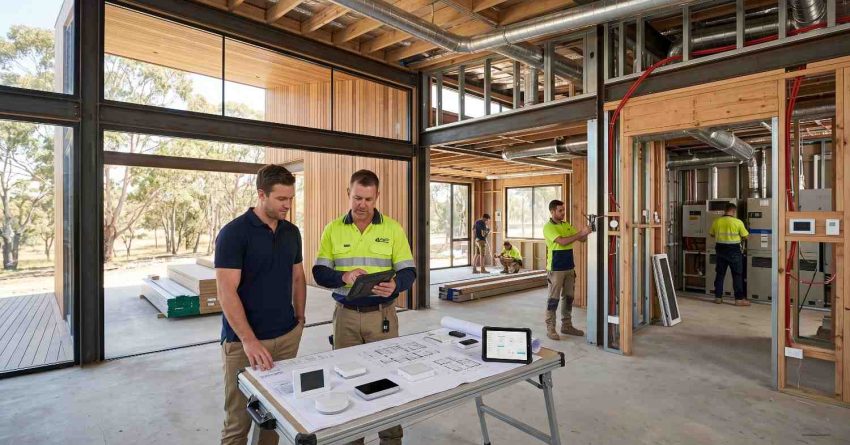
The construction phase is the ideal time to plan thermostat installation. Decisions made during rough-in directly affect what thermostats you can use and how well they perform.
Rough-In Wiring and C-Wire Planning
Work with your HVAC contractor and electrician to confirm that all thermostat wiring is pulled during rough-in. Key planning steps include:
- Specifying a C-wire at every thermostat location
- Running wire for any additional sensors (remote room sensors, outdoor sensors)
- Confirming wire gauge matches thermostat requirements (typically 18-gauge, 5-conductor)
- Labeling all wires clearly before drywall installation
If your new build uses a heat pump, confirm that the O/B wire is included in the rough-in bundle. Heat pump thermostats require this wire to control the reversing valve.
Placement and Wall Location Best Practices
Thermostat placement affects both comfort and accuracy. Poor placement leads to inaccurate temperature readings and inefficient system operation.
Best placement guidelines for new builds:
- Interior walls only — exterior walls cause temperature fluctuations from outdoor conditions
- Away from direct sunlight — sun exposure causes false high readings
- Away from supply vents — direct airflow skews temperature sensing
- Away from kitchens and bathrooms — heat and humidity from these rooms affect readings
- At eye level — approximately 52 to 60 inches from the floor
- Central location — represents the average temperature of the living area
For homeowners who need help with thermostat mounting, wiring connections, or final setup after construction, our handyman installation services provide reliable, professional support at every stage.
Energy Efficiency and Long-Term Cost Savings
Smart thermostats are one of the most cost-effective investments in a new build’s energy strategy. Their ability to automate temperature management and respond to occupancy patterns delivers measurable savings over time.
How Smart Thermostats Reduce Heating and Cooling Costs
Smart thermostats reduce energy consumption through several mechanisms:
- Occupancy detection — reduces heating and cooling when no one is home
- Learning schedules — eliminates unnecessary conditioning during predictable absence periods
- Geofencing — begins conditioning the home before you arrive, avoiding energy waste during the day
- Energy reports — identify patterns that lead to higher consumption
- Utility integration — some models participate in demand response programs, reducing energy use during peak grid periods
According to Energy Star, certified smart thermostats can save homeowners an average of $50 per year on energy bills, with savings varying based on climate, system type, and usage patterns.
Smart thermostats are one of the most cost-effective tools in a new build’s energy strategy — our energy efficiency upgrades covers additional improvements that work alongside smart HVAC controls to reduce long-term utility costs.
Top Smart Thermostat Options for New Construction Homes
Several smart thermostats stand out for new build applications based on compatibility range, feature depth, and ecosystem integration.
Google Nest Learning Thermostat — Best for homeowners who want a fully automated, learning-based experience. Supports multi-stage systems, heat pumps, and integrates with Google Home and Amazon Alexa. Requires a C-wire or Nest Power Connector.
Ecobee SmartThermostat Premium — Best for multi-zone and larger new builds. Includes a remote room sensor, supports up to 32 zones with compatible equipment, and integrates with Alexa, Google Home, Apple HomeKit, and SmartThings. Built-in Alexa speaker adds voice control without a separate device.
Honeywell Home T9 — Best for new builds with multiple rooms requiring independent temperature sensing. Supports up to 20 remote sensors, works with Alexa and Google Home, and offers flexible scheduling.
Emerson Sensi Touch 2 — Best for straightforward new build installations with standard forced air systems. Energy Star certified, supports Alexa, Google Home, and Apple HomeKit, and offers a clean interface with reliable scheduling.
Amazon Smart Thermostat — Best for budget-conscious new build owners already invested in the Alexa ecosystem. Energy Star certified, simple installation, and integrates with Alexa Hunches for automated adjustments.
When selecting from this list, confirm compatibility with your specific HVAC system type, wiring configuration, and smart home platform before purchasing.
Working With HVAC Professionals During New Build Planning
Smart thermostat selection should not happen in isolation. The best outcomes come from coordinating your thermostat choice with your HVAC contractor, builder, and electrician during the planning phase — not after construction is complete.
Key conversations to have with your HVAC professional:
- Which thermostat models are compatible with the specified HVAC equipment
- Whether the system supports multi-stage or variable-speed operation
- What wiring configuration is required at each thermostat location
- Whether zoning is planned and which zone controller will be used
- How the thermostat integrates with any whole-home automation system
Making these decisions early prevents costly changes after drywall installation and ensures your smart thermostat operates at full capability from move-in day.
Choosing the right thermostat is only effective when paired with expert system design and installation — our professional HVAC services connect new build owners with skilled technicians who handle everything from equipment selection to final commissioning.
Conclusion
Smart thermostat selection for a new build is a decision that touches HVAC compatibility, wiring infrastructure, smart home integration, and long-term energy performance. Getting it right during the planning phase sets the foundation for a comfortable, efficient home from day one.
The features that matter most — zoning support, learning algorithms, ecosystem compatibility, and energy monitoring — are all more accessible in a new build than in any retrofit scenario. The infrastructure advantage is significant.
At Mr. Local Services, our HVAC professionals work with new build owners at every stage of the planning process — from system selection to thermostat installation — so your home is set up for maximum comfort and efficiency before you move in.
Frequently Asked Questions
Do I need a C-wire for a smart thermostat in a new build?
Yes. Most smart thermostats require a C-wire for continuous power. In a new build, request a C-wire at every thermostat location during the electrical rough-in phase — it costs nothing extra at this stage and prevents installation problems later.
Can I use a smart thermostat with a radiant heating system in a new build?
Not all smart thermostats support radiant heating. Confirm that the thermostat you choose is rated for low-voltage radiant systems or hydronic heating before purchasing. Ecobee and Honeywell offer models compatible with radiant configurations.
How many smart thermostats does a new build need?
The number depends on your HVAC zoning plan. A single-zone system needs one thermostat. Multi-zone systems require one thermostat per zone or a central zone controller with individual sensors. Discuss your zoning plan with your HVAC contractor during the design phase.
What is the best smart home ecosystem for a new build thermostat?
The best ecosystem depends on which platform you plan to use throughout your home. Google Home, Amazon Alexa, and Apple HomeKit are the most widely supported. If you want maximum future compatibility, choose a thermostat that supports the Matter standard.
Can a smart thermostat be installed after a new build is complete?
Yes, but installation is more complex if C-wire wiring was not planned during rough-in. Some thermostats include power adapters or use power-stealing technology as a workaround, but these solutions can limit functionality. Planning during construction is always preferable.
How does geofencing work with a smart thermostat?
Geofencing uses your smartphone’s location to detect when you leave or return home. The thermostat adjusts to an energy-saving mode when you leave and begins conditioning the home before you arrive. This feature requires the thermostat’s app to have location permissions on your phone.
Are smart thermostats compatible with heat pumps in new builds?
Yes, but you must select a thermostat specifically rated for heat pump operation. Heat pump thermostats require an O/B wire to control the reversing valve. Confirm this wire is included in your rough-in bundle and that the thermostat supports your heat pump’s stage configuration.