Radon mitigation built into a new foundation is the most cost-effective way to protect your home from one of the most serious indoor air hazards in the USA. Installing a system during construction costs significantly less than retrofitting an existing home and delivers more reliable long-term results. This guide explains how radon enters new foundations, which mitigation methods work best, when installation should happen, what the process involves, and how to choose a qualified contractor to get it done right.
Radon is a naturally occurring radioactive gas that forms in soil and rock, and new foundations are especially vulnerable if protective systems are not built in from the start.
This guide covers every stage of radon mitigation in new foundation construction — from understanding the risk to testing results — so you can make confident, informed decisions before and after your home is built.
What Is Radon and Why New Foundations Are at Risk
Radon is a colorless, odorless radioactive gas produced by the natural decay of uranium in soil, rock, and groundwater. It is the second leading cause of lung cancer in the United States, according to the U.S. Environmental Protection Agency, which estimates radon causes approximately 21,000 lung cancer deaths each year.
New foundations present a specific and manageable risk. During construction, the soil beneath and around the foundation is disturbed, which can increase radon movement. Without a mitigation system built in from the start, radon has a direct path into the living space through cracks, joints, and porous concrete.
Understanding what radon is and how it behaves in soil and building materials is the foundation for every decision you make — our radon mitigation services covers the full range of solutions available for both new and existing homes.
How Radon Enters Through Foundation Materials
Radon moves from high-pressure soil into lower-pressure indoor air through any available opening. In new foundations, the most common entry points include construction joints between the footing and the foundation wall, poured concrete that has not fully cured, gaps around utility penetrations such as pipes and conduits, and hollow-core block walls that allow gas to travel upward.
The pressure difference between the soil and the interior of the home acts like a pump, drawing radon in continuously. This is why passive ventilation alone is rarely sufficient and why a properly designed mitigation system is the standard solution recommended by the EPA and the National Radon Program Services.
Radon Mitigation Methods Used During New Construction
New construction offers a significant advantage: mitigation systems can be designed into the foundation before the slab is poured, making installation cleaner, less invasive, and more effective than retrofitting an existing home.
Sub-Slab Depressurization Systems
Sub-slab depressurization (SSD) is the most widely used and most effective radon mitigation method for new foundations. The system works by creating a low-pressure zone beneath the concrete slab that prevents radon from rising into the home.
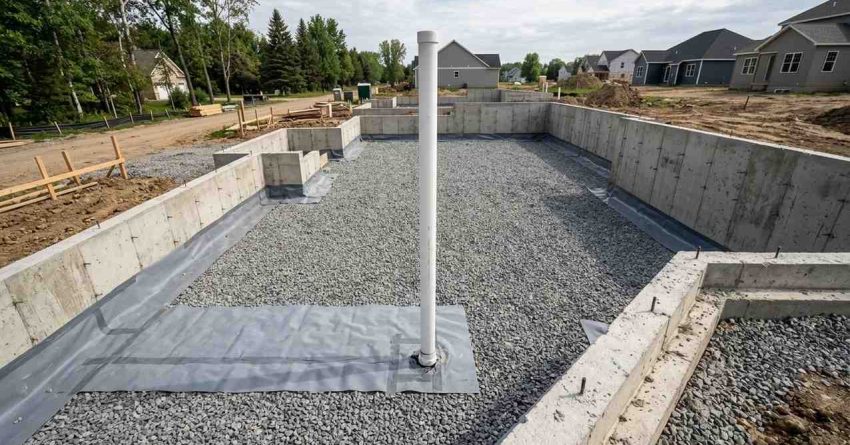
During construction, a layer of gas-permeable material — typically clean gravel or a specialized drainage mat — is placed beneath the slab. A perforated pipe is embedded in this layer and routed through the foundation wall or up through the interior of the home. A fan connected to the pipe continuously draws radon-laden air from beneath the slab and exhausts it safely above the roofline, away from windows and air intakes.
The EPA’s radon construction standards recommend SSD as the primary method for radon-resistant new construction (RRNC) because it can reduce indoor radon levels by up to 99% when properly installed.
Passive vs. Active Radon Mitigation Systems
New foundations can be equipped with either a passive or an active radon mitigation system, and understanding the difference helps you make the right choice for your home.
A passive system uses the natural pressure differential between the soil and the indoor air to draw radon through the pipe and vent it above the roofline. No fan is required. Passive systems are less expensive to install and have no operating costs, but their effectiveness depends heavily on local soil conditions and the pressure differential available. In many climates and soil types, passive systems alone do not reduce radon to the EPA’s recommended action level of 4 picocuries per liter (pCi/L).
An active system adds a continuously running fan to the same pipe network. The fan creates a reliable, consistent pressure differential regardless of weather, soil type, or seasonal changes. Active systems are more effective across a wider range of conditions and are the standard recommendation when radon levels are elevated or when soil permeability is low.
Radon control during new construction works best when it is coordinated alongside other protective measures — if you are also evaluating foundation waterproofing options, that guide explains how moisture and gas barriers work together to protect your home from below.
When to Install Radon Mitigation in a New Foundation
The ideal time to install radon mitigation is before the concrete slab is poured. At this stage, the sub-slab aggregate layer can be placed, the piping can be routed cleanly through the foundation, and the system can be fully integrated into the building structure without any demolition or disruption to finished surfaces.
If the slab has already been poured but the home is still under construction, mitigation can still be installed before interior finishing begins. This is the second-best window — more labor is involved, but the system can still be routed through unfinished walls and ceilings.
Waiting until after the home is complete significantly increases the cost and complexity of installation. Contractors must core-drill through the finished slab, route pipes through finished walls, and patch surfaces after installation. The system works just as well, but the process is more disruptive and more expensive.
Radon is one of several invisible threats that affect the air inside your home, and timing your mitigation correctly is critical — our resource on indoor air quality risks explains how radon fits into the broader picture of home health and what other hazards to watch for during construction.
What the Radon Mitigation Installation Process Looks Like
For homeowners and property managers overseeing new construction, understanding the installation sequence helps you coordinate with your builder and ensure the system is installed correctly at each stage.
The process begins with a site assessment. A certified radon mitigation contractor evaluates the soil type beneath the foundation, the foundation design, and the planned floor plan to determine the optimal pipe routing and fan placement. This assessment happens before the foundation is excavated.
Once excavation is complete and the footing is in place, the sub-slab aggregate layer is installed. The contractor places the perforated collection pipe in the aggregate and routes it to its exit point — either through the foundation wall to an exterior fan location or vertically through the interior of the home to a rooftop exhaust point.
After the slab is poured and cured, the fan is connected and the system is sealed. All penetrations through the slab and foundation wall are sealed with polyurethane caulk or hydraulic cement to prevent radon from bypassing the collection system.
Key Components of a New Foundation Radon System
A complete new foundation radon mitigation system includes several components that work together to keep radon levels below the EPA action level.
The sub-slab aggregate layer provides the permeable pathway for radon to travel to the collection pipe. Without adequate aggregate depth and coverage, the system cannot draw radon from the full area beneath the slab. The EPA recommends a minimum of 4 inches of clean aggregate beneath the slab for effective radon-resistant construction.
The collection pipe is typically 3-inch or 4-inch PVC, routed from the sub-slab layer to the fan location. The pipe must be sealed at all joints and penetrations to maintain system pressure.
The radon fan is the active component of the system. Fan selection depends on the sub-slab resistance — the ease with which air moves through the aggregate layer. A contractor uses a manometer to measure sub-slab pressure and select the correct fan model for the specific conditions.
The exhaust point must be located above the roofline and at least 10 feet above grade, positioned away from windows, doors, and air intakes to prevent exhausted radon from re-entering the home.
Radon Testing After Foundation Mitigation Is Complete
Installing a mitigation system does not guarantee that radon levels are below the EPA action level. Testing is the only way to confirm the system is working as intended.
The EPA recommends testing at least 90 days after a mitigation system is activated to allow radon levels to stabilize. Short-term tests using charcoal canisters can provide a preliminary reading within 48 to 96 hours, but long-term tests using alpha track detectors placed for 90 days or more give the most accurate picture of average annual exposure.
If post-mitigation testing shows radon levels above 4 pCi/L, the contractor should inspect the system for air leaks, check fan performance, and evaluate whether additional suction points are needed beneath the slab.
Testing is the only way to confirm your mitigation system is working as intended — our radon testing process guide walks through every method, device type, and result interpretation step you need to verify your home is safe after installation.
Cost of Radon Mitigation in New Foundation Construction
The cost of radon mitigation in new foundation construction is significantly lower than retrofitting an existing home. According to the EPA’s radon-resistant new construction guidance, installing a passive radon-resistant system during construction typically adds $350 to $500 to the cost of a new home. Upgrading to an active system with a fan adds an additional $150 to $300 at the time of construction.
By comparison, retrofitting a radon mitigation system into a completed home costs between $800 and $2,500 on average, depending on foundation type, home size, and local labor rates, according to the National Radon Program Services.
The cost difference makes a compelling case for installing mitigation during construction, even in areas where radon levels have not yet been measured. If post-construction testing shows levels are below the action level, the passive system can remain in place without a fan. If levels are elevated, activating the system requires only the addition of a fan — a straightforward and inexpensive upgrade.
Radon mitigation is one of many construction-phase investments that protect long-term property value — our home improvement costs resource helps homeowners and property managers budget across multiple service categories at once.
Choosing a Qualified Radon Mitigation Contractor
Radon mitigation is a specialized service that requires certification, experience with new construction, and familiarity with local soil and building conditions. Choosing the wrong contractor can result in a system that fails to reduce radon levels, fails inspection, or creates new moisture or structural problems.
Look for contractors certified by the National Radon Proficiency Program (NRPP) or the National Radon Safety Board (NRSB). Both organizations require contractors to pass competency exams, complete continuing education, and maintain professional standards. Many states also require state-specific radon contractor licensing — check your state’s requirements before hiring.
Ask any contractor you are considering for references from new construction projects specifically. New foundation mitigation requires different skills and coordination than retrofitting an existing home. A contractor experienced only in retrofit work may not be familiar with the construction sequencing, builder coordination, and sub-slab design requirements that new construction demands.
Finding a certified professional makes the difference between a system that works and one that fails inspection — Mr. Local Services connects you with qualified local contractors who are certified in radon mitigation and experienced with new foundation installations.
Conclusion
Radon mitigation in a new foundation is one of the most cost-effective health and safety investments a homeowner or property manager can make during construction. Building the system in before the slab is poured reduces cost, improves performance, and eliminates the disruption of retrofitting later.
Understanding the methods, timing, and components involved helps you coordinate with your builder and contractor to ensure the system is installed correctly from the start. Testing after installation confirms the system is working and gives you documented proof that your home meets EPA safety standards.
Mr. Local Services connects you with certified radon mitigation professionals experienced in new foundation construction — contact us today to get the right system installed at the right time and protect your home from the ground up.
Frequently Asked Questions
Is radon mitigation required by code in new construction?
Radon-resistant construction is required by building code in some states and counties, particularly in EPA Zone 1 high-radon areas. Requirements vary by location, so check your local building code and consult a certified contractor before construction begins.
Can a builder install the radon system, or does it require a specialist?
Some builders include basic radon-resistant construction features as standard practice, but a certified radon mitigation contractor should design and install the complete system. Builders are not always trained in radon system design, fan selection, or pressure diagnostics.
How long does a radon mitigation system last in a new foundation?
The sub-slab piping and sealing components are permanent and require no maintenance. The radon fan typically lasts 5 to 10 years and should be replaced when it shows signs of reduced performance. Annual visual inspections and periodic radon testing are recommended.
Does radon mitigation affect the structural integrity of the foundation?
No. A properly installed sub-slab depressurization system does not affect the structural integrity of the foundation. The aggregate layer and piping are placed beneath the slab and do not interfere with the load-bearing capacity of the concrete.
What radon level is considered safe after mitigation?
The EPA recommends taking action when radon levels reach 4 pCi/L or higher. After mitigation, the goal is to reduce levels as far below 4 pCi/L as possible. Many well-designed systems achieve levels below 2 pCi/L in new construction.
How soon after installation can I test for radon?
A short-term test can be conducted within 48 hours of system activation to get a preliminary reading. For the most accurate results, the EPA recommends a long-term test of at least 90 days after the system is running and the home is occupied under normal living conditions.
Does a passive radon system need to be upgraded to active?
Not always. Post-construction testing determines whether the passive system is sufficient. If radon levels remain below 4 pCi/L with the passive system in place, no fan is needed. If levels are elevated, adding a fan converts the system to active and typically resolves the problem without any additional piping work.