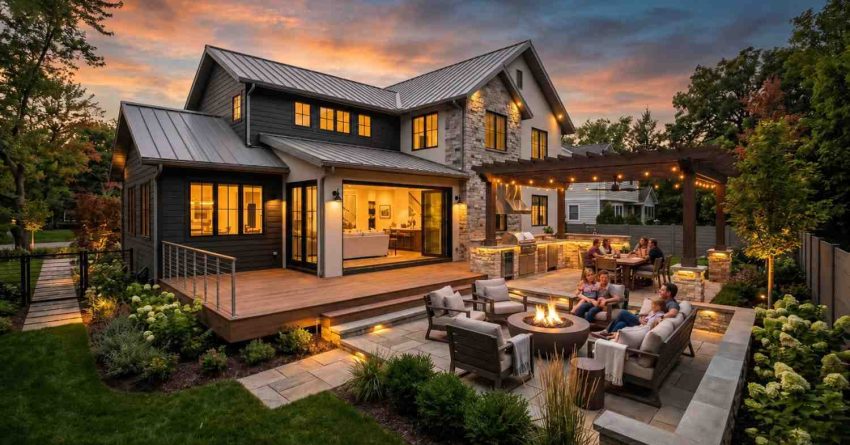
Outdoor living and exterior remodeling covers every project that expands or upgrades your home’s exterior — from decks, patios, and outdoor kitchens to pools, landscaping, siding replacements, and backyard structures. These improvements add usable living space, strengthen curb appeal, and consistently deliver some of the strongest resale returns of any home investment category.
Ignoring your home’s exterior means leaving measurable value untapped. Outdoor upgrades frequently return more than 100% of their investment at resale while fundamentally transforming how you use your property year-round.
This guide covers decks, patios, outdoor kitchens, pergolas, fire features, pools, landscaping, hardscape, exterior envelope upgrades, detached backyard structures, permits, budgeting, ROI, and contractor selection for every outdoor remodeling project.
What Outdoor Living and Exterior Remodeling Actually Covers
Outdoor living and exterior remodeling are two distinct but closely related categories of home improvement. Understanding the difference between them helps you plan strategically and budget accurately.
Outdoor Living Projects vs. Exterior Envelope Upgrades
Outdoor living projects create new functional spaces in your yard: decks, patios, outdoor kitchens, pergolas, fire features, pools, and landscape structures. These projects extend your home’s usable square footage beyond its conditioned walls and transform how you interact with your property throughout the year.
Exterior remodeling projects upgrade the building envelope itself: siding, windows, doors, roofing, gutters, and architectural trim. These components form the weather barrier that protects structure and interior finishes while directly driving curb appeal and perceived home value.
Both categories are frequently planned and executed together during major remodeling phases, particularly when homeowners are investing in a whole-property transformation. A new deck and a siding replacement executed simultaneously, for example, allow cost efficiencies in scaffolding, permitting, and contractor coordination that wouldn’t exist if done separately.
Why This Category Matters for Property Value
According to Remodeling Magazine’s annual Cost vs. Value Report, the top-returning residential remodeling projects year after year are dominated by exterior and outdoor upgrades. Manufactured stone veneer, garage door replacement, steel entry door replacement, and fiber cement siding consistently recover 80% to over 100% of project costs at resale — outperforming most interior remodeling categories.
Beyond financial return, outdoor living investment reflects a lasting shift in how Americans use their homes. The outdoor living space market reached $15.7 billion in 2023 according to Grand View Research, with consistent year-over-year growth driven by homeowners seeking to maximize their property as a full living environment.
Decks — Materials, Code and Design Options
A deck is a platform structure built adjacent to or extending from the home, typically elevated above grade and constructed from wood or composite materials. Decks create direct indoor-outdoor flow from primary living areas and are among the most popular outdoor additions across the United States, offering functional return at predictable cost.
Deck Material Choices: Composite, Wood and PVC
Deck materials divide into two primary groups: natural wood and manufactured alternatives.
Pressure-treated lumber is the most affordable wood option, widely used for structural framing regardless of the surface material chosen. Cedar and tropical hardwoods like ipe offer superior natural aesthetics and durability but require regular maintenance. Both wood options need periodic sealing, staining, or oiling to maintain appearance and structural integrity.
Composite decking, engineered from wood fiber and recycled plastics, has become the dominant surface material choice for new residential deck construction. It resists fading, staining, and moisture without the maintenance burden of natural wood. Capped composite products add an outer polymer shell that dramatically improves scratch and stain resistance. PVC decking, made entirely of polyvinyl chloride, offers the highest moisture resistance but at a greater cost.
Deck Code Basics and IRC 507 Requirements
The International Residential Code (IRC) Section 507 establishes minimum standards for residential deck construction nationally, governing ledger attachment methodology, footing depth and diameter, joist sizing and span, railing height (42 inches is now standard for many jurisdictions), and connection hardware specifications.
Most jurisdictions require a building permit for any deck above 30 inches from grade or attached to the home. Ledger connection, which is the point where the deck attaches to the house rim joist, is the most frequently cited inspection failure point because improper connections are a primary cause of deck collapse.
Deck Design Configurations
Design options range from a basic single-level platform to multi-tier configurations with built-in seating, lighting integration, pergola-covered sections, and hot tub cut-outs. Ground-level floating decks, raised decks above sloped terrain, and rooftop deck installations each carry different structural and permitting requirements.
Whether you’re choosing between composite and pressure-treated lumber or navigating IRC 507 ledger requirements, our complete deck materials and code guide walks through every material option, structural requirement, railing code standard, and design configuration you need to plan and execute your deck project with confidence.
Patios — Surfaces, Drainage and Material Choices
A patio is a ground-level or near-grade outdoor surface area, typically constructed without elevated framing or structural connections to the home. The absence of a structural frame generally makes patios less complex and less costly than decks, though material selection and site preparation costs can vary significantly based on square footage, material quality, and terrain conditions.
Pavers vs. Concrete vs. Flagstone
The four most common residential patio surfaces each offer a different balance of cost, durability, aesthetic flexibility, and maintenance demand:
Concrete: Poured concrete is durable, versatile, and cost-effective for large areas. It can be finished with broom texture, stamped patterns, exposed aggregate, or acid staining to create a range of visual results. Standard poured concrete typically costs $6 to $12 per square foot installed.
Concrete and Clay Pavers: Individually set pavers in sand or mortar offer excellent design flexibility, repairability without full removal, and strong visual variety. Patterns and color combinations are extensive. Sand-set paver installations typically cost $10 to $25 per square foot.
Flagstone: Natural stone including bluestone, travertine, and slate creates an organic, high-end aesthetic. Installation requires skilled labor, and costs typically run $15 to $40 per square foot depending on stone type.
Gravel and Decomposed Granite: The most budget-friendly option, suitable for informal spaces and properties with stormwater management constraints, since permeable surfaces allow natural infiltration.
Drainage, Slope and Edging Requirements
Drainage is one of the most consequential decisions in patio design. A minimum slope of 1/8 to 1/4 inch per foot away from the structure prevents water pooling near the foundation. In regions with heavy rainfall or high water tables, integrated drain channels, French drains, or catch basins may be necessary.
Patio permits vary by jurisdiction. Many municipalities exempt patios below a defined square footage from permit requirements, though this threshold differs widely.
From sand-set pavers and poured concrete to natural flagstone and decomposed granite, our patio design and installation guide breaks down every material option, cost range, and construction method in full detail.
Outdoor Kitchens — Layouts, Materials and Weatherproofing
An outdoor kitchen is a permanent or semi-permanent cooking and entertaining installation positioned in a yard, on a patio, or under a pergola. At minimum, an outdoor kitchen includes a built-in grill and countertop surface. At the high end, it may include an integrated sink with plumbing, under-counter refrigeration, pizza oven, bar counter with seating, and full prep workspace with storage.
Built-In vs. Modular Outdoor Kitchen Systems
Built-in outdoor kitchens are constructed with masonry or metal stud framing, then surfaced with stone, tile, stucco, or concrete. They are permanent installations that require professional construction and, in many jurisdictions, a building permit — particularly when gas line and electrical work is involved. Built-in systems typically range from $15,000 to $60,000+ depending on size and materials.
Modular outdoor kitchen systems use interchangeable stainless-steel or high-density polyethylene cabinet units that can be configured, rearranged, and partially relocated. They offer lower upfront cost (typically $5,000 to $20,000) and faster installation but sacrifice the integration and durability of a fully custom built-in design.
Gas, Plumbing, Refrigeration and Weatherproofing
Gas line extension is one of the most significant planning decisions in any outdoor kitchen project. Natural gas provides the best high-output cooking performance and lower operating cost than propane, but requires licensed plumbing work and permit approval. Propane is a practical alternative where natural gas is unavailable.
All outdoor kitchen materials must withstand UV degradation, freeze-thaw cycling, and moisture exposure. Granite, porcelain slab, and tile are the most common countertop choices. Stainless steel remains the standard for appliance faces and drawer panels.
Building a weatherproof outdoor kitchen requires material selection that withstands UV exposure and freeze-thaw cycles, proper gas line planning, and layout decisions that optimize workflow — our outdoor kitchen design and cost guide covers every layout configuration, appliance option, countertop material, gas vs. electric decision, and total project cost range.
Pergolas, Pavilions and Covered Outdoor Spaces
Overhead structures transform open decks and patio areas into shaded, weather-defined spaces that extend seasonal outdoor use. The main structure categories are pergolas, pavilions, covered patios, and retractable awnings, each offering a different level of weather protection, permanence, and design impact.
Types of Outdoor Cover Structures
A pergola is an open-beam overhead structure that provides partial shade and defines outdoor space without full weather protection. Traditional pergolas use wood posts and open rafters. Modern aluminum and vinyl pergolas offer lower maintenance profiles. A pavilion is a fully roofed structure, typically with an insulated solid-core roof panel, offering complete rain and UV protection comparable to a covered porch.
Covered patios with solid or polycarbonate roofing represent a middle ground, providing full overhead coverage at lower cost than a full pavilion. Retractable awnings offer motorized shade without a permanent structure, require no permit in most jurisdictions, and represent the entry-level option in this category.
Motorized Louvered Pergola Systems
The most significant market trend in outdoor overhead structures is the louvered pergola, a system with motorized adjustable aluminum louvers that open fully to allow sunlight or close completely to block rain. Several manufacturers now offer integrated LED lighting, electric privacy screens, and sensor-based weather automation within the same louvered system.
Installed costs for motorized louvered pergolas typically range from $15,000 to $45,000 depending on size and feature level, according to National Association of Remodeling Industry (NARI) project cost data. They have become one of the fastest-growing categories in the premium outdoor living segment.
Permit requirements for pergolas vary. Most jurisdictions require permits for any structure attached to the home or exceeding a defined square footage threshold.
Small urban lots present unique challenges for outdoor additions, from tight setback requirements to strict lot coverage limits that can eliminate many standard configurations — our forthcoming outdoor remodeling guide for small urban lots will cover every design and code strategy specific to urban and suburban properties with constrained footprints.
From traditional wood pergolas and solid-roof pavilions to motorized louvered systems that adapt to weather in real time, our pergola and covered outdoor space options guide covers every structure type, material choice, permit requirement, and installed cost range.
Outdoor Fireplaces and Fire Pits
Outdoor fire features, including fireplaces, fire pits, fire tables, and chimineas, are among the most requested outdoor additions in residential design. They extend seasonal outdoor use, create ambient focal points for entertaining, and add perceived value that buyers consistently respond to.
Gas vs. Wood-Burning Outdoor Fire Features
Fire features divide primarily by fuel type: gas and wood-burning.
Gas fire features, both natural gas and propane-fed, offer on-off convenience, minimal smoke output, and easier compliance with urban air quality regulations. They require a gas supply line routed to the feature location and a code-compliant shutoff valve within reach. Natural gas-connected features have lower long-term operating costs than propane alternatives.
Wood-burning fire pits and fireplaces produce the traditional campfire experience and greater heat output but generate smoke, require ash removal, and face stricter regulations in areas with air quality management zones or wildfire risk classifications. Many HOA-governed communities prohibit wood-burning open-flame features entirely.
Setback, Code and Safety Requirements
Built-in fire features require building permits in most jurisdictions and must meet minimum setback requirements from structures, fences, and property lines. These setbacks typically range from 10 to 25 feet depending on local code and the fuel type used.
Portable fire pits require no permit and no permanent installation in most locations, making them the lowest-commitment entry point. However, they integrate less naturally into hardscape design and carry higher repositioning risk on combustible decks.
According to the National Fire Protection Association (NFPA), outdoor fires account for a significant portion of residential structure fire ignition sources, underscoring the importance of proper setback compliance and spark-arrest screens for wood-burning features.
Gas and wood-burning fire features carry different permitting requirements, setback distances, air quality regulations, and design possibilities depending on your local code — our outdoor fire feature design guide explains every fuel type, built-in versus portable construction approach, safety standard, and project cost across the full spectrum of residential fire features.
Pools, Spas and Water Features
Adding a pool or spa to your property is one of the most significant and complex outdoor investments a homeowner can undertake. The decision involves far more than upfront cost: it requires assessment of lot size, soil stability, local zoning rules, permit approval timelines, electrical and plumbing capacity, and a realistic commitment to long-term maintenance.
Pool Types and Sizing Overview
In-ground pool construction uses three primary methods: gunite/shotcrete (custom-shaped concrete sprayed over rebar), vinyl liner (flexible liner over a steel or polymer frame), and fiberglass (pre-manufactured shell dropped into an excavated hole). Gunite allows the greatest design flexibility and durability but carries the highest cost, typically $60,000 to $150,000+ for a standard residential installation depending on size, features, and regional labor rates.
Vinyl liner pools offer mid-range cost and design flexibility but require liner replacement every 8 to 12 years. Fiberglass pools install faster, carry lower maintenance demand, and typically cost $45,000 to $100,000 installed.
Outdoor structure design also varies dramatically by climate zone — what works in Phoenix performs very differently in Minneapolis, both for material durability and year-round usability — our outdoor living design by climate zone guide will provide region-specific recommendations for structure types, heating options, shade strategies, and materials suited to your local conditions.
Hot Tubs, Plunge Pools, Spools and Water Features
Plunge pools and spools, a hybrid between a spa and a small pool, have become increasingly popular in smaller urban lots and among homeowners seeking hydrotherapy benefits without a full-size pool footprint. Plunge pool installations typically start at $20,000 to $40,000 for a basic fiberglass unit.
Hot tubs and portable spas represent a separate category. A factory-manufactured portable hot tub requires only a suitable pad, a dedicated 240-volt circuit, and a GFCI-protected subpanel. In-ground spa construction built as part of a pool requires full structural permitting.
Decorative water features, including pondless waterfalls, koi ponds, and fountain installations, range from prefabricated kit solutions under $1,000 to custom masonry installations exceeding $15,000.
Every in-ground pool and most permanent spa installations require building permits, barrier fencing that meets local code, and final inspection. Adding a pool or spa involves site assessment, soil testing, permit approval, electrical and plumbing tie-ins, and a long-term maintenance commitment that varies significantly by pool type and construction method — our pool and spa planning guide goes deeper into every option, from in-ground gunite pools and plunge pools to portable hot tubs, spools, and custom water features.
Landscaping and Hardscape
Landscaping and hardscape form the connective tissue of your outdoor environment. The ground surfaces, planted areas, retaining structures, water management systems, drainage plans, and outdoor lighting that surround every built outdoor element must be planned cohesively to prevent drainage conflicts, material incompatibilities, and visual inconsistency.
Hardscape vs. Softscape: Planning the Balance
Hardscape refers to the non-living, hard-surface components of your outdoor design: driveways, walkways, retaining walls, patio edging, fences, and any stone or concrete installation. Softscape refers to all living components: lawns, planting beds, trees, shrubs, ornamental grasses, and ground covers.
A balanced outdoor environment in most US climates allocates roughly 30-40% hardscape to 60-70% softscape, though urban properties and water-restricted climates frequently shift this ratio significantly. The hardscape-softscape balance directly affects stormwater runoff, heat island effect, and overall maintenance demand.
Retaining Walls, Driveways and Walkways
Retaining walls are among the most structurally significant hardscape elements, particularly on sloped or graded lots. Walls exceeding 3 to 4 feet in height, depending on jurisdiction, typically require engineering review and building permits. Materials range from concrete masonry units (CMU) and natural stone to segmental retaining wall systems and poured concrete.
Driveways represent another major hardscape investment. Asphalt, concrete, pavers, and gravel each carry different cost profiles, maintenance demands, drainage characteristics, and visual outcomes. Permeable paver driveways are increasingly required in jurisdictions with stormwater management mandates.
Walkways and garden paths connect outdoor living zones and define circulation through the landscape. Pressed stone, brick, concrete, and compacted gravel are the most common materials.
Outdoor Lighting, Irrigation and Drought-Tolerant Design
Outdoor lighting serves both functional and aesthetic purposes. Low-voltage landscape lighting systems are a popular and DIY-accessible option, with systems from brands like Kichler and Hampton Bay supporting path lights, uplights, and flood fixtures on simple low-voltage wire runs. Line-voltage systems for larger properties require licensed electrical installation.
Smart irrigation controllers have become a standard specification in professionally designed landscape installations. According to the EPA WaterSense program, weather-based smart irrigation controllers can reduce outdoor water use by up to 50% compared to traditional timer-based systems, making them both environmentally and financially beneficial over a project’s lifespan.
Balancing hard surfaces with planted areas, managing drainage and grading, and choosing materials suited to your regional climate are decisions that affect every other outdoor element — our landscaping and hardscape planning guide covers retaining walls, driveway materials, walkway design, outdoor lighting systems, smart irrigation, drought-tolerant planting strategies, and front yard curb appeal ROI in full depth.
Exterior Envelope Upgrades
Your home’s exterior envelope, which includes siding, windows, entry and garage doors, roofing, gutters, trim, and architectural details, forms the weather barrier that protects structure and interior finishes while setting the entire visual tone of your property. Exterior envelope upgrades are not “outdoor living” in the experiential sense, but they are inseparable from any comprehensive exterior remodeling plan.
Siding, Windows and Entry Door Replacements
Siding replacement consistently ranks among the top-returning residential remodeling investments in the United States. According to Remodeling Magazine’s 2024 Cost vs. Value Report, manufactured stone veneer accretion on key facade zones returns over 100% of project cost in most markets, representing the single highest-return exterior remodeling project tracked nationally. Fiber cement siding replacement (led by James Hardie board and batten, lap, and panel products) returns approximately 85-95% of cost in most markets while delivering a dramatic upgrade in durability, moisture resistance, and fire performance compared to aging vinyl or wood products.
Window replacement improves thermal comfort and reduces energy loss, with new double- and triple-pane units eliminating drafts that compound heating and cooling costs. Return on investment varies more widely than siding, depending on market and existing window condition.
Entry door replacement, particularly with a steel or fiberglass door unit, is one of the most cost-efficient single exterior upgrades available. A quality steel entry door installation typically costs $2,000 to $4,000 and returns 90-100%+ at resale in most markets.
Garage Doors, Gutters, Porches and Architectural Details
Garage door replacement is another consistently high-performing exterior project. A new insulated steel garage door with modern panel design and upgraded hardware transforms the front elevation significantly at a cost of $1,500 to $4,000 installed. The 2024 Cost vs. Value report found garage door replacement returning over 100% nationally for mid-range products.
Gutters and downspouts are unglamorous but foundational. Seamless aluminum gutters with leaf-guard systems protect fascia, foundation, and siding from chronic moisture exposure that leads to rot, mold, and settlement over time. A full seamless gutter replacement with guards on a typical home costs $1,500 to $3,500.
Adding a covered front porch or portico elevates street presence and creates functional outdoor entry space. Refreshing exterior paint and adding complementary shutters and trim details are among the most cost-effective curb appeal improvements available.
Your home’s siding, windows, entry doors, garage doors, and gutters form the weather barrier that protects structure and interior finishes while directly driving curb appeal and resale value — our exterior envelope remodeling guide covers every component, material comparison, installation consideration, and ROI data point from siding replacement to architectural detail additions.
Backyard ADUs, Studios and Detached Structures
The backyard has evolved from a simple green space to an active zone for income generation, dedicated remote work, creative pursuits, and multi-generational living. Detached backyard structures, ranging from simple prefabricated garden rooms to fully permitted accessory dwelling units, represent one of the fastest-growing categories in residential remodeling.
Backyard Office Pods, She Sheds and Creative Studios
Backyard office pods, she sheds, he sheds, and hobby studios span a wide range of cost and complexity. Prefabricated garden rooms with electrical service start under $10,000 for basic models. Custom-built workshop and studio spaces with insulation, HVAC, and full electrical typically range from $30,000 to $80,000 depending on size and finish level.
The key permit threshold to understand: most jurisdictions require a building permit for any enclosed structure with electrical service, regardless of size. Structures below certain square footage thresholds (commonly 120 to 200 square feet) are frequently exempt from permit requirements in many states, but electrical connections almost universally trigger permit review.
Detached Garages, Sports Courts and Greenhouse Additions
Detached garages represent a major investment with strong ROI, particularly in markets where garage parking is valued. A new two-car detached garage typically costs $30,000 to $60,000+ depending on construction method, foundation type, and finish level. Converting the space above the garage into habitable area, which may qualify as an accessory dwelling unit depending on local zoning, significantly increases both cost and complexity.
Sports courts, including pickleball, tennis, and basketball courts, require permits in most jurisdictions and substantial site preparation. Professional tennis court installation runs $25,000 to $100,000. Pickleball and multi-sport court surfaces run considerably less at $15,000 to $40,000.
Greenhouse and conservatory additions bridge outdoor and indoor living, offering year-round growing capability and striking visual impact from within the home.
Whether you need a home office pod, a creative studio, a detached garage, or a fully permitted backyard accessory dwelling unit, our backyard structures and ADU options guide covers zoning rules, permit processes, construction methods, and cost ranges for every detached structure category.
Planning, Permits and Budgeting for Outdoor Projects
Successful outdoor remodeling starts with two parallel tracks: regulatory compliance and financial planning. Most homeowners underestimate both.
Which Outdoor Projects Require a Building Permit?
A broader range of outdoor projects requires building permits than most people anticipate. Decks above 30 inches from grade, in-ground pools, structural retaining walls above 3-4 feet, outdoor kitchens with gas line connections, permanent fire features, most fences over 6 feet, and any enclosed detached structure with electrical service typically require permits in most US jurisdictions.
Patios, simple ground-level decks below defined height thresholds, portable fire pits, and small freestanding sheds below a defined square footage are commonly exempt, but these exemptions vary significantly by city, county, and state.
Working without required permits creates problems that compound over time: stop-work orders, mandatory demolition of unpermitted work, complications during mortgage refinancing, and disclosure requirements at point of sale. Buyers’ lenders regularly flag unpermitted structures, and sellers are typically required to disclose known unpermitted additions in most states.
Our outdoor remodeling permits and code guide explains exactly which outdoor projects trigger permit requirements in your jurisdiction, what the inspection schedule looks like, and how to navigate plan review for every common outdoor project type.
Building an Accurate Outdoor Project Budget
Outdoor project costs range enormously: a simple concrete patio may cost $3,000 to $8,000, while a full backyard transformation with deck, outdoor kitchen, pergola, pool, and professional landscaping can easily exceed $200,000.
Building an accurate budget means separating hard costs (materials and labor) from soft costs (design fees, permits, surveys, and soil testing) and building in a contingency reserve of 10-20% for unforeseen site conditions. Unforeseen conditions in outdoor work commonly include rocky soil requiring additional excavation, drainage issues that require remediation before surface installation, and utility conflicts that require rerouting.
Financing options for outdoor projects include home equity lines of credit (HELOCs), home equity loans, cash-out refinancing, and personal loans depending on project scale and available equity. Smaller projects under $25,000 are frequently self-funded or financed through personal loans.
ROI and Resale Value of Outdoor Remodeling
Not all outdoor investments return equally at resale. Understanding which projects deliver the strongest financial returns — and which carry greater risk of overcapitalization — is essential before committing to any major outdoor spending.
Which Outdoor Projects Return the Most at Resale
According to Remodeling Magazine’s 2024 Cost vs. Value Report, the top-performing exterior and outdoor projects by national average cost recovery are:
- Manufactured stone veneer: 100%+ recovery in most markets
- Garage door replacement: Approximately 100% recovery
- Steel entry door replacement: 90-100%+ recovery
- Fiber cement siding replacement: 85-95% recovery
- Midrange deck addition: 70-85% recovery depending on materials and market
At the other end of the spectrum, pools are among the most commonly overcapitalized outdoor investments. In most US markets, a pool adds significantly less to appraised value than its installation cost, narrowing the buyer pool and creating ongoing maintenance obligations that informed buyers factor into their offers.
The most important ROI consideration for any outdoor project is neighborhood price ceiling. Investing $100,000 in outdoor improvements on a $300,000 home in a neighborhood where comparable properties sell for $400,000 will return far less than the same investment on a $700,000 home in a $1.2 million neighborhood.
Understanding which outdoor projects deliver measurable returns at resale requires current cost-vs.-value data and an honest assessment of your neighborhood’s price ceiling — our outdoor remodeling ROI and resale data guide breaks down national and regional return metrics for every major outdoor project category, from deck additions and siding replacement to pool installations and backyard transformations.
Choosing the Right Contractor for Outdoor Work
Outdoor remodeling projects involve multiple specialty trades, each with its own licensing requirements, insurance standards, and risk profile. Deck builders, licensed landscapers, pool contractors, masonry specialists, outdoor kitchen installers, and electrical and gas contractors all need to be vetted and coordinated effectively.
When selecting any outdoor contractor, the vetting process should be consistent: verify active contractor licensing in your state for each trade involved, confirm both general liability insurance and workers’ compensation coverage, check references from at least three comparable recent projects, and review written contracts carefully before signing.
For outdoor kitchen installations involving gas line connections, always confirm that the contractor or their subcontractor holds a plumbing license and gas fitter certification. Pool installations involve licensed electrical work for bonding and circuitry requirements that vary by state code.
Get a minimum of three competitive bids and compare them on equal terms. The significantly lowest bid most often reflects missing scope, unlicensed subcontractors, or material specification downgrades rather than genuine efficiency.
Design-build firms that specialize in outdoor living spaces handle design, permitting, and construction under one contract, which can simplify project management for complex multi-element backyard transformations. General contractors who manage multiple outdoor trades are a strong option for mid-complexity projects with deck, hardscape, and landscape work.
Outdoor projects span multiple specialty trades, each with different licensing requirements, insurance standards, and contract structures, making thorough vetting critical — our guide to hiring outdoor remodeling contractors covers every step from finding qualified deck builders, pool installers, and landscape contractors to comparing bids, reviewing contracts, and managing multi-trade projects through completion.
Conclusion
Outdoor living and exterior remodeling covers every project that upgrades your home’s exterior space — from decks and patios to pools, landscaping, and backyard structures — each requiring its own planning, permitting, and professional expertise.
The dedicated guides linked throughout this resource go deeper into every topic — from deck materials and patio drainage to pool planning and exterior ROI.
Mr. Local Services connects homeowners with skilled outdoor remodeling professionals — deck builders, landscapers, pool installers, and exterior specialists. Contact us today to begin your transformation.
Frequently Asked Questions
What is the difference between outdoor living and exterior remodeling?
Outdoor living projects create new functional spaces in your yard: decks, patios, pools, and kitchens. Exterior remodeling upgrades the home’s building envelope — siding, windows, doors, and roofing. Both categories are often planned and completed together.
Which outdoor projects add the most value to a home at resale?
Manufactured stone veneer, garage door replacement, steel entry doors, fiber cement siding, and deck additions consistently deliver the strongest cost-to-value returns, frequently recovering 80-100% or more of their installation cost based on national data.
Which outdoor remodeling projects require a building permit?
Decks above 30 inches, in-ground pools, structural retaining walls, outdoor kitchens with gas connections, and any enclosed detached structure with electrical service typically require permits. Rules vary significantly by city, county, and state — always verify locally before starting.
How much does it cost to build an outdoor kitchen?
A basic outdoor kitchen with a built-in grill and countertop starts around $5,000 to $10,000. Mid-range built-in setups with sinks, refrigeration, and stone countertops typically range from $15,000 to $40,000 installed, depending on materials and regional labor rates.
What is the best decking material for a low-maintenance deck?
Composite decking is the top low-maintenance choice, offering fade and stain resistance without regular staining or sealing. PVC decking provides even greater moisture resistance but at a higher cost, making it ideal for extremely humid or waterfront environments.
Do I need a permit to build a pergola?
Permit requirements for pergolas vary by jurisdiction. Freestanding structures under a defined square footage threshold are often exempt, but pergolas attached to the home or exceeding a certain size typically require a building permit and inspection.
How should I prioritize outdoor remodeling projects on a limited budget?
Start with exterior envelope upgrades — siding, entry doors, and garage doors — for the highest measurable ROI. Then establish foundational hardscape. Reserve major feature investments like pools and full outdoor kitchens for later phases when equity supports the investment.