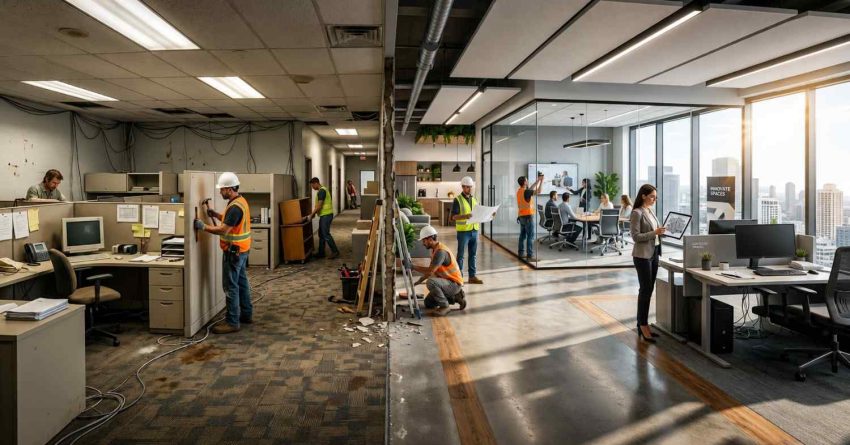
An office or commercial workspace remodel transforms a commercial interior through reconfiguration, renovation, or a full gut buildout to improve function, meet code requirements, and align the space with how work actually happens today, whether in traditional offices, coworking spaces, medical suites, or law firms.
Done right, a commercial workspace remodel increases productivity, supports talent attraction, reduces long-term operational costs, and ensures the space fully aligns with current building codes and evolving hybrid workforce models.
This guide covers remodel types, space planning, acoustics, lighting, MEP and technology infrastructure, finishes, code compliance, cost benchmarks, project timelines, and what to look for in a commercial remodeling contractor.
What Is an Office or Commercial Workspace Remodel?
An office or commercial workspace remodel is a construction and design project that transforms an existing commercial interior to better serve its occupants, meet code requirements, and reflect how work is actually performed. Projects span a wide spectrum, from refreshing surfaces and replacing lighting to fully gutting a space down to its structural shell before rebuilding it with entirely new systems, partitions, finishes, and technology infrastructure.
Unlike residential remodeling, commercial workspace projects operate under the International Building Code (IBC), are subject to commercial-grade fire safety, egress, and accessibility standards, and are almost always governed by a lease agreement that defines responsibilities between tenant and landlord. This lease context shapes everything from permit sequencing to how tenant improvement allowances are structured and when they are disbursed.
Three factors define the scope of any commercial remodel: the current condition of the space, the functional requirements of the occupants, and the code obligations triggered by the extent of the work. A cosmetic refresh may require no permit at all. A full gut buildout in a tenant improvement context will require plan review, building permits, and a series of construction inspections before the certificate of occupancy is issued.
Understanding your baseline, your requirements, and your code obligations before finalizing scope is what separates successful commercial buildouts from projects that exceed budget and delay occupancy.
Types of Office Remodels: From Cosmetic Refresh to Full Gut Buildout
Commercial workspace remodels fall into three distinct categories, each with different cost ranges, permitting requirements, and construction timelines. Knowing which category fits your project is the first planning decision that shapes everything downstream, from contractor selection to lease negotiation.
A cosmetic refresh addresses surfaces and aesthetics without touching mechanical, electrical, plumbing, or structural systems. New flooring, fresh paint, updated light fixtures, and new furniture fall into this category. Costs typically range from $5 to $25 per square foot. Permits are rarely required, and most cosmetic refreshes can be completed during business hours or over a weekend without significant disruption to ongoing operations.
A reconfiguration involves moving non-load-bearing partitions, adjusting power and data drops, and potentially repositioning HVAC diffusers to serve a revised floor plan. This category applies when the layout needs meaningful change but the underlying building systems remain fundamentally sound. Costs range from $25 to $85 per square foot depending on the complexity of mechanical, electrical, and plumbing modifications and the finish quality selected.
A full gut buildout strips a space to the structural slab and exterior shell walls before rebuilding it entirely. This scope applies when a new tenant requires a completely different configuration, when existing systems are outdated or non-compliant, or when a space is being adapted for a new commercial use. Full gut costs range from $80 to $250 per square foot or more depending on market, finish quality, and MEP complexity.
The post-pandemic shift to hybrid work has introduced a fourth common scenario: the right-sizing reconfiguration. Rather than expanding, these projects reconcentrate a smaller, activity-focused workspace within existing square footage after a company has reduced its in-office headcount. Our guide to reducing office footprint and right-sizing after hybrid work (/reducing-office-footprint-right-sizing) covers the space programming methods, planning logic, and construction scope that apply when a business is reconcentrating rather than growing.
The full breakdown of what distinguishes each remodel type, including scope triggers, cost thresholds, inspection requirements, and decision frameworks that guide the choice between a refresh, reconfiguration, or full gut, is covered in complete detail in our guide to office remodel types explained.
Office Space Planning: The Foundation of a Successful Buildout
Space planning is where every successful commercial buildout begins. Before a single partition is drawn or a workstation specified, the project team must answer foundational questions about how many people will use the space, how they work, what mix of focused work and collaboration the business requires, and how much square footage per person is appropriate given the organization’s model.
The answers to those questions drive every subsequent decision, from the number and type of conference rooms to the partition strategy, flooring selection, and electrical infrastructure required.
Square Footage Per Employee
Current industry benchmarks range from 75 to 250 square feet per employee depending on work model, industry, and density goals. Densely configured customer service environments may target 75 to 100 square feet per seat. Traditional legal and financial offices historically allocated 200 to 250 square feet per professional. Hybrid workplaces in 2025 typically target 120 to 175 square feet per headcount, reflecting the reality that not all employees are in the office every day.
Getting the density calculation right at the start of planning determines whether you hit your occupant load limits, size HVAC correctly, and deliver a space that functions under actual use conditions rather than theoretical ones.
Every space planning decision starts with occupancy targets and workforce analysis, and our resource on square footage per employee standards covers current benchmarks by workplace type, industry norms, and how hybrid headcounts affect the density calculation that drives every subsequent design decision.
Conference Rooms, Collaboration Spaces, and Support Areas
Standard planning ratios recommend one conference seat for every four to six desk seats. Phone booth pods and acoustic focus rooms are typically planned at one per eight to twelve seats. Support areas including reception, break rooms, server rooms, wellness rooms, and accessible restrooms add 20 to 35 percent to the net usable area on a typical office floor plan.
Underestimating support space needs during programming is one of the most common planning mistakes in commercial buildouts. Spaces that feel appropriate on paper often fail in practice when actual break room capacity, restroom ratios per occupant, and conference room demand under peak conditions are considered.
For a full comparison of open-plan, private-office, and hybrid workspace configurations, including productivity research, implementation costs, noise trade-offs, and the design decisions that affect which approach works best for a given organization, our page on open vs. private vs. hybrid layouts covers every dimension of this foundational planning choice.
Office Acoustics: The Most Underinvested Element in Commercial Remodels
Acoustic performance is consistently the most underestimated factor in commercial office design and the most common source of post-occupancy complaints. In an open-plan workspace, sound travels freely. Conversations at adjacent workstations, phone calls, keyboard noise, and HVAC hum accumulate into a persistent level of auditory distraction that impairs concentration and elevates stress for occupants without refuge from it.
Effective acoustic design in an office buildout addresses three distinct problems simultaneously. Sound absorption reduces reverberation within a space so that conversations do not echo and linger across the floor. Sound blocking prevents noise from traveling between adjacent rooms or between workstations. Sound masking raises the ambient noise floor to make individual conversations statistically less intelligible, reducing the distraction caused by overheard speech.
Sound absorption is addressed through the ceiling plane, floor finish, and wall treatments. Acoustic ceiling tiles with high Noise Reduction Coefficient (NRC) ratings, carpet or textile flooring, and fabric-wrapped acoustic panels all reduce reverberation time within a space. Open offices with hard ceilings, polished concrete floors, and glass partitions require intentional absorption treatments to remain acoustically tolerable as daily work environments.
Sound blocking between rooms is measured by the Sound Transmission Class (STC) rating of demising walls, doors, and partitions. Standard gypsum board partitions achieve an STC of 35 to 40. Conference rooms, private offices, HR suites, and executive spaces typically require STC ratings of 45 to 55, which requires added mass and structural decoupling of the wall assembly from the building framing.
Sound masking systems introduce a low-level broadband signal through ceiling-mounted speakers calibrated to raise the ambient noise floor to the point where nearby speech becomes unintelligible rather than distracting. Many modern commercial offices combine all three approaches for measurable improvement in both measured and perceived acoustic performance across the entire floor plate.
The technical and practical dimensions of acoustic design in commercial workspaces, including STC rating selection by space type, sound masking system specification, acoustic panel placement strategies, and how to sequence acoustic upgrades within a broader buildout budget, are covered comprehensively in our guide to office acoustic design fundamentals.
Office Lighting Design: Productivity, Comfort, and Code
Office lighting design has evolved well beyond providing adequate illuminance for screen-based work. A well-designed commercial lighting plan addresses task performance, occupant wellbeing, visual comfort, energy code compliance, and the first impression the workspace makes on visitors, clients, and prospective employees evaluating the office as a talent environment.
Modern commercial lighting plans are built in layers. Ambient lighting provides the baseline illuminance for the entire space, typically targeting 25 to 35 foot-candles at the work surface in open work areas. Task lighting at individual workstations, often through under-shelf LED fixtures or adjustable desk lamps, allows occupants to supplement ambient levels for detail work without increasing energy loads across the whole floor. Accent lighting defines architectural features, distinguishes collaboration zones from focus areas, and provides the visual hierarchy that makes a workspace feel purposefully designed rather than generically lit.
Tunable white lighting is now standard in most quality commercial buildouts. Fixtures with adjustable color temperature, ranging from warm 2700K settings in the morning to cooler 5000K settings during peak afternoon work hours, allow the lighting environment to shift in alignment with circadian rhythms. Research from the American Society of Interior Designers and occupant wellbeing studies consistently document positive correlations between circadian-supportive lighting environments and reduced midday fatigue among office workers.
Glare control is one of the most practically important factors in workstation design. Direct glare from overhead fixtures, reflected glare from monitor screens, and indirect glare from glazed partitions or windows are addressed through fixture shielding, window treatment specifications, and workstation orientation relative to primary daylight sources. Neglecting glare control is a leading cause of visual discomfort complaints in open offices with extensive glazing.
Energy codes in most US jurisdictions now require lighting power density calculations and automatic controls, including occupancy sensing and daylight harvesting systems, in commercial spaces. Compliance is verified during plan review and confirmed at the final construction inspection.
The complete framework for layering ambient, task, and accent lighting in commercial office environments, including fixture specification, tunable white system design, daylighting integration, glare control strategies, and energy code compliance, is developed in full in our guide to office lighting plan best practices.
HVAC, MEP, and Technology Infrastructure in Office Buildouts
The mechanical, electrical, plumbing, and technology systems of an office buildout represent the largest single cost category in a full gut renovation and carry the most consequential long-term operational implications. Getting MEP and technology infrastructure right during a buildout costs a fraction of what retrofits cost after walls are closed and ceilings are finished.
HVAC for Changing Office Densities
Commercial HVAC systems are engineered for a specific occupant load and ventilation rate. When a buildout significantly changes the floor plan configuration, whether by adding conference rooms, increasing workstation density, or transitioning from private offices to an open plan, the original HVAC design may no longer deliver adequate air distribution or comply with current ventilation standards.
ASHRAE 62.1, the mechanical ventilation standard adopted by most US jurisdictions for commercial occupancies, prescribes minimum outdoor air rates per person and per square foot of floor area. It also governs how HVAC zones must be configured when rooms with high and intermittent occupant loads, such as conference rooms and training spaces, are added to a floor plan. A buildout that materially changes occupant density or room configuration typically requires an HVAC load recalculation and may require new ductwork, variable air volume (VAV) boxes, zone controls, or supplemental mini-split systems.
Variable Refrigerant Flow (VRF) and ductless mini-split systems are increasingly common in commercial buildouts for their zone-level temperature control and the ability to serve new spaces without running new ductwork through occupied areas of a building.
Power, Data, and Network Infrastructure
Power and data distribution strategy is one of the most flexibility-critical decisions in an open-plan office buildout. Floor boxes, perimeter raceway, and overhead cable trays each offer different trade-offs between initial cost, long-term flexibility, and aesthetic impact.
Floor boxes allow power and data access at any point on an open floor plate without routing cables along walls or suspending them overhead. They require slab core-drilling and conduit installation during rough-in, but they are the most operationally flexible solution for offices where workstation configurations are expected to change over the lease term. Perimeter raceway is the most budget-friendly approach but limits workstation placement to walls. Overhead cable trays routed through the plenum above a drop ceiling provide flexibility for data cabling with power drops located at structural columns or demising walls.
Wi-Fi coverage in dense commercial offices requires careful access point placement and load planning. A general benchmark is one enterprise-grade access point per 1,500 to 2,000 square feet in open work areas, with additional dedicated access points in high-density conference rooms and large collaboration spaces. Enterprise-grade access points that support the 802.11ax (Wi-Fi 6) standard are the current baseline for new commercial buildouts.
The full range of power and data routing strategies in open-plan office environments, including floor box installation, perimeter raceway systems, overhead cable tray routing, and Wi-Fi access point density planning, is covered in practical detail in our guide to power and data layout options.
AV Infrastructure and Building Technology
Conference room AV infrastructure, including display mounts, cable connectivity (HDMI, USB-C, and network), microphone and camera systems, and room scheduling displays, must be pre-wired during the rough-in construction phase. The cost of retrofitting AV conduit and cabling after walls are closed is typically three to five times the cost of installing it correctly during construction, making pre-wire planning one of the highest-leverage decisions in any commercial buildout.
Building access control, video surveillance, and intercom systems are now routinely integrated during commercial office buildouts rather than added as afterthoughts. Each of these systems requires low-voltage pre-wire, panel space allocation, and coordination with the general contractor and AV integrator early in the design process.
The engineering decisions behind HVAC load recalculation, zone configuration, VAV and mini-split integration, and ASHRAE 62.1 ventilation code compliance when office densities or floor plan configurations shift significantly are covered in our resource on HVAC for changing office density.
Office Finishes, Furniture, and Workstation Systems
Finishes and furniture are the most visible aspect of any commercial office remodel and the most direct driver of daily occupant experience. The decisions made in this category define how the space looks, how sound behaves, how easily the space can be reconfigured in the future, and how durable the investment proves to be over a typical 5 to 10 year lease term.
Commercial Flooring Options
Commercial offices use three primary flooring categories in most buildouts. Carpet tile is the most acoustically effective, the most damage-tolerant at the individual tile level, and the most commonly specified finish in open-plan work areas. It absorbs ambient sound effectively, reduces impact noise transmission through shared floor slabs in multi-tenant buildings, and is available across a wide range of performance and aesthetic grades. Luxury vinyl tile (LVT) is standard in entry areas, corridors, break rooms, and accent collaboration zones for its durability, water resistance, and ease of maintenance. Polished or sealed concrete is a design-forward choice common in creative offices, coworking spaces, and technology environments, but it offers no acoustic benefit and requires careful subfloor preparation to ensure flatness tolerances are met.
The performance, acoustic properties, maintenance trade-offs, and zone-by-zone selection logic for carpet tile, LVT, and polished concrete in commercial office environments are covered in our guide to commercial office flooring options.
Workstations, Sit-Stand Desks, and Ergonomics
The workstation is the functional centerpiece of any office floor plan. Panel-based systems offer visual privacy and built-in cable management infrastructure but are less flexible than open benching or freestanding desk arrangements when floor plan changes occur. Height-adjustable or sit-stand workstations are now a standard specification in most commercial buildouts and are supported by OSHA ergonomic guidelines that emphasize reducing musculoskeletal disorders in workplace settings through appropriate workstation design and adjustability.
Specifying ergonomic seating, monitor arm systems, and task lighting as an integrated package during the buildout, rather than as separate procurement after construction, reduces total cost and ensures that components are properly sized and coordinated.
Partitions, Glass Walls, and Demountable Systems
The choice between fixed gypsum board partitions, glazed demountable walls, and glass partition systems has significant implications for cost, acoustic performance, and long-term flexibility. Fixed drywall construction is the lowest initial cost option but requires permitted demolition and reconstruction work for any future layout changes. Demountable wall systems can be reconfigured without demolition and without triggering a new permit in most jurisdictions, making them well-suited to organizations whose space programming needs are expected to evolve within the lease term.
The full cost-benefit analysis of demountable wall systems versus fixed drywall construction, including long-term flexibility value, acoustic performance by system type, real-world cost benchmarks per square foot, and the permit implications of each approach, is covered in our resource on demountable wall systems.
Office Remodel Code Compliance and Permits
Every commercial office remodel that goes beyond cosmetic finishes is subject to building code requirements, local permit processes, and inspection milestones that must be satisfied before the space can be legally occupied. Navigating the commercial permit process correctly, and in the right sequence, is one of the primary reasons that experienced commercial tenants and property managers engage licensed contractors and dedicated project managers rather than attempting self-management of the process.
The International Building Code and Commercial Occupancy
Commercial office spaces fall under IBC Group B Business Occupancy in most jurisdictions. This classification establishes minimum requirements for occupant load calculations, means of egress (the number, width, and maximum travel distance of exit corridors and doors), required restroom fixture counts per occupant, and fire protection system requirements.
Any buildout that increases the occupant load, changes the number or configuration of egress paths, or modifies fire sprinkler or alarm systems triggers a full plan review and a sequence of inspections including framing, rough-in MEP, insulation, and final occupancy inspections. The 2015 and 2021 editions of the IBC, now adopted with local amendments across most US jurisdictions, require that any change of occupancy or significant alteration bring affected areas into full current code compliance at the time of the permit.
ADA Accessibility Requirements
The Americans with Disabilities Act requires accessible routes, compliant restroom facilities, accessible entrance provisions, and reasonable accommodations for people with sensory and mobility disabilities in commercial spaces. ADA requirements in office remodels extend beyond ramp access to include aisle widths between workstations, clearances at conference room tables, lever or automatic door hardware, tactile signage placement, and service counter heights.
Any buildout that constitutes an alteration to a primary function area triggers a requirement to bring the accessible route to that primary function area into ADA compliance, up to 20 percent of the total construction cost of the triggering alteration. This requirement catches many tenants off guard if their accessible route from the building entrance or elevator lobby was not previously evaluated.
Fire Sprinkler, Fire Alarm, and the Tenant Improvement Permit
Commercial buildouts that add, relocate, or remove sprinkler heads, move fire alarm devices, or change the occupant load all require coordination with the fire authority having jurisdiction (AHJ), separate fire suppression and fire alarm permits in most municipalities, and inspections at rough-in and final installation phases. Failure to coordinate AHJ approvals early in the design process is a leading cause of project delays and certificate of occupancy holdbacks.
The complete permit sequence for a commercial office buildout, including which agencies are involved, what plan review requires at each stage, how fire suppression and alarm permits are handled separately from the building permit, and how the tenant improvement permit process differs from a standard owner-initiated building permit, is explained in our guide to the office buildout permits process.
Office Remodel Costs, Timelines, and Budgeting
Commercial office buildout costs vary significantly based on scope, geographic market, finish quality, and the condition of the existing space. Understanding the cost drivers and structuring a realistic budget before engaging contractors is essential for building accurate business cases, negotiating tenant improvement allowances effectively, and preventing the scope creep that derails commercial projects.
Cost Per Square Foot in 2025
The broad cost ranges for commercial office buildouts in 2025 break down as follows by scope level:
Cosmetic refresh: $5 to $25 per square foot. Reconfiguration with MEP modifications: $25 to $85 per square foot. Full gut buildout at standard finish: $85 to $150 per square foot. Full gut buildout at premium or high-end finish: $150 to $300 or more per square foot.
These ranges vary significantly by geography. Major metro markets including New York City, San Francisco, and Boston typically run 30 to 60 percent above national average benchmarks. Secondary markets and suburban locations typically run 10 to 20 percent below national averages. Hard construction costs, meaning labor and materials for framing, MEP systems, and finishes, account for roughly 60 to 70 percent of total project cost. Furniture, fixtures, equipment, AV, IT, and soft costs including design fees, permit fees, and project management fees account for the remaining 30 to 40 percent.
For current, granular benchmarks on what commercial office buildouts cost per square foot in 2025, segmented by finish level, market tier, and project scope, our resource on office buildout cost per square foot provides the figures that commercial tenants, property managers, and financial decision-makers use to benchmark contractor bids and build accurate project business cases.
Tenant Improvement Allowances
In most commercial office leases, the landlord contributes a tenant improvement (TI) allowance toward the cost of the buildout. TI allowances are expressed as a dollar amount per square foot and range from $40 to $150 or more per square foot depending on the market, the lease term length, the tenant’s creditworthiness, and the landlord’s interest in delivering a desirable space to a creditworthy tenant.
Negotiating a TI allowance effectively requires understanding current construction costs in your specific market, the structural condition of the base building, and the landlord’s economic position within the transaction. Tenants with long lease terms and strong credit profiles often negotiate allowances that cover the majority of a mid-grade buildout, shifting the buildout cost risk primarily to the landlord.
A new resource that translates per-square-foot buildout benchmarks into per-employee investment metrics, which are more useful for financial modeling, headcount planning, and lease negotiation, is currently in development at our office remodel cost per worker calculator.
Office Remodel ROI: What a Workspace Upgrade Actually Returns
The return on investment from a commercial office remodel is multidimensional and not fully captured by conventional real estate metrics. Unlike residential renovations where ROI is measured primarily through resale value or rental income, the primary financial returns from a commercial workspace investment flow through operational performance: productivity gains, talent retention improvements, reduced absenteeism, and the ability to attract and retain qualified employees in competitive hiring markets.
Research from McKinsey and the World Green Building Council has documented positive correlations between high-quality workspace design and employee cognitive performance, satisfaction scores, and reduced turnover intent. The cost of replacing a single professional-level employee typically ranges from 50 to 200 percent of annual compensation when recruiting, onboarding, and productivity ramp-up costs are included, which means that even modest improvements in retention measurably exceed the annualized cost of a quality workspace investment.
Secondary financial returns include lower energy costs when HVAC and lighting systems are upgraded to current efficiency standards, reduced maintenance expenses when aging building systems are replaced, and improved lease renewal positioning when a space is demonstrably better than comparable alternatives in the market.
How to Plan an Office Remodel: From Scope to Completion
A successful commercial office remodel follows a structured sequence that begins months before any construction activity starts. The most common cause of cost overruns and schedule delays in commercial buildouts is inadequate pre-construction planning, specifically insufficient time spent on space programming, design development, permit coordination, and contractor procurement before construction begins.
The typical pre-construction timeline for a commercial office buildout of any meaningful size runs 8 to 20 weeks from initial programming through permit issuance. Permit review timelines vary by jurisdiction, from 2 to 4 weeks in smaller markets to 8 to 16 weeks in dense urban jurisdictions with high permit application volumes and limited plan review staffing.
Construction duration for a commercial office buildout depends directly on scope and complexity. Cosmetic refreshes are typically completed in 2 to 4 weeks. Mid-grade reconfigurations run 6 to 12 weeks from permit issuance. Full gut buildouts of 5,000 to 15,000 square feet typically run 12 to 20 weeks from permit issuance to substantial completion, not including the pre-construction planning period.
A realistic week-by-week breakdown of the commercial office construction sequence, from permit submission through rough-in inspections, finish installation, punch list, and final occupancy approval, is mapped out in practical detail in our guide to the realistic office remodel timeline.
For organizations that cannot fully vacate during construction, a phased approach that keeps portions of the office operational while other areas are actively under construction is the most common mitigation strategy. Phasing adds 10 to 20 percent to total project cost relative to a single-phase approach, due to temporary partitions, dust barriers, extended supervision, and logistical complexity, but it is often the only viable path for businesses with continuous operational requirements. Our guide to phased office buildout strategy explains how to structure construction sequences, plan staged occupancy transitions, and coordinate employee communication through an active commercial buildout.
Hiring the Right Commercial Buildout Contractor
Selecting the right contractor for a commercial office buildout is fundamentally different from hiring a residential remodeler. Commercial buildout contractors operate under a different regulatory framework, work with different subcontractor networks, carry different insurance and bonding requirements, and are subject to commercial licensing standards that are distinct from residential contractor licensing in most states.
A qualified commercial buildout contractor holds a general contractor license appropriate for commercial work in the jurisdiction where the project is located, carries commercial general liability insurance at sufficient coverage limits (typically $2 million per occurrence minimum), and maintains active working relationships with licensed subcontractors in all required trades including electrical, mechanical, plumbing, fire suppression, and low-voltage.
For any buildout that involves a tenant improvement allowance, the landlord typically retains approval rights over the general contractor selection. Some landlords maintain approved vendor lists or require contractors to meet minimum qualification and insurance standards before they are permitted to work on the building. Understanding these landlord requirements before soliciting bids prevents wasted time and proposal efforts.
Interviewing commercial contractors should include questions about their experience with office buildouts of comparable size and complexity, their familiarity with the local plan review process, their approach to scheduling and noise control in occupied buildings, and their track record on projects with TI allowance structures where landlord draw requests and documentation requirements are ongoing throughout construction.
For the full framework on soliciting competitive bids, evaluating proposals, structuring commercial construction contracts, and managing a contractor through every phase from pre-construction through punch list completion, our commercial contractor management guide covers the contractor relationship from first contact through final certificate of occupancy.
The specific qualifications, commercial licensing requirements, insurance coverage standards, and vetting process for commercial buildout contractors, who operate under a distinct regulatory and scope framework from residential remodelers, are covered in our guide to finding a commercial buildout contractor.
Case Studies: Office Remodels in Action
Real-world case studies are among the most useful orientation resources for anyone in the early planning stages of a commercial workspace remodel. They illustrate how the planning, design, and construction decisions covered in this guide play out in actual projects, with documented cost and schedule outcomes.
The most common commercial remodel scenario since 2022 has been the hybrid conversion: a company reduces its overall footprint and reconfigures an existing lease space to serve fewer assigned workstations but a richer variety of collaboration areas, focus rooms, and amenity spaces. These projects typically involve demolishing banks of assigned workstations, adding new conference rooms and phone booth pods, upgrading break room amenities, investing in acoustic treatments, and pre-wiring AV and technology infrastructure for video-first collaboration.
A second major case study category involves specialty commercial buildouts for professional services firms including law offices, medical practices, and financial services firms. These projects involve specific code requirements, confidentiality infrastructure, and layout standards that differ substantially from general office buildouts. Law firm offices require secure file storage, private office configurations for attorney-client privilege, and reception and conference rooms that communicate professional credibility. Medical practices require handwashing sinks at specific intervals, infection control-grade finishes in clinical zones, and configurations that comply with patient privacy standards.
Understanding what differentiates a successful project from a troubled one, across different office types and market conditions, is the most practical preparation for engaging with contractors, designers, and landlords in your own buildout process. Our office remodel frequently asked questions resource compiles the most common questions from commercial tenants, property managers, and business owners undertaking workspace projects, covering scope, cost expectations, permit processes, construction timing, and contractor selection in one organized reference.
Conclusion
Commercial workspace remodeling covers a wide spectrum, from cosmetic refreshes to complete gut buildouts, each with distinct cost structures, code requirements, and construction timelines.
Understanding how space planning, acoustics, MEP systems, finishes, permits, and budgeting interact is what separates well-executed commercial buildouts from costly, delayed projects.
Ready to plan your office or commercial workspace remodel? Mr. Local Services connects you with vetted commercial professionals who deliver quality workmanship and reliable results.
Frequently Asked Questions
How much does a commercial office remodel cost per square foot in 2025?
Commercial office remodel costs in 2025 range from $5 to $25 per square foot for cosmetic refreshes, $25 to $85 for reconfigurations, and $85 to $300-plus for full gut buildouts depending on geographic market, finish quality, and MEP system complexity.
What permits are required for a commercial office buildout?
Most commercial office remodels beyond cosmetic finishes require a building permit and plan review, with separate permits for electrical, mechanical, plumbing, and fire suppression work issued by different agencies. Requirements vary by jurisdiction and the scope of construction.
How long does a commercial office buildout take from start to finish?
Pre-construction planning and permit review typically runs 8 to 20 weeks. Construction runs 6 to 12 weeks for reconfigurations and 12 to 20 weeks for full gut buildouts of 5,000 to 15,000 square feet, not including the pre-construction period.
What is a tenant improvement allowance and how is it negotiated?
A TI allowance is a per-square-foot contribution from the landlord toward the cost of a commercial buildout, typically ranging from $40 to $150 per square foot. It is negotiated as part of the lease and structured as either a landlord-managed construction fund or a cash reimbursement to the tenant upon project completion.
How many square feet per person should I plan for in a hybrid office?
Hybrid offices in 2025 typically target 120 to 175 square feet per headcount, reflecting reduced daily in-office attendance. Traditional private-office-heavy environments historically allocated 200 to 250 square feet per person.
What is the difference between an open office and a hybrid office layout?
An open office is predominantly open-plan benching or panel systems for most employees with limited enclosed rooms. A hybrid layout combines a reduced number of assigned or unassigned desks with a higher ratio of conference rooms, focus rooms, phone booths, and collaboration areas designed for both in-person and video-enabled remote collaboration.
Do I need an architect for a commercial office remodel permit?
Most commercial buildouts beyond cosmetic finishes require construction drawings stamped by a licensed architect or engineer for permit submission. Interior designers with commercial experience are valuable partners for space programming and finish selection and typically work alongside the architect of record who provides the stamped permit drawings.