
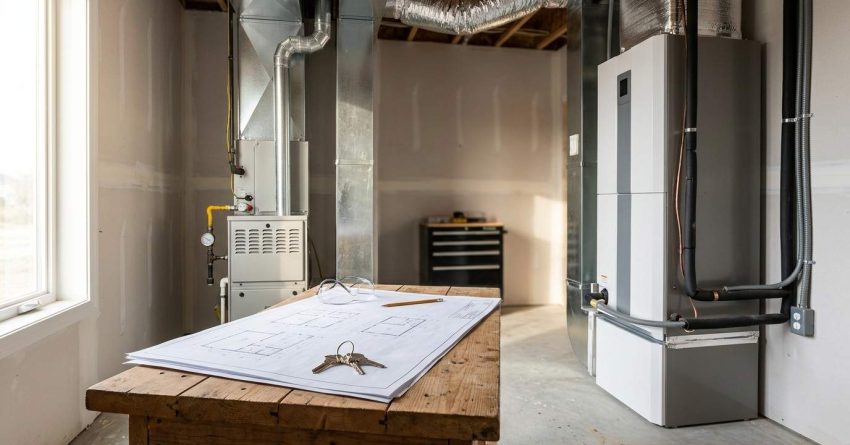
For new construction, the choice between a furnace and a heat pump comes down to three things: your climate, your budget, and your long-term energy goals. Heat pumps offer dual heating and cooling from one system and lower operating costs in mild climates. Furnaces deliver reliable, powerful heat in cold regions where gas is affordable and accessible.
This decision affects your comfort, utility bills, and home value for decades. Getting it right during the build phase is far easier and cheaper than changing systems later.
This guide covers how each system works, what each costs to install and operate, how climate affects performance, and which system makes the most sense for your specific situation.
What Is the Core Difference Between a Furnace and a Heat Pump?
A furnace is a heating system that burns fuel — typically natural gas or propane — to generate heat, then distributes that heat through your home via ductwork. A heat pump is a system that moves heat rather than creating it, using electricity and a refrigerant cycle to transfer thermal energy between the outdoors and your home’s interior.
That single distinction — generating heat versus moving it — drives every other difference in cost, efficiency, and performance between the two systems. Understanding the broader landscape of home heating and cooling — our HVAC services overview covers every system type, installation option, and maintenance need in one place — helps put this comparison in full context.
How Each System Generates or Moves Heat
A furnace works by igniting fuel in a combustion chamber, heating a heat exchanger, and pushing warm air through your duct system using a blower fan. The process is straightforward: burn fuel, produce heat, distribute it.
A heat pump works like a refrigerator in reverse. It uses a refrigerant that absorbs heat from outdoor air (even cold air contains usable thermal energy), compresses it to raise the temperature, and releases that heat inside your home. In summer, the process reverses — it pulls heat out of your home and releases it outside, functioning as an air conditioner. One system, two functions.
Climate Compatibility — Which System Suits Your Region?
Climate is the single most important variable in this decision. Heat pumps are highly efficient in mild to moderate climates but historically struggled in extreme cold. Furnaces perform consistently regardless of outdoor temperature, making them the traditional choice for northern states.
Modern cold-climate heat pumps have changed this equation significantly. Today’s best models maintain strong efficiency at temperatures well below 0°F, expanding the viable range for heat pumps into climate zones that previously required gas heat. However, in regions with sustained temperatures below -10°F to -15°F, a furnace or hybrid system still offers a performance advantage.
Homeowners in mild-to-moderate climates who lean toward a heat pump will want to understand what the heat pump installation process involves before committing to a system for new construction.
Cold Climates vs. Mild Climates: Performance Breakdown
| Climate Type | Heat Pump Performance | Furnace Performance |
| Mild (zones 1–3, southern US) | Excellent — high COP year-round | Functional but often oversized for heating load |
| Moderate (zones 4–5, mid-Atlantic, Pacific Northwest) | Very good — modern units handle most conditions | Reliable; gas access determines cost advantage |
| Cold (zones 6–7, northern US, mountain states) | Good with cold-climate models; backup heat may be needed at extremes | Excellent — consistent output regardless of temperature |
Homeowners in northern states considering a heat pump for extreme cold should also explore dual-fuel heat pump systems a hybrid approach that pairs a heat pump with a gas furnace backup to maintain efficiency across all temperature ranges.
Upfront Installation Costs for New Construction
In new construction, both systems are installed from scratch, which changes the cost comparison compared to a retrofit. Ductwork is being run regardless of which system you choose, so that cost is largely neutral. The key infrastructure differences are what drive the cost gap.
A gas furnace system requires a gas line connection, proper venting or flue installation, and an air handler. A heat pump requires a larger electrical service — typically 200-amp — and refrigerant line sets connecting the indoor air handler to the outdoor condenser unit. If your new construction already plans for 200-amp electrical service (standard in most modern builds), the heat pump’s electrical infrastructure cost is minimal.
For a complete breakdown of what drives HVAC installation costs across all system types — including ductwork, permits, and labor — our cost guide walks through every line item new construction buyers should budget for.
Equipment Costs, Labor, and Infrastructure Requirements
For a typical new construction home, a gas furnace with a central air conditioning system (required separately for cooling) runs approximately $6,000–$12,000 installed, depending on system size, efficiency rating, and regional labor rates. A heat pump system — which handles both heating and cooling — typically runs $5,000–$15,000 installed, with higher-efficiency cold-climate models at the upper end of that range.
The critical comparison: a furnace requires a separate AC unit for cooling. When you add that cost, the total installed price of a furnace-plus-AC system often matches or exceeds a heat pump system of equivalent capacity. In new construction, this makes the heat pump’s dual-function capability a significant cost consideration.
Homeowners who want to understand whether federal incentives can offset upfront costs should review available heat pump tax credits and rebates — including IRA provisions that may significantly reduce the installed cost of qualifying heat pump systems.
Long-Term Operating Costs and Energy Efficiency
A furnace’s efficiency is measured by its AFUE (Annual Fuel Utilization Efficiency) rating. A 96% AFUE furnace converts 96 cents of every dollar of gas into usable heat. High-efficiency furnaces range from 90% to 98% AFUE.
A heat pump’s efficiency is measured by its COP (Coefficient of Performance). A COP of 3 means the heat pump delivers three units of heat for every one unit of electricity consumed — effectively 300% efficiency. This is possible because the system moves heat rather than generating it. Modern heat pumps typically operate at COP 2.5–4.5 depending on outdoor temperature and model.
Whether a heat pump or furnace is cheaper to operate depends on your local electricity and natural gas rates. In regions where electricity is inexpensive relative to gas, heat pumps offer clear operating cost savings. Where gas is very cheap and electricity rates are high, a high-efficiency furnace may cost less to run. Homeowners focused on reducing utility bills over time will find a deeper comparison of energy-efficient HVAC systems — including COP and AFUE benchmarks across leading models — in our dedicated efficiency guide.
COP Ratings, AFUE Ratings, and What They Mean for Your Bills
COP is a ratio that measures how much heat a heat pump delivers per unit of electricity consumed. A COP of 3.5 means you receive $3.50 worth of heat for every $1.00 of electricity. AFUE measures what percentage of fuel a furnace converts to heat — a 95% AFUE furnace wastes only 5 cents of every dollar of gas.
To compare them directly: check your local electricity rate (cents per kWh) and gas rate (dollars per therm), then calculate the effective cost per BTU for each system. Your HVAC contractor can run this calculation for your specific region and system size during the design phase of your new construction project.
Heating and Cooling Capability — Year-Round Comfort
A furnace heats. That is its only function. To cool a new construction home with a furnace-based system, you need a separate central air conditioning unit — an additional equipment cost, additional installation labor, and an additional system to maintain.
Heat pumps provide both heating and cooling from a single unit, which is why many new construction projects pair them with professional air conditioning services to ensure the system is sized, installed, and commissioned correctly. In cooling mode, a heat pump operates identically to a central air conditioner, with efficiency measured by its SEER2 rating.
For new construction buyers, this dual-function capability simplifies the mechanical system, reduces the number of components requiring maintenance, and often reduces total installed cost when the AC unit is factored into the furnace comparison. It also simplifies the ductwork design, since one system handles both seasonal needs through the same air distribution network.
Environmental Impact and Sustainability Considerations
A gas furnace produces carbon dioxide and other combustion byproducts directly inside your home’s mechanical system. Even high-efficiency furnaces emit greenhouse gases as a direct result of burning fossil fuel. A heat pump produces zero direct combustion emissions — its environmental footprint depends entirely on the electricity grid that powers it.
In states with high renewable energy penetration — California, Washington, Colorado, and much of the Northeast — a heat pump’s effective carbon footprint is already significantly lower than a gas furnace. In states with coal-heavy grids, the advantage narrows but does not disappear, since heat pumps use electricity so efficiently that even a partially fossil-fuel grid often results in lower total emissions than direct combustion.
The long-term trajectory matters for new construction decisions. As the US grid continues to decarbonize, a heat pump installed today becomes progressively cleaner over its 15–20 year lifespan. A gas furnace’s emissions profile remains static. Builders and homeowners prioritizing low-carbon construction will find a full comparison of sustainable HVAC options — including electric heat pumps, hybrid systems, and high-efficiency furnaces — in our energy efficiency guide.
Which System Is Right for Your New Construction Project?
No single answer fits every new construction project. The right system depends on a combination of factors that are specific to your location, budget, and goals. Here is a practical framework for making the decision.
Choose a heat pump if: You are in climate zones 1–5, you want one system for heating and cooling, your electricity rates are moderate, you have sustainability goals, or you want to take advantage of federal tax credits for heat pump installation.
Choose a furnace if: You are in climate zones 6–7 with sustained extreme cold, natural gas is significantly cheaper than electricity in your area, your builder has already planned gas infrastructure, or your heating load is very high due to home size or design.
Consider a dual-fuel system if: You are in a cold climate but want heat pump efficiency for most of the year, with gas furnace backup for the coldest days. This hybrid approach captures the best of both systems.
Whichever system you choose, long-term performance depends on consistent upkeep — our guide to HVAC maintenance planning explains what routine service looks like for both furnaces and heat pumps after installation. Homeowners leaning toward gas heating for their new build can explore furnace installation options — including system sizing, fuel type selection, and what to expect during the installation process — in our furnace service guide.
Decision Factors: Budget, Climate, Energy Goals, and Home Size
Budget: Compare total installed cost — furnace plus AC versus heat pump — not equipment cost alone. Factor in available tax credits for heat pumps before finalizing the budget comparison.
Climate: Identify your USDA climate zone and your area’s average winter design temperature. If your design temperature is above 10°F, a heat pump handles the load efficiently. Below that, evaluate cold-climate models or a dual-fuel system.
Energy goals: If net-zero or all-electric construction is a goal, a heat pump is the only path. If minimizing upfront cost is the priority and gas is cheap locally, a high-efficiency furnace may pencil out better in the short term.
Home size: Larger homes with higher heating loads require careful Manual J load calculations to ensure either system is sized correctly. An undersized heat pump in a cold climate is a common and costly mistake — work with a qualified HVAC contractor during the design phase.
Contact Mr. Local Services to connect with a qualified HVAC professional who can evaluate your specific new construction project and recommend the right system for your climate, budget, and long-term goals.
Conclusion
Choosing between a furnace and a heat pump for new construction comes down to climate performance, total installed cost, and long-term operating efficiency. Both systems are proven, reliable options — the right choice depends on your specific region and goals.
Heat pumps offer dual-function capability, lower operating costs in moderate climates, and a cleaner environmental profile as the grid decarbonizes. Furnaces deliver consistent, powerful heat in cold climates where gas is affordable and accessible.
At Mr. Local Services, we connect homeowners and builders with qualified HVAC professionals who can assess your new construction project, run accurate load calculations, and install the right system correctly the first time. Reach out today to get started.
Frequently Asked Questions
Can a heat pump replace a furnace entirely in a new construction home?
Yes, in most US climate zones a heat pump can serve as the sole heating and cooling system. In climate zones 6–7 with sustained extreme cold, a cold-climate heat pump or dual-fuel system is recommended to ensure reliable performance on the coldest days.
What is the lifespan of a heat pump compared to a furnace?
Heat pumps typically last 15–20 years with proper maintenance. Gas furnaces generally last 20–30 years. The heat pump’s shorter lifespan is partially offset by the fact that it replaces both a furnace and an air conditioner, which would each need replacement separately.
Do heat pumps work well in humid climates?
Yes. Heat pumps function as air conditioners in cooling mode and dehumidify as part of that process. In humid southern climates, a heat pump handles both cooling and dehumidification effectively, making it a practical choice for year-round comfort.
Is a heat pump more expensive to install than a furnace in new construction?
When comparing total system cost — furnace plus separate AC versus heat pump — the price difference is often smaller than it appears. Heat pump systems typically run $5,000–$15,000 installed. A furnace plus central AC system runs $6,000–$12,000 or more. Federal tax credits can further reduce the heat pump’s net cost.
How do I know which climate zone I am in for HVAC planning?
The US Department of Energy divides the country into climate zones 1 through 7. Zones 1–3 cover the South and Southwest, zones 4–5 cover the mid-Atlantic and Midwest, and zones 6–7 cover the northern states and mountain regions. Your HVAC contractor uses your zone and local design temperature to size your system correctly.
What maintenance does a heat pump require compared to a furnace?
Heat pumps require annual professional service including refrigerant checks, coil cleaning, and electrical inspection. Furnaces require annual service including burner inspection, heat exchanger check, and filter replacement. Both systems need regular filter changes. Heat pumps require slightly more frequent attention because they run year-round for both heating and cooling.
Can I switch from a furnace to a heat pump after my home is built?
Yes, but retrofitting is more complex and expensive than installing the right system during construction. New construction is the ideal time to choose your system because ductwork, electrical service, and gas lines are all being planned simultaneously. Changing systems after construction often requires electrical panel upgrades, gas line capping, or ductwork modifications.