Sizing an EV charger circuit correctly means matching your charger’s amperage draw to the right breaker, wire gauge, and dedicated circuit — most Level 2 home chargers require a 40- or 50-amp, 240-volt dedicated circuit with 6 or 8 AWG copper wire.
Getting the circuit size wrong creates real risks: tripped breakers, overheated wiring, failed inspections, and in serious cases, electrical fires. These problems are entirely preventable with the right information upfront.
This guide covers every key factor in EV charger circuit sizing — from charger levels and amperage rules to wire gauge, breaker selection, and knowing when to bring in a licensed electrician.
What Is EV Charger Circuit Sizing?
EV charger circuit sizing is the process of determining the correct amperage, wire gauge, and breaker capacity needed to safely power an electric vehicle charger from your home’s electrical panel. It ensures the circuit can handle the charger’s continuous electrical load without overheating, tripping, or violating the National Electrical Code (NEC).
Every EV charger draws a sustained electrical load for hours at a time. Unlike a toaster or a lamp that cycles on and off, a charger runs continuously — which means the circuit supplying it must be sized larger than the charger’s actual draw. An undersized circuit does not just trip occasionally. It degrades wiring insulation over time, creates heat buildup inside walls, and creates a genuine fire hazard.
Understanding EV charger circuit sizing is one part of a broader set of residential electrical services that keep your home safe, code-compliant, and ready for modern energy demands.
Level 1 vs. Level 2 EV Chargers: Circuit Requirements Compared
Not every EV charger requires new electrical work. The circuit requirements depend almost entirely on which charger level you are installing. Level 1 and Level 2 chargers operate on different voltages and draw very different amounts of current, which means their circuit needs are not comparable.
Level 1 Charger Circuit Needs
A Level 1 charger plugs into a standard 120-volt household outlet and draws between 12 and 16 amps. In most cases, no new circuit is required. However, a dedicated 20-amp circuit is strongly recommended to prevent overloading a shared outlet that also serves other appliances or devices.
Level 1 charging is slow — typically adding 3 to 5 miles of range per hour. For drivers who cover short daily distances and can charge overnight, this is often sufficient without any electrical upgrades.
Level 2 Charger Circuit Needs
A Level 2 charger operates on a 240-volt circuit and draws between 16 and 40 amps depending on the unit. It requires a dedicated 240-volt circuit — meaning no other appliances share that circuit — with a double-pole breaker and appropriately sized copper wire.
Most residential Level 2 chargers are rated at 32 amps or 40 amps of output. A 32-amp charger requires a 40-amp dedicated circuit. A 40-amp charger requires a 50-amp dedicated circuit. The difference comes from the NEC’s continuous load rule, which is covered in the next section. Common outlet configurations include the NEMA 14-50, though many Level 2 chargers are hardwired directly rather than plugged in.
If you have already decided on a charger type and are ready to move forward, our EV charger installation guide covers the full process from permit to final connection.
What Amperage Does an EV Charger Circuit Need?
Most Level 2 EV chargers require a 40- or 50-amp dedicated circuit. The specific amperage depends on your charger’s rated output and a key NEC requirement: circuits carrying continuous loads must be sized at 125% of the load. This is known as the 80% continuous load rule.
In practical terms, it works like this. A charger that draws 32 amps continuously requires a circuit rated for at least 40 amps (32 ÷ 0.80 = 40). A charger that draws 40 amps continuously requires a 50-amp circuit (40 ÷ 0.80 = 50). The circuit is not oversized — it is correctly sized for sustained use.
A 30-amp circuit is sometimes used for smaller or older chargers drawing 24 amps or less, but this is increasingly uncommon with modern Level 2 units. When in doubt, sizing up to a 50-amp circuit provides room for a future charger upgrade without rewiring.
Homes with older panels may not have the spare capacity for a dedicated 50-amp circuit, making an electrical panel upgrade a necessary first step before installation can begin.
Wire Gauge and Breaker Size for EV Charger Circuits
Wire gauge and breaker size must match the circuit amperage. Using wire that is too thin for the amperage creates resistance, generates heat, and creates a fire risk. The American Wire Gauge (AWG) system works inversely — a lower number means a thicker, higher-capacity wire.
For EV charger circuits, always use copper wire. Aluminum wire requires a larger gauge for the same amperage and is generally not recommended for EV applications due to its higher resistance and connection requirements.
All EV charger circuits on 240 volts require a double-pole breaker — a breaker that occupies two slots in your panel and controls both legs of the 240-volt supply simultaneously.
| Circuit Amperage | Wire Gauge (Copper) | Breaker Size |
| 30-amp | 10 AWG | 30-amp double-pole |
| 40-amp | 8 AWG | 40-amp double-pole |
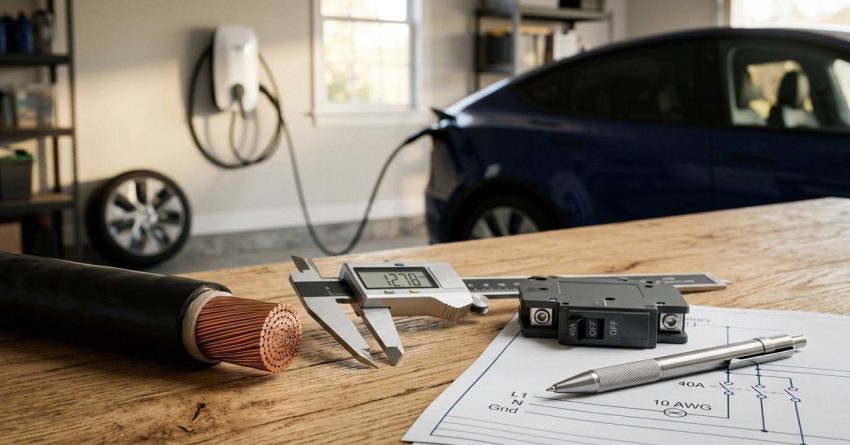
| 50-amp | 6 AWG | 50-amp double-pole |
These specifications reflect NEC minimums. Local codes may require conduit, specific wire types, or additional protections such as GFCI or AFCI breakers depending on where the circuit runs and your jurisdiction. If you want a deeper look at GFCI and AFCI requirements specific to EV circuits, EV charger GFCI and AFCI requirements covers the code requirements by installation location and jurisdiction.
Selecting the correct wire gauge and breaker size is licensed electrical work that must meet NEC standards and local code requirements to pass inspection.
How to Determine the Right Circuit Size for Your Home
Determining the right circuit size starts with two pieces of information: your charger’s amperage requirements and your electrical panel’s available capacity. Neither can be skipped.
Start by checking your charger’s specification sheet or manufacturer documentation. It will list the maximum amperage draw. Apply the 125% rule: divide the charger’s amperage by 0.80 to get the minimum circuit size. A 32-amp charger needs a 40-amp circuit. A 40-amp charger needs a 50-amp circuit.
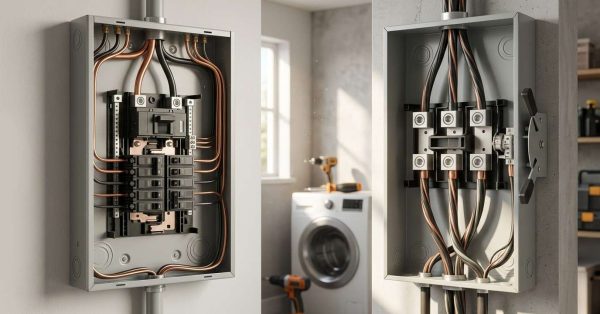
Next, assess your electrical panel. Open the panel door and look at the main breaker rating — this is your home’s total service capacity, typically 100, 150, or 200 amps. Count the available open slots for a new double-pole breaker. If your panel is full or the main breaker is already near its capacity limit, you may need a panel upgrade or a sub-panel before the new circuit can be added.
Before sizing a new circuit, a home electrical inspection can identify existing capacity, panel condition, and any wiring issues that could affect the installation.
Finally, consider future-proofing. If your current charger needs a 40-amp circuit but you may upgrade to a faster charger in the next few years, installing a 50-amp circuit now avoids a second round of electrical work later. The cost difference between a 40-amp and 50-amp circuit installation is small compared to the cost of rewiring.
For the permit and inspection process that follows circuit installation, EV charger permit and inspection requirements outlines what to expect at each stage and how to prepare your installation for a passing inspection.
Common EV Charger Circuit Sizing Mistakes to Avoid
Even well-intentioned homeowners and contractors make circuit sizing errors that lead to failed inspections, safety hazards, or costly rework. These are the most common mistakes.
Using a shared circuit instead of a dedicated one. Plugging a Level 2 charger into a circuit that also serves other outlets or appliances creates an overload risk. EV chargers require a dedicated circuit — one that serves only the charger.
Ignoring the 80% continuous load rule. Installing a 40-amp breaker for a 40-amp charger violates NEC requirements. The charger draws 40 amps continuously, which requires a 50-amp circuit. This mistake is extremely common and will fail inspection.
Undersizing the wire gauge. Using 10 AWG wire on a 40-amp circuit is a code violation and a fire hazard. Wire gauge must match or exceed the circuit amperage rating.
Skipping the permit. EV charger circuit installations require an electrical permit in most U.S. jurisdictions. Unpermitted work can create problems when selling the home, void homeowner’s insurance coverage for related incidents, and leave the installation uninspected for safety issues.
Failing to future-proof. Installing the minimum circuit size for today’s charger without considering a future upgrade means paying for the same work twice. A 50-amp circuit costs only marginally more to install than a 40-amp circuit.
When to Call a Licensed Electrician for EV Charger Installation
Most EV charger circuit installations require a licensed electrician. The work involves your home’s main electrical panel, new circuit runs through walls or conduit, and a permit process that requires a licensed contractor in most states.
Call a licensed electrician when any of the following apply.
Your installation requires a new circuit run from the panel to the garage or charging location. This involves running wire through walls, attic space, or conduit — work that must meet NEC and local code requirements.
Your panel needs an upgrade or lacks available breaker slots. Panel work is high-voltage work that carries serious injury risk and must be performed by a licensed professional.
Your home has aluminum wiring. Aluminum wiring requires specific connectors, anti-oxidant compounds, and careful termination — work that requires expertise to do safely.
Your installation requires a permit. In most U.S. jurisdictions, a permit is required for new circuit installations, and the permit must be pulled by a licensed electrician or the homeowner in states that allow owner-builder permits.
You are installing a hardwired Level 2 charger rather than a plug-in unit. Hardwired installations require direct panel connections and conduit work that go beyond standard outlet replacement.
For any work involving new circuit runs, panel connections, or permit applications, professional electrician services ensure the job is done safely and to code.
At Mr. Local Services, our licensed electricians handle every aspect of EV charger circuit installation — from panel assessment and permit application through final inspection. Contact us to schedule an assessment and get your home ready for EV charging.
Conclusion
EV charger circuit sizing comes down to three core decisions: the right amperage for your charger’s continuous load, the correct wire gauge for that amperage, and a dedicated circuit with a properly rated double-pole breaker.
Getting these specifications right protects your home, ensures your installation passes inspection, and prevents the cost of rework. The NEC 80% rule is the most important concept to understand — it explains why your circuit must be sized larger than your charger’s rated output.
When the work involves your electrical panel, a new circuit run, or a permit application, Mr. Local Services connects you with licensed electricians who handle EV charger circuit installations safely, correctly, and to code — so your charging setup works reliably from day one.
Frequently Asked Questions
Can I install an EV charger on an existing circuit?
A Level 1 charger can use an existing 120-volt outlet, though a dedicated 20-amp circuit is recommended. A Level 2 charger always requires a new dedicated 240-volt circuit and cannot share an existing circuit with other loads.
What is the difference between a 40-amp and 50-amp EV charger circuit?
A 40-amp circuit supports chargers with up to 32 amps of output. A 50-amp circuit supports chargers with up to 40 amps of output. Most electricians recommend a 50-amp circuit for future-proofing, even if your current charger only requires 40 amps.
Do I need a permit to install an EV charger circuit?
Yes, in most U.S. jurisdictions a permit is required for new circuit installations. The permit ensures the work is inspected for code compliance. Skipping the permit can create issues with home insurance and property sales.
How long does it take to install an EV charger circuit?
A straightforward Level 2 charger circuit installation typically takes 2 to 4 hours for a licensed electrician. If a panel upgrade or sub-panel installation is needed, the project may take a full day or longer.
Can I use aluminum wire for an EV charger circuit?
Aluminum wire is not recommended for EV charger circuits. It requires a larger gauge than copper for the same amperage, has higher resistance, and requires specific connectors and anti-oxidant compounds to terminate safely. Copper wire is the standard for EV charger installations.
What happens if my electrical panel is full?
If your panel has no available breaker slots, you have two options: a panel upgrade to a higher-capacity panel, or the installation of a sub-panel in the garage or charging area. A licensed electrician can assess which option is more practical and cost-effective for your home.
Does a Level 2 EV charger need a GFCI breaker?
GFCI protection requirements for EV charger circuits vary by jurisdiction and installation location. Outdoor installations and garage installations in some jurisdictions require GFCI protection. Your electrician will confirm the local code requirement during the permit process.