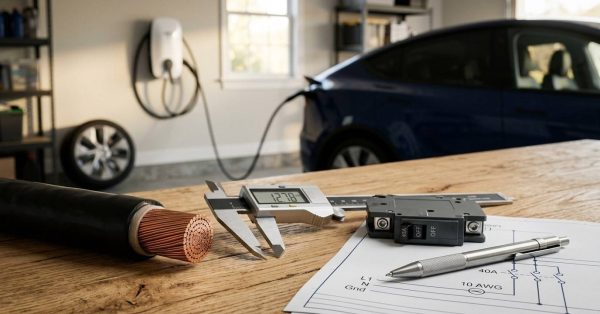
Choosing between 200A and 400A electrical service comes down to one question: how much power does your property actually need? For most single-family homes, a 200A panel handles everyday demand comfortably. But larger homes, properties with electric vehicles, whole-home generators, or major additions often require the expanded capacity that only a 400A service can reliably deliver.
Getting this decision wrong creates real problems — an undersized panel causes tripped breakers, limits future upgrades, and creates safety risks that grow more serious over time.
This guide explains both service levels clearly, compares them side by side, and helps you identify which option fits your property, your budget, and your long-term plans.
What Is Electrical Service Capacity and Why Does It Matter?
Electrical service capacity refers to the maximum amount of electrical current your home’s main panel can safely receive and distribute from the utility grid. It is measured in amperes, commonly called amps, and determines how many circuits your home can support simultaneously without overloading the system.
Every appliance, lighting fixture, HVAC unit, and outlet in your home draws current from that panel. When total demand approaches or exceeds the panel’s rated capacity, breakers trip, circuits fail, and in serious cases, wiring overheats. Choosing the right service capacity from the start — or upgrading to the right level — protects your property and supports everything you want to power.
How Amperage Affects Your Home’s Power Supply
Amperage is the measure of electrical current flowing through your system at any given moment. A higher amperage rating means your panel can handle more simultaneous demand without strain. A 200A panel allows up to 200 amps of total current draw across all circuits. A 400A panel doubles that ceiling, giving large or high-demand properties the headroom they need to operate safely and efficiently.
Understanding your home’s electrical capacity is the foundation of every safe upgrade decision — our electrical services overview covers the full range of residential and commercial electrical work we provide, from panel inspections to complete rewiring.
Understanding 200A Electrical Service
A 200A electrical service is the standard panel size installed in most modern single-family homes built or upgraded in the last three decades. It provides enough capacity to power a full range of household systems — central air conditioning, electric ranges, water heaters, washers and dryers, lighting, and general outlets — without issue.
For homes under approximately 2,500 square feet with conventional appliances and no high-demand additions, a 200A service is typically sufficient. It meets current National Electrical Code requirements for new residential construction and supports most standard home improvement projects without requiring a service upgrade.
What a 200A Panel Supports in a Typical Home
A properly installed 200A panel comfortably handles the following loads in a typical residential setting:
- Central HVAC systems (heating and cooling)
- Electric water heater
- Electric range or oven
- Washer and dryer
- Refrigerator, dishwasher, and standard kitchen appliances
- Lighting throughout the home
- General-purpose outlets on all circuits
If your home currently operates on a 100A panel — common in homes built before the 1980s — upgrading to 200A is often the most practical and cost-effective improvement you can make to your electrical system.
If your current panel is undersized or aging, a licensed electrician can assess whether a replacement is the right move — our panel upgrade services explains what the process involves, what it costs, and how long it typically takes.
Understanding 400A Electrical Service
A 400A electrical service delivers twice the capacity of a standard 200A panel. It is typically installed in large single-family homes, multi-unit residential properties, properties with significant electrical additions, or homes where multiple high-demand systems operate simultaneously.
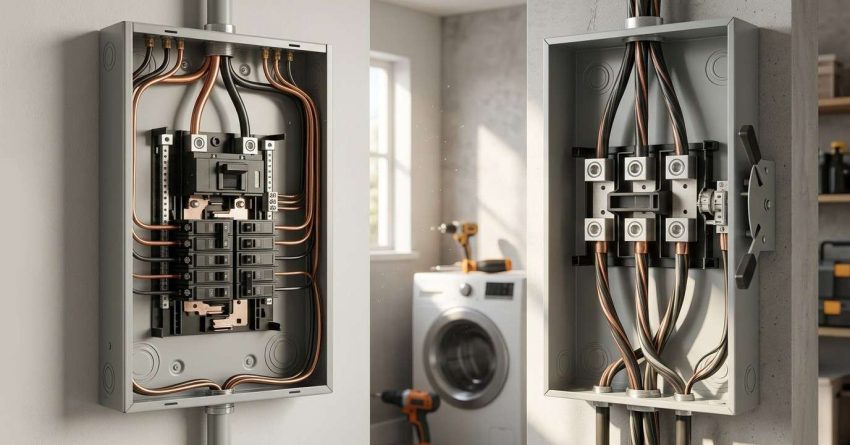
A 400A service is not simply a larger version of a 200A panel. It requires a different meter base, a larger service entrance cable, and in most cases, two 200A sub-panels working in tandem rather than a single oversized unit. This configuration allows the electrical load to be distributed across two panels, each managing a portion of the home’s circuits.
What a 400A Panel Supports in Larger or High-Demand Properties
A 400A service is the right choice when a property needs to support combinations of high-demand systems that would strain a 200A panel, including:
- Multiple HVAC systems or large commercial-grade units
- Electric vehicle charging stations (Level 2 or DC fast chargers)
- Whole-home backup generators with automatic transfer switches
- Hot tubs, pools, or large outdoor electrical installations
- Home workshops with heavy power tools or welding equipment
- Large additions, accessory dwelling units, or in-law suites
- Multi-unit properties where two meters share a single service entrance
Homes undergoing major additions or full renovations frequently require a 400A service upgrade to support the expanded load — our home remodeling guide outlines how electrical planning fits into the broader remodeling process.
200A vs 400A Service: Key Differences Side by Side
| Feature | 200A Service | 400A Service |
| Total capacity | 200 amps | 400 amps |
| Typical property size | Up to ~2,500 sq ft | 2,500+ sq ft or high-demand |
| Panel configuration | Single main panel | Two 200A sub-panels |
| EV charging support | Level 1 / limited Level 2 | Full Level 2 and DC fast charge |
| Whole-home generator | Possible with load management | Fully supported |
| Multi-unit support | Single-family standard | Multi-unit or large estate |
| Typical upgrade cost | $1,500–$4,000 | $4,000–$10,000+ |
| Permit required | Yes | Yes |
| Utility coordination required | Sometimes | Always |
The right choice depends on your current load, your planned additions, and how your property’s electrical needs are likely to grow over the next 10 to 20 years.
When Should You Choose 200A Service?
A 200A service is the right choice for most homeowners upgrading from an older 60A or 100A panel, or for new construction on a standard single-family home. Choose 200A when:
- Your home is under 2,500 square feet with standard appliances
- You have no plans to add an EV charger, pool, or large workshop
- You are not adding a significant addition or accessory dwelling unit
- Your current 100A panel is causing frequent breaker trips or cannot support a new appliance
- You want a cost-effective upgrade that meets code and supports your current lifestyle
For the majority of homeowners in the USA, a 200A upgrade resolves capacity problems, satisfies permit requirements, and provides enough headroom for reasonable future additions without the cost of a full 400A installation.
When Should You Choose 400A Service?
A 400A service is the right choice when your property’s electrical demand genuinely exceeds what a 200A panel can safely handle. Choose 400A when:
- Your home exceeds 3,000 square feet with multiple HVAC zones
- You are installing or planning to install an EV charging station
- You are adding a large addition, guest house, or accessory dwelling unit
- You operate a home-based business with significant electrical equipment
- You want a whole-home backup generator with full-load transfer capability
- You manage a multi-unit property sharing a single service entrance
- Your electrician’s load calculation shows demand approaching or exceeding 200A
A 400A service is a significant investment, but for properties with genuine high-demand needs, it eliminates capacity constraints for the life of the building and avoids the cost of a second upgrade later.
Cost Considerations for 200A vs 400A Upgrades
Electrical service upgrades involve several cost components beyond the panel itself. Understanding what drives the total price helps you budget accurately and avoid surprises.
200A upgrade typical cost range: $1,500–$4,000
This range covers the panel replacement, labor, permit fees, and inspection. Costs increase when the service entrance cable needs replacement, when the meter base requires upgrading, or when the existing wiring inside the home needs remediation to meet current code.
400A upgrade typical cost range: $4,000–$10,000+
The higher cost reflects the more complex installation — two sub-panels, a larger meter base, heavier service entrance conductors, and mandatory utility coordination to upgrade the service drop from the street. In some areas, utility upgrade fees add $500–$2,000 to the total.
Factors that affect both:
- Local permit and inspection fees (vary by municipality)
- Age and condition of existing wiring
- Distance from the meter to the main panel
- Whether the utility requires a service drop upgrade
- Labor rates in your area
For smaller electrical tasks that fall outside a full panel upgrade — such as outlet additions or minor wiring fixes — our handyman service options provide a cost-effective path for routine electrical maintenance needs.
How the Upgrade Process Works
An electrical service upgrade follows a defined sequence regardless of whether you are moving to 200A or 400A. Understanding the steps helps you plan the timeline and coordinate with your electrician and utility provider.
What to Expect During an Electrical Service Upgrade
Step 1 — Load calculation and assessment A licensed electrician performs a load calculation to determine your current and projected electrical demand. This calculation drives the recommendation for 200A or 400A service.
Step 2 — Permit application Your electrician submits a permit application to the local building department. Most jurisdictions require a permit for any service upgrade. Work cannot legally begin until the permit is approved.
Step 3 — Utility notification For 400A upgrades, and often for 200A upgrades as well, the utility company must be notified and may need to upgrade the service drop — the overhead or underground cable connecting your home to the grid.
Step 4 — Installation The electrician disconnects power, removes the old panel, installs the new panel or sub-panels, connects all circuits, and installs the new meter base if required.
Step 5 — Inspection and reconnection A municipal inspector verifies the installation meets code. Once approved, the utility reconnects power and the upgrade is complete.
Most 200A upgrades are completed in one day. A 400A installation typically takes one to two days, with additional time if utility coordination requires scheduling a separate crew.
Electrical upgrades often go hand in hand with broader safety improvements throughout the property — our home safety upgrades explains how we help homeowners address accessibility, hazard prevention, and code compliance together.
Conclusion
Choosing between 200A and 400A electrical service is a decision rooted in your property’s actual demand, its size, and the systems you plan to run. Most standard homes are well-served by a 200A upgrade, while larger properties and high-demand installations require the expanded capacity of a 400A service.
Getting the capacity right the first time avoids costly second upgrades and ensures your electrical system supports your property safely for decades. The load calculation your electrician performs is the most reliable guide to making the right choice.
At Mr. Local Services, our licensed electricians assess your property’s full electrical needs, walk you through the 200A vs 400A decision with clear recommendations, and handle the entire upgrade process from permit to final inspection.
Frequently Asked Questions
Can I upgrade from 200A to 400A later if my needs change?
Yes, but it is a significant second project. Upgrading from 200A to 400A later requires replacing the meter base, service entrance cable, and panel configuration, plus utility coordination. If your load calculation shows you are close to 200A capacity now, installing 400A upfront is often more cost-effective.
Does a 400A service use more electricity than a 200A service?
No. Amperage rating describes capacity, not consumption. A 400A panel does not draw more power than a 200A panel — it simply allows more current to flow when demand requires it. Your actual electricity bill is determined by how much power your appliances and systems consume, not by your panel’s rated capacity.
Do I need a permit to upgrade my electrical panel?
Yes. Virtually all jurisdictions in the USA require a permit for electrical service upgrades. Your licensed electrician handles the permit application as part of the project. Work performed without a permit can create insurance, resale, and safety complications.
How long does a 200A or 400A upgrade take?
A standard 200A upgrade typically takes one full day. A 400A installation usually takes one to two days, with additional scheduling time if the utility needs to upgrade the service drop separately. Your electrician can give you a specific timeline after the initial assessment.
What is a load calculation and why does it matter?
A load calculation is a formal assessment of your home’s total electrical demand — adding up the amperage requirements of every circuit, appliance, and system. It determines whether your current panel is adequate or whether an upgrade is needed, and it specifies whether 200A or 400A service is the right solution for your property.
Will a 400A service support a whole-home EV charging setup?
Yes. A 400A service provides sufficient capacity to support multiple Level 2 EV chargers simultaneously alongside your home’s other electrical loads. A 200A panel can typically support one Level 2 charger with load management, but properties with two or more EVs or high baseline demand benefit significantly from 400A service.
What happens if I run too many appliances on an undersized panel?
An undersized panel causes circuit breakers to trip repeatedly as a safety response to overload. Over time, repeated overloading can damage wiring insulation, create heat buildup inside the panel, and increase the risk of electrical fire. If your breakers trip frequently under normal use, a service upgrade assessment is the appropriate next step.