Deck repair is the process of correcting damage to an existing deck’s boards, structural frame, railings, stairs, and hardware — restoring it to safe, functional condition without a full replacement. Every deck sustains wear over time, and timely repairs protect safety and value.
Neglected deck problems compound fast — surface rot invades structural framing, corroded hardware creates fall hazards, and each season of delay significantly increases both the scope and total cost of repair.
This guide covers repair fundamentals, board replacements, structural fixes, railing and stair repairs, rot and moisture treatment, hardware and fastener issues, specialty damage scenarios, contractor selection, repair pricing, and prevention.
Deck Repair Fundamentals — Know Before You Fix
Deck repair covers a broad range of interventions — from replacing a single cracked plank to reinforcing a compromised structural frame. Understanding the full spectrum of problems, and how to assess them accurately, is the first step toward making decisions that are both safe and cost-effective.
When to Repair vs. Replace Your Deck
The core question every homeowner eventually faces is whether targeted repairs are economically justified or whether a full replacement delivers better long-term value. As a general rule, if the total cost of needed repairs exceeds 50 percent of the full replacement cost, replacement is often the smarter investment. Repair is appropriate when damage is isolated — a single rotted post, a few cracked boards, a loose railing. Replacement becomes necessary when the structural frame has failed across multiple members, when the deck is well beyond its material lifespan, or when the existing structure does not meet current building codes.
The Most Common Deck Problems and Their Causes
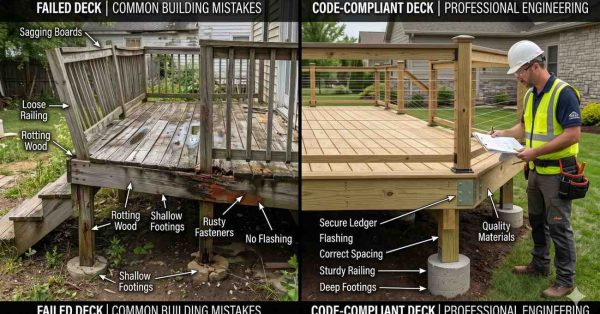
Decks fail in predictable ways. According to research by the North American Deck and Railing Association (NADRA), the leading causes of deck structural failures include deteriorated ledger board attachments, rotted support posts, missing lateral load connectors, and inadequate footing depth. Beyond structural failure, cosmetic and surface-level problems — cracked boards, warped planks, splintering, fading stains, and hardware corrosion — are far more common and typically more straightforward to address.
Common deck problems by category:
- Surface issues: Cracked boards, warped planks, cupping, splintering, fading, surface mold
- Structural issues: Rotted joists, sagging beams, shifted footings, ledger board separation
- Safety issues: Wobbly railings, loose balusters, damaged stair stringers, exposed nails
- Moisture issues: Wood rot, standing water damage, mold, mildew, and algae growth
DIY vs. Professional Deck Repair
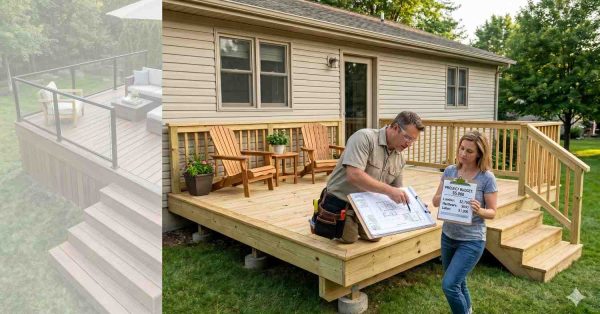
Surface repairs — replacing individual boards, sanding, tightening railings, applying stain — are generally achievable for a skilled homeowner with basic tools. Structural repairs to joists, ledger boards, beams, and posts require a licensed contractor. Improper structural repairs not only fail to resolve the problem but create serious safety risks and are likely to fail local building inspections.
Our dedicated cluster on deck repair fundamentals covers the complete pre-repair inspection checklist, a breakdown of average costs by repair type, a side-by-side DIY vs. professional comparison, and emergency repair guidance — giving you everything needed to assess your deck accurately before any work begins.
Board-Level Deck Repair
Board-level damage is the most visible and most frequently encountered type of deck repair. Cracked, warped, cupped, splintered, or rotted surface boards affect both the safety and appearance of a deck and should be addressed before deterioration spreads to the structural members below.
Cracked, Warped, Cupped, and Splintered Boards
Surface cracking and checking in wood decking are natural results of repeated moisture absorption and UV exposure. Minor surface checks — fine hairline cracks — do not necessarily require board replacement and can be stabilized with a penetrating wood consolidant or sealer. Warping and cupping occur when the top face of a board dries more rapidly than the bottom, creating differential shrinkage. This is often the result of boards installed too tight, inadequate gapping for moisture expansion, or moisture imbalance between the board faces. Splintering creates a direct hazard for bare feet and pets and should not be ignored.
How to Replace a Single Deck Board
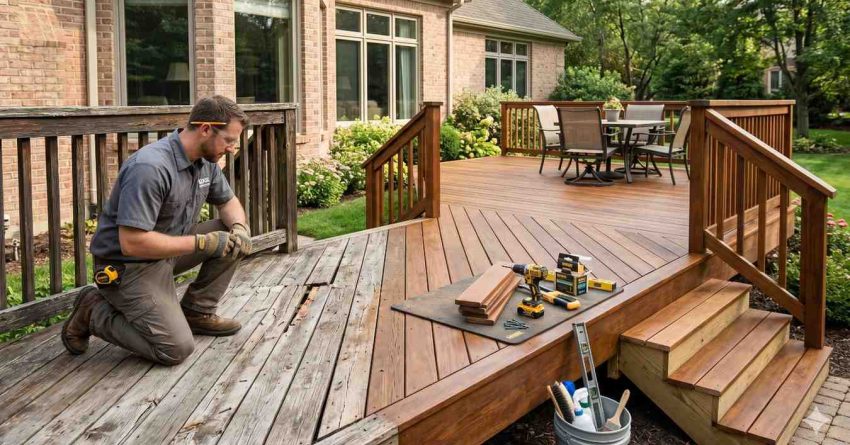
Replacing a single damaged board without disturbing adjacent planks is a straightforward process with the right approach. It involves removing the fasteners from the damaged board (extracting face screws or carefully cutting hidden fastener clips), prying the board free, inspecting the joists below for rot or moisture damage before proceeding, selecting a replacement board matched to the existing species and dimensions, and re-securing with appropriate fasteners at the correct spacing. For composite decking, the removal process differs because composite boards often use proprietary hidden fastener systems that require brand-specific installation tools.
Matching Replacement Boards to Existing Decking
Color and texture matching is one of the most overlooked challenges in board replacement. New lumber will not replicate the patina of weathered wood immediately. Options include sourcing boards from the same lumber lot if available, pre-treating replacement boards with a diluted stain to approximate the existing color, or refinishing the entire deck surface after replacement to achieve visual consistency across the full deck field.
For a complete walkthrough of every board-level fix, our detailed guide to replacing individual deck boards covers matching weathered decking, removing composite boards without disturbing adjacent ones, repairing cupped and splintered planks, and every fastener and gap technique you need to restore a damaged deck surface correctly.
Structural Deck Repair
Structural deck repairs represent the most serious category of deck work. A structurally compromised deck is a fall and collapse hazard, and the consequences of failure can be severe. The U.S. Consumer Product Safety Commission (CPSC) estimates that deck failures result in tens of thousands of emergency room visits annually in the United States, with ledger board failures and rotted framing among the primary causes.
Joists, Beams, and Post Repair
Deck joists are the horizontal framing members that directly support the surface boards from below. When joists show early-stage rot or localized damage, sistering is often the correct approach — attaching a full-length new joist alongside the damaged one and bolting them together to restore full structural capacity without complete removal. Beams carrying multiple spans require assessment by an experienced contractor before any repair is attempted, as partial rot in a critical bearing point can create sudden failure under load.
Posts that show surface checking without deep fiber penetration can sometimes be stabilized and sealed. Posts with soft, spongy cores resulting from wet rot require full replacement. Replacing a post involves temporarily supporting the beam above, removing the damaged post, and installing a correctly sized replacement anchored to the footing with an appropriate post base standoff that prevents ground-contact moisture accumulation.
Sagging, Bouncy, and Pulling-Away Decks
A sagging deck floor signals beam deflection or joist failure, often from prolonged moisture exposure combined with span lengths that exceed the lumber’s design capacity. A bouncy or springy feel underfoot typically indicates missing blocking between joists, failed joist hanger connections, or joist spacing that is too wide for the decking material above. A deck that has visibly begun to separate from the house is experiencing ledger board failure — one of the most urgent and dangerous structural conditions a deck can present.
Ledger Board Failures and Fixes
The ledger board connects the deck directly to the home’s rim joist and carries a significant structural load. Improper flashing installation is the leading cause of ledger failure: water infiltrates behind the ledger and rots the ledger itself and the house framing behind it. Repairing a failed ledger requires removing the existing ledger, drying and treating the home’s rim joist if rot is present, installing proper step flashing and drainage, and reinstalling a new ledger with correctly sized lag screws or through-bolts at code-mandated spacing intervals.
Our full guide to structural deck repair methods explains how to sister joists, replace rotted posts, fix a failed ledger board, reinforce a bouncy floor, and stabilize a deck that has begun pulling away from the house — the essential resource before attempting any framing-level repair.
Railing and Stair Repair
Deck railings and stairs are safety-critical components governed by specific building code requirements. A wobbly railing is not a cosmetic inconvenience — it is a fall hazard. CPSC injury data consistently identifies railing failure and stair collapses as among the most common mechanisms of deck-related injuries in residential settings, particularly on decks elevated more than 30 inches above grade.
Wobbly Railings, Loose Balusters, and Damaged Newel Posts
Deck railings lose stability most commonly because the newel posts — the structural anchor points of the railing system — have loosened from their deck connections, rotted at the base, or were inadequately attached during initial installation. Sound newel post connections use through-bolts to a structural blocking member within the frame, or standoff-style post anchors that create a secure mechanical connection to the rim joist. Loose balusters (the vertical infill members between posts) rarely represent structural failure but can constitute a code violation if the gap between them exceeds 4 inches — a threshold set to prevent child entrapment.
Stair Stringer, Tread, and Riser Repair
Stair stringers are the diagonal structural members that transfer stair loads down to grade-level footings or a concrete pad. Stringers with cracks, rot penetration through their full depth, or notch damage are serious hazards requiring full replacement rather than repair by sistering. Stair treads — the horizontal surfaces users step on — are the most frequently replaced stair components and can generally be swapped individually. Stair risers (the vertical face boards between treads) are optional on many deck stair designs but can be added during repair for aesthetic or child-safety reasons.
Code Compliance for Repaired Railings
Current IRC requirements mandate a minimum railing height of 36 inches on decks up to 30 inches above grade, 42 inches on decks higher than that, and a maximum 4-inch spacing between balusters. Railing repair is an ideal opportunity to bring an older deck into full code compliance — particularly on decks built before the 2009 IRC updates that introduced lateral load connector requirements for railing post connections.
Our comprehensive resource on railing and stair repair goes deeper into every type of fix, from tensioning cable railings and replacing glass panels to repairing rotted stair stringers and bringing aging railings up to current IRC code requirements.
Rot, Mold, and Moisture Damage Repair
Moisture is the most destructive long-term force acting on any outdoor wood structure. The U.S. Forest Products Laboratory identifies a wood moisture content above 19 percent as the threshold at which wood-decaying fungi become active — a threshold that is routinely exceeded in unprotected or poorly maintained decks across all U.S. climate zones.
Identifying Wood Rot — Dry Rot vs. Wet Rot
Wood rot is caused by fungal organisms that break down the cellulose and lignin in wood fiber, progressively weakening the structural integrity of the affected member. Dry rot (Serpula lacrymans) causes wood to become brittle and crumbly with a distinctive brown or gray color, and it can spread through the wood’s fiber even after the original moisture source is removed. Wet rot is typically confined to the area that has remained consistently wet and produces soft, spongy, dark-colored wood that crumbles under pressure. The simplest field test for rot is a screwdriver probe: if the tip penetrates easily with light pressure, rot is present and repair or replacement is required.
Mold, Mildew, and Algae Removal and Prevention
Mold and mildew develop on deck surfaces wherever consistent humidity and limited airflow create ideal growth conditions — most commonly in shaded sections, beneath furniture, and around planters that trap moisture. Oxygen bleach (sodium percarbonate) is the preferred treatment for wood decks: it is effective at killing mold spores, does not discolor wood fiber, and is safer for surrounding plantings than sodium hypochlorite. Algae — the green or black slippery growth prevalent in wet coastal and Pacific Northwest climates — responds to the same oxygen bleach treatment and can be prevented with annual applications of a sodium percarbonate deck cleaner.
When Moisture Damage Means Replacement, Not Repair
When rot has fully penetrated the cross-section of a structural member, repair with epoxy alone is insufficient and the member must be replaced. When multiple adjacent joists in the same bay show advanced decay, the repair scope expands to the entire framing section. When a failed ledger has allowed moisture to infiltrate the home’s rim joist and wall framing, the repair extends well beyond the deck itself and may require a licensed contractor familiar with both deck and building envelope systems.
Our complete guide to wood rot and moisture damage repair walks through how to identify dry rot vs. wet rot, which epoxy consolidants work best for structural members, how to safely treat mold and algae, and precisely when moisture damage crosses the threshold into replacement territory.
Hardware and Fastener Repair
Every deck is assembled with hundreds of fasteners, connector plates, and structural hardware components. Over time, exposed metal hardware is vulnerable to corrosion — particularly on decks treated with ACQ (alkaline copper quaternary) or CA (copper azole) pressure-treated lumber, which is significantly more corrosive to standard zinc-plated steel hardware than traditional CCA-treated wood.
Replacing Rusted Screws and Popped Nails
Deck screws that have corroded through their protective coating lose holding power and create iron oxide staining that bleeds into the surrounding wood grain. Replacement involves extracting old fasteners (often requiring vice grips or screw extractors when rust has seized them), treating any stripped or oversized screw holes with epoxy wood filler or a wood-plug repair system, and re-driving new fasteners adjacent to the repaired locations where wood integrity is confirmed sound. Popped nails — a near-universal complaint on decks more than 10 years old — should always be replaced with screws rather than re-driven. Nails pop because the wood beneath has dried and contracted, and re-driving produces only temporary holding power.
Upgrading Hardware to Modern Standards
Hardware replacement is an opportunity to upgrade the entire connector system simultaneously. Replacing galvanized joist hangers with hot-dipped galvanized or stainless steel equivalents, adding positive connection hurricane ties to post-to-beam joints, and upgrading post bases to standoff designs that create an air gap between the post and footing — preventing moisture wicking at the most rot-vulnerable point — can substantially extend the structural life of an aging deck at a relatively modest cost.
Our focused guide on deck fastener and hardware repair explains how to replace rusted screws, fix popped nails, repair stripped screw holes, replace damaged joist hangers, and add hurricane ties that significantly strengthen an aging deck frame during a routine hardware repair visit.
Specialty Deck Repairs
Not all deck damage results from ordinary wear and weathering. Storm events, pest infestations, UV degradation, and the specific failure modes of composite materials all require repair strategies that differ meaningfully from standard wood board replacement.
Storm, Wind, and Weather Damage
High winds, falling limbs, and hail can cause sudden structural damage — cracked or snapped posts, split or dislodged boards, compromised fascia boards, and damaged stair systems. Storm damage repair frequently intersects with homeowner’s insurance claims, making thorough photo documentation immediately after the event essential for a successful claim. Structurally damaged members from storm impact events typically require full replacement rather than sistering or patching, because impact damage can create internal fractures in wood fiber that are not visible on the surface.
If your deck has sustained storm damage and you need to file an insurance claim, a dedicated guide to storm-related deck damage repair and the insurance documentation process is available here: deck storm damage and insurance claims
Pest and Termite Damage
Subterranean termites and carpenter ants are the two primary insect threats to wood deck structures in the United States. Termite damage is particularly dangerous because termites consume wood from the interior, leaving an intact outer shell that appears sound until probed. Warning signs include mud tubes on posts or beams, hollow-sounding wood when tapped, and small piles of frass (granular waste material) near affected members. Carpenter ants excavate galleries through already soft or rotted wood rather than consuming it as food, but their presence reliably signals existing moisture and decay issues that require correction alongside pest treatment.
Repairing Composite Decking
Composite decking presents repair challenges that differ substantially from wood. Modern capped composite boards are resistant to rot and insect damage, but they are vulnerable to surface scratches, UV color shift, and heat-related expansion issues. Shallow scratches on capped composite can often be minimized by applying controlled heat (a heat gun set to low) to re-fuse the cap layer. Deep scratches and broken boards require full replacement of the individual board. First-generation composite products (manufactured approximately before 2005) exhibit unique failure modes including surface mold that penetrates below the board face and a phenomenon called “mushrooming” where the cap layer peels and raises — these boards generally require full replacement rather than repair.
Our guide to specialty and damage-specific deck repairs covers storm and wind damage, termite and carpenter ant infestations, pet damage, post-fire repair, insurance claim documentation, and the unique challenges of composite boards including fading, deep scratching, and first-generation mushrooming defects.
Deck Repair Costs and Hiring a Contractor
Understanding what deck repairs actually cost — and what distinguishes a qualified contractor from an unqualified one — protects homeowners from both overpaying and from substandard work that fails to resolve the underlying problem.
Average Deck Repair Costs by Repair Type
Deck repair costs vary significantly by repair type, material, regional labor rates, and accessibility. As a general planning reference:
- Individual board replacement: $50–$150 per board including labor
- Railing repair or tightening: $200–$600 depending on railing type and length
- Stair stringer replacement: $300–$800 per stringer
- Joist sistering: $150–$400 per joist
- Post replacement: $400–$850 per post including temporary bracing
- Ledger board repair or replacement: $600–$2,500 depending on scope and accessibility
- Mold and rot treatment across full deck surface: $300–$1,000
These figures represent national mid-range estimates. Labor costs in high-cost metros like New York City, Boston, or San Francisco can run 30 to 60 percent above these benchmarks, while rural markets and Midwest mid-tier cities typically fall below them.
What to Ask Before Hiring a Deck Repair Contractor
Before signing any deck repair agreement, ask these five questions:
- Are you licensed and insured in this state, and can you provide documentation?
- Do you pull required permits for structural repairs in this jurisdiction?
- Will you provide a written, itemized scope of work and estimate?
- What warranty do you offer on labor, and what does the materials warranty cover?
- Can you provide at least two references from similar deck repair projects completed within the past 12 months?
Avoid contractors who demand payment in full before work begins, cannot provide proof of liability insurance and workers’ compensation, or are unwilling to commit the scope of work to a written contract.
Our full resource on professional deck repair costs breaks down average prices by repair type and region, explains what labor warranties to expect, compares same-day service pricing, and lists the exact questions to ask before signing any deck repair contract.
Beyond Repair — Restoration, Refinishing, and Replacement
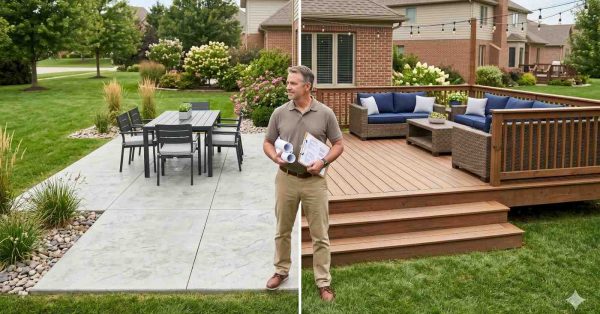
Not every aging deck is best served by targeted patch repairs. When surface wear is widespread, when the decking has grayed uniformly across its entire field, or when the structural framing has deteriorated at multiple points, alternative approaches — restoration, refinishing, or full replacement — may deliver better outcomes than piecemeal fixes.
When Restoration Makes Sense
Deck restoration involves deep cleaning, chemical stripping of degraded finishes, sanding, and the application of fresh protective coatings across the entire deck surface. It is most appropriate when the structural frame is confirmed sound but the surface finish has deteriorated uniformly and aesthetically. When surface wear runs deeper than individual boards, restoration may deliver more value than patching — our complete deck restoration process explains the full cleaning, stripping, sanding, and refinishing sequence that extends an aging deck’s useful life without the cost of full replacement.
When Refinishing Addresses the Problem
Deck refinishing is a lighter intervention than full restoration — it typically involves surface preparation (cleaning, light sanding) and the application of a fresh finish coat over an existing prepared surface. It is the appropriate approach when the existing finish has worn but the wood beneath remains structurally and dimensionally sound, with no significant cracking, warping, or moisture damage present.
When Replacement Is the Right Call
When structural failure spans multiple framing members, when footings have shifted, or when the deck cannot be brought into current code compliance through repair alone, full replacement is the most responsible path forward. For decks where structural failure is extensive across multiple members, our guide to when deck replacement makes sense walks through the full cost-benefit analysis, material upgrade options from pressure-treated to composite, and the complete construction process for a new deck built to current code.
Preventing Future Deck Repairs — Maintenance and Seasonal Care
The most cost-effective deck repair strategy is consistent prevention. A well-maintained deck experiences dramatically less deterioration, requires significantly fewer and smaller repairs, and retains its structural integrity and resale contribution far longer than a deck that receives only reactive attention.
Annual Inspection and Cleaning
Every deck should receive a thorough annual inspection covering: structural members (probe wood surfaces for soft spots with a screwdriver), all hardware and connectors (check for rust and loosening), railing stability (apply lateral force to each post), stair condition (test each tread and check stringer integrity), and surface finish wear (look for bare wood exposure, peeling, or color fading). Annual cleaning — removing mold, algae, debris accumulation, tannin stains, and grease — should precede the inspection so that damage is clearly visible beneath surface contamination.
Seasonal Maintenance Priorities
Spring inspection targets damage caused by winter freeze-thaw cycles: frost heaving can shift footings, ice expansion can crack boards at fastener points, and snowmelt infiltration can accelerate ledger rot. Fall maintenance focuses on removing leaf accumulation (a primary driver of tannin staining and moisture retention), applying or refreshing protective coatings before winter, and confirming that drainage channels beneath the deck are clear.
Our year-round deck maintenance schedule covers seasonal inspection checklists, material-specific care calendars for wood and composite, DIY vs. professional maintenance comparisons, and subscription-based service options that dramatically reduce repair frequency across all climate types.
Staining and Sealing as Repair Prevention
A quality protective finish applied at the correct interval is the single most impactful maintenance action a homeowner can take to prevent moisture infiltration and UV degradation — the two forces responsible for the majority of deck repair costs. Pressure-treated decking typically benefits from initial staining 12 to 24 months after installation (once the wood has dried sufficiently to accept a finish) and every 2 to 3 years thereafter. Cedar and redwood benefit from annual or biennial sealing with a penetrating oil-based product. Composite decking generally does not require a protective finish but benefits from annual cleaning and a bi-annual inspection of fasteners and hardware.
A quality protective finish applied on schedule is one of the most effective defenses against the moisture and UV damage that drive most repair costs, which is why our deck staining and sealing guide explains exactly when to stain, which products perform best by wood species, and how to apply them for maximum protection.
Conclusion
Deck repair spans a wide spectrum — from a single splintered board to a failing structural frame — and correctly identifying the problem determines the right response.
A proactive repair approach combined with consistent maintenance extends deck lifespan, preserves property value, and keeps outdoor spaces safe for families year-round.
For expert deck repair you can trust, contact Mr. Local Services to connect with skilled local professionals who deliver quality workmanship at transparent prices.
Frequently Asked Questions
How do I know if my deck needs repair or full replacement?
Check for structural failures including rotted posts, a separated ledger board, or compromised joists across multiple bays. When combined repair costs would exceed 50 percent of full replacement value, or when structural damage is extensive, replacement is typically the better long-term investment.
What is the most common type of deck repair homeowners need?
Surface board replacement is the most frequent repair, followed by railing tightening, stair tread replacement, and hardware upgrades. Structural repairs such as joist sistering and post replacement are less common but significantly more costly when they become necessary.
Can I replace just a few boards without replacing the entire deck?
Yes. Individual damaged boards can typically be replaced without removing adjacent boards, as long as the underlying joists are structurally sound. Matching the replacement board’s species, dimensions, and finish to the existing deck ensures visual consistency and avoids a patchwork appearance.
How much does a typical deck repair cost?
Minor repairs such as replacing a few boards or tightening railings typically cost $150 to $500. Mid-range repairs including stair stringer replacement or joist sistering run $500 to $2,500. Extensive structural repairs involving ledger replacement or multiple post replacements range from $2,500 to $8,000 or more, depending on scope, materials, and local labor rates.
Is wood rot always a sign that I need to replace my deck?
Not always. Localized rot confined to a single board or a small joist section can often be addressed with wood epoxy consolidant and filler products, or by sistering a new joist alongside the damaged one. Full member replacement is required when rot has penetrated the full cross-section of a structural component or spread across multiple framing members in the same bay.
Do deck repairs require building permits?
Surface repairs including board replacement, railing tightening, and stair tread swaps generally do not require permits in most jurisdictions. Structural repairs — particularly work involving the ledger board, posts, beams, or footings — may require permits depending on local building department requirements. Always verify permit requirements before beginning any structural repair work.
When should I call an emergency deck repair service rather than scheduling routine work?
Call immediately if the deck is visibly separating from the house, a support post or beam has cracked through, a railing has collapsed under normal use, or the deck has sustained sudden impact damage from a storm or falling limb. Any of these conditions makes the structure unsafe for use until a licensed contractor has assessed and repaired the damage.