Building a deck without proper permits or code compliance is one of the most costly mistakes a homeowner can make. Unpermitted structures and failed inspections can result in forced demolition, financial liability, and injury risks that threaten your family and property value.
Skipping permits or ignoring code is never just a paperwork problem. It can void your homeowner’s insurance, create serious legal exposure, and leave your deck structurally dangerous for many years.
This guide covers the permit process, building codes, inspection stages, safety standards, load engineering codes, and legal implications that every homeowner needs to understand before and after a deck project.
What Are Deck Permits and Why Do They Matter?
A deck permit is an official authorization issued by your local government’s building department confirming that your proposed deck meets all applicable safety, zoning, and structural requirements before construction begins. Permits exist for one reason: to protect people. A properly reviewed and inspected deck is far less likely to fail structurally, and far less likely to create the kind of liability exposure that costs homeowners thousands of dollars in repairs, demolition orders, or legal settlements.
When a Permit Is Required
Most municipalities require a permit when any of the following conditions apply:
- The deck is attached to the house through a ledger board connection
- The deck surface is 30 inches or more above grade
- The project involves any structural work, electrical installation, or plumbing
- The deck exceeds a square footage threshold specified in local code, commonly between 100 and 200 square feet
Floating or freestanding decks below 30 inches may be exempt in some jurisdictions, but exemptions vary significantly from one municipality to another. Assuming a freestanding deck is permit-free without verifying the local threshold is one of the most common mistakes homeowners make at the start of a project.
Because permit requirements vary so dramatically by location, there is no single answer to whether your specific project needs a permit. Reviewing detailed deck permit requirements by state is essential before assuming any project is exempt, as thresholds, exemptions, and application processes differ significantly across all 50 states.
What Happens If You Skip the Permit
The consequences of skipping a permit can follow a property for years. Insurance companies frequently deny claims on structures that were never permitted and inspected. Lenders and title companies flag unpermitted structures during real estate transactions, which can halt or significantly complicate a home sale. Municipalities that discover unpermitted construction can issue stop-work orders, require full demolition at the owner’s expense, or both, regardless of the structural quality of the work.
The full spectrum of consequences for building a deck without a permit including forced demolition orders, insurance claim denials, lender complications, and reduced resale value is examined in detail so homeowners understand the complete financial picture before making that decision.
How the Permit Process Works
In most jurisdictions, the process involves submitting a permit application with site plans, construction drawings, and material specifications. The building department reviews the submission for code compliance, issues the permit upon approval, and then schedules inspections at defined stages of construction. Approval timelines range from a few business days to several weeks depending on the jurisdiction’s workload and the project’s complexity.
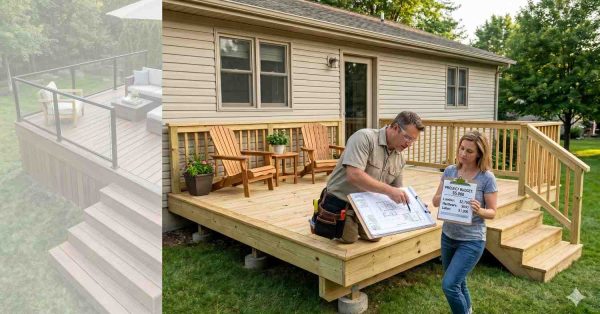
Permit costs typically range from $50 to $500 for a standard residential deck, according to data from the National Association of Home Builders, though larger or more complex projects can incur higher fees. Homeowners who need to plan their total project budget accurately before starting will find a complete deck permit cost by state breakdown that covers fee ranges and submission requirements across the country.
For homeowners who own or are purchasing a property with a deck that was never permitted, retroactive permitting is an available path in most jurisdictions. The process typically requires a current inspection, a permit application with as-built drawings, and upgrades to bring the structure to current code standards where deficiencies exist. A dedicated guide on retroactive deck permitting explains how this process works by jurisdiction type, what it typically costs, and which upgrades are most commonly required to pass a retroactive inspection.
Understanding exactly when a permit is required, what documents to submit, and what the approval timeline looks like in your municipality is covered step by step in our deck permit process guide, which walks through every stage from application submission to final sign-off.
Building Codes That Apply to Decks
Deck building codes establish the minimum structural, safety, and design standards that every deck must meet to protect occupants, neighboring properties, and the public. In the United States, two primary code frameworks govern deck construction depending on whether a project is residential or commercial.
The IRC R507 Deck Code
The International Residential Code (IRC), specifically Chapter R507, is the most widely adopted standard for residential deck construction in the country. Most U.S. states have adopted the IRC in some form, and it serves as the baseline against which virtually all residential deck permit applications are reviewed.
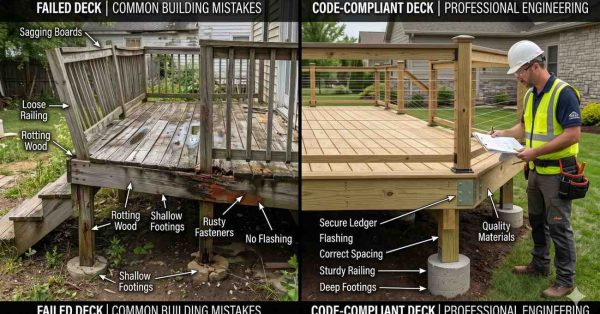
IRC R507 establishes specific, detailed requirements for footing depth and diameter based on soil conditions and frost line; ledger board attachment hardware and fastener schedules; beam and joist sizing based on span, spacing, and design load; connection hardware specifications including joist hangers, post bases, and lateral load connectors; stair geometry covering riser height, tread depth, and stringer design; railing height minimums (36 inches for decks under 30 inches above grade; 42 inches for decks at 30 inches and above); baluster spacing (maximum 4 inches to prevent child entrapment); and handrail graspability dimensions for stair handrails.
The IRC operates on a three-year revision cycle, and requirements change meaningfully between editions. A deck built to the 2009 IRC may not meet 2021 IRC requirements in areas such as ledger connection hardware and lateral load connectors, which is particularly relevant when renovating existing decks or evaluating older structures at time of property purchase.
The IBC for Commercial Decks
The International Building Code (IBC) governs commercial deck construction and applies to multi-family residential properties. IBC requirements are more stringent than the IRC in areas such as occupancy load calculations, fire resistance ratings for materials in certain occupancy categories, ADA accessibility compliance, and structural redundancy requirements. Commercial deck projects require licensed contractors, stamped engineering drawings, and more rigorous inspection protocols than residential projects.
Local Code Variations
States and municipalities routinely adopt the IRC or IBC with local amendments that can significantly change specific requirements. California adds seismic design requirements through the California Residential Code. Coastal communities in hurricane zones require specific wind uplift design provisions. Northern states specify deeper frost lines for footing installations. When applying for a permit in a specific jurisdiction, the permit application process should make clear which code edition and which local amendments apply to your project. Many building departments publish their local amendments online alongside the adopted code cycle, and a direct phone call to the local building department is always the fastest way to confirm current requirements.
Common Code Requirements at a Glance
Key requirements that appear consistently across most jurisdictions include: footings extending below the local frost line; ledger boards requiring properly installed flashing, bolts, and corrosion-resistant hardware; railings meeting height minimums with baluster spacing no greater than 4 inches; handrails that are graspable along their full length; stair dimensions within code-specified rise and run ranges; and lateral load connectors at the ledger-to-house connection to resist horizontal forces.
Every structural specification your deck must meet, from footing depth to railing height to ledger hardware, is explained in full context in our comprehensive deck code requirements guide, which covers IRC R507, IBC commercial standards, and how to identify and apply your local jurisdiction’s specific code amendments.
Deck Inspections: What to Expect
A deck inspection is a site visit conducted by your local building official to verify that construction at each stage of the project meets the requirements specified in the approved permit drawings. Inspections are not optional and are not performed retroactively after work is complete. They must occur at specific construction milestones while the relevant structural work is still visible and verifiable.
Most residential deck projects require two to four inspections: a footing inspection, a framing or structural inspection, and a final inspection. Some jurisdictions add a setback or zoning confirmation before construction begins.
Footing Inspection
The footing inspection occurs before any concrete is poured while footing holes remain open. The building official checks hole diameter, hole depth confirming it extends below the local frost line, soil conditions at the base of the hole, and the placement of footing forms relative to the approved site plan.
This is the inspection stage most often failed due to insufficient footing depth. Frost line depths vary significantly by location, ranging from as shallow as 12 inches in the deep South to more than 60 inches in northern Minnesota. A footing hole that does not reach the required depth fails inspection regardless of how well the rest of the project is executed.
Framing Inspection
The framing inspection occurs after all framing is complete but before any decking boards are installed. All structural connections must remain fully visible at this stage, which is why decking cannot be installed before this inspection is passed. The inspector checks ledger attachment hardware and flashing, joist hanger installation and fastener counts, beam-to-post connections, post-to-footing connections, and lateral load connectors at the ledger.
Using joist hanger hardware not rated for the specific load condition, or using incorrect fasteners in an otherwise properly installed hanger, is a frequent cause of failed framing inspections that require partial disassembly to correct.
Final Inspection
The final inspection occurs after all work is complete, including decking, railings, stairs, and any special features. The inspector checks railing height, baluster spacing, stair rise and run dimensions, handrail graspability, and the installation of any permitted special features. If the project included electrical, gas lines, or plumbing, those components are verified at the final inspection as well.
Common Reasons Decks Fail Inspection
The most frequently documented inspection failures include footing depth insufficient for local frost line conditions; missing or improperly installed ledger flashing; joist hangers installed with incorrect fasteners or insufficient fastener count; railing height below the applicable minimum; baluster spacing exceeding 4 inches; stair rise or run outside code-specified dimensions; missing lateral load connectors at the ledger; and special features such as hot tub surrounds or outdoor kitchens added without an updated structural review.
Inspectors approach their work as a verification service. A building official whose goal is to confirm safety will always prefer to identify issues at the framing stage, where they are low-cost to fix, rather than after a project is complete. Communicating openly with your inspector and asking questions at each site visit is standard practice among experienced deck contractors.
What inspectors check at each construction stage, including complete checklists, the most common failure points, and what steps to take if your deck does not pass, is documented in full in our deck inspection guide, which covers footing, framing, and final walkthroughs for projects of every size.
Deck Safety Standards Every Homeowner Should Know
Deck safety extends far beyond the initial build. A deck that passed every required inspection on the day it was completed can become structurally unsafe within a few years through moisture infiltration, fastener corrosion, wood rot, and connection fatigue, often without any visible sign at the surface level.
According to the Consumer Product Safety Commission, approximately 224,000 deck-related injuries are treated in U.S. emergency rooms each year, with structural failures accounting for a significant proportion of serious incidents. The two most common structural failure modes are ledger board detachment and post base rot, both of which develop over years and are entirely preventable with consistent inspection and maintenance.
Signs of an Unsafe Deck
Any of the following signs indicate a deck that should be assessed by a qualified professional before use:
- Soft, spongy, or discolored wood anywhere in the deck surface or frame
- Rust staining around screws, nails, joist hangers, or post bases
- Wobbly or loose railings, where any movement in a railing indicates a connection failure requiring immediate attention
- Posts that rock or shift under lateral pressure
- Stair stringers with visible cracks or deep notching at bearing points
- Decking boards that flex more than half an inch underfoot at mid-span
- Any visible gap, crack, or separation at the point where the ledger board meets the house rim joist
- Standing water pooling on the deck surface, which accelerates rot in all wood species
Deck Collapse: Causes and Prevention
Deck collapses are sudden events with no warning, which makes them particularly dangerous under normal occupancy conditions. The most thoroughly documented cause of major deck collapses is ledger failure, which occurs when the connection between the ledger board and the house rim joist is weakened by moisture intrusion, inadequate fasteners, or improper flashing installation. Under the load of a typical outdoor gathering, a compromised ledger can fail completely and rapidly.
Post base rot is the second most documented failure mode. It occurs when post base hardware corrodes, when wood posts make direct contact with concrete footings without a post cap fitting, or when inadequate drainage allows moisture to accumulate at the base of posts over time. Inspecting post bases each spring, looking for rust on hardware, soft wood at the post base, or visible gaps between the post and its footing, is one of the most valuable safety tasks a property owner can perform.
The single most effective tool for keeping a deck safe and structurally sound year after year is a consistent maintenance routine, and our deck maintenance and inspection schedule walks through every annual, seasonal, and material-specific care task that prevents the structural failures most commonly flagged in safety audits.
Safety for Children, Pets, and Older Adults
Children face specific deck hazards that general structural safety standards do not fully address. Baluster spacing violations are the most frequently cited child safety issue in deck inspections. Gaps exceeding 4 inches allow a young child’s head to pass through the opening, creating a serious entrapment hazard. Gate latch hardware on pool deck access gates must be positioned out of reach of children, typically above 54 inches. Weathered softwood decking surfaces introduce splinter risk for barefoot use that requires regular inspection and refinishing.
Families with young children or pets face specific hazards that warrant dedicated guidance beyond general structural safety standards, including baluster spacing compliance, gate latch height requirements, surface texture considerations, and pool deck fencing specifications, all of which are covered in our deck safety for children and pets guide.
Older adults are disproportionately represented in stair fall data, making handrail graspability a critical safety feature rather than an aesthetic choice. IRC-specified handrail dimensions (between 1.25 and 2 inches in diameter for round graspable rails) exist specifically so that a person who loses balance can grip the rail and arrest a fall rather than sliding off a flat cap rail.
The complete framework for evaluating whether your deck is structurally sound, including step-by-step DIY safety audit procedures, what to look for in older pre-2004 decks, and when professional assessment is the appropriate next step, is covered in our comprehensive deck safety standards resource, which every homeowner and property manager should review at the start of each season.
Structural Load and Engineering Codes
Structural load calculations determine how much weight a deck must be designed to carry, what size structural members are required, how deep footings must extend, and how posts must be sized and spaced to prevent deflection or structural failure. These calculations form the engineering foundation beneath every code-compliant deck build.
Live Load vs Dead Load
Two categories of structural load govern deck engineering design.
Live load is the variable, movable weight a deck must safely support: people, furniture, snow accumulation, and portable equipment. The IRC requires residential decks to be designed for a minimum live load of 40 pounds per square foot (psf). This baseline assumes typical residential use. Decks intended to support a hot tub, an outdoor kitchen with masonry countertops, significant snow accumulation, or large-scale gatherings require higher design loads calculated specifically for those conditions.
Dead load is the permanent, fixed weight of the deck structure itself: decking boards, framing members, railings, permanently installed appliances, and any fixed architectural features. A standard deck dead load is approximately 15 psf, bringing the minimum total design load to 55 psf under IRC standards. Projects that deviate significantly from standard framing materials or add heavy permanent features must recalculate dead load accordingly.
Wind and Snow Load Requirements
Regional environmental conditions add load requirements that the base IRC addresses by reference to ASCE 7, the American Society of Civil Engineers’ standard for minimum design loads in buildings and other structures. Coastal areas in hurricane zones require specific wind uplift design provisions affecting connection hardware, lateral bracing, and in some cases post and beam sizing. High-elevation properties in the Rocky Mountain West and the Northeast must carry additional snow load that can exceed standard residential design parameters. These requirements affect structural member sizing, connection hardware specifications, and footing design.
Span Tables and Post Sizing
Joist and beam span tables are the practical tool that translates load calculations into specific lumber sizes. The IRC publishes span tables organized by lumber species, joist spacing, design load, and board dimensions. A No. 2 Southern Yellow Pine 2×10 joist spaced at 16 inches on center can safely span a different distance than a Douglas Fir joist of the same size under the same conditions. Using the span table for the wrong lumber species is a code violation that structural inspectors flag consistently. The correct table must match the actual lumber species, grade, and moisture content conditions of the installed material.
For homeowners in earthquake-prone regions, additional footing anchoring specifications, post-to-beam connection hardware, and hold-down requirements apply beyond what the base IRC requires. The seismic design requirements that apply to deck foundations in California, the Pacific Northwest, and the Mountain West, including hold-down hardware specifications and connection details, are examined in detail in our guide on seismic code requirements for decks.
When a Structural Engineer Is Required
Most jurisdictions require stamped drawings from a licensed structural engineer for decks designed to hold a hot tub, which can weigh between 3,000 and 6,000 pounds when filled; for elevated second-story or rooftop platforms; for outdoor kitchens using masonry or stone countertops; and for any project in a seismic design category that mandates engineered design. When stamped drawings are required, the permit application is typically not accepted without them, and the structural engineer of record becomes responsible for the adequacy of the design.
The specific values governing live load, dead load, wind resistance, snow load, and seismic requirements across U.S. regions, along with practical joist span tables, post sizing guides, and guidance on when a licensed structural engineer is required, are compiled in our complete load and engineering codes reference for homeowners and contractors alike.
Legal Liability, HOA Approval, and Real Estate Implications
The consequences of an unpermitted or non-code-compliant deck extend well beyond the construction phase. They affect homeowner’s insurance coverage, personal injury liability exposure, property value, real estate transaction viability, and standing with homeowners associations.
HOA Approval for Decks
At most planned communities and condominium developments, HOA approval is required before any exterior modification, including new deck construction and major renovations to existing structures. HOA approval is a separate, parallel process from municipal permitting. A building permit does not satisfy HOA approval requirements, and HOA approval does not satisfy permit requirements. Both must be obtained independently before construction begins.
HOA approval typically involves submitting design drawings, material specifications, and sometimes a written description of the project’s impact on adjacent units or common areas. Approval can be denied for aesthetic, setback, or footprint reasons even when the municipality has issued a valid permit. Renovations completed without required HOA approval can result in fines, mandated restoration of original conditions, and forced removal at the homeowner’s full expense.
Homeowner’s Insurance and Deck Coverage
Homeowner’s insurance coverage for deck-related incidents is frequently complicated by permit status. Many standard homeowner’s policies contain exclusions for structures not built to code or not properly permitted. If a deck collapses and injures a visitor, and the structure was never permitted or inspected, the insurer may deny the liability claim entirely, leaving the homeowner personally responsible for medical costs, legal defense fees, and any judgment against them.
The National Association of Insurance Commissioners recommends confirming with your insurer that all structures on your property are properly documented, covered under the policy, and built to code. Providing permit records and inspection certificates to your insurer when a new deck is completed is standard practice for maintaining clear, unambiguous coverage.
Property Line Setbacks and Real Estate Disclosure
Setback requirements establish minimum distances between a deck structure and property lines, easements, public rights-of-way, and neighboring structures. Common requirements include 3-to-10-foot setbacks from side and rear property lines, though easements and local zoning classifications can create tighter constraints that are not visible without a property survey. Building a deck that violates setback requirements, even accidentally, can result in a mandatory partial or complete demolition order regardless of the quality of the construction.
When listing a property for sale, deck permit and code compliance status has direct financial implications. Mortgage lenders frequently require a clear permit history for all structures. In many states, sellers are legally required to disclose known construction deficiencies. Omitting that disclosure can create post-closing legal liability for the seller.
Homeowners preparing to sell should understand exactly what selling a home with an unpermitted deck entails, including mandatory disclosure requirements by state, lender restrictions, and the financial difference between pursuing retroactive permitting versus accepting a negotiated price reduction at closing.
Property owners selling in states with specific construction defect disclosure statutes should also understand that deck disclosure requirements in real estate transactions vary by state and by the nature and severity of the deficiency, making consultation with a real estate attorney or experienced agent essential before listing any property with known permit or code compliance issues.
Everything from HOA approval processes and property line setbacks to what an unpermitted deck means when you sell your home is addressed in comprehensive detail in our deck legal and liability guide, which helps homeowners understand the full financial and legal risks of skipping proper authorization before construction begins.
How Permits and Codes Affect Your Deck Project
Permit and code requirements are not obstacles to good deck design. They are inputs that should shape the design from the very beginning. Every major design decision, including deck height, footprint size, proximity to property lines, structural load requirements, and material specifications, has a corresponding code constraint that will appear during permit review and at each inspection stage.
The most common and expensive planning mistake is finalizing a deck design and only then checking it against code requirements. Changes made during the design phase cost nothing. Changes required after a permit is denied or an inspection fails can cost thousands in redesign fees, wasted materials, and contractor rescheduling.
Building a complex deck is where the interaction between design ambition and code requirements becomes most consequential. Custom decks with features like hot tubs, outdoor kitchens, and elevated platforms each trigger additional code and engineering requirements that must be addressed from the very first design session, all of which are explained in our custom deck construction guide.
Starting the planning process with code compliance as a primary input, not a revision-stage afterthought, is the single most effective strategy for avoiding permit delays and failed inspections, which is why our deck design and planning guide integrates code considerations directly into every stage of the design framework, from initial site assessment through final material selection.
Code Compliance Across All Deck Types
While the IRC and local amendments establish a common compliance baseline for most residential decks, certain deck types carry additional regulatory layers that require specialized knowledge and advance planning.
Pool Decks
Pool decks are governed by both standard residential deck code and the International Swimming Pool and Spa Code (ISPSC), which is published alongside the IRC and adopted by most jurisdictions with in-ground pool construction activity. ISPSC requirements add specifications for slip-resistant surface finishes with minimum coefficient of friction ratings, self-closing and self-latching gates on all pool access points, minimum fence heights and gap limitations for pool enclosures, drain placement and water management provisions, and non-combustible material requirements near pool mechanical equipment. Pool decks carry additional compliance layers under the ISPSC, including slip-resistance requirements, self-closing gate standards, and specific fencing specifications that go beyond standard residential deck code, all of which are covered in full in our pool deck construction guide.
Rooftop Decks
Rooftop decks require a level of compliance complexity that substantially exceeds ground-level deck construction. A complete rooftop deck approval process typically includes structural engineering assessment of the existing roof’s load capacity, stamped structural drawings for the deck system and all point loads, a waterproofing and drainage plan reviewed by a building official, egress code compliance review, fire code compliance for materials and open-flame features, and zoning approval for structures above certain heights. Rooftop decks require structural engineering approval, waterproofing inspections, egress compliance, and often condo board review before construction begins, and every additional layer of approval unique to elevated structures is explained in our rooftop deck code requirements guide.
Commercial Decks
Commercial decks fall under the IBC rather than the IRC, introducing a compliance framework substantially different from what residential homeowners encounter. IBC requirements address occupancy load calculations, fire rating requirements for materials in specific occupancy categories, ADA accessibility mandates for all businesses open to the public, and contractor licensing and bonding requirements that residential projects do not face. Commercial decks fall under the IBC rather than the IRC, introducing occupancy load requirements, ADA accessibility mandates, and licensed contractor bonding standards that residential projects do not face, and our commercial deck code compliance resource covers all IBC requirements organized by property and business type.
Working with Mr. Local Services on Code-Compliant Deck Projects
Every deck project benefits from professionals who understand permit requirements, inspection protocols, and code compliance from the very first planning conversation. Errors identified before permit submission cost nothing to correct. Errors discovered during an inspection can cost thousands in rework, delays, and contractor fees.
At Mr. Local Services, our network of deck professionals is trained to navigate every stage of the permit and compliance process, from preparing complete permit applications and construction drawings to scheduling and passing every required inspection stage. We connect homeowners, landlords, and property managers across the United States with licensed, code-literate deck contractors who treat compliance as a fundamental component of quality workmanship, not an afterthought.
Contact Mr. Local Services today to connect with a qualified deck professional who builds to code on every project, pulls every permit, and delivers finished structures that protect your property, your family, and your long-term investment.
Conclusion
Deck permits, building codes, inspections, safety standards, load engineering, and legal liability together define every dimension of responsible deck ownership in the United States.
Each section connects to a dedicated cluster resource covering every subtopic in full detail, from permit costs to seismic codes to real estate disclosure.
We are here to help. Contact Mr. Local Services today to connect with a code-compliant deck contractor who protects your property and your investment.
Frequently Asked Questions
Do I need a permit to build a deck?
Most decks require a permit, particularly when attached to the house or more than 30 inches above grade. Always verify with your local building department before starting any deck construction.
What is the IRC R507 deck code?
IRC R507 is the chapter of the International Residential Code that governs residential deck construction nationwide. It sets minimum requirements for footings, ledgers, framing, railings, and stairs.
How many inspections are required for a new deck?
Most jurisdictions require two to four inspections: a footing inspection before concrete is poured, a framing inspection before decking is installed, and a final inspection after all work is complete.
What are the most common reasons a deck fails inspection?
The most common failures are insufficient footing depth, missing ledger flashing, incorrect joist hangers, and baluster spacing exceeding four inches. Catching these at framing is far less costly.
How do I know if my existing deck is safe?
Look for soft or discolored wood, rust at fasteners, wobbly railings, or any separation at the ledger. If found, have a professional inspector assess the deck before use.
What happens if I sell a house with an unpermitted deck?
You may be required to disclose the deficiency, and lenders often need a clear permit history. Retroactive permitting or forced upgrades may be required before a sale can close.
Do pool decks have different code requirements than standard decks?
Yes. Pool decks must comply with the ISPSC in addition to standard deck code, adding requirements for slip-resistant surfaces, self-closing gates, fence height, and ADA accessibility in commercial settings.