The foundation you choose for a shipping container structure determines everything — structural stability, longevity, moisture resistance, and code compliance. Container builds require careful foundation planning because steel containers transfer load differently than traditional wood-frame construction. The right foundation type depends on your soil conditions, climate, container count, and local building codes across the USA.
This guide matters because a poorly chosen or improperly installed foundation leads to container racking, door misalignment, moisture intrusion, and costly structural repairs down the line.
This covers every major container foundation type, how each works, what it costs, and how to choose the right system for your specific project and site.
What Are Container Foundation Options?
A container foundation is the structural system that supports, levels, and anchors one or more shipping containers to the ground. Unlike traditional homes built on continuous footings, shipping containers are engineered to bear load at their four corner castings — the reinforced steel fittings at each corner of the container frame. This means foundation systems for container builds must align support points with those corner castings rather than distributing load along the entire base.
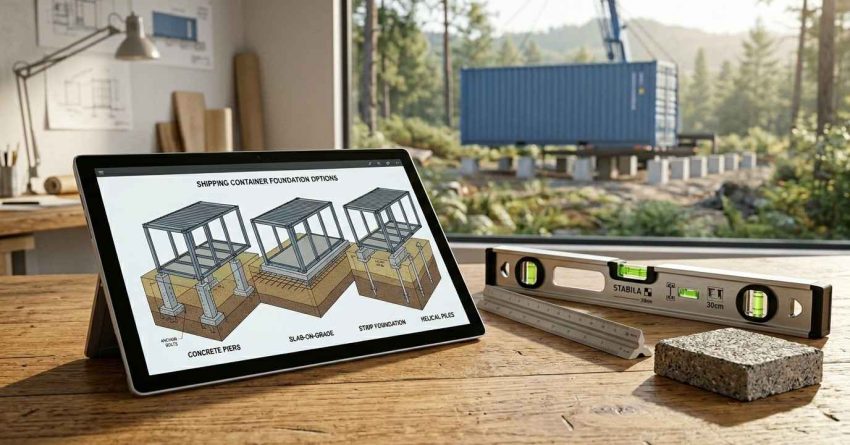
Container foundation options fall into two broad categories: permanent foundations and temporary or relocatable foundations. Permanent foundations — including concrete slabs, strip footings, and poured piers — are required for permitted structures intended for long-term occupancy. Temporary or semi-permanent systems — including ground screws, adjustable steel piers, and timber blocking — are used for storage units, off-grid cabins, or structures that may be relocated.
The foundation type you select also affects insulation strategy, drainage planning, utility rough-in, and interior finishing options. Our tiny home foundations service explains how we approach structural planning for compact and alternative housing projects, including container-based builds, from the ground up.
Choosing the wrong foundation type for your soil or climate is one of the most common and expensive mistakes in container construction. Understanding each option before breaking ground protects your investment and ensures your structure meets local building codes.
Permanent vs. Temporary Foundation Types
Permanent foundations are poured or constructed in place and are not designed to be removed. They include concrete slabs, strip footings, poured concrete piers, and basement walls. These are required by most US municipalities for any container structure used as a dwelling, office, or commercial space.
Temporary and relocatable foundations include adjustable steel screw piles, timber blocking, concrete deck blocks, and compacted gravel pads. These are appropriate for storage containers, agricultural buildings, and off-grid structures where permits are not required and relocation is possible.
How Foundation Choice Affects Structural Integrity
Shipping containers are designed to stack six to nine units high when loaded, making them inherently strong along their corner posts. However, that strength depends on proper corner support. A foundation that allows any corner to sink, shift, or remain unsupported causes the container frame to rack — twisting the steel structure and making doors and windows impossible to open or seal properly.
Foundation settlement, frost heave, and soil erosion are the three primary causes of container racking in the USA. Each foundation type addresses these risks differently, which is why soil testing and site assessment are essential before any foundation decision is finalized.
Pier and Beam Foundations for Shipping Containers
Pier and beam foundations use individual concrete or steel piers positioned at each container corner casting, with optional intermediate piers for longer containers or multi-container builds. This is one of the most widely used foundation systems for container construction because it is cost-effective, adaptable to uneven terrain, and allows airflow beneath the container — reducing moisture accumulation on the steel floor frame.
Piers are typically poured concrete cylinders or precast concrete blocks set on compacted gravel or poured footings that extend below the local frost line. The frost line depth varies significantly across the USA — from a few inches in southern states to more than 48 inches in northern regions — and all pier footings must extend below this depth to prevent frost heave from lifting and shifting the foundation.
For smaller pier installations and leveling adjustments that don’t require a full structural crew, our handyman foundation support team can assist with site prep, shimming, and minor structural corrections on existing pier systems.
Concrete Piers — Design, Depth, and Load Requirements
Each concrete pier must be sized to carry the load of the container corner above it. A standard 20-foot container weighs approximately 4,850 pounds empty, and a 40-foot container weighs around 8,380 pounds. When loaded or used as a dwelling with interior finishes, mechanical systems, and occupants, the load per corner increases substantially.
Pier diameter typically ranges from 10 to 18 inches depending on soil bearing capacity and load. Piers are reinforced with rebar and poured into tube forms or excavated holes. The top of each pier must be level with all other piers to within a tolerance of approximately 1/8 inch — any variation requires shimming with steel plates before the container is set.
Steel Beam Supports and Leveling Considerations
In some pier and beam configurations, steel I-beams or wide-flange beams are placed across the tops of piers to create a continuous bearing surface. This approach is common for multi-container builds where containers are placed side by side or stacked, as the beams distribute load more evenly and provide a rigid platform for welding containers together.
Leveling is critical at this stage. Containers are set using a crane or telehandler, and any out-of-level condition must be corrected before the container is permanently welded or bolted to the foundation. Adjustable leveling plates or shim stacks are used to achieve precise alignment.
Concrete Slab Foundations for Container Builds
A concrete slab foundation is a flat, reinforced concrete pad poured directly on prepared ground. For container builds, slabs are typically 4 to 6 inches thick with thickened edges at container corner positions to handle concentrated point loads. Slabs provide a clean, level surface, eliminate the gap between the container and ground, and simplify interior flooring installation.
Slabs are the preferred foundation type for container homes and commercial container buildings in warm to moderate climates where frost heave is not a significant concern. In colder climates, insulated slab systems — sometimes called frost-protected shallow foundations — use rigid foam insulation around the slab perimeter to prevent frost penetration without requiring deep footings.
A properly poured slab also opens the door to interior finishing work — our concrete remodeling projects covers how slab-based container builds transition into fully finished living or working spaces, including flooring, partition walls, and utility connections.
Full Slab vs. Perimeter Slab — Which Is Right for Your Project?
A full slab covers the entire footprint of the container or container cluster. This is the most common choice for container homes because it provides a finished floor surface, simplifies plumbing rough-in (pipes are embedded in the slab before pouring), and creates a sealed barrier against ground moisture and pests.
A perimeter slab — sometimes called a grade beam — is a continuous concrete beam poured around the container perimeter with the interior left as compacted gravel or soil. This approach reduces concrete volume and cost while still providing a solid bearing surface at the container edges. It is commonly used for container workshops, garages, and agricultural buildings where a finished interior floor is not required.
Reinforcement, Drainage, and Moisture Barriers
All container slabs require steel reinforcement — either rebar grids or welded wire mesh — to control cracking and distribute load. Thickened edges at corner positions typically include additional rebar to handle the concentrated loads from container corner castings.
Drainage planning is essential before the slab is poured. The site must be graded so that surface water flows away from the slab on all sides. A vapor barrier — typically 6-mil polyethylene sheeting — is placed beneath the slab to prevent ground moisture from migrating up through the concrete and into the container floor system.
Strip Foundations and Perimeter Footings
Strip foundations — also called continuous footings — are concrete beams poured in a continuous line beneath the container perimeter. Unlike individual piers, strip foundations distribute the container’s load along the entire length of each side rather than concentrating it at corner points. This makes them particularly effective on sites with moderate soil bearing capacity where point loads from piers might cause differential settlement.
Strip foundations are poured into trenches excavated to below the frost line. The trench width and depth depend on soil conditions and the load being supported. Reinforcing steel runs continuously through the strip to prevent cracking and maintain structural integrity across the full length of the footing.
Once perimeter footings are in place, the framing and structural carpentry phase begins — our structural carpentry work details how we connect container structures to their foundation systems with precision framing and load-bearing support for walls, roofs, and interior partitions.
When Strip Foundations Are the Best Choice
Strip foundations are the right choice when soil bearing capacity is moderate and consistent across the site, when the container structure includes significant additional loads from attached decks, porches, or roof extensions, or when local building codes require continuous footings for permitted dwellings. They are also preferred in areas with expansive clay soils where point-load piers are more susceptible to differential movement.
Soil Assessment and Load Distribution for Strip Footings
The width of a strip footing is calculated based on the total load above it divided by the allowable soil bearing pressure. Most residential soils in the USA have a bearing capacity between 1,500 and 3,000 pounds per square foot. A geotechnical report or soil test confirms the actual bearing capacity at your specific site and is required by most building departments before a foundation permit is issued.
Helical Pier and Ground Screw Foundations
Helical piers — also called screw piles or ground screws — are steel shafts with helical plates welded along their length. They are installed by rotating them into the ground using hydraulic machinery, much like a large screw being driven into soil. Once installed, helical piers provide immediate load-bearing capacity without the curing time required for poured concrete foundations.
This makes helical piers one of the fastest foundation systems available for container builds. A typical residential container foundation using helical piers can be installed in a single day, compared to several days or weeks for poured concrete systems that require excavation, forming, pouring, and curing.
Helical piers are also widely used in elevated deck construction on challenging terrain — our helical pier deck systems explains how the same ground-screw technology applies to outdoor structures built on slopes, soft ground, or sites with limited excavation access.
How Helical Piers Work for Container Structures
Each helical pier is installed at a container corner position and torqued to a specified installation torque that correlates directly to the soil bearing capacity at that depth. A structural engineer specifies the pier diameter, helix configuration, and minimum installation torque based on the load requirements and soil conditions at the site.
Once installed, a steel bracket is welded or bolted to the top of each pier. The container corner casting rests on this bracket and is secured with bolts or welded in place. The result is a rigid, level foundation that can be installed on slopes, in tight spaces, and on sites where excavation equipment cannot easily access.
Advantages for Sloped, Soft, or Remote Sites
Helical piers are the preferred foundation system for sloped sites because each pier can be installed to a different depth to achieve a level bearing surface without extensive grading. On soft or saturated soils — including clay, peat, and fill material — helical piers can be driven to deeper, more competent soil layers that poured concrete piers cannot easily reach.
For remote or off-grid sites where concrete delivery is impractical, helical piers eliminate the need for ready-mix trucks, water supply for mixing, and extended curing periods. The entire foundation system arrives on a single truck and is installed with compact hydraulic equipment.
Basement and Below-Grade Foundations
Integrating a shipping container with a basement or below-grade foundation is an advanced construction approach used in container homes where additional living space, mechanical room, or storage is needed below the main container level. In this configuration, the container sits at or near grade level while the basement structure below is built from poured concrete walls or concrete masonry units.
The container’s corner castings bear on the top of the basement walls, transferring load down through the concrete structure to the basement floor slab and footings below. This requires careful structural engineering to ensure the basement walls are designed to handle both the vertical load from the container and any lateral soil pressure from the surrounding earth.
Below-grade container foundations carry significant moisture risk without proper sealing — our basement waterproofing solutions outlines the protective systems we install to prevent water intrusion, mold, and structural degradation in below-ground builds, including drainage boards, waterproof membranes, and interior drainage systems.
Integrating Containers with Basement Structures
The connection between the container and the basement wall top plate requires a steel bearing plate or ledger system that distributes the container’s corner loads across the wall width. Structural engineers typically specify weld plates or anchor bolt systems to secure the container to the basement structure and prevent lateral movement during seismic events or high-wind conditions.
Utility penetrations — plumbing, electrical conduit, HVAC ducts — pass through the basement walls and up into the container floor system. Planning these penetrations before the basement walls are poured is essential, as cutting through poured concrete after the fact is expensive and structurally disruptive.
Waterproofing and Structural Considerations
Below-grade walls must be waterproofed on the exterior face before backfilling. Waterproofing systems for container basement foundations typically include a combination of crystalline waterproofing applied to the concrete surface, a drainage board to direct water away from the wall, and a perimeter drain tile system that routes groundwater to a sump pit or daylight outlet.
Interior waterproofing systems — including interior drain channels and sump pumps — provide a secondary line of defense and are often required by building codes in areas with high water tables or significant annual rainfall.
Soil Testing, Site Preparation, and Local Building Codes
No foundation decision should be made without understanding the soil conditions at your specific site. Soil type, bearing capacity, drainage characteristics, and depth to bedrock or groundwater all directly influence which foundation system is appropriate and how it must be designed. Skipping soil assessment is one of the most common causes of foundation failure in container construction.
Proper site preparation goes beyond soil testing and includes grading, drainage routing, and vegetation management — our site grading and drainage covers how we prepare land for construction to prevent erosion and water pooling around foundation systems, including clearing, grading, and installing surface drainage infrastructure.
Soil Bearing Capacity and What It Means for Your Foundation
Soil bearing capacity is the maximum load per unit area that a soil can support without excessive settlement or shear failure. It is measured in pounds per square foot (psf) or kilopascals (kPa). Sandy and gravelly soils typically have higher bearing capacities — often 2,000 to 4,000 psf — while clay soils and organic soils may have bearing capacities as low as 500 to 1,500 psf.
A geotechnical engineer or soil testing firm performs a site investigation that includes soil borings or test pits, laboratory analysis of soil samples, and a written report with foundation recommendations. Most US building departments require a geotechnical report for any permitted structure, and the report findings directly determine footing sizes, pier depths, and reinforcement requirements.
Site Grading, Drainage Planning, and Preparation Steps
The site must be graded so that the finished grade slopes away from the foundation on all sides — a minimum of 6 inches of fall over the first 10 feet is the standard requirement in most US building codes. This prevents surface water from pooling against the foundation and infiltrating beneath the slab or around pier footings.
Vegetation, topsoil, and organic material must be stripped from the building footprint before any foundation work begins. Organic material compresses under load and causes settlement. The exposed subsoil is then compacted to a specified density — typically 95% of maximum dry density per ASTM D698 — before gravel base material is placed.
Permits, Inspections, and Code Compliance Across the USA
Container foundation permits are issued by local building departments and are required for any container structure used as a dwelling, office, or commercial space. Permit requirements vary significantly by state, county, and municipality. Some jurisdictions have adopted specific container construction guidelines, while others apply standard residential or commercial building codes to container builds.
The permit process typically includes a foundation plan review, a footing inspection before concrete is poured, and a final foundation inspection before the container is set. Working with a licensed structural engineer to prepare stamped foundation drawings is required in most jurisdictions and ensures your foundation design meets local code requirements.
After permits are approved and the foundation is inspected, interior work can begin — our interior finishing after permits explains how we sequence drywall, ceiling, and finishing work to follow structural and code milestones in container builds.
Choosing the Right Foundation for Your Container Project
Selecting the right foundation requires balancing four primary factors: soil conditions, climate, project budget, and the number and configuration of containers in your build. No single foundation type is universally best — the right choice is the one that matches your specific site and project requirements.
Selecting the right foundation is the first step in a broader build plan — our container remodeling planning walks through how we help property owners design and execute full container conversion projects from foundation to finish, including structural modifications, interior layout, and utility installation.
Key Factors — Climate, Soil, Budget, and Container Count
Climate determines frost line depth, which governs how deep all footings and piers must extend. In USDA Hardiness Zones 5 and colder — covering much of the northern USA — frost depths of 36 to 60 inches require deeper and more expensive foundation systems. In warmer southern states, shallow foundations are often sufficient and significantly less costly.
Soil conditions determine which foundation types are structurally viable. Stable, well-drained sandy or gravelly soils support most foundation types. Expansive clay soils, soft organic soils, and fill material require engineered solutions — often helical piers driven to competent soil layers or reinforced slab systems with perimeter grade beams.
Budget is a practical constraint that must be balanced against structural requirements. Pier and beam systems are typically the most cost-effective option for single-container builds on stable soil. Concrete slabs add cost but simplify interior finishing. Helical piers carry higher material costs but reduce labor and eliminate curing time. Basement foundations are the most expensive option but add significant usable space.
Container count and configuration affect foundation complexity. A single 20-foot container requires four support points. A multi-container build with containers placed side by side, end to end, or stacked requires a coordinated foundation plan that accounts for combined loads, connection points, and differential settlement between containers.
Working with a Structural Engineer vs. DIY Planning
A licensed structural engineer is required for any permitted container structure in the USA. The engineer performs load calculations, specifies foundation dimensions and reinforcement, and stamps the drawings required for permit submission. Attempting to design a container foundation without engineering input risks structural failure, permit rejection, and significant liability.
For unpermitted storage or agricultural container placements on private land, DIY foundation planning using manufacturer guidelines and published load tables is sometimes acceptable. However, even in these cases, consulting with a local contractor or engineer familiar with your soil conditions and climate is strongly recommended.
Foundation Costs — What to Expect for Container Builds
Foundation costs for container builds vary widely based on foundation type, site conditions, container count, and regional labor rates. Understanding the cost ranges for each foundation type helps you budget accurately and avoid surprises during the construction process.
Foundation type also influences flooring options and subfloor requirements — our flooring for container builds explains which flooring systems work best over slab, pier, and raised foundation configurations, including subfloor insulation, moisture barriers, and finish flooring compatibility.
Budget planning for a container build should also include window and door rough-in costs alongside foundation work — our container window installation outlines what to expect when adding openings to steel container walls, including structural reinforcement, framing, and weatherproofing requirements.
Cost Ranges by Foundation Type
Pier and beam foundations for a single 20-foot container typically range from $1,500 to $5,000 depending on pier depth, concrete volume, and site access. For a 40-foot container, costs range from $2,500 to $8,000. Multi-container builds with steel beam systems can reach $15,000 to $30,000 or more depending on complexity.
Concrete slab foundations for a single container range from $4,000 to $12,000 depending on slab thickness, reinforcement, and site preparation requirements. Larger multi-container slabs can range from $15,000 to $40,000 or more for complex builds with thickened edges and embedded utility rough-ins.
Helical pier foundations typically cost $3,000 to $8,000 for a single container, with costs rising to $10,000 to $25,000 for multi-container builds. The premium over concrete piers reflects the specialized installation equipment and engineered pier specifications required.
Strip foundations and perimeter footings range from $5,000 to $15,000 for single-container builds, with costs increasing significantly for larger footprints and deeper frost requirements.
Basement foundations are the most expensive option, typically starting at $20,000 to $50,000 for a single-container build with a full basement and rising substantially for larger projects with complex waterproofing and structural requirements.
Hidden Costs and Budget Planning Tips
Several costs are frequently overlooked in container foundation budgets. Soil testing and geotechnical reports typically cost $500 to $2,500 depending on the number of borings and the complexity of the report. Structural engineering fees for stamped foundation drawings range from $1,500 to $5,000 for residential projects.
Permit fees vary by jurisdiction but typically range from $500 to $3,000 for residential container foundation permits. Site preparation — including clearing, grading, and compaction — adds $1,000 to $10,000 or more depending on site conditions and the amount of material that must be removed or imported.
Crane or telehandler rental for setting containers on the foundation adds $500 to $2,000 per day depending on equipment size and regional availability. Planning all of these costs together before breaking ground ensures your project budget is realistic and complete.
Conclusion
Container foundation options range from simple pier and beam systems to engineered basement structures, and each type serves a specific combination of soil conditions, climate, budget, and project scope. Understanding the structural logic behind each foundation type — and how it interacts with your site — is the foundation of a successful container build.
Soil conditions, frost depth, container count, and local code requirements are the four variables that narrow your foundation choices from many options to the right one for your specific project and location across the USA.
At Mr. Local Services, our team connects you with skilled professionals who handle every phase of your container project — from site assessment and foundation planning to interior finishing — so your build is safe, code-compliant, and built to last.
Frequently Asked Questions
Do shipping containers need a special foundation?
Shipping containers need a foundation that supports their four corner castings, where all structural load is concentrated. Standard residential foundations designed for continuous wall loads are not always appropriate without modification. A foundation engineer familiar with container construction should review your specific project.
What is the cheapest foundation for a shipping container?
Pier and beam foundations using poured concrete piers are typically the most cost-effective option for single-container builds on stable, well-drained soil. Costs generally range from $1,500 to $5,000 for a single 20-foot container, depending on pier depth and site conditions.
Can I place a shipping container directly on the ground?
Placing a container directly on bare ground is not recommended for long-term use. Ground contact accelerates corrosion of the steel floor frame, allows moisture to accumulate beneath the container, and provides no protection against frost heave or soil settlement. At minimum, containers should rest on compacted gravel or concrete supports.
How deep do container foundation footings need to be?
Footing depth depends on the local frost line depth, which ranges from a few inches in southern US states to more than 48 inches in northern regions. All footings must extend below the frost line to prevent frost heave from lifting and shifting the foundation. Your local building department can confirm the required frost depth for your area.
Do I need a permit for a shipping container foundation?
Any container structure used as a dwelling, office, or commercial space requires a building permit in virtually all US jurisdictions. Storage containers on agricultural or rural land may be exempt in some areas, but requirements vary significantly by state, county, and municipality. Always verify with your local building department before beginning foundation work.
Can helical piers be used on sloped land?
Yes. Helical piers are one of the best foundation options for sloped sites because each pier can be installed to a different depth to achieve a level bearing surface without extensive grading. They are also effective on soft or saturated soils where conventional poured concrete piers may not achieve adequate bearing capacity.
How long does a container foundation last?
A properly designed and installed container foundation — whether concrete piers, a slab, or helical piers — should last 50 years or more with minimal maintenance. Foundation longevity depends on proper drainage, adequate frost protection, and the use of corrosion-resistant materials at the container-to-foundation connection points.
What soil type is best for a container foundation?
Well-drained sandy or gravelly soils with a bearing capacity of 2,000 psf or higher are ideal for container foundations. These soils support most foundation types without requiring deep piers or extensive reinforcement. Clay soils, organic soils, and fill material require engineered foundation solutions and often professional soil testing before a foundation type can be selected.