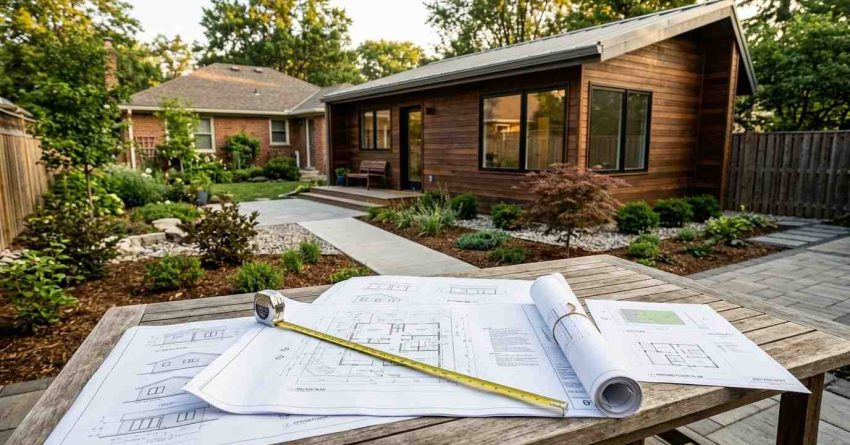
Getting an ADU permit approved requires completing seven distinct steps — zoning research, design, application, plan review, construction, inspections, and final occupancy approval — in the correct order. Skipping or rushing any single step can result in stop-work orders, fines, or a structure you cannot legally rent or sell.
Homeowners and landlords who understand the full permit process before breaking ground avoid the most expensive mistakes and move from idea to approved ADU in the shortest possible time.
This guide walks through every step of the ADU permit process, explains what each stage requires, and shows you what to expect at each milestone from application to move-in.
What Is an ADU and Why Does It Require a Permit?
An accessory dwelling unit (ADU) is a secondary residential unit built on the same lot as a primary single-family or multi-family home. It functions as a fully independent living space with its own entrance, kitchen, and bathroom. Because an ADU adds permanent habitable square footage to a property, it triggers the same building permit requirements as any new home construction or major addition.
Permits exist to confirm that the structure meets local building codes for structural integrity, fire safety, electrical capacity, plumbing, and energy efficiency. Without a permit, the unit is considered unpermitted construction, which creates serious legal and financial exposure.
Types of ADUs That Require Permits
Most jurisdictions require permits for all four ADU types: detached ADUs (separate structures in the backyard), attached ADUs (additions connected to the main home), garage conversion ADUs (converted attached or detached garages), and interior ADUs (basement or attic conversions). Junior ADUs (JADUs), which are smaller units carved from existing interior space, typically follow a simplified permit pathway but still require approval.
Why Skipping the Permit Is a Costly Mistake
An unpermitted ADU cannot be legally rented in most states, cannot be included in a home’s appraised value, and must be disclosed to buyers during any future sale. Many lenders will require the structure to be demolished or brought up to code before approving financing. The cost of retroactive permitting — if allowed at all — almost always exceeds the cost of permitting correctly from the start.
Step 1 — Research Your Local Zoning Laws and ADU Regulations
Before hiring anyone or drawing a single line, confirm that your property is eligible for an ADU under your local zoning code. Zoning laws govern where ADUs are allowed, how large they can be, how far they must sit from property lines, and whether the owner must live on-site.
California, Oregon, and Washington have passed state-level ADU reform laws that override many local restrictions, but rules still vary significantly by city and county. In states without preemptive legislation, local zoning codes have full authority over ADU eligibility.
Understanding your municipality’s rules is the foundation of every successful application — our complete guide to ADU zoning regulations covers setback requirements, lot coverage limits, owner-occupancy rules, and utility connection standards by state so you know exactly what applies to your property before you spend a dollar on design.
Key Zoning Questions to Answer Before You Apply
Confirm the answers to these questions at your local planning or building department before proceeding: Is your zoning district ADU-eligible? What is the maximum allowable ADU square footage? What are the minimum setbacks from rear and side property lines? Does your jurisdiction require owner-occupancy? Are there parking replacement requirements? What utility connection standards apply?
Step 2 — Hire a Licensed Designer or Architect to Prepare Plans
Once you confirm eligibility, hire a licensed architect or residential designer to prepare a complete set of construction documents. Most building departments will not accept permit applications without professionally prepared plans that meet their specific submittal requirements.
Working with a licensed architect who specializes in accessory dwelling units saves significant time during plan review — our resource on ADU design plans explains what structural drawings, site plans, and energy compliance documents must include to pass your local building department’s first review.
What Your ADU Plans Must Include
A complete ADU plan set typically includes a site plan showing the lot, existing structures, and proposed ADU location; floor plans with room dimensions and door and window locations; exterior elevations showing all four sides of the structure; foundation and framing plans; electrical, plumbing, and mechanical plans; and a Title 24 energy compliance report (required in California and several other states). Some jurisdictions also require a soils report or geotechnical assessment for detached structures.
Step 3 — Submit Your ADU Permit Application
With your plans complete, submit your permit application to the local building department. Most jurisdictions now offer online portal submission, but some still require in-person submittal with physical plan sets. Confirm your department’s preferred method before preparing your package.
Gathering every required document before you walk into the building department prevents costly delays — use our permit application checklist to confirm you have your site plan, architectural drawings, title report, and utility letters ready before submission day.
Documents Required for ADU Permit Submission
Standard ADU permit application packages include a completed permit application form, the full plan set (number of copies varies by jurisdiction), proof of property ownership or authorization, a preliminary title report, a soils report if required, utility will-serve letters from water and sewer providers, and payment of the initial permit fee. Some jurisdictions also require a neighbor notification package or a design review application for properties in historic districts.
Step 4 — Navigate the Plan Review and Approval Process
After submission, your plans enter the plan review queue. A plan checker reviews your documents against the applicable building code, zoning code, fire code, and energy standards. Review timelines vary widely — some jurisdictions complete over-the-counter reviews in one day, while others take four to twelve weeks for initial review.
If the plan checker identifies deficiencies, they issue a correction notice listing every item that must be addressed before approval. You revise the plans, resubmit, and the review cycle repeats until all corrections are resolved and the permit is issued.
Common Reasons ADU Plans Get Rejected
The most frequent plan review corrections involve setback violations (the proposed structure is too close to a property line), insufficient structural detail in the framing plans, missing or incomplete energy compliance documentation, inadequate fire separation between the ADU and the main dwelling, and plumbing or electrical plans that do not meet current code. Addressing these issues before initial submission — by working with an experienced designer — significantly reduces correction cycles.
Step 5 — Begin Construction With Licensed Contractors
Once your permit is issued, you can begin construction. Post the permit card visibly at the job site — inspectors will check for it at every inspection visit. All work must be performed by licensed contractors in the trades required by your jurisdiction. Unlicensed work is grounds for a stop-work order and can void your permit.
Choosing the right construction team is as important as the permit itself — our licensed remodeling contractors work within permitted scopes, coordinate directly with inspectors, and ensure every phase of your ADU build meets the approved plans without costly change orders or stop-work notices.
Permits Required During ADU Construction
In addition to the primary building permit, most ADU projects require separate sub-permits for electrical work, plumbing work, and mechanical (HVAC) work. Each sub-permit has its own inspection schedule. Your general contractor or project manager should track all open permits and schedule inspections at the correct construction milestones.
Step 6 — Pass All Required Inspections
Inspections happen at specific milestones throughout construction, not just at the end. You must request each inspection and receive approval before covering the work with drywall, insulation, or other finishes. Proceeding without a required inspection approval is a code violation that can require you to open walls for retroactive inspection.
Knowing what each inspector looks for before they arrive gives you the best chance of passing on the first visit — our inspection preparation guide walks through framing, rough electrical, plumbing, insulation, and final inspection requirements so nothing gets flagged unexpectedly.
What Inspectors Check at Each Stage
Foundation inspections verify footing depth, rebar placement, and soil bearing conditions before concrete is poured. Framing inspections confirm structural members, shear wall nailing, and fire blocking. Rough electrical, plumbing, and mechanical inspections check all systems before walls are closed. Insulation inspections verify R-value compliance. The final inspection confirms that all systems are complete, all corrections are resolved, and the unit is safe for occupancy.
Step 7 — Receive Your Certificate of Occupancy
After passing the final inspection, the building department issues a Certificate of Occupancy (CO). The CO is the official document confirming that the ADU was built in compliance with all applicable codes and is legally approved for habitation. Without a CO, the unit cannot be legally occupied or rented.
What to Do After Your ADU Is Approved
Once you receive the CO, update your homeowner’s insurance policy to include the new structure and its replacement value. Contact your county assessor’s office — the ADU will trigger a reassessment of the property’s value, which affects your property tax. If you plan to rent the unit, check your city’s rental registration requirements, as many jurisdictions require landlords to register rental units and obtain a business license before accepting tenants.
How Long Does the ADU Permit Process Take?
The total timeline from initial zoning research to Certificate of Occupancy typically ranges from six months to two years, depending on jurisdiction, project complexity, and contractor availability. Plan review alone can take four to twelve weeks in high-volume building departments. Construction timelines for a detached ADU average four to eight months. Jurisdictions with streamlined ADU programs — including pre-approved plan libraries — can cut the permitting phase to as little as four to six weeks.
How Much Does It Cost to Permit an ADU?
Permit fees vary significantly by jurisdiction and are typically calculated as a percentage of the project’s estimated construction value. For a detached ADU, total permit fees commonly range from $3,000 to $15,000, not including design fees, impact fees, or utility connection costs. Impact fees — charged by some cities to offset infrastructure demand — can add $10,000 to $30,000 or more to the total cost in high-fee jurisdictions.
Permit fees are only one part of the total investment — our ADU cost breakdown covers design fees, impact fees, utility connection costs, and construction estimates by ADU type so you can build a realistic budget before your first meeting with a contractor.
Common ADU Permit Mistakes Homeowners Make
The most expensive ADU permit mistakes share a common cause: starting construction before completing the permitting process. Beginning site work before permit issuance results in stop-work orders and potential fines. Hiring unlicensed contractors to reduce costs creates liability exposure and inspection failures. Submitting incomplete plan sets extends the review timeline by weeks or months. Failing to schedule required inspections at the correct milestones forces costly wall openings. And underestimating the total permit and fee budget leads to project stalls mid-construction.
Each of these mistakes is avoidable with proper planning, a complete understanding of local requirements, and a qualified team managing the process from the start.
Working With Professionals to Streamline Your ADU Permit Process
The ADU permit process involves multiple agencies, multiple licensed trades, and a precise sequence of approvals. Homeowners who attempt to manage the process without professional support frequently encounter delays, correction cycles, and cost overruns that extend timelines by months.
Working with experienced architects, licensed contractors, and permit expeditors who specialize in ADU projects reduces correction cycles, keeps inspections on schedule, and ensures that every phase of the build stays aligned with the approved plans. Mr. Local Services connects homeowners and property managers with skilled professionals who handle every phase of the ADU process — from initial zoning research through final inspection — so you can move from permit to occupancy with confidence.
From zoning research through final inspection, every phase of the permit process moves faster with experienced professionals in your corner — our ADU construction guide connects the full planning, permitting, and building journey so you understand how each step feeds into the next.
Conclusion
The ADU permit process follows a clear sequence — zoning research, design, application, plan review, construction, inspections, and Certificate of Occupancy — and each step builds directly on the one before it. Understanding the full process before you start prevents the delays and cost overruns that derail most ADU projects.
Homeowners who invest in proper planning, licensed professionals, and complete permit documentation consistently reach occupancy faster and with fewer complications than those who cut corners at any stage.
Mr. Local Services connects you with the licensed architects, contractors, and permit specialists who know your local requirements and can guide your ADU from first application to final approval — contact us today to get started.
Frequently Asked Questions
Do all ADUs require a building permit?
Yes. All ADU types — detached, attached, garage conversion, interior conversion, and junior ADUs — require a building permit in virtually every U.S. jurisdiction. The permit pathway and fee structure vary by location, but no ADU can be legally occupied without a permit and Certificate of Occupancy.
Can I submit an ADU permit application without an architect?
Most building departments require professionally prepared construction documents for ADU permit applications. Some jurisdictions offer pre-approved ADU plan libraries that allow homeowners to use standardized designs without hiring an architect, which can significantly reduce design costs and plan review time.
What happens if I build an ADU without a permit?
An unpermitted ADU cannot be legally rented, cannot be included in your home’s appraised value, and must be disclosed to buyers during any sale. Retroactive permitting — if allowed — is expensive and not guaranteed. In some cases, the structure must be demolished entirely.
How many inspections does an ADU require?
Most ADU projects require a minimum of five to eight inspections: foundation, framing, rough electrical, rough plumbing, rough mechanical, insulation, and final inspection. Projects with additional scope — such as solar installation or fire sprinklers — require additional inspection stages.
Can I live in the ADU while my primary home is rented out?
Owner-occupancy requirements vary by jurisdiction. Some cities require the property owner to live in either the primary home or the ADU as a condition of the ADU permit. California eliminated owner-occupancy requirements statewide through 2025 legislation, but many other states still enforce them. Confirm your local rules during the zoning research phase.
How long does ADU plan review take?
Plan review timelines range from one day (for jurisdictions with over-the-counter review or pre-approved plan programs) to twelve weeks or more in high-volume building departments. Submitting a complete, code-compliant plan set on the first attempt is the single most effective way to reduce review time.