A well-designed THOW electrical system powers your tiny house on wheels safely, whether you’re plugged into shore power at a campsite or running fully off-grid on solar and battery storage. Getting the design right from the start determines how reliable, safe, and code-compliant your home will be for years to come. This guide covers every major element of THOW electrical design — from core components and load calculations to wiring standards, off-grid setups, and common problems to watch for.
Understanding your electrical options early prevents costly mistakes during the build phase and keeps your THOW safe for daily living.
This guide walks through components, panel sizing, NEC compliance, off-grid versus grid-tied setups, and practical troubleshooting for THOW owners.
What Is a THOW Electrical System?
A THOW electrical system is the complete network of wiring, panels, power sources, and safety devices that delivers electricity to a tiny house on wheels. Unlike a standard stick-built home, a THOW must be designed to handle multiple power sources — shore power, solar, generator, and battery — while meeting both residential electrical codes and the structural demands of a mobile structure.
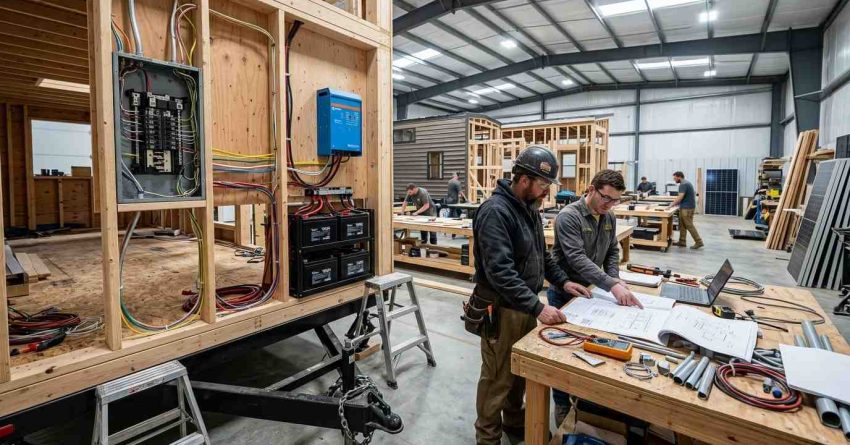
The system typically includes an inlet box for shore power connection, a main breaker panel, circuit wiring, outlets, lighting, and one or more alternative power sources such as a solar array or battery bank. Every component must be sized correctly for the home’s total electrical load and secured to withstand road vibration during transport.
A THOW electrical system shares foundational principles with residential electrical services — our complete guide to residential electrical services covers the full range of wiring, panel, and safety work that applies to both traditional and alternative housing structures.
How THOW Wiring Differs from Standard Home Wiring
Standard residential wiring assumes a fixed structure connected permanently to the utility grid. THOW wiring must account for movement, weight limits, multiple power inputs, and the possibility of operating entirely off-grid. Wire runs are typically shorter, conduit or armored cable is often used to protect against vibration damage, and all connections must be mechanically secured rather than relying on gravity or static positioning.
THOWs also require a transfer switch or automatic changeover system to safely switch between shore power and alternative sources without backfeeding current into either system. This is a critical safety requirement that standard residential wiring does not typically address.
Key Components of a THOW Electrical System
A functional THOW electrical system is built from several interdependent components. Each one must be correctly specified and installed for the system to operate safely across all power modes.
Shore Power Connection and Inlet Box
The shore power inlet box is the primary connection point between your THOW and an external power pedestal at a campsite, RV park, or residential property. Most THOWs use a 30-amp or 50-amp inlet, with 50-amp service preferred for builds with higher electrical loads such as electric water heaters, air conditioning, or induction cooktops.
The inlet box must be weatherproof, mounted securely to the trailer frame or exterior wall, and wired with the correct gauge cable to handle the rated amperage without voltage drop or heat buildup.
Inverter, Converter, and Battery Bank
An inverter converts DC power stored in your battery bank into the 120V AC power that standard household appliances use. A converter does the reverse — it takes AC shore power and converts it to DC to charge your batteries. Many THOW builders install a combined inverter-charger unit that handles both functions automatically.
Battery bank sizing depends on your daily energy consumption and how many days of autonomy you want without recharging. Lithium iron phosphate (LiFePO4) batteries are the most common choice for THOWs due to their high energy density, long cycle life, and tolerance for partial states of charge.
Solar Panel Integration
Solar panels mounted on the THOW roof charge the battery bank through a charge controller, which regulates voltage and current to prevent overcharging. A properly sized solar array can provide enough daily energy to run a THOW indefinitely in sunny climates without any shore power connection.
Every component in a THOW electrical system is selected to match the compact, mobile demands of tiny home construction — our tiny home construction resource explains how structural and systems decisions work together to create a safe, functional living space.
THOW Electrical Load Planning and Panel Sizing
Load planning is the process of calculating how much electricity your THOW will consume under normal operating conditions. This calculation determines the size of your breaker panel, the capacity of your battery bank, the output of your solar array, and the amperage of your shore power inlet.
Calculating Your Total Electrical Load
To calculate your total electrical load, list every appliance and device in your THOW along with its wattage and estimated daily hours of use. Multiply wattage by hours to get watt-hours per day for each item, then add all items together to get your total daily consumption.
Common high-draw appliances in THOWs include mini-split air conditioners (600–1,500 watts), electric water heaters (1,200–4,500 watts), induction cooktops (1,200–1,800 watts), and refrigerators (100–400 watts). Lighting, phone charging, and small electronics typically add 100–300 watts of additional load.
Choosing the Right Breaker Panel
Most THOWs use a 100-amp or 125-amp main breaker panel, which provides enough capacity for standard residential loads while keeping weight and cost manageable. Builds with heavy electrical loads — particularly those with electric heating, multiple air conditioning units, or large battery charging systems — may require a 200-amp panel.
Accurate load planning is the foundation of safe electrical panel sizing — if your THOW calculations reveal a need for a larger or upgraded panel, our electrical panel sizing guide walks through every factor that determines the right capacity for your build.
Wiring Standards and Code Compliance for THOWs
THOW electrical systems must comply with specific codes and standards that differ from both standard residential construction and traditional RV manufacturing. Understanding which standards apply to your build is essential before purchasing materials or beginning installation.
NEC Requirements and RVIA Certification
The National Electrical Code (NEC) provides the baseline wiring standards that apply to most THOW builds, particularly those intended for use as permanent or semi-permanent residences. Key NEC requirements for THOWs include proper wire sizing, ground fault circuit interrupter (GFCI) protection in wet areas, arc fault circuit interrupter (AFCI) protection in living spaces, and correct grounding and bonding throughout the system.
THOWs built to RVIA (Recreational Vehicle Industry Association) standards follow a separate certification path that uses ANSI/NFPA 1192 as its electrical standard. RVIA certification is required by some campgrounds and RV parks as a condition of occupancy and may affect financing and insurance options.
Meeting electrical code compliance standards is non-negotiable for any THOW build — our electrical code compliance resource outlines the inspection, permitting, and compliance steps that licensed electricians follow to bring any residential or alternative structure up to code.
Off-Grid vs. Grid-Tied THOW Electrical Setups
The choice between an off-grid and grid-tied electrical setup is one of the most consequential decisions in THOW design. It affects component selection, system cost, daily operating habits, and where you can legally park and live.
A grid-tied setup relies primarily on shore power from an external source, using the battery bank and solar array as backup or supplemental power. This approach is simpler and less expensive to build but limits where you can park long-term to locations with electrical hookups.
An off-grid setup is designed to operate indefinitely without any external power connection, relying entirely on solar, wind, or generator charging to maintain the battery bank. Off-grid systems require larger battery banks, more solar capacity, and more careful energy management but offer complete location independence.
Hybrid Systems and Battery Backup Options
Most modern THOW builds use a hybrid approach — a system designed primarily for off-grid operation but capable of accepting shore power when available. A hybrid system uses an automatic transfer switch to prioritize shore power when connected, switch seamlessly to battery and solar when disconnected, and use a generator as a backup charging source during extended cloudy periods.
Homeowners choosing an off-grid THOW setup often pair their battery bank with solar energy installation — our solar energy installation guide covers system sizing, panel placement, and inverter selection for residential and alternative housing applications.
Common THOW Electrical Problems and How to Fix Them
Even a well-designed THOW electrical system will develop issues over time, particularly as the structure is moved repeatedly and components age. Knowing the most common problems and their causes helps you diagnose issues quickly and decide whether a repair is within your skill level or requires professional help.
Tripped breakers are the most frequent issue and are usually caused by overloading a circuit, a failing appliance, or a loose connection. Resetting the breaker and identifying the source of the overload resolves most cases. Persistent tripping on the same circuit indicates a wiring fault or a failing breaker that needs replacement.
Voltage drop — where appliances receive less than the rated voltage — is common in THOWs with long wire runs or undersized conductors. It causes motors to run hot, lights to dim, and sensitive electronics to malfunction. The fix is replacing undersized wire with the correct gauge for the circuit length and load.
Grounding and bonding failures are among the most dangerous THOW electrical problems because they create shock hazards that are not always visible. Symptoms include tingling sensations when touching metal surfaces, GFCI outlets that trip without an apparent cause, and appliances that behave erratically.
When to Call a Licensed Electrician
Any problem involving the main breaker panel, service entrance wiring, grounding system, or transfer switch should be handled by a licensed electrician. These components carry the full amperage of your electrical system and present serious shock and fire risks if worked on incorrectly.
While some minor THOW electrical issues fall within the scope of general home repair services, most wiring faults, breaker failures, and grounding problems require a licensed electrician — our home repair services helps you identify which tasks are safe for a handyman and which demand a certified professional.
Conclusion
A THOW electrical system brings together shore power, solar, battery storage, and code-compliant wiring into one integrated design that must perform reliably in a mobile, space-constrained environment.
Getting the components, load calculations, and compliance requirements right from the start protects your investment and ensures your THOW is safe to live in and legal to park wherever your plans take you.
At Mr. Local Services, our licensed electricians help THOW owners design, install, and inspect electrical systems that meet NEC standards, pass inspections, and deliver dependable power for every stage of tiny home living — contact us today to get started.
Frequently Asked Questions
What size electrical panel does a THOW need?
Most THOWs use a 100-amp or 125-amp main breaker panel. Builds with high-draw appliances like electric heating or multiple air conditioning units may require a 200-amp panel. Load calculations determine the correct size before installation begins.
Does a THOW need to follow the NEC?
Yes, most THOW builds must comply with the National Electrical Code (NEC), which governs wire sizing, GFCI and AFCI protection, grounding, and bonding. THOWs pursuing RVIA certification follow ANSI/NFPA 1192 instead, which has its own electrical requirements.
Can I wire my THOW myself?
Some THOW owners with electrical experience complete their own wiring, but all work must meet NEC or RVIA standards and pass inspection. Main panel work, service entrance wiring, and transfer switch installation should always be performed by a licensed electrician.
How many solar panels does a THOW need?
The number of solar panels depends on your daily energy consumption and your battery bank capacity. A typical THOW with moderate energy use requires 400–800 watts of solar capacity. High-consumption builds with electric appliances may need 1,200 watts or more.
What is the difference between a 30-amp and 50-amp THOW shore power connection?
A 30-amp connection provides approximately 3,600 watts of continuous power, which is sufficient for most basic THOW loads. A 50-amp connection provides up to 12,000 watts and is recommended for builds with air conditioning, electric water heaters, or induction cooking.
How do I prevent electrical problems caused by road vibration?
Use armored cable or conduit for all wire runs, secure every connection with mechanical fasteners rather than relying on friction, and inspect all connections and junction boxes after each move. Loose connections are the primary cause of vibration-related electrical failures in THOWs.
When should I upgrade my THOW electrical system?
Upgrade your THOW electrical system when you add high-draw appliances that exceed your current panel capacity, when you experience persistent voltage drop or tripped breakers, or when an inspection reveals wiring that does not meet current NEC standards.