
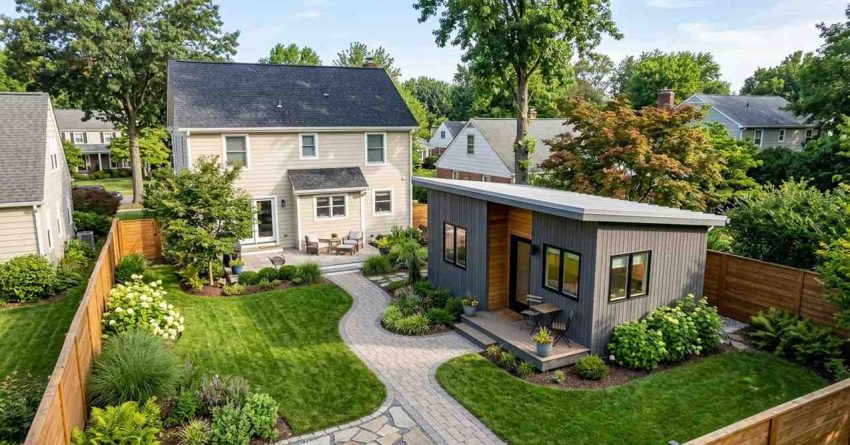
ADU zoning laws determine whether you can legally build an accessory dwelling unit on your property — and getting them wrong can cost thousands in fines, forced demolition, or failed inspections. These regulations govern everything from how far your unit must sit from the property line to whether you can rent it out at all. For homeowners, landlords, and property managers across the USA, understanding these rules before breaking ground is not optional — it is the foundation of every successful ADU project.
Zoning laws vary dramatically by city, county, and state, making it easy to act on outdated or incomplete information and end up with an unpermitted structure.
This guide explains the core zoning rules that govern ADUs, walks through the permit process, and clarifies how state and local laws interact so you can move forward with confidence.
What Is an ADU and Why Do Zoning Laws Matter?
An accessory dwelling unit is a secondary residential space built on the same lot as a primary single-family or multi-family home. It functions as a fully independent living space with its own entrance, kitchen, and bathroom — but it sits on land already occupied by another dwelling.
Zoning laws matter because they are the legal framework that decides whether your property qualifies for an ADU at all. Local governments use zoning codes to control land use, density, and neighborhood character. Without zoning approval, no permit can be issued, no contractor can legally build, and no tenant can lawfully occupy the unit.
The rules cover physical dimensions, placement on the lot, utility connections, occupancy requirements, and in some cases, who can live in the unit. Ignoring any one of these categories creates legal exposure that can follow a property through future sales, refinancing, and insurance claims.
How ADUs Are Classified Under Local Zoning Codes
Zoning codes classify ADUs based on their physical relationship to the primary dwelling. The three most common classifications are detached units, attached units, and interior conversions. Each classification carries its own set of dimensional rules, setback requirements, and utility standards.
Some jurisdictions also distinguish between new construction ADUs and conversion ADUs, applying different standards to each. A newly built detached structure typically faces stricter setback and height rules than a converted garage or basement, because the conversion uses existing footprint rather than adding new square footage to the lot.
Understanding how your local code classifies the unit type you want to build is the first step before any design or contractor conversation begins. Our ADU complete guide covers every unit type, ownership structure, and planning consideration in one place, giving homeowners and landlords the full picture before they begin.
Types of ADUs Allowed Under Zoning Regulations
Most zoning codes recognize four primary ADU types, each with distinct approval pathways and physical requirements.
Detached ADUs are standalone structures built separately from the primary home. They offer the most privacy and flexibility but typically require the most land and face the strictest setback rules.
Attached ADUs share at least one wall with the primary dwelling. They are often easier to permit because they use existing structural elements, but they must meet fire separation and egress standards that detached units do not always require.
Garage conversion ADUs repurpose an existing attached or detached garage into a livable space. This is one of the most cost-effective ADU paths because the structure already exists, reducing both construction time and material costs.
Interior ADUs — sometimes called junior ADUs or JADUs — convert existing interior space such as a basement, attic, or large bedroom into a separate unit. These typically face the fewest zoning hurdles because they add no new footprint to the lot.
Detached ADUs and Setback Requirements
Setback requirements define how far a structure must sit from property lines, fences, and other buildings. For detached ADUs, setbacks are typically measured from the rear and side property lines and range from four to ten feet depending on the jurisdiction.
Some states have passed legislation capping maximum setback requirements to encourage ADU construction. California, for example, limits rear and side setbacks for detached ADUs to no more than four feet under state law — though local codes may be more permissive.
Height limits for detached ADUs commonly range from 16 to 25 feet, with some jurisdictions allowing taller structures when the ADU sits above a garage or carport.
Attached ADUs, Garage Conversions, and Interior Units
Attached ADUs and conversions generally face fewer setback restrictions because they use existing building footprints. However, they introduce different compliance requirements — particularly around fire-rated wall assemblies between the primary dwelling and the ADU, separate exterior entrances, and egress window sizing.
Garage conversions require special attention to floor elevation, insulation, and utility rough-ins. Many garages were not built to residential thermal or structural standards, meaning upgrades are required before the space qualifies as habitable. Converting an existing structure is one of the most cost-effective ADU paths available, and our garage conversion services explains exactly what the process involves, what permits are typically required, and how professionals handle the structural and utility work.
Key Zoning Requirements Homeowners Must Meet
Beyond unit type and setbacks, zoning codes impose a range of additional requirements that determine whether a property qualifies for an ADU and what the unit can legally include.
Minimum lot size is one of the most common barriers. Many jurisdictions require a minimum lot area — often between 5,000 and 7,500 square feet — before an ADU is permitted at all. Some states have eliminated minimum lot size requirements for ADUs to expand housing supply.
Lot coverage limits cap the total percentage of a lot that can be covered by structures. Adding an ADU counts toward this limit, and exceeding it requires a variance — a separate approval process that adds time and cost.
Maximum ADU size is typically expressed as a percentage of the primary dwelling’s square footage or as an absolute cap. Many jurisdictions limit ADUs to 50% of the primary home’s floor area or 1,200 square feet, whichever is smaller.
Parking requirements vary widely. Some jurisdictions require one off-street parking space per ADU bedroom. Others have eliminated parking requirements entirely for ADUs located near transit corridors.
Every jurisdiction has its own dimensional and occupancy rules, and our dedicated ADU permit requirements breaks down the specific documentation, site plan standards, and approval criteria homeowners need to prepare before submitting an application.
Lot Size, Coverage Limits, and Height Restrictions
Lot size, coverage, and height restrictions work together to define the physical envelope within which an ADU can exist. A property may clear the minimum lot size threshold but still fail coverage limits if existing structures already consume most of the allowable footprint.
Height restrictions interact with setback rules in important ways. A taller structure may be permitted if it sits farther from property lines, while a shorter structure may be allowed closer to the boundary. Understanding how these three variables interact on your specific lot is essential before committing to a design.
Owner-Occupancy Rules and Rental Restrictions
Owner-occupancy requirements mandate that the property owner live in either the primary dwelling or the ADU as their primary residence. These rules were historically common but have been rolled back in many states as part of broader ADU reform legislation.
Where owner-occupancy rules still apply, violating them can result in fines, required removal of the ADU, or loss of rental income. Landlords and investors purchasing properties with existing ADUs should verify current owner-occupancy status before closing.
Rental restrictions may also limit short-term rental use of ADUs. Many jurisdictions prohibit using an ADU as a vacation rental or short-term rental platform listing, even when long-term rental is permitted.
The ADU Permit and Approval Process
Building an ADU without a permit is one of the most common and costly mistakes property owners make. Unpermitted ADUs cannot be legally rented, reduce property value, and create significant liability during sale or refinancing.
The permit process for an ADU typically involves a pre-application meeting with the local planning department, submission of architectural drawings and site plans, plan review by building and zoning officials, permit issuance, construction inspections at key milestones, and a final inspection before occupancy is approved.
Many ADU projects involve structural changes that go beyond zoning compliance alone — our remodeling services outlines how skilled professionals manage the construction, utility connections, and finishing work that turn an approved plan into a livable space.
What to Expect From Application to Final Inspection
Timeline expectations vary significantly by jurisdiction. Some cities have streamlined ADU permitting to 30–60 days through pre-approved plan programs. Others still require 6–12 months for full discretionary review.
Pre-approved ADU plans — offered by many California cities and a growing number of municipalities nationwide — allow homeowners to select from a library of pre-reviewed designs, bypassing much of the plan review process and dramatically reducing approval timelines.
Key inspection milestones typically include foundation, framing, rough plumbing, rough electrical, insulation, and final occupancy. Missing or failing any inspection requires correction and re-inspection before the project can advance.
State vs. Local ADU Zoning Laws — What Takes Priority?
State ADU laws have become increasingly powerful over the past several years. In states like California, Oregon, Washington, and Maine, state legislation now sets a floor of ADU rights that local governments cannot restrict below.
This means that even if a local zoning code prohibits ADUs in a particular zone, state law may override that prohibition and require the local government to approve a compliant application. State preemption rules have reshaped what local governments can restrict, and our ADU state law overview tracks the most current legislative changes across key states, helping property owners understand which rules actually govern their project.
In states without strong preemption laws, local governments retain full authority over ADU regulations. This creates significant variation — a property in one county may qualify for an ADU while an identical property in the adjacent county does not.
When state and local rules conflict, the more permissive standard generally applies in states with preemption legislation. Property owners should always verify current state law before accepting a local denial as final.
Common Zoning Violations and How to Avoid Them
The most frequent ADU zoning violations fall into predictable categories: building without a permit, exceeding approved dimensions, violating setback requirements, and failing to complete required inspections.
Unpermitted construction is the most serious violation because it affects the entire property — not just the ADU. Lenders, insurers, and buyers all conduct due diligence that surfaces unpermitted structures, and the cost of legalization or removal often exceeds the original construction cost.
Setback violations typically occur when homeowners rely on informal measurements rather than a licensed survey. Even a few inches of encroachment can trigger a violation notice and require costly remediation.
Many zoning violations stem from unpermitted work or improper installations — connecting with qualified professionals through our handyman services ensures that repairs, modifications, and improvements are completed to code from the start.
Inspection failures are often caused by work that was completed before the inspector arrived or by contractors who skipped required rough-in stages. Maintaining a clear inspection schedule and never covering work before it is inspected prevents the most common causes of project delays.
How to Prepare Your Property for ADU Compliance
Preparation before submitting a permit application significantly increases approval speed and reduces the risk of costly redesigns. The most effective preparation steps address the three areas most likely to trigger plan review comments: utility capacity, site conditions, and dimensional compliance.
Utility assessment should happen before design begins. Existing water, sewer, and electrical service must be capable of supporting an additional dwelling unit. In many cases, service upgrades are required — and these upgrades must be reflected in the permit application.
Utility readiness is one of the most common preparation gaps before ADU approval — our plumbing services explains how licensed plumbers assess existing systems, add connections, and bring infrastructure up to the standards required for a separate dwelling unit.
Site survey establishes accurate property boundaries, existing structure locations, and easements. A current survey prevents setback miscalculations and identifies any encumbrances that could affect ADU placement.
Zoning research should confirm current allowances for your specific parcel — not just the general zone. Overlay districts, historic preservation areas, flood zones, and fire hazard severity zones all impose additional requirements that standard zoning maps do not show.
Property Improvements That Support ADU Approval
Several property improvements directly support ADU approval by addressing the most common plan review deficiencies before they arise.
Panel upgrades ensure the property has sufficient electrical capacity for a second dwelling unit with its own circuits, appliances, and HVAC system. Separate metering and panel capacity are frequent requirements for ADU approval, and our electrical services covers how licensed electricians evaluate your current setup and complete the upgrades needed to meet local utility and inspection standards.
Sewer lateral inspection and certification confirms that the existing lateral can handle additional load. Many jurisdictions require a video inspection report as part of the ADU permit application.
Landscaping and drainage improvements may be required when an ADU adds impervious surface to the lot, triggering stormwater management requirements. Addressing these proactively prevents permit holds during the review process.
Conclusion
ADU zoning laws govern every dimension of what you can build, where you can build it, and how you can use it — making early research the most valuable investment in any ADU project. Understanding unit classifications, setback rules, permit requirements, and the relationship between state and local law gives homeowners and landlords the foundation to move forward without costly surprises.
State preemption has expanded ADU rights significantly across the USA, but local rules still shape the details that determine project feasibility on any specific parcel.
At Mr. Local Services, our network of skilled professionals handles the property improvements, utility upgrades, and structural work that support ADU approval — contact us today to connect with the right experts for your project.
Frequently Asked Questions
What is the minimum lot size required to build an ADU?
Minimum lot size requirements vary by jurisdiction and range from 5,000 to 7,500 square feet in many cities, though some states have eliminated minimum lot size rules entirely. Check your local zoning code or planning department for the specific threshold that applies to your parcel.
Do I need a permit to build an ADU?
Yes. Building an ADU without a permit is illegal in virtually every jurisdiction and creates serious financial and legal risks, including fines, required demolition, and complications during property sale or refinancing. All ADU construction requires a building permit and passing inspections at each construction milestone.
Can I rent out my ADU?
In most jurisdictions, ADUs can be rented as long-term residential units. However, short-term rental use is often prohibited, and some areas still require the property owner to live on-site. Verify current rental rules with your local planning department before listing the unit.
How long does the ADU permit process take?
Permit timelines range from 30 days in cities with pre-approved ADU plan programs to 6–12 months in jurisdictions requiring full discretionary review. Submitting a complete application with accurate site plans and utility documentation is the most effective way to reduce review time.
What happens if my ADU violates setback requirements?
A setback violation can result in a stop-work order, fines, and a requirement to modify or remove the structure. If the violation is discovered after construction, legalization may require a variance application or, in some cases, partial demolition. Always verify setbacks with a licensed survey before construction begins.
Does state law override local ADU zoning restrictions?
In states with ADU preemption legislation — including California, Oregon, and Washington — state law sets a minimum floor of ADU rights that local governments cannot restrict below. In states without preemption laws, local governments retain full authority. Always verify current state law before accepting a local denial as final.
What is a junior ADU and how does it differ from a standard ADU?
A junior ADU, or JADU, is an interior conversion of existing space within the primary dwelling — typically a bedroom, basement, or attic — into a unit of no more than 500 square feet. JADUs typically face fewer zoning hurdles than detached or attached ADUs because they add no new footprint to the lot and often require only a separate entrance rather than a fully independent kitchen.