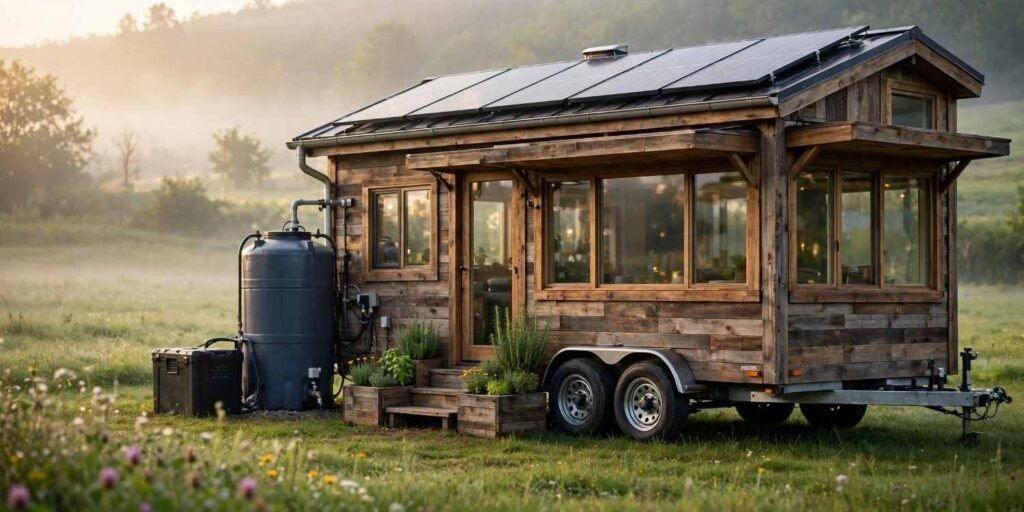
A tiny home on wheels becomes genuinely sustainable through a handful of connected systems: solar power, water-saving fixtures, recycled materials, and tight insulation working together. I have walked through builds where every one of these pieces was an afterthought, and the owner paid for it every winter. The eco-friendly label only means something when the systems actually perform.
Tiny homes concentrate resource use into a small footprint, which makes efficiency losses obvious fast. A poorly insulated wall or an undersized solar array shows up immediately in comfort and cost. That pressure is exactly why sustainable design matters more here than in a standard house.
I walk through the energy systems that keep a tiny home running off-grid, the water and waste solutions built for mobile living, the materials and insulation choices that hold up on the road, and the design habits and incentives that make going green actually pay off.
What Makes a Tiny Home on Wheels Truly Sustainable
Sustainability in a tiny home on wheels is the combined performance of its energy, water, waste, and material systems working as one unit. It is not a single feature. It is how the whole structure behaves under real conditions.
A tiny home is a small-footprint dwelling built on a trailer chassis that prioritizes resource efficiency and mobility over square footage. That definition matters because mobility changes every sustainability decision that follows, from insulation thickness to plumbing layout.
Core Principles Behind Eco-Friendly Tiny Living
Three principles drive most eco-friendly tiny home decisions: reduce consumption, generate what you use, and choose materials that last. I see builders skip the third one constantly because it costs more upfront.
Reduced consumption comes from smaller square footage and efficient appliances. Generation comes from solar and passive design. Material longevity comes from choosing components rated for vibration and temperature swings on the road.
How Sustainability Differs for Mobile vs. Stationary Tiny Homes
A stationary tiny home connects to a fixed grid and municipal water. A tiny home on wheels usually can’t count on either, so it needs self-contained systems built into the design from day one.
Weight limits also shape every material and system choice on a mobile build. A stationary home never has to weigh its insulation against axle capacity, but a wheeled one absolutely does.
Solar Power Systems for Off-Grid Energy Independence
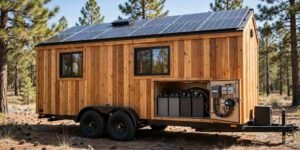
Solar power is a photovoltaic energy system that converts sunlight into usable electricity through panels, a charge controller, and a battery bank. For a tiny home on wheels, it is usually the single feature that determines how far off-grid the owner can actually go.
I always tell people to size the system around their real appliance load, not around what fits on the roof. A DOE analysis found rooftop solar generation costs dropped nearly 30% over the past decade, which makes small residential systems far more accessible than they used to be.
Sizing a Solar Setup for a Tiny Home on Wheels
Sizing starts with adding up daily watt-hours for every appliance, then building in a buffer for cloudy days. Most tiny homes on wheels run comfortably on a 600–1,200 watt array paired with a mid-size battery bank.
Roof space is the real constraint here, not budget. A 200-square-foot roof caps out around 1,200–1,600 watts of panels no matter how much someone wants to spend.
Battery Storage and Backup Power Options
Lithium iron phosphate batteries have become the standard choice for tiny home solar setups because of their cycle life and weight advantage over lead-acid options. They cost more upfront but last considerably longer under daily deep discharge.
A backup generator still makes sense for extended cloudy stretches or winter parking in low-sun locations. I never recommend going 100% solar-dependent without some kind of backup plan.
Composting and Water-Saving Toilet Systems
A composting toilet is a waterless sanitation system that breaks down human waste into compost material using aerobic decomposition instead of water flushing. It eliminates one of the largest water demands in a conventional bathroom setup.
Water-saving fixtures throughout the rest of the bathroom cut consumption even further. Low-flow showerheads and faucet aerators reduce usage by roughly half compared to standard fixtures without any noticeable pressure drop.
Composting Toilets vs. Incinerating Toilets
Composting toilets separate liquid and solid waste and use natural decomposition, while incinerating toilets burn waste down to sterile ash using electricity or propane. Composting units use zero water and minimal power, which makes them the more common choice for off-grid setups.
Incinerating toilets suit owners who want zero handling of compost material. They do use more energy per cycle, so that tradeoff matters for smaller solar systems.
Maintenance and Odor Control Basics
Proper ventilation through a small fan and exterior vent stack keeps odor under control in a composting system. Skipping this step is the number one complaint I hear from new composting toilet owners.
Adding a carbon or peat moss layer after each use speeds decomposition and controls smell further. The solid compartment typically needs emptying every three to six weeks depending on household size.
Rainwater Harvesting and Greywater Recycling Systems
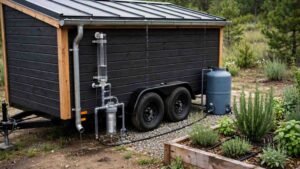
Rainwater harvesting is a collection system that captures runoff from a roof surface and stores it in tanks for later use in cleaning, irrigation, or filtered drinking water. It reduces dependence on hauling water to remote parking locations.
Greywater recycling reuses water from sinks and showers rather than sending it straight to a holding tank. Combined, these two systems can cut a tiny home’s fresh water hauling needs substantially.
Collection, Filtration, and Storage Components
A basic system includes gutters, a first-flush diverter, a storage tank, and a filtration stage before use. The first-flush diverter is the piece people skip most often, and it is the one that keeps debris and roof contaminants out of the tank.
Storage tank size depends on roof catchment area and average local rainfall. Most tiny home setups run 20–50 gallon tanks given the weight limits involved.
Greywater Reuse for Irrigation and Cleaning
Greywater from sinks and showers works well for irrigation and exterior cleaning once it passes through a basic filter. It is not safe for drinking without significant additional treatment.
Local regulations on greywater reuse vary widely across states and counties. I always tell owners to check municipal rules before installing a permanent greywater line, since some jurisdictions restrict it entirely for mobile dwellings.
Sustainable Building Materials for Tiny Home Construction
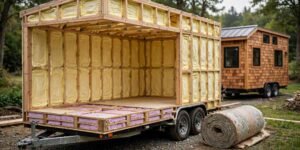
Sustainable building materials are construction components sourced, manufactured, or reused in ways that reduce environmental impact compared to conventional options. In a tiny home, material choice affects weight, durability, and indoor air quality all at once.
Reclaimed wood, recycled steel framing, and low-impact insulation show up constantly in eco-focused builds. Each one solves a different problem beyond just being “green.”
Reclaimed and Recycled Framing Materials
Reclaimed wood pulled from old barns or factories brings character and reduces demand on new lumber. It does need careful inspection for structural integrity and pest damage before use.
Steel framing offers a lighter, more durable alternative to standard wood framing on a mobile structure. It resists warping from road vibration far better than traditional stick framing.
Low-VOC Finishes and Non-Toxic Insulation
Low-VOC paints and finishes release far fewer volatile organic compounds into a small, tightly sealed living space. Standard finishes off-gas for weeks, and that matters enormously in 200 square feet of air volume.
Sheep’s wool and cellulose insulation avoid the formaldehyde binders found in some fiberglass products. Both perform well thermally while keeping indoor air quality higher.
High-Performance Insulation for Energy Efficiency
Insulation performance drives heating and cooling costs more than almost any other single system in a tiny home. A poorly insulated wall forces the HVAC system to work overtime regardless of how efficient that system is.
Spray foam, rigid foam board, and mineral wool are the three materials I see most often in quality tiny home builds. Each handles the unique framing constraints of a mobile structure differently.
Insulation Types Suited to Mobile Structures
Closed-cell spray foam offers the highest R-value per inch, which matters enormously when wall cavities are limited to 2×4 or 2×3 framing. It also adds structural rigidity that helps the walls handle highway vibration.
Rigid foam board works well in the subfloor and roof, where sheet application is straightforward. Mineral wool suits interior partition walls where fire resistance and soundproofing matter more than raw R-value.
Insulation R-Values by Climate Zone
Cold climate builds generally need R-21 or higher in walls and R-30+ in the roof to stay comfortable through winter. Warm climate builds can get by with somewhat less, but radiant barriers become more important for cooling load.
Matching insulation to the actual climate zone the home will spend most time in avoids paying for performance that never gets used.
Energy-Efficient Appliances and Smart Systems

Energy-efficient appliances are units engineered to deliver standard performance while consuming less electricity or propane than conventional models. In a solar-powered tiny home, appliance choice directly determines how large the solar array needs to be.
Smart monitoring systems track power and water use in real time, which helps owners catch problems before a battery bank drains unexpectedly.
Propane vs. Electric Appliance Trade-Offs
Propane appliances draw far less from the battery bank, which extends how long a solar setup lasts between sunny days. They do require ventilation and periodic tank refills, which is its own logistical task on the road.
Electric appliances integrate more simply with a solar and battery setup and skip the propane supply chain entirely. The tradeoff is a larger required battery bank to handle the higher draw.
Smart Monitoring for Power and Water Use
A battery monitor showing real-time state of charge prevents the common mistake of running a battery bank down too far, which shortens its lifespan. Most systems pair with a phone app for remote monitoring.
Water tank sensors work the same way, alerting owners before a fresh water supply runs out unexpectedly during travel.
Passive Design Strategies for Natural Heating and Cooling
Passive design uses a structure’s orientation, window placement, and airflow path to regulate temperature without relying on mechanical heating or cooling. It reduces the load on both the HVAC system and the solar array that powers it.
These strategies cost nothing to operate once built in, which makes them some of the highest-value decisions in the entire design process.
Window Placement and Orientation
South-facing windows in the Northern Hemisphere capture passive solar heat gain during winter months. Overhangs sized correctly block that same high summer sun to prevent overheating.
Window placement gets decided at the design stage, long before construction starts, which is why I push clients to think about it early rather than as an afterthought.
Ventilation and Airflow Design
Cross-ventilation through opposing windows creates natural airflow that cools the interior without a single watt of electricity. Roof vents paired with lower intake windows create a stack effect that pulls hot air out continuously.
Getting this right reduces or eliminates the need for air conditioning during shoulder seasons in most US climate zones.
Waste Reduction and Minimalist Living Practices
Waste reduction in a tiny home comes naturally from limited storage space, but intentional habits push it further. Composting food scraps and choosing reusable products cuts down what actually leaves the home as trash.
Minimalist living and sustainability reinforce each other constantly in this format. Less stuff means less to produce, package, ship, and eventually discard.
Reducing Household Waste in a Small Footprint
Bulk buying reduces packaging waste significantly compared to single-serving purchases, and it suits the smaller but more frequent shopping trips common to tiny home living. Reusable containers replace disposable ones in a kitchen with limited cabinet space anyway.
Digital documents and subscriptions cut paper waste, which matters more when there’s no room for a filing cabinet.
Recycling and Composting in Limited Space
A small stackable bin system handles recycling sorting without eating up floor space. Countertop compost bins pair naturally with a composting toilet setup or an outdoor compost pile.
Community recycling drop-off points fill the gap when curbside pickup isn’t available at a given parking location.
Cost, ROI, and Incentives for Going Green
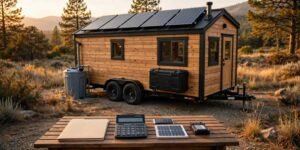
Sustainable features carry a higher upfront cost than standard builds, but they reduce ongoing utility and water hauling expenses substantially over time. Solar alone can eliminate a monthly electric bill entirely for an off-grid owner.
The math works out differently depending on how much the home travels and how long the owner keeps it, so it’s worth running real numbers before committing to every feature.
Upfront Costs vs. Long-Term Savings
A full solar and battery setup runs several thousand dollars upfront but eliminates grid or generator fuel costs for the life of the system. Composting toilets and rainwater systems carry smaller upfront costs but meaningfully cut water hauling and hookup fees.
Payback periods on solar typically run five to eight years depending on system size and usage patterns.
Rebates, Tax Credits, and Grants Available in the US
The federal residential clean energy credit allows homeowners to claim 30% of solar system costs through 2032, and that applies to qualifying tiny home installations. Some states add their own incentives on top of the federal credit.
Local utility rebate programs sometimes cover a portion of battery storage costs as well. Checking state-specific programs before purchasing equipment often uncovers savings owners didn’t know existed.
Conclusion
Sustainable tiny homes on wheels succeed when solar, water systems, materials, and insulation all work together rather than as isolated add-ons. Every system in this guide affects the others in ways that matter once you’re actually living in the space.
Getting the details right from the design stage forward saves money and headaches for years down the road. Sustainability here is a system, not a checklist item.
We help homeowners plan and build these features correctly from the start. Reach out to Mr. Local Services to talk through what a truly sustainable tiny home build looks like for your situation.
Frequently Asked Questions
How much does it cost to make a tiny home on wheels fully off-grid?
A complete off-grid setup with solar, batteries, and water systems typically costs $8,000 to $20,000 depending on system size. Costs vary widely based on appliance choices and battery capacity.
Do composting toilets really eliminate odor completely?
Proper ventilation and regular maintenance keep odor to a minimum, though it’s rarely completely eliminated. A working vent fan and carbon layer handle most of the smell effectively.
How long do solar batteries last in a tiny home?
Lithium iron phosphate batteries typically last 8 to 15 years with proper charging habits. Lead-acid alternatives usually last far less, closer to 3 to 5 years.
Can a tiny home on wheels be 100% self-sufficient?
Solar, rainwater harvesting, and composting toilets combined can get a tiny home very close to self-sufficient. Most owners still keep a backup generator or occasional water refill as a safety net.
What insulation works best for hot climates?
Radiant barriers combined with rigid foam board handle heat gain effectively in hot climates. Reflective roofing materials reduce cooling load further in these regions.
Are there tax credits for solar on a tiny home on wheels?
The federal residential clean energy credit covers 30% of solar costs on qualifying installations through 2032. Some states offer additional incentives on top of that federal credit.
How often does a composting toilet need emptying?
Most composting toilets need emptying every three to six weeks depending on how many people use the home. Usage frequency and tank size both affect that timeline.
Does going eco-friendly increase resale value for a tiny home?
Solar systems and water-efficient features generally increase resale appeal since buyers avoid retrofitting those systems themselves. Well-documented sustainable features often shorten time on market too.