Exterior finish and cladding are the outer material layers that protect a custom home from water, wind, sun, and fire while defining how it looks. I treat this choice as one of the biggest decisions in any custom build, because it drives durability, maintenance cost, and curb appeal for decades.
Cladding failures cause more moisture damage claims than roofing in many regions. I have watched owners spend twice as much on a rushed material pick.
This guide covers fiber cement, wood, vinyl, masonry, stucco, metal, coatings, mixed facades, climate and code factors, cost, selection, installation, and long-term maintenance.
What Exterior Cladding Is and Why It Matters on a Custom Home
Exterior cladding is the weather-facing skin of a building assembly that sheds bulk water, resists impact, and carries the architectural identity of the home. On a custom project, it is also the single largest visible surface you specify.
I always frame it this way for clients. The roof gets the attention, but the walls take the abuse for far more square footage.
Cladding vs. Siding vs. Exterior Finish: Clearing Up the Terms
People use these words interchangeably, and that causes real confusion during bidding. Cladding is the broadest term, covering any attached exterior surface material, including panels and masonry veneer.
Siding refers specifically to lapped or interlocking board and panel products. Exterior finish is the widest umbrella of all, covering cladding plus the coating layer on top of it, including exterior painting services that seal and color the substrate.
We use the precise term on every spec sheet, because a contractor bidding “siding” and a contractor bidding “cladding assembly” are quoting two different scopes.
The Four Jobs Every Exterior Finish Has to Do
Every cladding system does four things at once. It manages water, moderates heat and solar gain, resists physical and fire damage, and delivers the aesthetic the owner paid an architect to draw.
I rank water management first, always. The U.S. Department of Energy notes that moisture control in wall assemblies is essential to both durability and indoor air quality.
Aesthetics matter, and I never dismiss them. But a beautiful wall that traps water becomes an ugly, expensive problem in five years.
How the Wall Assembly Works Behind the Finish
The visible material is one layer in a system. Behind it sits a drainage gap or rainscreen, a water-resistive barrier, continuous insulation in many modern assemblies, sheathing, and the framing itself.
That drainage gap does enormous work. Water gets behind every cladding material eventually, and the gap gives it a path back out instead of into the sheathing.
I tell owners to judge a bid by what it says about the layers they will never see.
Fiber Cement Siding: The Modern Default
Fiber cement is a composite of cement, sand, and cellulose fiber pressed into boards, panels, and shingles. It has become the default premium choice on custom homes across most of the country for good reason.
It resists rot, termites, and fire, and it holds paint far longer than wood. The Insurance Institute for Business & Home Safety identifies noncombustible cladding as a core wildfire-resilience measure, and fiber cement qualifies.
Where Fiber Cement Performs Best
I specify it most often in mixed-humidity and wildfire-exposed regions. It handles freeze-thaw cycling, coastal salt air, and high UV exposure without the dimensional movement wood shows.
Weight is the tradeoff. Boards are heavy, cutting produces silica dust, and installation demands a crew that knows the fastening pattern.
Maintenance and Repaint Cycles
Factory-finished fiber cement typically holds color for 15 years or more before a repaint. Field-painted board runs shorter, closer to eight to twelve years depending on exposure.
Caulk joints and butt seams need attention long before the field paint does. We inspect those annually and reseal on a five to seven year rhythm.
Wood and Engineered Wood Siding
Wood remains the material architects reach for when they want warmth and texture that no composite fully matches. It also carries the highest maintenance obligation of any option on this list.
I am direct with clients about that tradeoff. Wood rewards owners who maintain it and punishes owners who forget it.
Cedar, Redwood, and Thermally Modified Wood
Western red cedar and redwood contain natural extractives that resist decay and insects. Both come in clear vertical grain for a refined look and rustic grades for texture.
Thermally modified wood is the newer option worth knowing. Heat treatment removes the sugars fungi feed on, giving softwoods decay resistance without chemical preservatives.
Any wood cladding depends on skilled installation and periodic refinishing, which is where experienced carpentry services earn their fee on detail work around windows and corners.
Engineered Wood Alternatives
Engineered wood siding uses wood strands or fibers bonded with resin and treated with zinc borate. It ships primed or prefinished, cuts like lumber, and costs meaningfully less than fiber cement.
It performs well in most climates and poorly in chronic wetting conditions. I keep it off grade-level walls and away from splash zones.
Vinyl and Composite Siding
Vinyl is PVC extruded into interlocking panels, and it remains the most-installed residential cladding in the United States by volume. On custom homes it appears less often, but dismissing it entirely is a mistake.
The economics are hard to argue with. It never needs paint, and it survives decades of weather with a wash.
Insulated Vinyl and Performance Grades
Premium vinyl differs sharply from builder-grade panel. Thicker profiles resist wind uplift and oil-canning, and insulated vinyl bonds rigid foam to the back of each panel for added R-value and rigidity.
Insulated grades also feel and sound more solid underfoot and under hand. That perceived quality gap matters on a custom project.
Where Vinyl Fits a Custom Build
I use vinyl on rear elevations, detached garages, and rental-focused builds where budget goes to interiors. It also works on accessory dwellings and tiny home builds where weight and cost both matter.
Heat is the limit. Dark colors on south-facing walls in hot climates invite warping unless you specify a heat-stable formulation.
Brick, Stone, and Masonry Veneer
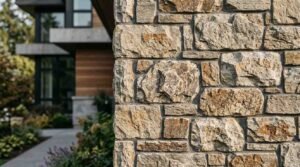
Masonry delivers permanence no other cladding matches. Brick and stone routinely outlast the framing behind them, and they carry an architectural authority that reads as substantial from the street.
Cost and structural requirements are the gate. Masonry needs a supporting ledge, proper flashing, and weep openings that many crews install incorrectly.
Full Masonry vs. Thin Veneer
Full brick or stone veneer is a nominal three- to four-inch wythe supported on a foundation ledge with an air gap behind it. That air gap and its weeps are non-negotiable.
Thin veneer is a sawn or manufactured facing under two inches thick, adhered to a prepared substrate. It removes the foundation ledge requirement and opens masonry to remodels and upper stories.
Manufactured Stone Considerations
Manufactured stone is molded concrete colored to mimic natural stone. Quality varies enormously between producers, and installation quality varies more.
Most manufactured stone failures I see trace to drainage, not the product. Missing weep screeds and mortar bridging the drainage plane cause the damage, and once water gets behind the wall, you are calling for water damage restoration rather than a siding repair.
Stucco and Exterior Plaster Systems
Stucco is a cementitious plaster applied in coats over lath or a prepared substrate. It dominates the Southwest, Florida, and California for reasons of climate, cost, and architectural tradition.
Done right, it lasts fifty years. Done wrong, it becomes the most litigated cladding in American construction.
Traditional Three-Coat vs. EIFS
Traditional three-coat stucco applies scratch, brown, and finish coats over metal lath with a drainage plane behind. It is vapor-open and forgiving of moisture that gets behind it.
EIFS bonds insulation board to the sheathing and coats it with a thin synthetic lamina. Modern drainable EIFS solved the barrier-wall failures of the 1990s, and the U.S. Department of Housing and Urban Development has documented those early moisture problems extensively.
I specify drainable assemblies only. Barrier EIFS belongs in the past.
Climate and Drainage Requirements
Stucco needs a drainage plane, correct weep screed at the base, and proper window integration. Cracking is normal and cosmetic; water intrusion at penetrations is not.
Dry climates tolerate more forgiveness. Humid and freeze-thaw climates punish every shortcut.
Metal Cladding and Standing Seam Panels
Metal cladding has moved from agricultural and commercial buildings into high-end residential design. Standing seam wall panels, flat-lock shingles, and corrugated profiles all read as modern and deliberate.
Metal excels where fire and longevity drive the decision. It is noncombustible, dimensionally stable, and often carries fifty-year finish warranties.
Steel, Aluminum, Zinc, and Copper
Galvalume-coated steel gives the best value and the widest color range. Aluminum costs more and eliminates corrosion concerns, making it the coastal choice.
Zinc and copper are the architectural tier. Both develop a living patina, both cost several times steel, and both need installers who work in soft metals regularly.
Corrugated, Flat-Lock, and Rainscreen Profiles
Profile drives the whole visual outcome. Corrugated reads agricultural and industrial, standing seam reads crisp and vertical, and flat-lock shingles read as texture rather than line.
Nearly all residential metal cladding installs as a rainscreen over a drainage gap. That gap prevents condensation from sitting against the sheathing.
Paint, Stain, and Coating Systems
The coating is the sacrificial layer that takes UV and moisture so the substrate does not. On a custom home, the coating specification deserves as much attention as the cladding itself.
I have seen premium fiber cement fail early under a cheap coating. The material and the finish are one system.
Factory Finish vs. Field Applied
Factory prefinishing applies coating in a controlled environment with baked-on cure. Coverage is uniform, warranties run longer, and the panel edges get sealed before they ever reach the site.
Field application costs less and allows unlimited color choice, including changes mid-project. It also depends entirely on weather windows and crew discipline during application.
For repaints and refinishing on existing homes, coordinated painting services handle prep, priming, and topcoat as one scope rather than three.
Color, Sheen, and Fade Resistance
Dark and saturated colors absorb more heat and fade faster, especially reds and deep blues. Inorganic pigments hold color far better than organic ones.
Sheen affects both look and cleanability. I lean toward low-sheen on large fields and higher sheen on trim, where dirt shows most.
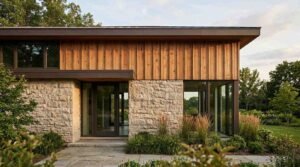
Mixed-Material Facades and Architectural Style Matching
Most custom homes built now use two or three cladding materials rather than one. Mixing done well creates hierarchy and scale; mixing done poorly reads as indecision.
I keep the palette tight. Two primary materials plus one accent is usually the ceiling.
Common Material Pairings That Work
Stone base with fiber cement or wood above is the most reliable pairing, because it puts the heavy material where the eye expects mass. Board-and-batten with lap siding creates texture change without a material change.
Metal accents over a masonry or fiber cement field give a clean modern read. Stucco with wood soffits and timber brackets anchors Mediterranean and Spanish revival styles.
Transitions, Trim, and Detailing
Material transitions are where facades succeed or fail. Every change of plane or material needs a flashing detail, a drip edge, and a deliberate reveal.
I insist on horizontal transitions at logical building lines, not at random heights. Vertical transitions belong at inside corners where they read as intentional.
Climate, Code, and Regional Performance Factors
Climate drives cladding selection more than any other single factor. The same material that thrives in Arizona fails in coastal Maine, and code increasingly reflects that reality.
I start every material conversation with the address. Zone, exposure, and local amendments narrow the field before aesthetics enter.
Moisture, Freeze-Thaw, and Coastal Exposure
Humid climates need vapor-open assemblies and generous drainage gaps. Freeze-thaw regions punish porous materials that absorb water and then expand as it freezes.
Coastal exposure adds salt, which attacks fasteners and coatings aggressively. I specify stainless or hot-dip galvanized fasteners within a mile of salt water, every time.
Fire-Resistant Cladding and WUI Zones
Wildland-urban interface requirements now govern material choice across large portions of the West. Ignition-resistant cladding, closed soffits, and ember-resistant vents are becoming standard rather than optional.
The National Fire Protection Association’s Firewise USA program documents the role of noncombustible exterior materials in structure survival. Fiber cement, stucco, masonry, and metal all perform here.
Energy Codes and Continuous Insulation
Current energy codes push continuous exterior insulation in most climate zones. That changes cladding attachment, because fasteners now pass through foam before reaching the structure.
Furring strips over insulation create the fastening base and the drainage gap simultaneously. I treat that as a feature, not a complication.
Cost, Lifespan, and Return on Investment
Cladding cost spans a wide range, and the cheapest install is rarely the cheapest ownership. I build every comparison on installed cost plus expected maintenance across thirty years.
Exterior work also returns well at resale. The Remodeling 2024 Cost vs. Value Report found fiber cement siding replacement recovered a strong share of project cost nationally, ranking among the top exterior projects.
Installed Cost Ranges by Material
| Material | Installed Cost Range (per sq ft) | Typical Lifespan | Maintenance Load |
| Vinyl | $4 – $9 | 25 – 40 yrs | Low |
| Engineered wood | $6 – $12 | 25 – 40 yrs | Medium |
| Fiber cement | $8 – $16 | 40 – 60 yrs | Medium |
| Stucco (three-coat) | $9 – $18 | 50 – 80 yrs | Low – Medium |
| Cedar/redwood | $10 – $22 | 30 – 50 yrs | High |
| Metal (steel/aluminum) | $12 – $26 | 40 – 70 yrs | Low |
| Brick/stone veneer | $18 – $50 | 75 – 100+ yrs | Very low |
| Zinc/copper | $30 – $60 | 80 – 100+ yrs | Very low |
Ranges reflect national averages and shift substantially with labor market, wall complexity, and access.
Lifetime Cost vs. Upfront Cost
Cedar costs less than brick at installation and more than brick across sixty years of ownership. Refinishing every seven years compounds quickly.
I ask owners how long they plan to hold the house. That answer changes the right material more often than budget does.
How to Choose Your Exterior Finish: A Decision Framework
Choosing cladding gets simpler when you sequence the questions correctly. I work through constraints first, then performance, then aesthetics.
Aesthetics last is not a demotion. It means the look you choose is one you can actually maintain.
Five Questions to Answer Before You Specify
Start with climate zone and fire exposure, because those eliminate materials outright. Then set the total exterior budget as a percentage of the build, not a dollar guess.
Third, decide your maintenance appetite honestly. Fourth, confirm HOA, historic district, and local code constraints. Fifth, match the architectural style your plans already committed to.
Owners who answer these five in order rarely change their mind later.
Common Specification Mistakes
The most common mistake is specifying material without specifying the assembly behind it. The second is mixing four or more materials on one facade.
Third is ignoring the trim and flashing package, which is where most bids diverge. I compare bids line by line on flashing, fasteners, and sealant before I compare material price.
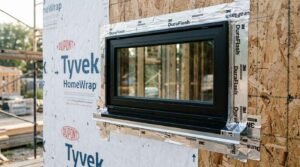
Installation, Sequencing, and Who Does the Work
Cladding installation sits at a critical junction in the build schedule. Get the sequence wrong, and you either trap moisture or tear out finished work.
I coordinate this stage tightly. Too many trades touch the wall in the same two weeks.
Where Cladding Falls in the Build Schedule
Cladding follows sheathing, water-resistive barrier, and window installation. It runs before final grading and often overlaps with roofing completion at the eaves.
Window and door integration is the highest-risk detail in the whole sequence. Proper window installation and flashing must be complete and inspected before any cladding covers the opening.
Trades Involved and Coordination Points
Siding crews, masons, plasterers, and metal specialists each own different materials, and mixed facades often need three of them. Painters follow, and roofers, electricians, and HVAC trades all penetrate the wall.
Every penetration needs flashing and sealing. I hold a single walk-through before cladding closes the wall, with every trade present.
Maintenance, Inspection, and Repair Over Time
Every cladding system needs a maintenance rhythm, even the ones marketed as maintenance-free. The rhythm is what determines whether the material reaches its rated lifespan.
I run inspections twice a year. Spring and fall catch nearly everything before it becomes structural.
Seasonal Inspection Points
Check sealant at all penetrations, butt joints, and material transitions. Look for peeling coating, staining below windows, and any soft spot in wood or trim.
Wash the walls annually to remove chalking, pollen, and organic growth. Gentle pressure washing removes buildup on fiber cement, vinyl, and masonry without damaging the finish, and it also reveals damage hiding under grime.
Repair, Refinish, or Replace
Isolated damage on lap siding and panel systems repairs cleanly board by board. Coating failure across a full elevation calls for refinishing rather than replacement.
Full replacement makes sense when the substrate behind the cladding shows moisture damage. At that point we open the wall, correct the assembly, and reclad properly.
Conclusion
Exterior cladding ties together material science, climate, code, cost, and architecture. You now understand every major option and how each performs over decades.
Each material here deserves its own deep dive, and the linked resources go further on installation, coatings, and repair specifics for your region.
We help you specify, install, and maintain the right exterior finish. Contact Mr. Local Services to connect with vetted exterior specialists today.
Frequently Asked Questions
What is the most durable exterior cladding for a custom home?
Brick and stone veneer last longest, routinely exceeding 75 years with almost no maintenance. Metal cladding and fiber cement follow closely at 40 to 60 years.
How much does exterior cladding cost on a custom home?
Installed costs run roughly $4 per square foot for vinyl to $60 for copper. Fiber cement, the common premium choice, lands between $8 and $16.
Can I mix two or three cladding materials on one house?
Yes, and most custom homes do. I keep it to two primary materials plus one accent, with deliberate flashing at every transition.
Which exterior finish needs the least maintenance?
Masonry veneer and metal panels need the least, requiring only annual washing and sealant checks. Vinyl also stays low because it never needs paint.
How often does exterior siding need repainting?
Field-painted fiber cement and wood need repainting every eight to twelve years. Factory-finished products stretch that to fifteen years or more.
Is stucco a good choice outside dry climates?
Traditional three-coat stucco performs well in humid climates with a proper drainage plane behind it. Barrier systems without drainage fail in wet regions.
What cladding works best in wildfire areas?
Fiber cement, stucco, masonry, and metal all qualify as ignition-resistant. Pair them with closed soffits and ember-resistant vents for full protection.