Earthen wall construction uses natural soil, clay, sand, and organic materials to build strong, long-lasting walls without conventional concrete or manufactured brick. Cob, adobe, and rammed earth are the three most widely used earthen building methods in the USA, each with a distinct process, material mix, and performance profile suited to different climates, budgets, and project types.
Homeowners and property managers choosing natural building materials need clear, practical information to make confident decisions about which method fits their property.
This guide explains how each earthen wall method works, compares their strengths and limitations, and covers what maintenance and professional support these structures require.
What Is Earthen Wall Construction?
Earthen wall construction is a building method that uses minimally processed natural materials — primarily soil, clay, sand, and fibrous organic matter — to form load-bearing or non-load-bearing walls. These techniques have been used for thousands of years across every inhabited continent, and they remain viable, code-compliant options for residential construction in many US states today.
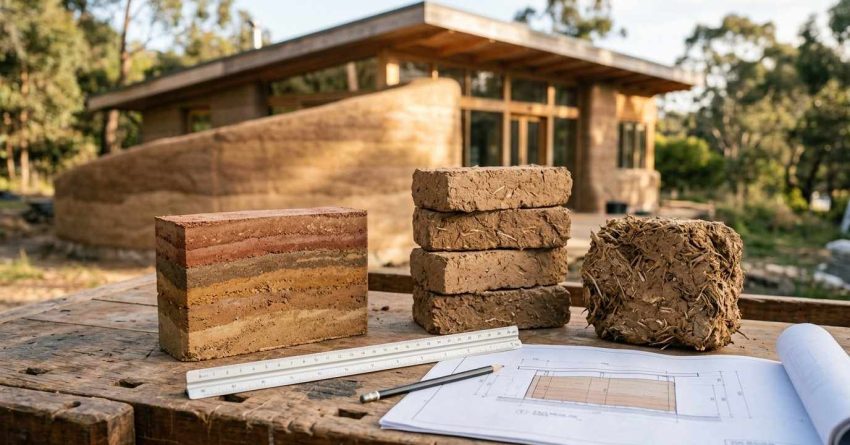
The three primary methods — cob, adobe, and rammed earth — share the same core material (earth) but differ significantly in how that material is shaped, dried, and assembled into a finished wall. Each method produces walls with high thermal mass, meaning they absorb heat during the day and release it slowly at night, which reduces heating and cooling loads in the right climate.
Earthen walls are not a niche or experimental choice. According to the United Nations Environment Programme, approximately one-third of the world’s population lives in earth-built homes, and interest in these methods has grown steadily in the USA as homeowners seek sustainable, low-embodied-carbon alternatives to conventional construction.
Earthen wall construction is one of several natural building methods that homeowners and builders use to create durable, low-impact structures — our complete guide to natural building methods covers the full range of sustainable construction approaches available in the USA today.
Cob Construction: Building With Earth and Straw
Cob is a hand-formed building method that combines subsoil, sand, water, and straw into a dense, monolithic mass. Unlike adobe, cob is not formed into individual bricks. Instead, builders mix the material on-site and apply it in successive layers directly onto the wall, sculpting it by hand or with simple tools as it dries.
Cob walls are typically 12 to 24 inches thick, which gives them excellent thermal mass and structural strength without any internal framing. The finished surface is smooth and can be left natural, lime-plastered, or finished with earthen plaster in a wide range of textures and colors.
Cob is especially popular in small-scale residential projects, and homeowners exploring tiny home construction often find cob walls to be a practical, cost-effective choice for compact, energy-efficient living spaces.
How Cob Walls Are Built
Building a cob wall begins with a rubble trench or concrete foundation that keeps the earthen material elevated above ground moisture. Builders mix the cob material — typically two to three parts subsoil to one part sand, with straw added for tensile strength — using feet, a tarp, or a mechanical mixer.
The mixed cob is applied in lifts of 8 to 12 inches and allowed to dry partially before the next layer is added. This process continues until the wall reaches its full height. Openings for windows and doors are formed during construction using wooden bucks or frames embedded directly in the cob mass.
Cob Wall Thickness and Structural Considerations
Cob walls must be thick enough to support their own weight and any roof loads placed on them. In most residential applications, a minimum wall thickness of 12 inches is standard, with 18 to 24 inches common for exterior load-bearing walls. Thicker walls improve thermal performance but require more material and longer drying time between lifts.
Cob is not suitable for areas with high seismic activity unless reinforced with internal bamboo, rebar, or mesh, and local building codes vary significantly in how they treat cob construction. Homeowners should verify permit requirements with their local jurisdiction before beginning any cob project.
Adobe Construction: Sun-Dried Brick Building
Adobe construction uses the same basic material as cob — a mixture of soil, clay, sand, and straw — but forms it into individual bricks that are sun-dried before being laid in courses with an earthen or lime mortar. This modular approach makes adobe faster to build with than cob on larger projects and allows bricks to be produced in advance and stockpiled on-site.
Adobe bricks are typically 4 inches thick, 10 inches wide, and 14 inches long, though dimensions vary by region and manufacturer. Walls are usually two bricks wide, producing a finished thickness of 10 inches or more. Adobe is one of the oldest building materials in North America and remains common in the American Southwest, where the dry climate supports both brick production and long-term wall performance.
How Adobe Bricks Are Made and Laid
Adobe bricks are formed by pressing the soil-straw mixture into wooden molds, then turning the bricks out onto flat ground to dry in the sun for two to four weeks. Properly dried bricks are hard, dimensionally stable, and resistant to crumbling under normal handling.
Bricks are laid in a running bond pattern — each brick offset from the one below — using a mortar made from the same soil mix used for the bricks. Window and door lintels are typically wood or reinforced concrete beams that span the opening and transfer roof loads to the surrounding wall mass.
Adobe Wall Durability and Maintenance
Adobe walls perform well in dry climates but are vulnerable to moisture damage in regions with significant rainfall or freeze-thaw cycles. Unprotected adobe exposed to sustained rain will erode at the base and face, eventually compromising structural integrity. Exterior lime plaster or cement stucco coatings are the standard protective finish in most US applications.
Adobe walls are particularly vulnerable to moisture intrusion over time, and when water damage does occur, professional water damage repair services can assess the extent of the problem and restore structural integrity before it spreads.
Rammed Earth Construction: Compressed Soil Walls
Rammed earth construction compresses a slightly moist mixture of gravel, sand, silt, and clay into temporary formwork using pneumatic or manual tampers. The compression process densifies the material to a hardness comparable to soft sandstone, producing walls that are structurally strong, visually striking, and highly durable without any firing or chemical treatment.
Modern rammed earth in the USA typically includes a small percentage of Portland cement — usually 5 to 10 percent by weight — to improve compressive strength and moisture resistance. This stabilized rammed earth variant is more predictable in performance and more widely accepted by building departments than unstabilized mixes.
The Rammed Earth Building Process
Rammed earth construction begins with formwork — typically plywood or steel panels — set to the finished wall dimensions. The soil mix is added in layers of 4 to 6 inches and compacted with a pneumatic tamper until each layer reaches its target density. The process repeats until the wall reaches full height, at which point the formwork is removed to reveal the finished surface.
The natural layering of different soil colors during compaction creates visible horizontal strata in the finished wall, which many homeowners and architects consider a design feature. Rammed earth walls are typically 12 to 18 inches thick and require no additional finish coating, though a penetrating sealer is often applied to improve moisture resistance.
Rammed Earth Performance and Insulation
Rammed earth walls have a high thermal mass but a relatively low R-value — typically R-0.45 per inch, or approximately R-6 to R-8 for a standard 14-inch wall. In climates with large daily temperature swings, this thermal mass performs well by moderating interior temperatures. In climates with sustained cold winters, supplemental insulation is often added to the exterior or interior face of the wall.
Homeowners who want to incorporate rammed earth walls into an existing property can work with experienced home remodeling services professionals who understand how to integrate compressed soil construction with modern structural systems.
Comparing Cob, Adobe, and Rammed Earth
Each earthen wall method has a distinct profile of strengths, limitations, and ideal use cases. The table below summarizes the key differences to help homeowners and property managers identify the right approach for their project.
| Factor | Cob | Adobe | Rammed Earth |
| Wall formation | Hand-sculpted monolithic | Modular sun-dried bricks | Compressed in formwork |
| Typical thickness | 12–24 inches | 10–14 inches | 12–18 inches |
| Best climate | Dry to semi-arid | Dry, low rainfall | Dry to temperate |
| Moisture resistance | Low (needs plaster) | Low (needs coating) | Moderate (sealer recommended) |
| Thermal mass | Very high | High | Very high |
| Skill requirement | Low to moderate | Low to moderate | Moderate to high |
| Equipment needed | Minimal | Minimal | Pneumatic tamper, formwork |
| Typical cost range | Low | Low to moderate | Moderate to high |
| Seismic performance | Poor (unless reinforced) | Moderate | Good (stabilized) |
No single method is universally superior. Cob suits small, owner-built projects in dry climates. Adobe is well-suited to larger residential builds in the American Southwest. Rammed earth is the strongest and most durable option but requires more equipment and technical expertise.
Benefits of Earthen Wall Construction for Homeowners
Earthen wall construction offers a set of practical advantages that go beyond aesthetics or environmental preference. For homeowners evaluating long-term property value and operating costs, these benefits are worth understanding in concrete terms.
Thermal performance. The high thermal mass of earthen walls reduces peak heating and cooling loads, which translates directly to lower energy bills in climates with significant day-night temperature variation. The US Department of Energy identifies thermal mass as a key passive solar design strategy that can meaningfully reduce HVAC demand in the right building configuration.
Material cost. The primary raw material — soil — is often available on-site or sourced locally at minimal cost. Labor is the dominant expense in earthen wall construction, particularly for cob and adobe, where hand-forming is time-intensive.
Indoor air quality. Earthen walls do not off-gas volatile organic compounds (VOCs) and regulate interior humidity naturally by absorbing and releasing moisture vapor. This contributes to a healthier indoor environment compared to many conventional wall assemblies.
Longevity. Well-maintained earthen walls in appropriate climates last for centuries. Adobe structures in New Mexico and the American Southwest have stood for hundreds of years with periodic replastering and basic upkeep.
Environmental impact. Earthen wall construction has a very low embodied carbon footprint compared to concrete, steel, or fired brick. The Carbon Leadership Forum identifies embodied carbon in building materials as a significant contributor to total lifecycle emissions, and earthen materials rank among the lowest available options.
Earthen Wall Repair and Maintenance
Earthen walls require periodic maintenance to remain structurally sound and weather-resistant. The most common maintenance tasks involve repairing surface erosion, resealing cracks, and reapplying protective plaster or stucco coatings.
Surface cracks are normal in earthen walls and typically result from seasonal moisture cycling or minor settling. Hairline cracks can be filled with a matching earthen plaster mix and smoothed flush with the surrounding surface. Larger cracks — particularly those that run vertically through the full wall thickness — should be evaluated by a professional before repair, as they may indicate foundation movement or structural stress.
Routine maintenance tasks like resealing cracks, reapplying plaster, and patching damaged sections are well within the scope of skilled handyman repair services professionals who work with specialty wall materials.
Base erosion — where the bottom of the wall is splashed by rain or exposed to standing water — is the most serious maintenance concern for cob and adobe walls. Addressing it promptly prevents progressive structural loss. When earthen wall damage extends to interior finishes or ceiling connections, coordinating with a drywall and ceiling repair specialist ensures the surrounding surfaces are restored to match the original finish.
Maintenance frequency depends on climate, finish type, and wall exposure. In dry climates with good roof overhangs, earthen walls may need replastering only every 10 to 20 years. In wetter climates or on exposed elevations, annual inspection and spot repairs are standard practice.
Hiring Professionals for Earthen Wall Projects
Earthen wall construction is not a standard service offered by conventional general contractors. Homeowners should look specifically for builders with documented experience in the method they are planning to use — cob, adobe, or rammed earth — and request references from completed projects in a similar climate.
Key qualifications to verify include familiarity with local building codes and permit requirements for earthen construction, experience with the specific soil types available in your region, and knowledge of appropriate foundation and moisture protection details. In states where earthen construction is more common — New Mexico, Arizona, California, and Colorado — there are established networks of experienced builders and owner-builder support organizations.
For repair and maintenance work on existing earthen wall structures, a skilled general contractor or handyman with natural building experience can handle most routine tasks. For structural repairs, foundation issues, or significant moisture damage, a licensed structural engineer with earthen construction experience should assess the wall before any repair work begins.
Homeowners ready to move forward with an earthen wall project can explore the broader context of material selection, site preparation, and contractor vetting in our sustainable building guide, which covers every phase of the planning process.
If you are planning an earthen wall project or need maintenance support for an existing structure, Mr. Local Services connects you with skilled professionals who understand specialty construction materials and can deliver reliable results from assessment through completion.
Conclusion
Cob, adobe, and rammed earth each offer a proven, sustainable path to durable residential walls with strong thermal performance and low environmental impact. Understanding how these methods differ in process, climate suitability, and maintenance requirements helps homeowners make informed decisions that align with their property goals and local conditions.
Earthen wall construction rewards careful planning, appropriate material selection, and consistent maintenance — all of which contribute directly to long-term property value and structural integrity.
Mr. Local Services connects homeowners and property managers with experienced professionals who handle earthen wall repair, maintenance, and specialty construction projects with the expertise and reliability these structures demand.
Frequently Asked Questions
How long do earthen walls last?
Well-maintained earthen walls in appropriate climates can last for centuries. Adobe structures in the American Southwest have stood for hundreds of years with periodic replastering and basic upkeep. Longevity depends on climate, moisture protection, and maintenance frequency.
Are earthen walls legal to build in the USA?
Yes, earthen wall construction is legal in many US states, but permit requirements vary significantly by jurisdiction. New Mexico, Arizona, California, and Colorado have the most established code frameworks for cob, adobe, and rammed earth. Always verify local building department requirements before starting any earthen wall project.
Which earthen wall method is the cheapest to build?
Cob and adobe are generally the least expensive earthen wall methods because they require minimal equipment and the primary material — soil — is often available on-site. Rammed earth typically costs more due to formwork and pneumatic tamping equipment requirements, though stabilized rammed earth offers superior durability in return.
Can earthen walls be used in wet or cold climates?
Earthen walls perform best in dry climates with low annual rainfall. In wetter or colder regions, they require robust moisture protection — including wide roof overhangs, elevated foundations, and exterior lime plaster or cement stucco coatings — to prevent erosion and freeze-thaw damage. Rammed earth with stabilization is the most moisture-resistant of the three methods.
How thick do earthen walls need to be?
Cob walls are typically 12 to 24 inches thick. Adobe walls are usually 10 to 14 inches thick. Rammed earth walls range from 12 to 18 inches. Thickness affects both structural capacity and thermal mass performance, so the right dimension depends on the building’s load requirements and climate.
What maintenance do earthen walls require?
Earthen walls need periodic inspection for surface cracks, base erosion, and plaster deterioration. Hairline cracks can be patched with matching earthen plaster. Protective coatings should be reapplied as needed — every 10 to 20 years in dry climates, more frequently in wetter conditions. Prompt attention to moisture damage prevents progressive structural loss.
Can I repair an earthen wall myself?
Minor surface repairs — filling hairline cracks, patching small areas of eroded plaster — are manageable for experienced DIYers using matching earthen or lime plaster mixes. Larger structural repairs, foundation-related cracking, or significant moisture damage should be assessed and repaired by a professional with earthen construction experience before the problem worsens.