An earthship home is a radically self-sufficient dwelling built from natural and recycled materials — designed to generate its own energy, collect its own water, manage its own waste, and grow its own food without relying on conventional utility infrastructure. These structures represent one of the most comprehensive approaches to sustainable residential living available to homeowners today.
Understanding earthship construction matters now more than ever as energy costs rise, environmental concerns intensify, and homeowners seek greater independence from aging utility systems. Without a clear framework, the complexity of earthship systems can overwhelm even experienced property owners and builders.
This guide covers earthship design principles, construction methods, structural systems, energy and water independence, interior finishing, permits, costs, maintenance, and how professional services support every phase of ownership.
What Is an Earthship Home and How Does It Work?
An earthship home is a type of passive solar, off-grid dwelling pioneered by architect Michael Reynolds in the 1970s, constructed primarily from earth-rammed tires, recycled bottles, cans, and natural materials — engineered to function as a closed-loop living system that heats and cools itself, collects and recycles water, generates electricity, and produces food without connection to municipal utilities.
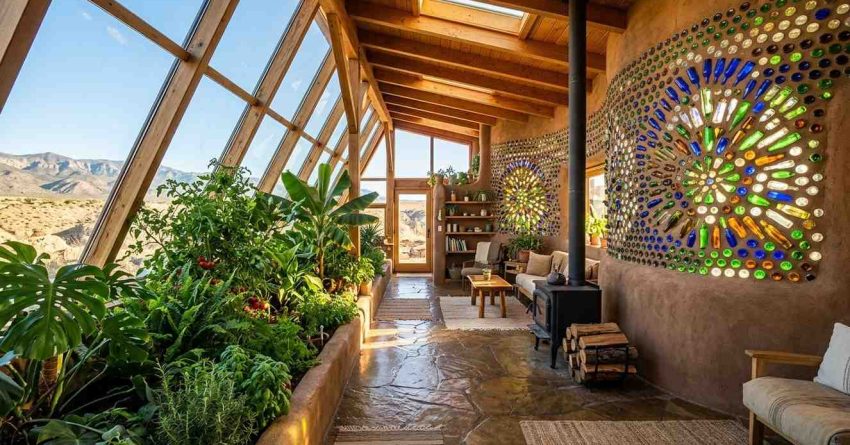
The defining characteristic of an earthship is not simply its materials but its systems integration. Every component serves multiple functions simultaneously. The thermal mass walls — typically constructed from tires packed tightly with compacted earth — absorb solar heat during the day and release it slowly at night, maintaining interior temperatures within a comfortable range year-round without mechanical heating or cooling in most climates. The south-facing greenhouse wall admits winter sunlight while the earth-bermed north wall insulates against cold.
Six core systems define every earthship:
- Thermal and solar heating and cooling through passive design and thermal mass
- Solar and wind electricity generation through photovoltaic panels and small turbines
- Water harvesting from rain and snowmelt collected from the roof
- Contained sewage treatment through interior and exterior botanical cells
- Food production in the integrated greenhouse and exterior garden beds
- Building with natural and recycled materials to minimize environmental impact
What distinguishes earthships from other sustainable homes is the deliberate interdependence of these systems. Water collected from the roof flows first to household use, then to interior planters, then to a contained greywater system, then to exterior landscaping — each stage extracting maximum value before the water leaves the property. This cascading resource model is the philosophical and engineering core of earthship design.
Earthships exist on a spectrum from fully off-grid rural builds to urban-adapted versions that maintain some utility connections while dramatically reducing consumption. Understanding where a specific build falls on that spectrum shapes every decision from site selection through long-term maintenance planning.
Earthship Design Principles and Architectural Philosophy
Earthship architecture is governed by a set of interlocking design principles that prioritize passive performance, material efficiency, and human comfort — principles that must be understood before any site is selected or any material is sourced.
The foundational principle is thermal mass combined with passive solar orientation. Every earthship is oriented with its primary glazed face toward true south (in the Northern Hemisphere) to maximize solar gain during winter months. The glazing angle, roof overhang depth, and thermal mass volume are calculated together to ensure the building captures heat when needed and sheds it when temperatures rise. This is not decorative architecture — it is precision environmental engineering expressed in earth and glass.
The second principle is earth integration. Earthships are typically built into a hillside or bermed with earth on three sides, using the ground’s stable temperature (approximately 55°F at depth in most North American climates) as a thermal buffer. This dramatically reduces the heating and cooling load the building must manage through passive solar alone.
The third principle is material honesty. Earthship design treats waste materials — tires, bottles, cans, reclaimed lumber — as structural and aesthetic resources rather than liabilities. This philosophy reduces construction costs, diverts materials from landfills, and creates the distinctive visual character that defines earthship interiors and exteriors.
The fourth principle is systems redundancy. No single system is relied upon exclusively. Water collection is supplemented by well or municipal backup. Solar generation is paired with battery storage and sometimes a generator. Food production supplements but does not replace purchased food. This layered redundancy is what makes earthships genuinely livable rather than merely experimental.
Architectural variations include the original Global Model with its curved tire walls and U-shaped floor plan, the Packaged Earthship designed for faster construction, the Simple Survival model for minimal-cost builds, and the Hybrid Earthship that integrates conventional framing with earthship systems — each suited to different climates, budgets, and regulatory environments.
Site Selection and Land Requirements for Earthship Construction
Choosing the right site for an earthship is among the most consequential decisions in the entire build process, because the land itself is a primary building material and performance component — not simply a location.
Solar access is the non-negotiable starting point. The site must provide unobstructed southern exposure throughout the winter months. Shade from trees, hills, or neighboring structures during peak solar hours will fundamentally compromise the thermal performance of the building. A solar site analysis using tools such as a sun path diagram or digital modeling software should be completed before any land purchase is finalized.
Topography determines how effectively the building can be earth-bermed. A gentle south-facing slope is ideal — it allows the north wall to be set into the hillside while the south face opens to sunlight and views. Flat sites require imported earth for berming, which adds cost and labor. Steep slopes introduce drainage and structural complexity.
Soil composition affects both construction feasibility and water management. Clay-heavy soils compact well inside tires but drain poorly, which can create challenges for the earthship’s greywater and blackwater botanical cells. Sandy or loamy soils drain effectively but may require soil amendment for tire-packing. A basic soil test before purchase is a minimal investment that prevents significant problems later.
Water availability matters even for a building designed to harvest its own water. Annual precipitation data for the site determines whether roof catchment alone can meet household needs or whether a well, cistern supplementation, or municipal backup connection is required. In arid climates, water planning is as critical as solar planning.
Regulatory environment varies dramatically by county and state. Some jurisdictions in New Mexico, Colorado, and other western states have established pathways for earthship permitting. Others require extensive engineering documentation or variance applications. Researching zoning classifications, building codes, and health department requirements for alternative septic systems before purchasing land prevents costly surprises.
Access to the site for heavy equipment — tire delivery, excavation machinery, concrete trucks — is a practical consideration that is frequently underestimated in early planning stages.
Earthship Construction Methods and Building Materials
Earthship construction combines labor-intensive hand-building techniques with conventional construction practices in a sequence that differs significantly from standard residential building — understanding this sequence is essential for accurate scheduling, budgeting, and contractor coordination.
Tire walls form the structural and thermal core of most earthship designs. Each tire is placed in a running bond pattern, filled with compacted earth using sledgehammers, and stacked to form load-bearing walls typically 2.5 to 3 feet thick. A standard earthship requires between 800 and 1,200 tires depending on floor plan size. Tire packing is physically demanding work — each tire requires approximately 300 pounds of compacted earth — and is well-suited to organized volunteer labor or community building events that have become a tradition in the earthship community.
Bottle and can walls fill non-load-bearing interior partitions and decorative elements. Glass bottles are mortared together with cement to create translucent panels that admit colored light. Aluminum cans are similarly mortared into walls, providing thermal mass and visual texture. These elements are among the most visually distinctive features of earthship interiors and require no specialized skills beyond basic masonry patience.
Adobe and cob finishing covers the tire walls inside and out, creating smooth curved surfaces that are plastered, painted, or left in natural earth tones. The finishing layer also seals the tires from UV exposure, which degrades rubber over time if left exposed.
Conventional framing is used for the south-facing greenhouse structure, roof framing, and in hybrid designs for portions of the building that benefit from lighter construction. Engineered lumber, steel posts, or reclaimed timber are all used depending on structural requirements and local material availability.
Concrete and rebar are used for bond beams at the top of tire walls, foundation footings, and floor slabs. The floor is typically a poured concrete slab with radiant heating tubes embedded — a conventional system that works in concert with the passive solar design to distribute stored heat evenly.
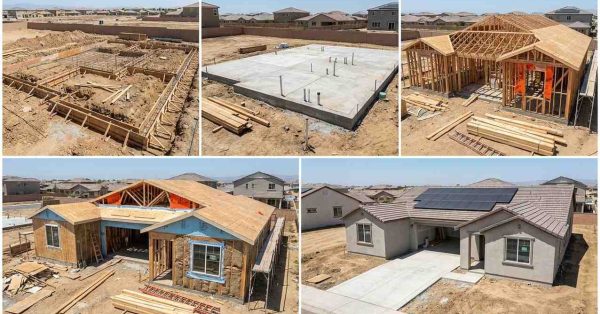
The construction sequence typically runs: site excavation and foundation, tire wall construction, bond beam and roof framing, glazing installation, rough mechanical systems (electrical, plumbing, HVAC backup), concrete floor pour, interior and exterior plastering, finish work, and systems commissioning.
Earthship Energy Systems: Solar, Wind, and Battery Storage
Energy independence is one of the defining promises of earthship living, and the electrical systems that deliver it combine photovoltaic solar generation, optional wind generation, battery storage, and power management electronics into an integrated off-grid power plant sized to the household’s actual consumption needs.
Photovoltaic solar panels are the primary generation source in virtually all earthship installations. Panel arrays are typically roof-mounted or ground-mounted on the south-facing slope, sized to generate sufficient daily energy to meet household needs while accounting for seasonal variation in solar availability. A typical earthship household requires between 2 kW and 6 kW of installed solar capacity depending on climate, occupancy, and appliance loads.
Battery storage is the component that transforms intermittent solar generation into reliable 24-hour power. Traditional earthship builds used lead-acid battery banks — large, heavy, and requiring regular maintenance but relatively low in upfront cost. Modern builds increasingly use lithium iron phosphate (LiFePO4) battery systems, which offer longer cycle life, higher depth of discharge, and significantly reduced maintenance requirements at a higher initial cost. Battery bank sizing is calculated from daily consumption estimates and the number of autonomy days — consecutive cloudy days the system must sustain without generation.
Charge controllers regulate the flow of power from panels to batteries, preventing overcharge and optimizing charging efficiency. Modern MPPT (Maximum Power Point Tracking) controllers extract significantly more energy from panels than older PWM controllers, particularly in variable light conditions.
Inverters convert the DC power stored in batteries to the AC power used by standard household appliances. Inverter sizing must account for both continuous load and surge capacity — the brief high-draw moment when motors in appliances like refrigerators and well pumps start.
Wind generation supplements solar in locations with consistent wind resources, providing generation during cloudy periods when solar output drops. Small wind turbines in the 400W to 2kW range are most common in earthship applications.
Energy conservation is as important as generation capacity in earthship design. LED lighting, Energy Star appliances, efficient water heating, and behavioral conservation practices all reduce the generation and storage capacity required — and therefore the system cost.
Earthship Water Systems: Harvesting, Filtration, and Greywater Recycling
Water independence in an earthship is achieved through a four-stage cascade system that collects rainwater from the roof, filters it for household use, recycles greywater through interior planters, and manages blackwater through contained botanical cells — a closed-loop approach that can reduce or eliminate dependence on municipal water and conventional septic systems.
Roof catchment is the entry point of the water system. The earthship roof is designed as a collection surface, channeling rain and snowmelt into cisterns — typically buried polyethylene tanks ranging from 5,000 to 30,000 gallons depending on household size and local precipitation. Roof area, annual precipitation, and household consumption are the three variables that determine whether catchment alone can meet needs or whether supplemental sources are required.
Filtration and treatment converts collected rainwater into potable household water. A multi-stage filtration system typically includes sediment pre-filters, activated carbon filters, and ultraviolet sterilization. Some systems add reverse osmosis for the highest water quality. The filtration system requires periodic filter replacement and UV lamp maintenance — straightforward tasks that any homeowner can perform with basic instruction.
Greywater recycling is the system that gives earthship water its cascading efficiency. Water used in sinks, showers, and laundry — greywater — flows to interior planter cells rather than directly to a septic system. These planters, typically built along the south-facing greenhouse wall, use the nutrients in greywater to support food-producing plants while the plants and soil biologically treat the water before it flows to a contained outdoor botanical cell for final treatment and evapotranspiration.
Blackwater management handles toilet waste through a contained septic system — either a conventional septic tank and leach field or an earthship-specific rubber-lined outdoor botanical cell that treats waste through plant uptake and evaporation. Regulatory approval for alternative blackwater systems varies significantly by jurisdiction and is one of the most common permitting challenges earthship builders face.
Water system maintenance includes regular filter replacement, annual cistern inspection, monitoring of planter health as an indicator of greywater system function, and periodic inspection of cistern inlet screens and overflow systems.
Earthship Food Production: The Integrated Greenhouse and Garden Systems
Food production is the earthship system that most directly connects the building to its occupants’ daily lives — the south-facing greenhouse is not an amenity but a functional component of the home’s resource systems, providing fresh produce year-round while simultaneously managing greywater and contributing to interior climate regulation.
The interior greenhouse runs the full length of the south-facing wall, typically 4 to 8 feet deep, enclosed by the angled glazing that also admits solar heat to the living spaces behind it. This space maintains temperatures warm enough for year-round food production in most North American climates, even when exterior temperatures drop well below freezing. Banana trees, citrus, herbs, leafy greens, tomatoes, and peppers are among the most productive crops in earthship greenhouse conditions.
Planter cell design integrates food production with greywater treatment. The planter cells that receive household greywater are planted with food crops and ornamental plants that thrive in the nutrient-rich water. This dual function — food production and water treatment — is a core example of the earthship’s systems integration philosophy.
Exterior garden beds extend food production beyond the greenhouse during the growing season. Earthship sites typically include raised beds, swales, and food forest plantings that take advantage of the site’s water management features — roof runoff, greywater overflow, and condensation from the building’s thermal systems all contribute to exterior landscape irrigation.
Soil management in earthship planters requires attention to nutrient balance, pH, and biological activity. Because the planters receive greywater rather than fresh water, salt accumulation can become a concern over time and is managed through periodic flushing with fresh water and soil amendment.
Food production in an earthship is supplementary rather than complete self-sufficiency for most households — the greenhouse provides fresh produce and herbs year-round but does not replace grocery shopping. The value is in the daily connection to food systems, the reduction in grocery costs, and the contribution to the building’s overall resource efficiency.
Earthship Permits, Codes, and Legal Considerations
Navigating the regulatory landscape is consistently identified by earthship builders as one of the most challenging and time-consuming aspects of the entire project — not because earthships are inherently unsafe, but because building codes were written for conventional construction and alternative methods require documentation, engineering review, and sometimes variance applications that conventional builds do not.
Building permits are required in virtually all jurisdictions for any permanent dwelling. The earthship’s non-standard construction methods — tire walls, alternative septic systems, rainwater harvesting for potable use — each require documentation demonstrating that the building meets the intent of applicable codes even when it does not follow conventional prescriptive methods. Structural engineering calculations for tire wall load capacity, energy modeling for passive solar performance, and water quality testing protocols for rainwater systems are commonly required.
Zoning regulations determine whether a dwelling can be built on a given parcel at all, and whether alternative construction methods are permitted. Agricultural and rural residential zones typically offer the most flexibility. Some counties — particularly in New Mexico, where earthship construction has the longest history — have developed specific alternative construction pathways that streamline the permitting process.
Health department approval for alternative water and septic systems is a separate regulatory track from building permits in most states. Rainwater harvesting for potable use is regulated differently in every state — legal and encouraged in some, restricted in others, and subject to specific treatment and testing requirements in most. Alternative septic systems require health department review and approval before construction begins.
Owner-builder exemptions exist in many states, allowing property owners to act as their own general contractor and perform their own construction work without a contractor’s license. These exemptions vary in scope and have important implications for insurance, financing, and future resale.
Working with a permit expediter or attorney familiar with alternative construction in the target jurisdiction can significantly reduce the time and cost of the permitting process. Connecting with the earthship community in the target region — through organizations like Earthship Biotecture or regional alternative building networks — provides access to permit documentation that has already been approved in similar jurisdictions.
Earthship Construction Costs and Budget Planning
Earthship construction costs vary more widely than almost any other residential building type — from under $50,000 for a minimal owner-built structure using volunteer labor to over $500,000 for a professionally built, fully finished earthship with premium systems — and understanding the variables that drive this range is essential for realistic budget planning.
Labor is the largest variable in earthship construction costs. Tire packing, bottle wall construction, and plastering are labor-intensive processes that are well-suited to owner-builder participation and organized volunteer labor. Earthship builds that leverage community labor events — where groups of volunteers pack tires in exchange for meals, camping, and the experience — can dramatically reduce labor costs for the most time-consuming phases of construction. Professional labor for the same work adds significant cost but reduces the time commitment required from the owner.
Materials for an earthship are a mix of free or very low-cost recycled materials and conventional construction materials at standard market prices. Tires are typically available free from tire shops and recycling centers. Bottles and cans are similarly free or very low cost. Conventional materials — concrete, rebar, lumber, glazing, roofing, electrical components, plumbing fixtures, solar panels, batteries, inverters — are purchased at market rates and represent the majority of material costs.
Systems costs — solar, battery storage, water filtration, and backup systems — have declined significantly over the past decade as solar and battery technology has matured. A complete off-grid electrical system for a typical earthship household currently costs between $15,000 and $40,000 depending on system size and battery technology. Water systems add $5,000 to $15,000 depending on cistern size and filtration complexity.
Land costs vary enormously by location and are separate from construction costs. Rural land suitable for earthship construction in the American Southwest can be found for $5,000 to $50,000 per acre. Land in more populated regions or with better access commands significantly higher prices.
Professional design and engineering fees for earthship projects typically run 10 to 15 percent of construction costs and include architectural design, structural engineering, energy modeling, and permit documentation.
A realistic budget framework for a 1,500 to 2,000 square foot earthship in a favorable regulatory environment, using a combination of owner labor and professional subcontractors, typically falls between $150,000 and $300,000 for construction costs excluding land — with significant variation based on finish level, systems choices, and labor strategy.
Earthship Interior Design and Finishing
The interior of an earthship offers a design environment unlike any conventional home — curved walls, bottle glass light panels, integrated planters, and the warm texture of earth plaster create a living space that is simultaneously ancient and contemporary, and finishing choices made during construction define the character of the home for decades.
Earth plaster is the primary interior finish material. Applied over tire walls and framing in multiple coats, earth plaster creates smooth, sculptural surfaces that can be left in natural earth tones, tinted with natural pigments, or finished with lime plaster for a brighter, more reflective surface. Earth plaster is breathable, repairable, and adds to the thermal mass of the wall assembly. It is also one of the most accessible finish skills for owner-builders to develop.
Bottle glass panels are among the most visually striking interior elements. Arranged in geometric patterns and mortared into non-load-bearing walls, bottle glass panels transmit colored light that changes character throughout the day as the sun moves. The design possibilities are extensive — from simple grid patterns to elaborate mandalas and murals — and the material cost is essentially zero.
Flooring in earthships is typically polished concrete, tile, or natural stone — materials with high thermal mass that contribute to the building’s passive solar performance by absorbing and releasing heat. Radiant heating tubes embedded in the concrete slab provide supplemental warmth during extended cold periods and are one of the most comfortable heating systems available.
Built-in furniture and cabinetry are commonly integrated into earthship interiors, using the curved walls and niches created by the tire wall geometry to create shelving, seating, and storage that feels organic to the space rather than added to it. Adobe benches, cob shelving, and reclaimed wood cabinetry are all common approaches.
Lighting design in an earthship must account for the building’s passive solar orientation — south-facing spaces receive abundant natural light while north-facing spaces are darker and benefit from thoughtful artificial lighting design. LED systems powered by the earthship’s solar electrical system are standard.
Earthship Maintenance and Long-Term Ownership
Earthship homes require a different maintenance mindset than conventional houses — the systems that make them self-sufficient also require regular attention to function reliably, and owners who understand their building’s systems are far better positioned to maintain performance and prevent costly failures.
Solar and electrical system maintenance includes annual inspection of panel connections and mounting hardware, battery state-of-health monitoring, inverter firmware updates, and replacement of aging components on manufacturer-recommended schedules. Battery banks — particularly lead-acid systems — require regular electrolyte checks and equalization charging. Solar panels should be cleaned periodically to maintain generation efficiency, particularly in dusty environments.
Water system maintenance is the most frequent maintenance task in earthship ownership. Sediment pre-filters require replacement every one to three months depending on water quality. Carbon filters and UV lamps follow manufacturer replacement schedules. Cisterns should be inspected annually for sediment accumulation and inlet screen condition. Interior planter health is a useful indicator of greywater system function — declining plant health often signals a water chemistry or flow issue before it becomes a system failure.
Structural maintenance for earthship walls is minimal compared to conventional construction — tire walls do not rot, warp, or require painting. Earth plaster does require periodic repair where cracking occurs, particularly in the first few years as the building settles. Exterior plaster exposed to weather requires more frequent attention than interior surfaces and benefits from a lime or cement-stabilized finish coat for durability.
Roof maintenance follows conventional practices — inspection after major weather events, gutter and downspout cleaning to maintain water catchment efficiency, and periodic inspection of roofing membrane or metal roofing fasteners.
Greenhouse maintenance includes soil amendment, pest management, pruning, and replanting as crops complete their cycles. The greenhouse environment — warm, humid, and productive — also requires monitoring for fungal issues that can spread from plants to the building’s wood framing if ventilation is inadequate.
Seasonal preparation includes winterizing water lines in exposed locations, checking battery charge levels before extended cloudy periods, and inspecting the building envelope for any gaps or damage that could compromise thermal performance.
Homeowners who invest time in understanding their earthship’s systems — ideally through the construction process itself or through formal earthship academy training — are significantly better equipped for long-term ownership than those who treat the building as a black box. For maintenance tasks that exceed owner capability or comfort, connecting with professionals experienced in off-grid systems, alternative construction, and sustainable building is the most reliable path to keeping an earthship performing at its design potential. Our earthship home maintenance and repair services cover every system from solar and water to structural repairs and plaster restoration, giving earthship owners a single trusted resource for professional support across the full lifecycle of their home.
Professional Services for Earthship Homeowners
While earthship philosophy celebrates owner-builder participation and self-sufficiency, the reality of long-term ownership is that professional services play an important role at every stage — from initial design and permitting through construction, systems installation, and ongoing maintenance.
Design and engineering services are essential for any earthship project navigating formal permitting. Architects and engineers with earthship or alternative construction experience can produce the structural calculations, energy models, and permit documentation that jurisdictions require — and their familiarity with the specific challenges of earthship permitting can save months of back-and-forth with building departments.
Specialized construction contractors with earthship or natural building experience are available in regions where earthship construction has a longer history — particularly New Mexico, Colorado, Arizona, and California. These contractors understand tire wall construction, earth plaster application, passive solar design, and the integration of off-grid systems in ways that conventional contractors do not.
Solar and off-grid electrical contractors design, install, and commission the photovoltaic, battery, and power management systems that provide earthship electricity. Proper system sizing, component selection, and installation quality are critical to long-term reliability — undersized or poorly installed systems are the most common source of earthship owner dissatisfaction.
Plumbing contractors familiar with rainwater harvesting, greywater systems, and alternative septic installations are essential for the water systems that define earthship performance. These systems require both technical expertise and familiarity with local regulatory requirements.
General home service professionals — handymen, painters, flooring specialists, window and door contractors, and general maintenance providers — support the conventional elements of earthship construction and maintenance that do not differ significantly from standard residential work. Finding service providers willing to work in an earthship environment and comfortable with its unconventional materials and systems is an important part of building a reliable maintenance network.
Mr. Local Services connects earthship homeowners and property managers with skilled professionals across every service category — from specialized off-grid systems maintenance to general home repair and improvement — providing the reliable, end-to-end support that keeps earthship homes performing at their full potential year after year.
Conclusion
Earthship homes integrate passive solar design, recycled materials, off-grid energy, water harvesting, and food production into a unified living system that offers genuine independence from conventional utility infrastructure.
Mastering earthship ownership means understanding how each system connects to the others — and knowing when professional expertise strengthens what self-sufficiency alone cannot fully sustain across every phase of the building’s life.
At Mr. Local Services, our network of skilled professionals supports earthship homeowners with reliable maintenance, repair, and improvement services — keeping your sustainable home performing at its full potential every season.
Frequently Asked Questions
What makes an earthship different from other sustainable or green homes?
An earthship is distinguished by its complete systems integration — it generates electricity, harvests water, manages waste, and produces food as interconnected functions of the building itself, rather than adding green features to a conventional structure. Most sustainable homes reduce consumption; earthships are designed to function independently of utility infrastructure entirely.
How long does it take to build an earthship home?
A typical earthship takes one to three years from site selection through occupancy, depending on owner-builder participation, permitting complexity, and construction approach. Owner-built projects with volunteer labor phases take longer but cost significantly less than professionally contracted builds.
Can an earthship be built in cold climates?
Yes. Earthships have been successfully built and occupied in cold climates including Canada, northern Europe, and high-altitude locations in the American Rockies. Cold-climate designs require larger solar panel arrays, greater battery storage capacity, and careful attention to glazing performance and thermal mass sizing to maintain comfortable interior temperatures.
Do earthships require building permits?
In most jurisdictions, yes. Earthships are permanent dwellings and require building permits, though the permitting process is more complex than for conventional construction due to non-standard materials and systems. Some counties have established alternative construction pathways; others require engineering documentation and variance applications.
How much does it cost to maintain an earthship annually?
Annual maintenance costs for a well-built earthship are typically lower than for a comparable conventional home, primarily because there are no utility bills. Ongoing costs include solar system maintenance, water filter replacement, earth plaster repairs, and general home maintenance — typically ranging from $1,500 to $5,000 per year depending on system age and owner participation in maintenance tasks.
Is earthship living truly off-grid, or do most owners maintain some utility connections?
Most earthship owners operate fully off-grid for electricity and water, but some maintain a municipal water backup connection or a propane backup generator for extended periods of low solar generation. The degree of utility independence depends on system sizing, climate, and owner preference — earthship design supports full independence but does not require it.
Can an earthship home be financed with a conventional mortgage?
Conventional mortgage financing for earthships is challenging because most lenders require standard appraisal comparables that do not exist for earthship properties. Owner-builder construction loans, land loans combined with personal construction financing, and portfolio lenders familiar with alternative construction are the most common financing paths for earthship projects.