A barndominium is a hybrid structure combining a barn or metal building shell with fully finished residential living quarters, offering homeowners a durable, cost-efficient, and highly customizable alternative to traditional stick-built homes. Originally popularized across rural America, barndominiums have expanded into suburban and semi-rural markets as buyers seek more space, lower per-square-foot costs, and flexible floor plans that traditional construction rarely delivers.
Understanding what a barndominium involves before you build, buy, or finance one determines whether the project succeeds or stalls. Skipping foundational knowledge leads to budget overruns, zoning conflicts, financing denials, and maintenance surprises that cost far more than proper planning would have.
This guide covers barndominium types and styles, construction methods, costs and budgeting, floor plan design, site preparation, financing options, interior finishing, utilities and systems, permits and zoning, maintenance, and how to choose the right builder — giving you a complete orientation across every dimension of the barndominium journey.
What Is a Barndominium?
A barndominium is a residential structure built within or converted from a metal, steel, or post-frame barn shell, designed to function as a full-time home, vacation property, or combined living-and-workspace. The term blends “barn” and “condominium,” though modern barndominiums bear little resemblance to traditional agricultural barns beyond their structural framing approach.
The defining characteristic of a barndominium is its post-frame or steel-frame construction system. Rather than relying on load-bearing interior walls like conventional wood-frame homes, barndominiums use large exterior columns spaced at regular intervals to carry the structural load. This creates wide-open interior spans that homeowners can configure freely — a flexibility that conventional construction cannot easily replicate without significant engineering costs.
Barndominiums serve several distinct use cases. Some owners build them as primary residences on rural acreage, combining living space with workshop, garage, or agricultural storage under one roof. Others construct them as vacation retreats, rental properties, or downsized retirement homes. The “barndo” category has also expanded to include fully urban-style interiors with high-end finishes, vaulted ceilings, and open-concept layouts that rival custom luxury homes in appearance while maintaining the structural efficiency of metal construction.
According to data from the National Association of Home Builders, post-frame construction has grown steadily as a residential building method, driven by material cost advantages and faster build timelines compared to traditional framing. The average barndominium delivers 30–50% more usable square footage per dollar than a comparable stick-built home in the same market, making the value proposition compelling for budget-conscious buyers and large-family households alike.
The barndominium category is broad. Shell-only kits, custom-designed builds, converted agricultural structures, and prefabricated modular units all fall under the barndominium umbrella — which is why understanding the full landscape before committing to a build path is essential for every prospective owner.
Types and Styles of Barndominiums
Barndominiums are not a single product category. They span a wide range of structural approaches, aesthetic styles, and functional configurations — and choosing the right type early in the planning process shapes every decision that follows, from site selection to financing to interior design.
Metal and Steel Frame Barndominiums
Steel-frame barndominiums use a rigid steel skeleton as the primary structural system. Steel offers exceptional strength-to-weight ratios, resistance to fire, pests, and rot, and the ability to span very large distances without interior support columns. These builds are common in regions with high wind loads, heavy snow, or extreme temperature swings, where the durability of steel outperforms wood framing over the long term.
Post-Frame (Pole Barn) Barndominiums
Post-frame construction uses large vertical posts embedded in the ground or anchored to a concrete foundation, with horizontal girts and purlins connecting them to form the wall and roof structure. Post-frame barndominiums are among the most cost-effective build types, with material and labor costs typically 15–25% lower than steel-frame equivalents at comparable square footage. They are the dominant barndominium construction method across the American Midwest and South.
Converted Barn Barndominiums
Some barndominiums begin as existing agricultural structures — old dairy barns, hay storage buildings, or equipment sheds — that are renovated and converted into residential living spaces. Conversions can preserve historic character and reduce material costs but often require significant structural assessment, foundation work, and systems upgrades to meet modern residential building codes.
Prefabricated and Kit Barndominiums
Prefabricated barndominium kits are factory-engineered packages that include the structural frame, roofing panels, wall panels, doors, and windows — delivered to the build site ready for assembly. Kit barndominiums reduce design time and material sourcing complexity, though the interior finishing, foundation, and systems work still require local contractors and represent the majority of the total project cost.
Hybrid and Custom Barndominiums
Hybrid barndominiums combine metal or post-frame structural systems with traditional wood framing for specific sections — often the interior partition walls, dormers, or attached garages. Custom barndominiums are fully architect-designed builds that use barndominium structural principles while incorporating unique aesthetic elements, complex rooflines, or mixed-material exteriors that distinguish them from standard kit builds.
Understanding which barndominium type aligns with your land, budget, and lifestyle goals is the first structural decision in any barndominium project, and it directly determines which builders, lenders, and contractors you will need to engage throughout the process.
Barndominium Costs and Budgeting
Cost is the most searched dimension of barndominium planning, and for good reason — the total investment varies dramatically based on location, size, finish level, site conditions, and whether you purchase a kit, hire a general contractor, or act as your own owner-builder. Understanding the full cost picture before breaking ground prevents the budget overruns that derail a significant percentage of barndominium projects.
Average Cost Per Square Foot
The cost to build a barndominium in the United States ranges from $70 to $230 per square foot for a fully finished structure, depending on region, finish quality, and construction method. According to HomeAdvisor’s construction cost data, the national average for a finished barndominium sits between $120 and $150 per square foot — compared to $150 to $200 per square foot for a comparable stick-built home. Shell-only construction (structure, roof, and exterior walls without interior finishing) typically runs $30 to $60 per square foot.
Major Cost Categories
Barndominium budgets break into five primary categories:
- Land and site preparation: Clearing, grading, access road construction, and utility connections can add $10,000 to $50,000+ before a single structural component is installed, depending on site conditions.
- Foundation: A concrete slab foundation for a 2,000-square-foot barndominium typically costs $8,000 to $25,000. Pier-and-beam or full basement foundations increase this range significantly.
- Shell and structure: The metal or post-frame shell, including roofing, exterior walls, doors, and windows, represents 30–40% of total project cost for most builds.
- Interior finishing: Insulation, drywall, flooring, cabinetry, trim, and fixtures account for the largest variable cost range — from budget-level finishes at $25 per square foot to high-end custom interiors exceeding $80 per square foot.
- Mechanical systems: Plumbing, electrical, HVAC, and septic or sewer connections typically represent 20–30% of total project cost and are non-negotiable regardless of finish level.
Hidden and Overlooked Costs
Several cost categories consistently surprise first-time barndominium builders: permit fees (which vary widely by county and can reach $5,000 to $15,000 in some jurisdictions), engineering and architectural drawings, well drilling if municipal water is unavailable, propane or natural gas line installation, and contingency reserves. Industry best practice recommends budgeting a 10–15% contingency above your base project estimate to absorb unexpected site conditions, material price changes, and scope adjustments.
Accurate barndominium budgeting requires line-item cost modeling specific to your site, size, and finish goals — not national averages alone. The cost variables are significant enough that two 2,000-square-foot barndominiums in the same state can differ by $100,000 or more in total project cost based on site conditions and finish selections.
Barndominium Floor Plans and Design
Floor plan design is where the barndominium’s structural advantages become most visible. The wide-span, column-free interior that post-frame and steel-frame construction enables gives barndominium owners a degree of layout freedom that conventional home construction rarely allows without expensive structural engineering.
Open-Concept Living Layouts
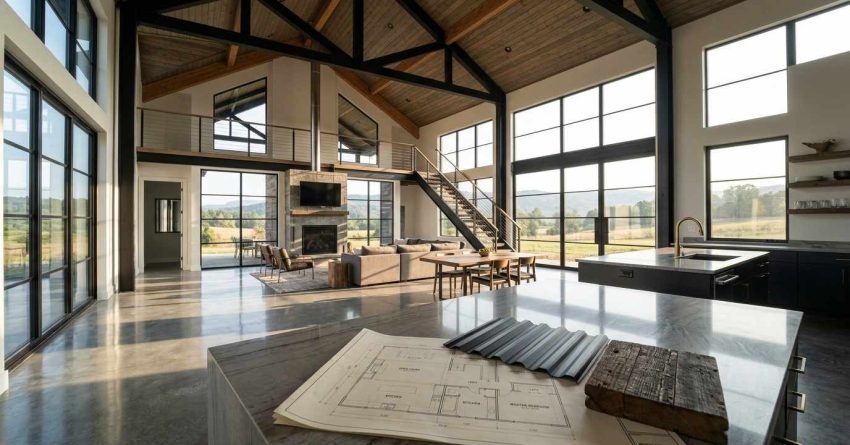
The most popular barndominium floor plan configuration is the open-concept layout, which combines the kitchen, dining area, and living room into a single continuous space beneath a vaulted or cathedral ceiling. Open-concept barndominiums maximize the visual impact of the wide-span structure, create natural light flow across the interior, and support the casual, functional lifestyle that most barndominium buyers are seeking. Ceiling heights in open-concept barndominiums commonly range from 14 to 20 feet in the main living area.
Shop-House and Live-Work Configurations
A significant segment of barndominium buyers specifically want a structure that combines residential living space with a large attached workshop, garage, or agricultural storage area under one roof. These “shop-house” configurations typically dedicate 40–60% of total square footage to the non-residential workspace, with the living quarters occupying one end or one side of the structure. This layout is particularly common among tradespeople, hobbyists, small business owners, and rural property owners who need functional workspace adjacent to their home.
Single-Story vs. Two-Story Designs
Single-story barndominiums are the most common configuration, offering accessibility, simpler construction, and lower per-square-foot costs for the structural shell. Two-story barndominiums — often featuring a loft-style upper level overlooking the main living area — maximize square footage on smaller footprints and are increasingly popular in markets where land costs make larger single-story footprints expensive. Mezzanine-level lofts are a common compromise, adding sleeping or office space above the main living area without the full structural complexity of a true second story.
Bedroom and Bathroom Configurations
Barndominium floor plans range from compact one-bedroom, one-bathroom configurations of 800 to 1,200 square feet to sprawling five-bedroom family homes exceeding 4,000 square feet. The most popular configurations in the current market are three-bedroom, two-bathroom layouts in the 1,800 to 2,400 square foot range — large enough for a family, efficient enough to build within a moderate budget, and flexible enough to accommodate a home office or hobby room within the same footprint.
Good floor plan design accounts for structural column placement, natural light orientation, mechanical system routing, and future expansion potential — all of which are easier to address at the design stage than after construction begins.
Barndominium Construction Process
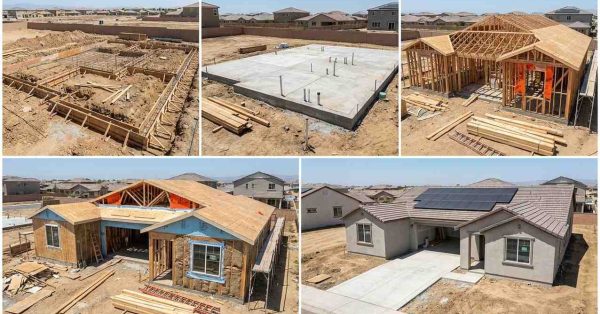
Understanding the barndominium construction sequence helps owners set realistic timelines, coordinate contractors effectively, and identify the decision points where delays most commonly occur. A typical barndominium build from site preparation to move-in takes four to twelve months, depending on project complexity, contractor availability, permit processing times, and weather conditions.
Phase 1: Site Preparation and Foundation
Site preparation begins with land clearing, grading, and access road construction if needed. Soil testing determines foundation requirements — a step that is frequently skipped by first-time builders and frequently regretted when unexpected soil conditions require foundation redesign mid-project. The concrete slab foundation is poured after utility rough-ins (electrical conduit, plumbing sleeves, and any radiant heat tubing) are positioned, since accessing these systems after the slab is poured requires expensive concrete cutting.
Phase 2: Shell Erection
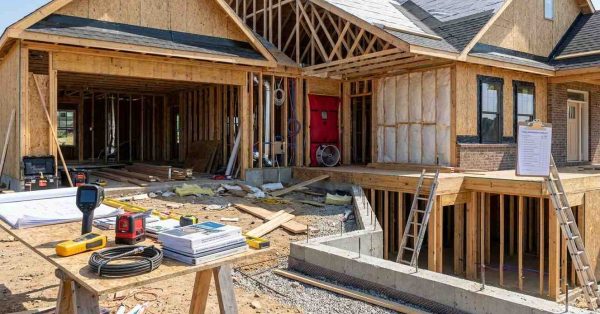
Once the foundation has cured — typically 28 days for full concrete strength — the structural frame is erected. For post-frame builds, this involves setting the vertical posts, installing the roof trusses, and attaching the wall and roof panels. A standard barndominium shell can be erected by an experienced crew in three to seven days for a 2,000-square-foot structure, though larger or more complex designs take longer. This phase moves quickly relative to the overall project timeline and is often the most visually dramatic stage of the build.
Phase 3: Rough Mechanical Systems
After the shell is enclosed, rough plumbing, electrical wiring, and HVAC ductwork are installed before insulation and interior wall finishes go in. This phase requires licensed contractors in most jurisdictions and must pass inspection before work can proceed. Scheduling mechanical contractors well in advance of this phase is critical — skilled tradespeople in high-demand markets often have four to eight week lead times.
Phase 4: Insulation and Interior Framing
Barndominium insulation is a technically important decision. Metal and steel structures conduct heat and cold efficiently, making thermal performance heavily dependent on insulation quality. Spray foam insulation applied directly to the interior of the metal panels is the highest-performing option, eliminating condensation risk and providing both thermal and vapor barrier protection. Rigid foam board and batt insulation are lower-cost alternatives with acceptable performance when properly installed. Interior partition walls are framed during this phase, defining the room layout within the open structural shell.
Phase 5: Interior Finishing
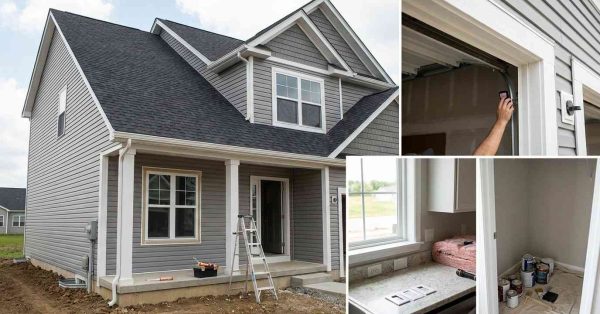
Drywall, flooring, cabinetry, trim, fixtures, and paint transform the framed interior into a finished living space. This phase represents the longest elapsed time in most barndominium projects and the highest concentration of subcontractor coordination. Sequencing finish trades correctly — drywall before flooring, flooring before cabinetry, cabinetry before countertops — prevents costly rework and keeps the project on schedule.
Phase 6: Final Systems, Inspections, and Certificate of Occupancy
Final mechanical connections, fixture installations, and systems testing precede the final building inspection. A certificate of occupancy (CO) is issued by the local building authority once all inspections pass, legally authorizing the structure for residential use. No lender will release final construction loan funds, and no homeowner’s insurance policy will activate, without a valid CO.
Barndominium Site Selection and Land Requirements
The land you build on shapes every aspect of your barndominium project — from construction costs and timeline to long-term livability and resale value. Site selection deserves as much analytical attention as floor plan design or builder selection, yet it is frequently treated as an afterthought by first-time barndominium buyers.
Zoning and Land Use Classification
Not all land is legally buildable for residential use. Agricultural-zoned land, which is where many prospective barndominium buyers look first, may or may not permit residential structures depending on county regulations. Some counties explicitly permit barndominiums on agricultural land; others require a variance or special use permit; others prohibit residential use on agricultural parcels entirely. Verifying zoning classification and permitted uses with the county planning department before purchasing land is non-negotiable — zoning conflicts discovered after land purchase are expensive and sometimes unresolvable.
Utilities and Infrastructure Access
Rural land parcels frequently lack access to municipal water, sewer, natural gas, and high-speed internet — all of which must be addressed before or during construction. Well drilling costs range from $5,000 to $15,000 depending on depth and geology. Septic system installation adds $3,000 to $10,000 for a standard system, with engineered systems on challenging soils costing significantly more. Electrical service extension from the nearest utility pole can range from $1,000 to $30,000+ depending on distance. These infrastructure costs are site-specific and must be researched before finalizing a land purchase budget.
Soil Conditions and Topography
Soil bearing capacity determines foundation design requirements. Expansive clay soils, high water tables, and rocky terrain all create foundation engineering challenges that increase costs. Flat or gently sloping sites minimize grading costs and simplify foundation work. Sites with significant grade changes require either extensive grading, retaining walls, or a foundation design that accommodates the slope — all of which add cost and complexity.
Access and Setback Requirements
County regulations specify minimum setback distances from property lines, roads, wetlands, and floodplains. These setbacks determine the buildable envelope on your parcel — the area within which your structure can legally be placed. Narrow parcels, irregular shapes, or parcels with multiple setback constraints can significantly limit the size and orientation of your barndominium, sometimes making an otherwise attractive piece of land unsuitable for the project you have in mind.
Barndominium Permits and Zoning
Navigating the permit and zoning process is one of the most consistently underestimated challenges in barndominium construction. Requirements vary dramatically by state, county, and municipality — and the consequences of building without proper permits range from stop-work orders and fines to forced demolition and financing denial.
Building Permits
A building permit is required for virtually all new residential construction in the United States, including barndominiums. The permit application typically requires engineered drawings, a site plan, a foundation plan, and documentation of compliance with local building codes. Some rural counties have adopted the International Residential Code (IRC) as their standard; others use state-specific codes; a small number of rural counties have minimal or no residential building code requirements. Identifying which code applies to your site before finalizing your design saves significant revision costs.
Zoning Variances and Special Use Permits
In jurisdictions where barndominiums are not explicitly permitted by right under the applicable zoning classification, owners must apply for a variance or special use permit. These processes involve public notice, a hearing before a zoning board, and a formal decision — a process that can take 60 to 180 days and carries no guarantee of approval. Understanding the local regulatory environment before purchasing land is the most effective way to avoid this risk.
HOA Restrictions
Barndominiums in areas governed by homeowners associations (HOAs) face an additional layer of restrictions. Many HOAs prohibit metal exterior finishes, non-traditional rooflines, or structures that do not conform to neighborhood architectural standards. HOA restrictions are private contractual obligations that exist independently of local zoning — meaning a barndominium can be legally permitted by the county but prohibited by the HOA. Reviewing HOA covenants, conditions, and restrictions (CC&Rs) before purchasing land in any HOA-governed area is essential.
Inspections and Code Compliance
Building inspections occur at multiple stages of construction — foundation, framing, rough mechanical, insulation, and final — and each must pass before the next phase can proceed. Failed inspections require corrective work and re-inspection, adding time and cost to the project. Working with a builder who has a strong local inspection track record significantly reduces the risk of inspection failures and associated delays.
Barndominium Financing Options
Financing a barndominium is more complex than financing a conventional home, and many first-time barndominium buyers are surprised to discover that standard mortgage products do not always apply. Understanding the financing landscape before committing to a build plan prevents the frustrating scenario of having a complete design and a purchased lot with no viable path to funding.
Construction Loans
A construction loan is the most common financing vehicle for new barndominium builds. Construction loans are short-term, typically 12 to 18 months, and fund the project in draws as construction milestones are completed. Interest is paid only on the amount drawn, not the full loan amount. At project completion, the construction loan is either paid off or converted to a permanent mortgage through a construction-to-permanent loan product. Lenders require detailed construction budgets, builder contracts, and appraisals based on the completed value of the structure before approving construction financing.
USDA Rural Development Loans
The USDA Section 502 Direct and Guaranteed Loan programs offer financing for homes in eligible rural areas, and barndominiums can qualify if they meet the program’s property eligibility requirements — including being a modest, decent, safe, and sanitary dwelling. USDA loans offer zero down payment for qualifying borrowers and competitive interest rates, making them an attractive option for rural barndominium buyers. Property eligibility is determined by location using the USDA’s eligibility map.
FHA and Conventional Loans
FHA loans and conventional mortgages can be used for barndominiums, but both require the property to meet specific appraisal standards — including being a permanently affixed structure on a permanent foundation, having comparable sales in the area, and meeting minimum property condition requirements. The “comparable sales” requirement is the most common obstacle for barndominium financing in rural markets where few comparable sales exist, which can result in appraisals that come in below the construction cost.
Portfolio Lenders and Farm Credit Institutions
Portfolio lenders — banks and credit unions that hold loans on their own books rather than selling them to the secondary market — often have more flexible underwriting criteria for non-traditional properties like barndominiums. Farm Credit institutions, including Farm Credit Services of America and AgSouth Farm Credit, specifically serve rural property buyers and have extensive experience financing barndominium construction in agricultural markets. These lenders are frequently the most practical financing option for barndominium projects in rural areas where conventional lenders are reluctant to lend.
Owner-Builder Financing
Some lenders offer owner-builder construction loans to borrowers who intend to act as their own general contractor. These loans typically require demonstrated construction experience, detailed project plans, and a higher down payment — often 20–25% — to compensate for the increased risk the lender assumes when a licensed general contractor is not managing the project. Owner-builder financing is available but requires careful lender selection and thorough documentation.
Barndominium Insulation and Energy Efficiency
Insulation is the single most consequential technical decision in barndominium construction for long-term comfort, energy costs, and structural durability. Metal and steel structures are thermally conductive by nature — without proper insulation, they become extremely hot in summer, extremely cold in winter, and prone to interior condensation that damages finishes and creates mold conditions.
Spray Foam Insulation
Closed-cell spray polyurethane foam (SPF) is the highest-performing insulation option for metal barndominium construction. Applied directly to the interior surface of metal panels, closed-cell spray foam creates a seamless air and vapor barrier that eliminates condensation risk, provides R-6 to R-7 per inch of thermal resistance, and adds structural rigidity to the wall and roof panels. The primary disadvantage is cost — spray foam insulation typically runs $1.50 to $3.50 per square foot of applied surface, making it the most expensive insulation option by a significant margin.
Rigid Foam Board Insulation
Rigid foam board insulation — polyisocyanurate, extruded polystyrene (XPS), or expanded polystyrene (EPS) — offers good thermal performance at a lower cost than spray foam. Rigid board must be carefully detailed at seams and penetrations to prevent air infiltration and condensation, and it requires a vapor barrier in most climate zones. It is a practical choice for budget-conscious builds in moderate climates where extreme temperature differentials are less severe.
Batt Insulation with Vapor Barrier
Fiberglass or mineral wool batt insulation installed between interior framing members is the lowest-cost insulation approach for barndominiums. Batt insulation requires a properly installed vapor barrier on the warm side of the assembly to prevent condensation within the wall cavity — a detail that is frequently installed incorrectly and leads to moisture problems over time. In cold climates, batt insulation alone in a metal building is generally considered inadequate for long-term performance without supplemental insulation layers.
Energy Efficiency Beyond Insulation
Barndominium energy efficiency also depends on window and door selection, roof ventilation design, HVAC system sizing, and the thermal mass of the foundation. Metal roofs with reflective coatings can reduce cooling loads by 10–15% in hot climates according to Oak Ridge National Laboratory research. Proper HVAC sizing — based on a Manual J load calculation specific to the building’s insulation levels and climate zone — prevents the oversizing that leads to short-cycling, humidity problems, and premature equipment failure.
Barndominium Interior Design and Finishing
The interior of a barndominium can range from utilitarian and functional to architecturally sophisticated and design-forward — and the finish decisions made during construction largely determine which end of that spectrum the finished home occupies. Interior finishing represents the largest variable cost category in most barndominium projects and the dimension that most directly affects daily livability and long-term resale value.
Flooring Options
Concrete floors — either polished, stained, or epoxy-coated — are the most popular flooring choice in barndominiums, leveraging the existing concrete slab as a finished surface. Polished concrete is durable, easy to maintain, and visually compatible with the industrial aesthetic that many barndominium owners prefer. Luxury vinyl plank (LVP) flooring is the most popular alternative, offering warmth, comfort, and design flexibility at a moderate cost. Hardwood, tile, and carpet are all viable options in specific rooms and are installed over the concrete slab using standard subfloor methods.
Ceiling and Wall Treatments
Exposed metal roof panels and structural trusses are a signature design element in many barndominiums, creating the dramatic vaulted ceiling aesthetic that distinguishes the style. Drywall ceilings and walls are the standard finish for fully residential interiors, providing a conventional appearance and better acoustic performance than exposed metal. Shiplap, board-and-batten, and reclaimed wood accent walls are popular design choices that add warmth and texture to interiors that might otherwise feel industrial or cold.
Kitchen and Bathroom Design
Kitchen and bathroom design in barndominiums follows the same principles as conventional residential construction — the structural differences of the building shell do not constrain interior layout in these spaces. Open-concept kitchen designs with large islands, farmhouse sinks, and exposed shelving are popular choices that complement the barndominium aesthetic. Bathroom finishes range from basic builder-grade selections to spa-quality tile work, soaking tubs, and custom vanities depending on budget and personal preference.
Lighting Design
Lighting design is particularly important in barndominiums because the large open volumes and high ceilings that define the style require deliberate layering of ambient, task, and accent lighting to feel warm and livable rather than cavernous. Pendant lighting over kitchen islands and dining areas, recessed lighting in living spaces, and statement fixtures in entry areas are common design approaches. LED lighting throughout is standard practice given the energy efficiency advantages and the long fixture life that reduces maintenance in hard-to-reach high-ceiling locations.
Barndominium Utilities and Mechanical Systems
Mechanical systems — plumbing, electrical, HVAC, and water supply — represent a non-negotiable cost category in every barndominium project and require careful planning to install correctly within the post-frame or steel-frame structural system. Unlike conventional homes where mechanical systems follow well-established routing conventions, barndominiums require deliberate coordination between the structural design and the mechanical layout to avoid conflicts and ensure code compliance.
Plumbing Systems
Plumbing in a barndominium follows the same principles as conventional residential plumbing — supply lines, drain-waste-vent (DWV) systems, and fixture connections — but the open structural system requires careful planning of pipe routing through or beneath the concrete slab and within interior partition walls. Radiant floor heating, which circulates warm water through tubing embedded in the concrete slab, is a popular heating option in barndominiums because it leverages the thermal mass of the slab and provides even, comfortable heat distribution across large open floor plans.
Electrical Systems
Electrical service for a barndominium is sized based on the total connected load — the sum of all lighting, appliances, HVAC equipment, workshop tools, and other electrical loads the structure will serve. A standard residential service of 200 amps is adequate for most barndominiums without large workshop equipment. Barndominiums with electric vehicle charging, large shop equipment, or electric HVAC systems may require 400-amp service. Conduit routing through metal framing requires careful attention to grounding and bonding requirements to prevent electrical hazards.
HVAC Systems
HVAC system selection for a barndominium depends on climate zone, insulation levels, and the ratio of conditioned to unconditioned space within the structure. Mini-split heat pump systems are popular in barndominiums because they allow zone-by-zone temperature control, avoid the ductwork complexity of central forced-air systems in large open volumes, and provide both heating and cooling from a single system. Propane or natural gas forced-air systems are common in cold climates where heat pump efficiency decreases at very low outdoor temperatures. Geothermal heat pump systems offer the highest long-term energy efficiency but require significant upfront investment in ground loop installation.
Water Supply and Waste Management
Rural barndominiums typically rely on private wells for water supply and septic systems for waste management. Well yield testing — measuring the gallons-per-minute output of a drilled well — should be completed before finalizing a land purchase to confirm adequate water supply for residential use. Septic system design is regulated by county health departments and must be engineered to match the soil percolation rate of the specific site. Alternative waste management systems, including aerobic treatment units and mound systems, are required on sites where conventional septic systems cannot be installed due to soil conditions or lot size constraints.
Barndominium Maintenance and Long-Term Care
Barndominiums are generally lower-maintenance than conventional wood-frame homes in several key areas — metal exteriors do not rot, warp, or require painting on the same cycle as wood siding — but they have their own specific maintenance requirements that owners should understand before and after construction.
Metal Exterior Maintenance
Metal panel exteriors require periodic inspection for scratches, dents, and areas where the protective coating has been compromised. Exposed bare metal is vulnerable to rust, particularly in coastal environments or areas with high humidity. Touch-up paint specifically formulated for metal building panels should be applied to any scratched or chipped areas promptly. Gutters and downspouts on metal-roofed barndominiums should be cleaned at least twice annually to prevent water backup that can cause fascia damage and foundation erosion.
Roof Maintenance
Metal roofs are among the most durable roofing systems available, with lifespans of 40 to 70 years when properly maintained. Annual inspection of roof panel fasteners, sealants at penetrations and ridge caps, and flashing at wall-to-roof transitions is the most important preventive maintenance task for a metal-roofed barndominium. Fastener screws with neoprene washers can loosen over time due to thermal expansion and contraction cycles and should be re-torqued or replaced as needed. Roof coatings can be applied to extend the life of aging metal panels and improve reflectivity.
Foundation and Drainage Maintenance
Concrete slab foundations require monitoring for cracks, particularly in regions with expansive soils or significant freeze-thaw cycles. Hairline cracks are common and generally cosmetic; cracks wider than 1/4 inch or cracks with vertical displacement warrant professional evaluation. Maintaining positive drainage away from the foundation — ensuring the grade slopes away from the structure on all sides — is the single most effective long-term foundation protection measure and requires periodic re-grading as soil settles over time.
HVAC and Mechanical System Maintenance
HVAC filter replacement, annual system inspections, and coil cleaning are standard maintenance requirements for barndominium mechanical systems. Mini-split systems require periodic cleaning of the indoor air handler filters and annual inspection of refrigerant levels and electrical connections. Well pumps and pressure tanks should be inspected annually, and water quality testing is recommended every one to three years to monitor for changes in bacterial content, mineral levels, or chemical contamination. Septic systems require pumping every three to five years depending on household size and usage.
For homeowners who want professional support managing the full range of barndominium maintenance tasks — from roof inspections and HVAC servicing to plumbing repairs and exterior upkeep — our comprehensive home maintenance services cover every system in your property with skilled professionals, transparent pricing, and dependable scheduling year-round.
Choosing a Barndominium Builder
Builder selection is the single decision with the greatest impact on whether your barndominium project is completed on time, within budget, and to the quality standard you expect. The barndominium construction market includes a wide range of providers — from large national kit manufacturers to regional post-frame specialists to local general contractors with limited barndominium experience — and distinguishing between them requires deliberate evaluation.
Types of Barndominium Builders
Kit manufacturers and suppliers provide the structural shell package — frame, roofing, wall panels, doors, and windows — but do not manage construction. The owner or a separate general contractor is responsible for site preparation, foundation, shell erection, and all interior work. Kit suppliers are appropriate for experienced owner-builders or for buyers who have a trusted local contractor to manage the build.
Turnkey barndominium builders manage the entire project from site preparation through interior finishing and certificate of occupancy. Turnkey builders provide a single point of accountability for the complete project and are the appropriate choice for most first-time barndominium buyers who do not have construction management experience.
General contractors with barndominium experience are conventional construction managers who have completed multiple barndominium projects and understand the specific requirements of post-frame or steel-frame residential construction. Verifying the number and type of barndominium projects a general contractor has completed — and speaking directly with past clients — is essential before signing a contract.
What to Evaluate in a Builder
Key evaluation criteria for barndominium builder selection include: number of completed barndominium projects, references from recent clients, licensing and insurance verification, clarity of contract terms and payment schedule, warranty coverage on both the structure and the workmanship, and the builder’s familiarity with local permit requirements and inspection processes. Builders who are reluctant to provide references, who request large upfront payments before work begins, or who cannot provide a detailed written contract with a fixed price or clearly defined cost-plus terms are significant red flags.
Getting and Comparing Bids
Obtaining a minimum of three competitive bids for any barndominium project is standard practice. Bids should be compared on a line-item basis — not just total price — to identify where cost differences originate. A significantly lower bid may reflect a less experienced builder, lower-quality materials, or a scope that excludes items the other bids include. A significantly higher bid may reflect superior materials, more comprehensive warranty coverage, or a builder whose reputation commands a premium. Understanding what each bid includes and excludes is more important than the total number.
Barndominium Resale Value and Market Considerations
Resale value is a legitimate concern for barndominium buyers, particularly in markets where comparable sales are limited and appraiser familiarity with the property type is low. Understanding the resale landscape before building helps owners make design and finish decisions that protect long-term value.
Appraisal Challenges
The most significant resale challenge for barndominiums is the appraisal process. Appraisers determine value primarily through the sales comparison approach — identifying recent sales of comparable properties and adjusting for differences. In rural markets where few barndominium sales have occurred, appraisers may struggle to find adequate comparables, resulting in appraisals that undervalue the property relative to its construction cost and market appeal. This appraisal gap can complicate both the original construction financing and any future sale that involves buyer financing.
Design Decisions That Support Resale Value
Barndominiums with conventional residential interior finishes — drywall walls and ceilings, standard flooring, traditional kitchen and bathroom layouts — appraise more consistently than those with highly unconventional or industrial interiors. Structures that are clearly designed and finished as full-time residences rather than agricultural or commercial buildings are more likely to qualify for conventional mortgage financing, which expands the pool of potential buyers. Avoiding highly personalized or niche design choices that appeal to a narrow buyer segment protects resale flexibility.
Market Trends
The barndominium market has grown significantly over the past decade, driven by rising conventional home prices, increased interest in rural and semi-rural living, and the influence of social media platforms that have dramatically increased public awareness of the barndominium lifestyle. Zillow research indicates that rural property searches increased by over 50% during the post-2020 period, a trend that has expanded the buyer pool for barndominium properties in markets that previously had limited demand. As barndominium sales volume increases in more markets, the comparable sales data that appraisers need to value these properties accurately is gradually becoming more available.
Conclusion
Barndominiums represent a compelling intersection of structural efficiency, design flexibility, and cost-effective construction that has made them one of the fastest-growing residential building categories in the United States. From site selection and zoning to construction methods, financing, interior design, and long-term maintenance, every dimension of the barndominium journey rewards careful planning and informed decision-making.
The resources available through this guide — covering costs, floor plans, construction sequencing, insulation, utilities, builder selection, and resale considerations — give you the orientation framework needed to move from concept to completed project with confidence and clarity.
At Mr. Local Services, our network of skilled professionals supports barndominium owners at every stage — from construction-phase trades to ongoing maintenance, repair, and improvement services that keep your property safe, functional, and well-maintained for the long term. Contact us today to connect with trusted experts in your area.
Frequently Asked Questions
What is the average cost to build a barndominium in the United States?
The average cost to build a fully finished barndominium in the United States ranges from $120 to $150 per square foot, with total project costs for a 2,000-square-foot home typically falling between $240,000 and $300,000 depending on location, site conditions, and finish level.
How long does it take to build a barndominium from start to finish?
A typical barndominium build takes four to twelve months from site preparation to certificate of occupancy. Timeline varies based on project complexity, permit processing times, contractor availability, and weather conditions during construction.
Can you get a regular mortgage for a barndominium?
Yes, barndominiums can qualify for FHA loans, conventional mortgages, and USDA rural development loans, but they must meet specific appraisal and property condition requirements. Construction loans and portfolio lenders are often the most practical financing options, particularly in rural markets with limited comparable sales.
Do barndominiums hold their value over time?
Barndominiums generally hold their value well when built with conventional residential interior finishes and located in markets with growing barndominium sales activity. Appraisal challenges in rural markets with limited comparable sales can affect financing for future buyers, which is the primary resale risk to manage through design and finish decisions.
What is the best insulation for a barndominium?
Closed-cell spray polyurethane foam is the highest-performing insulation option for metal barndominiums, providing an R-6 to R-7 per inch thermal rating while eliminating condensation risk. Rigid foam board and batt insulation with vapor barriers are lower-cost alternatives suitable for moderate climates.
Do barndominiums require special permits or zoning approvals?
Yes, barndominiums require standard residential building permits in virtually all jurisdictions, and zoning compliance must be verified before purchasing land. Agricultural-zoned parcels may require a variance or special use permit for residential construction, and HOA restrictions can prohibit barndominiums independently of local zoning rules.
What are the main maintenance requirements for a barndominium?
Key barndominium maintenance tasks include annual metal roof inspection and fastener re-torquing, gutter cleaning, foundation drainage monitoring, HVAC filter replacement and annual servicing, and periodic inspection of exterior panel coatings for scratches or rust. Well and septic systems on rural properties require additional annual testing and pumping on a regular schedule.