
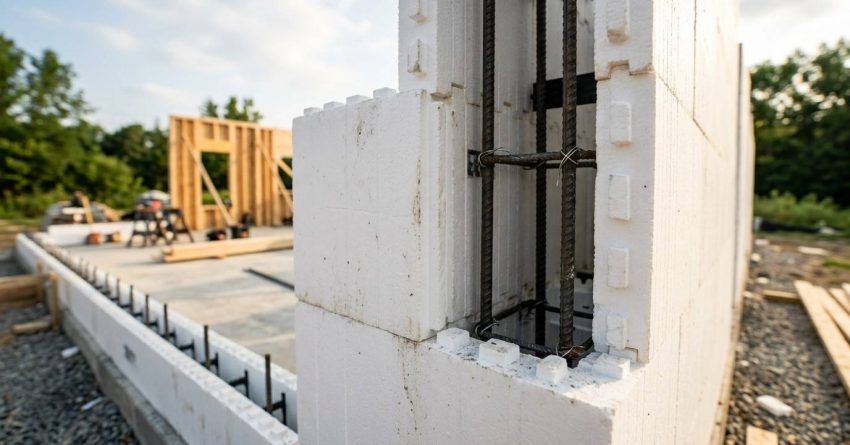
The ICF assembly process for new builds follows a precise sequence of steps — from footing preparation through concrete placement — that determines the structural integrity, energy performance, and long-term durability of the finished wall system. Skipping or rushing any phase creates compounding problems that are costly to correct after the pour. Understanding each stage before breaking ground is the most effective way to protect your investment and keep the project on schedule.
ICF construction is gaining ground across the USA because it delivers superior insulation, sound control, and disaster resistance compared to traditional framing methods.
This guide walks through every major stage of the ICF assembly process — from site preparation and block stacking to bracing, rebar placement, concrete pouring, and interior finishing — so you know exactly what to expect at each step.
What Is ICF Construction and Why It Matters for New Builds
Insulated Concrete Forms, or ICF, are hollow foam blocks or panels that stack together to form the shape of a wall. Once stacked and reinforced with rebar, the cavity is filled with poured concrete. The foam stays in place permanently, acting as continuous insulation on both sides of the concrete core.
The result is a monolithic concrete wall with built-in thermal mass and insulation — a combination that wood-frame construction cannot replicate without significant added cost. ICF walls typically achieve R-values between R-22 and R-30 depending on form thickness, compared to R-13 to R-21 for standard insulated stud walls.
ICF is one of the most energy-efficient structural systems available today — our new home construction guide covers how it compares to wood frame, concrete block, and other building methods so you can choose the right system for your project.
Beyond energy performance, ICF walls resist fire, high winds, and moisture infiltration at a level that makes them particularly well-suited for new builds in storm-prone or extreme-climate regions of the USA.
Site Preparation and Foundation Work Before ICF Installation
Footing Requirements for ICF Systems
ICF walls require a properly sized and leveled concrete footing before the first block is placed. The footing must be wide enough to support the full width of the ICF form plus any required bearing surface on each side — typically a minimum of 4 inches of bearing on each face of the form.
Footing width varies by wall thickness. A 6-inch ICF core wall (the most common residential specification) typically requires a footing at least 16 inches wide. Footing depth must reach below the frost line for your specific region, which varies significantly across USA climate zones.
Keyways — grooves cast into the top of the footing — are strongly recommended. They lock the first course of ICF blocks in place and prevent lateral movement during the pour. Some contractors use rebar dowels set into the footing instead of or in addition to keyways.
The footing surface must be level within 1/8 inch across its full length before block placement begins. Any deviation greater than this will compound through every course stacked above it, creating alignment problems that are difficult to correct without cutting and shimming individual blocks.
Before the first block goes down, understanding the full range of ICF construction methods helps you select the right form type, wall thickness, and footing design for your specific soil conditions and load requirements.
How to Stack and Align ICF Blocks Correctly
Corner Blocks, T-Sections, and Specialty Pieces
ICF blocks interlock through a tongue-and-groove system on their top and bottom edges. Stacking begins at the corners, which use pre-formed corner blocks designed to maintain consistent wall thickness through the turn. Corners are the most critical alignment point in the entire wall — errors here affect every straight run connected to them.
Standard straight blocks are typically 16 inches tall and 48 inches long, though dimensions vary by manufacturer. Each course is offset from the one below by half a block length, similar to a running bond brick pattern. This staggered layout distributes load and eliminates continuous vertical seams that could become weak points.
T-sections are used wherever interior walls intersect exterior ICF walls. These specialty pieces maintain the foam-to-foam connection at the junction while allowing the interior wall to tie into the structural concrete core. Proper use of T-sections is essential for maintaining the thermal envelope — gaps at intersections are a common source of energy loss in ICF homes.
Alignment is checked continuously during stacking using a level and string line. The wall must be plumb, straight, and at the correct height before bracing is installed.
Bracing the ICF Wall System During Construction
ICF walls are not self-supporting before the concrete is placed. A temporary bracing system holds the walls plumb and straight during the pour and until the concrete achieves sufficient strength to be self-supporting.
Bracing systems consist of aluminum or steel walers — horizontal members that run along the face of the wall — connected to diagonal braces that anchor to the floor slab or footing. Braces are typically spaced every 6 to 8 feet along the wall and at every corner.
The bracing system serves two purposes. First, it keeps the wall in the correct position during the pour. Second, it provides the scaffolding from which workers can access the top of the wall to place and vibrate concrete. Bracing must be engineered for the specific wall height and concrete pressure — taller walls and faster pour rates generate significantly higher lateral pressure on the forms.
Bracing is not removed until the concrete has cured to a minimum compressive strength — typically 2,000 psi, which is usually reached within 24 to 48 hours under normal temperature conditions.
Placing Rebar and Meeting Structural Requirements
Rebar placement in ICF walls is governed by the structural engineer’s drawings and the applicable building code for your jurisdiction. Most residential ICF walls use horizontal rebar at every other course (every 16 inches vertically) and vertical rebar at 24 to 48 inches on center, depending on wall height and load conditions.
ICF blocks include built-in plastic or steel rebar chairs — horizontal ledges molded into the foam webs — that hold horizontal rebar at the correct position within the concrete core. Vertical rebar is tied to the horizontal bars using wire ties and must be positioned to maintain the required concrete cover on all sides.
Window and door openings require additional rebar to form a structural lintel above each opening. The lintel transfers the load from above the opening to the wall sections on either side. Lintel design is a structural calculation — it must be sized by an engineer based on the span width and the loads it carries.
Homeowners planning additions or structural changes alongside a new ICF build can explore our remodeling services to understand how load-bearing modifications are handled safely and to code.
Concrete Pouring Process for ICF Walls
Lift Heights, Vibration, and Blowout Prevention
Concrete placement in ICF walls is the most technically demanding phase of the assembly process. The concrete mix, pour rate, lift height, and vibration technique all directly affect the quality of the finished wall and the risk of a blowout — a failure of the foam form under concrete pressure.
The concrete mix used for ICF walls must be specifically designed for the application. It requires a slump of 5 to 7 inches for proper flow through the rebar cage without segregation, and aggregate size must not exceed 3/4 inch to prevent bridging. Self-consolidating concrete (SCC) is increasingly used in ICF construction because it flows around rebar without vibration, reducing blowout risk.
Concrete is placed in lifts — layers of a controlled height — rather than filling the entire wall in one continuous pour. Standard lift height for ICF walls is 4 feet maximum per lift. After each lift, the concrete is consolidated using an internal vibrator inserted at regular intervals. The vibrator eliminates air pockets and ensures the concrete fully encapsulates the rebar.
Vibration technique matters significantly. The vibrator should be inserted vertically, moved slowly through the lift, and withdrawn slowly — rapid withdrawal leaves voids. It should not contact the ICF foam directly, as this can displace the form and create surface defects.
Blowouts occur when concrete pressure exceeds the lateral resistance of the bracing system or when a form connection fails. They are most common at the base of tall walls, at corners, and around window and door bucks. Monitoring the wall continuously during the pour — watching for bulging, movement, or seam separation — allows crews to respond before a full blowout occurs.
Electrical, Plumbing, and Mechanical Rough-Ins in ICF Walls
Rough-in work in ICF walls requires coordination between trades before the concrete is placed and after the wall has cured. Sleeves for pipes and conduit that must pass through the wall are placed before the pour and held in position with foam adhesive or mechanical fasteners.
After the pour and cure, electrical boxes and conduit runs are installed by routing channels into the foam using a hot knife or router. The foam cuts cleanly and the channels are sized to accept standard electrical boxes and conduit. Wiring is then run through the channels and boxes are secured to the foam using manufacturer-approved fasteners.
Coordinating trades inside ICF walls requires precise sequencing — our plumbing rough-in services explains how licensed plumbers approach pipe placement and pressure testing within concrete wall systems.
Wiring inside ICF walls follows a different process than standard stud framing, and our electrical rough-in work outlines what licensed electricians do to route conduit, place boxes, and meet code inside foam-form walls.
HVAC ductwork in ICF homes is typically run through interior partition walls, floor systems, or a dedicated mechanical chase rather than through the exterior ICF walls. The high thermal performance of ICF walls means that duct runs through exterior walls are rarely necessary and would compromise the thermal envelope.
Finishing ICF Walls Inside and Out
ICF walls require a finish layer on both the interior and exterior surfaces. The foam itself is not a finished surface — it requires protection from UV exposure on the exterior and a fire-rated covering on the interior.
ICF construction requires specific buck framing around every opening, and our window installation process covers how windows are set, sealed, and flashed in concrete form walls to prevent air and water infiltration.
On the exterior, common finish options include polymer-modified stucco applied directly to the foam, brick or stone veneer attached to the concrete core through the foam, and fiber cement or vinyl siding installed over furring strips. Each system has specific attachment and moisture management requirements that must be followed to maintain the wall’s weather resistance.
On the interior, most ICF walls are finished with drywall. Once the ICF wall system is complete and rough-ins are inspected, interior finishing begins — our drywall installation services explains how furring strips, fasteners, and moisture barriers are used to prepare ICF walls for drywall.
Building codes in most USA jurisdictions require that the interior foam surface of ICF walls be covered with a minimum 1/2-inch gypsum board or equivalent fire-rated material. This requirement exists because expanded polystyrene foam, while an excellent insulator, is combustible and must be separated from the living space by a thermal barrier.
Common ICF Assembly Mistakes and How to Avoid Them
The most frequent ICF assembly errors fall into four categories: footing problems, alignment errors, inadequate bracing, and improper concrete placement.
Footing problems — particularly an unlevel footing surface — are the most consequential because they affect every course above. Checking footing level before placing the first block, and correcting any deviation before proceeding, eliminates this risk entirely.
Alignment errors accumulate through the stack. A wall that is 1/4 inch out of plumb at the second course will be 1 inch out of plumb by the eighth course. Checking plumb and straightness at every course — not just at the top — keeps the wall within tolerance throughout the build.
Inadequate bracing is the primary cause of blowouts. Bracing must be designed for the actual wall height and pour rate, not estimated or reduced to save time. Cutting corners on bracing is the single most expensive mistake in ICF construction.
Improper concrete placement — specifically, exceeding the maximum lift height or vibrating too aggressively — creates pressure spikes that the bracing system is not designed to handle. Following the pour plan exactly, including lift heights and vibration intervals, is non-negotiable.
When minor ICF assembly errors are caught after the pour, targeted repairs are often needed — our handyman repair services explains the types of surface corrections and patching work that can be handled without structural intervention.
Conclusion
The ICF assembly process for new builds is a structured sequence where each phase directly affects the quality of the next — from footing level to block alignment, bracing, rebar placement, and concrete pour technique. Understanding the full process before construction begins is the most effective way to avoid costly errors and deliver a wall system that performs as designed.
ICF construction delivers measurable advantages in energy efficiency, structural strength, and long-term durability that make it a strong choice for new residential and commercial builds across the USA.
At Mr. Local Services, our network of skilled construction professionals handles every phase of the ICF assembly process — from site preparation through finishing — so your new build is completed correctly, on schedule, and built to last.
Frequently Asked Questions
What is the typical timeline for the ICF assembly process on a new home?
The ICF assembly process for a standard single-story home typically takes 3 to 5 days for block stacking and bracing, followed by 1 day for the concrete pour and 2 to 3 days of curing before bracing removal. Total wall assembly time is generally 1 to 2 weeks depending on crew size and wall complexity.
How thick are ICF walls in a typical new build?
Most residential ICF walls use a 6-inch concrete core with 2.5 inches of EPS foam on each side, resulting in a total wall thickness of approximately 11 inches. Thicker cores of 8 or 10 inches are used for taller walls, higher load conditions, or when additional thermal mass is required.
Can ICF walls be used for below-grade construction in new builds?
Yes. ICF is widely used for below-grade foundation walls because the foam provides continuous insulation against soil contact and the concrete core resists hydrostatic pressure. Below-grade ICF walls require waterproofing on the exterior face and drainage board to manage groundwater.
What concrete mix is required for ICF wall placement?
ICF walls require a concrete mix with a 5 to 7 inch slump, a maximum aggregate size of 3/4 inch, and a minimum compressive strength of 3,000 psi at 28 days. Self-consolidating concrete (SCC) is an approved alternative that eliminates the need for mechanical vibration in most ICF applications.
How do you cut ICF blocks to fit around windows and doors?
ICF blocks are cut using a standard hand saw, circular saw, or reciprocating saw. Cuts are made through the foam only — the plastic webs cut easily with any saw blade. Window and door openings are formed using pre-made or site-built bucks, which are frames installed inside the opening before the pour to hold the concrete in place and provide a nailing surface for windows and doors.
Is a building permit required for ICF construction in the USA?
Yes. ICF construction requires a building permit in all USA jurisdictions. The permit application must include structural drawings stamped by a licensed engineer, a site plan, and energy compliance documentation. Inspections are required at the footing, rebar, and framing stages before the concrete pour is approved.
How does ICF construction affect homeowner’s insurance costs?
ICF homes often qualify for reduced homeowner’s insurance premiums because of their superior resistance to fire, wind, and impact damage. Premium reductions vary by insurer and location, but discounts of 20 to 25 percent are reported by some ICF homeowners in high-risk areas. Homeowners should contact their insurer directly to confirm eligibility and documentation requirements.