Hurricane strapping is a system of metal connectors that ties your roof structure directly to your home’s walls and foundation, creating a continuous load path that resists wind uplift forces during a hurricane or severe storm. Required by building codes across much of the USA, these connectors are a front-line defense against catastrophic roof loss. Understanding what the code requires, when strapping is mandatory, and how installation works helps homeowners make informed decisions about their property’s structural safety.
Millions of homes across storm-prone states lack adequate hurricane strapping, leaving roofs vulnerable to separation during high-wind events. Knowing your home’s compliance status can mean the difference between minor storm damage and total roof failure.
This guide explains hurricane strapping requirements, code standards, installation basics, and how to determine whether your home currently meets code so you can take the right steps to protect your property.
What Is Hurricane Strapping?
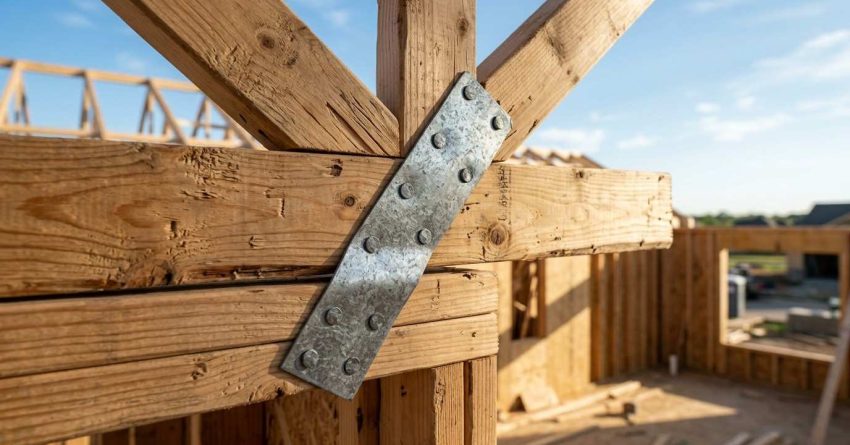
Hurricane strapping refers to galvanized or stainless steel metal connectors, also called hurricane ties or roof-to-wall connectors, that mechanically fasten roof rafters or trusses to the wall framing below. Without these connectors, a roof is held in place primarily by the weight of roofing materials and basic nailing patterns, which are insufficient to resist the uplift forces generated by hurricane-force winds.
The core function of hurricane strapping is to create what engineers call a continuous load path. This means that wind forces acting on the roof are transferred downward through the wall framing, into the floor system, and ultimately into the foundation, rather than lifting the roof off the structure. A properly strapped home distributes storm forces across the entire building rather than concentrating them at vulnerable connection points.
Hurricane strapping is one of the most critical structural components in residential roofing — our roofing services guide covers the full range of roof-related work that keeps your home protected from storm damage year-round.
How Hurricane Straps Work
Each strap wraps around or attaches to a rafter or truss and is nailed or screwed into the top plate of the wall below. The metal connector acts as a mechanical anchor, preventing the rafter from lifting away from the wall when wind pressure builds beneath the roof deck. The number of fasteners, the gauge of the metal, and the strap configuration all determine how much uplift force the connection can resist, measured in pounds.
Manufacturers like Simpson Strong-Tie and MiTek produce hurricane straps rated for specific uplift loads. Contractors select the appropriate product based on local wind speed requirements, roof pitch, and rafter spacing, all of which are governed by the applicable building code.
Types of Hurricane Straps Used in Residential Construction
The most common hurricane strap types include single-sided straps, double-sided straps, and twist straps. Single-sided straps attach to one face of the rafter and are used where wall framing allows direct access. Double-sided straps wrap around both sides of the rafter for higher uplift resistance. Twist straps, also called H-straps or hip straps, are used at hip roof corners and other complex framing configurations where standard straps cannot be applied.
Embedded anchor bolts and structural clips are also used in some construction types, particularly in concrete block or masonry wall construction common in Florida and other Gulf Coast states.
Hurricane Strapping Code Requirements in the USA
Building codes in the United States establish minimum standards for hurricane strapping based on geographic wind zone classifications. The primary model code governing residential construction is the International Residential Code, which most states adopt with local amendments. In high-wind regions, these requirements are significantly more stringent than in low-risk areas.
International Residential Code (IRC) Standards
The IRC requires that roof assemblies in high-wind areas include approved connectors at every rafter-to-wall-plate connection. Section R802.11 of the IRC specifically addresses roof-to-wall connections and mandates that rafters and trusses be connected to wall top plates using approved metal connectors or equivalent fastening methods capable of resisting the calculated uplift forces for the design wind speed of the location.
Design wind speeds are mapped by ASCE 7, the American Society of Civil Engineers’ standard for minimum design loads, which divides the country into wind exposure categories. Homes in areas with design wind speeds of 115 mph or higher — which includes most of Florida, coastal Texas, the Gulf Coast, and parts of the Carolinas — face the most demanding strap requirements.
State-Specific Code Variations
Florida has the most comprehensive hurricane strapping requirements in the country, enforced through the Florida Building Code. Florida adopted mandatory hurricane strapping requirements statewide following Hurricane Andrew in 1992, which caused catastrophic roof failures across South Florida. The Florida Building Code requires continuous load path construction for all new residential buildings and mandates specific connector types and fastener counts based on wind speed zones.
Texas, Louisiana, South Carolina, North Carolina, Georgia, and Alabama all have coastal construction zones with enhanced strap requirements that exceed the base IRC standards. Homeowners in these states should verify their local jurisdiction’s adopted code version and any amendments, as county-level requirements can be stricter than the state baseline.
When Is Hurricane Strapping Required?
Hurricane strapping is required by code in all new residential construction located in designated high-wind zones. The specific threshold varies by jurisdiction, but most coastal and hurricane-prone areas require strapping for any home built after the local code adoption date for wind-resistant construction standards.
New Construction vs. Existing Homes
For new construction, hurricane strapping is a mandatory inspection item. A building inspector will verify that approved connectors are installed at every required connection point before the roof sheathing is applied, since the straps must be visible for inspection. Failing this inspection means the project cannot proceed until corrections are made.
For existing homes, the rules are more nuanced. Homes built before modern code requirements were adopted are generally grandfathered under the code in effect at the time of construction. However, if a homeowner undertakes a re-roofing project that involves removing and replacing the roof structure, most jurisdictions require the work to be brought up to current code, which includes installing hurricane straps where they were not previously present.
In Florida, re-roofing projects that expose the roof deck trigger a requirement to install hurricane straps if they are missing, under the Florida Building Code’s substantial improvement provisions.
How Hurricane Strapping Is Installed
Hurricane strap installation is performed during the framing stage of new construction, before roof sheathing is applied. In retrofit situations on existing homes, installation requires accessing the attic space to reach the rafter-to-wall-plate connections from below.
What the Installation Process Involves
A contractor begins by identifying the rafter or truss spacing and selecting the appropriate strap product rated for the local wind speed requirement. Each strap is positioned to wrap around or attach to the rafter and is fastened to both the rafter and the wall top plate using the manufacturer-specified nail pattern. The number and size of nails are critical — using fewer nails or the wrong nail diameter reduces the connector’s rated uplift capacity and may result in a code violation.
In attic retrofit installations, the process is more labor-intensive because the contractor must work in a confined space and may need to remove insulation to access connection points. The total number of connections depends on the roof size and rafter spacing, but a typical single-family home may require 40 to 80 individual strap connections.
For homeowners who need a professional to assess and install hurricane straps, our handyman installation services connect you with skilled technicians who handle structural hardware projects efficiently and to code.
How to Know If Your Home Meets Hurricane Strap Code
Determining whether your home has hurricane strapping requires a physical inspection of the rafter-to-wall connections, which are located in the attic. A homeowner can perform a basic visual check by entering the attic and looking at the points where rafters or trusses meet the top of the exterior walls. If metal connectors are present at each connection, strapping has been installed. If the rafters simply rest on the wall plate with only toe-nails, strapping is absent.
However, visual presence alone does not confirm code compliance. The strap must be the correct product for the wind zone, installed with the correct fastener count, and free of corrosion or damage. A licensed contractor or home inspector can provide a formal assessment.
If you are unsure whether your current strapping meets local code requirements, our safety and mobility services include property assessments that identify structural vulnerabilities before they become costly problems.
If you suspect your home lacks hurricane strapping, a hurricane strapping inspection checklist can help you document what is present and what may need to be addressed before your next re-roofing project or storm season.
Signs Your Strapping May Be Non-Compliant
Common indicators of non-compliant or missing hurricane strapping include a home built before 1994 in Florida or before local code adoption in other states, no record of a wind mitigation inspection, visible toe-nailing only at rafter connections in the attic, corroded or damaged metal connectors, and an absence of hurricane strapping documentation in the home’s permit history. Homes that have undergone roof replacement without a permit are also at higher risk of missing required strapping.
Hurricane Strapping and Your Roofing System
Hurricane strapping does not function in isolation. It is one component of a broader roofing system that includes roof sheathing attachment, ridge connections, gable end bracing, and the quality of the roofing materials themselves. A home with properly installed hurricane straps but inadequate sheathing nailing patterns, for example, may still experience roof damage in a major storm because the load path is broken at a different point.
This is why code-compliant hurricane protection requires evaluating the entire roof assembly, not just the presence of metal connectors. A properly strapped roof works as a complete system — our professional roofing services ensure every component, from decking to ridge caps, is installed and secured to withstand high-wind conditions.
Homeowners in hurricane-prone areas should also consider a wind mitigation inspection which documents the specific features of their roof system for insurance purposes. Many insurers offer significant premium discounts for homes with verified hurricane strapping and other wind-resistant construction features.
Conclusion
Hurricane strapping is a foundational element of wind-resistant construction, creating the continuous load path that keeps roofs attached to walls during high-wind events. Code requirements vary by state and wind zone, but the underlying principle is consistent: mechanical connectors at every rafter-to-wall connection are the most reliable way to prevent catastrophic roof loss.
Understanding when strapping is required, what the installation process involves, and how to verify your home’s compliance gives you the information needed to protect your property before storm season arrives.
At Mr. Local Services, our network of skilled professionals handles hurricane strap installation, roof inspections, and full roofing system assessments — contact us today to schedule a property evaluation and ensure your home is built to withstand whatever the season brings.
Frequently Asked Questions
What is the purpose of hurricane strapping on a home?
Hurricane strapping creates a mechanical connection between roof rafters and wall framing, forming a continuous load path that transfers wind uplift forces down through the structure rather than lifting the roof off the building.
Is hurricane strapping required by law in the USA?
Hurricane strapping is required by building code in high-wind zones across the USA, including most of Florida, the Gulf Coast, and coastal areas of the Carolinas, Georgia, and Texas. Requirements vary by state and local jurisdiction.
Can hurricane straps be added to an existing home?
Yes, hurricane straps can be retrofitted to existing homes through attic access. A contractor installs the connectors at each rafter-to-wall-plate connection, though the process is more labor-intensive than installation during original construction.
How much does hurricane strap installation cost?
Retrofit hurricane strap installation typically ranges from a few hundred to several thousand dollars depending on home size, attic accessibility, and the number of connections required. Costs vary by region and contractor.
Does hurricane strapping affect homeowners insurance?
Yes. Many insurers in hurricane-prone states offer premium discounts for homes with verified hurricane strapping. A wind mitigation inspection documents the presence and type of strapping, which is submitted to the insurer for discount eligibility.
How do I know if my home already has hurricane straps?
Enter your attic and look at the points where roof rafters or trusses meet the top of the exterior walls. Metal connectors at each connection indicate strapping is present. A licensed inspector can confirm whether the installation meets current code requirements.
What happens if hurricane strapping is missing during a re-roofing project?
In most jurisdictions, including Florida, a re-roofing project that exposes the roof deck triggers a requirement to install hurricane straps if they are absent. Failing to install them can result in a failed inspection and may require corrective work before the project is approved.