Converting a park model home to a permanent foundation transforms a relocatable structure into a fixed, code-compliant dwelling — increasing its stability, appraised value, and eligibility for traditional financing and insurance.
A permanent foundation changes how lenders, insurers, and local governments classify your home. Understanding the process before you start helps you avoid costly surprises and make decisions that protect your investment long-term.
This guide covers what a permanent foundation conversion involves, the types of foundations available, the step-by-step process, typical costs, and how to select a qualified contractor for the job.
What Is a Park Model Permanent Foundation?
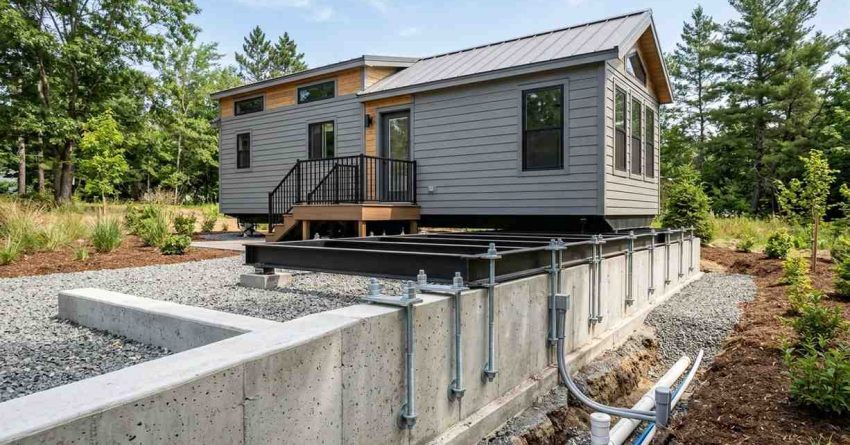
A park model permanent foundation is a fixed structural base — typically concrete, masonry, or engineered pier systems — that anchors a park model home to the ground in a way that meets local building codes for permanent residential structures.
Park model homes are factory-built units classified under ANSI A119.5 standards, originally designed for seasonal or recreational use. They are typically set on temporary supports, tie-downs, or blocking systems that allow for relocation. A permanent foundation replaces those temporary supports with a fixed base that connects the home to the ground permanently.
Park model homes are a distinct category of manufactured housing — our park model homes guide covers everything you need to know about how these structures are built, classified, and set up on a property.
How a Permanent Foundation Differs from a Standard Park Model Setup
A standard park model setup uses removable blocking, piers, or chassis supports that keep the home elevated but not permanently attached to the ground. This setup preserves the home’s mobility classification and keeps it subject to RV or manufactured housing regulations.
A permanent foundation eliminates mobility. The home is anchored to a fixed base, the chassis may be removed or encased, and the structure is reclassified under local residential building codes. This distinction affects everything from property taxes to mortgage eligibility.
Why Convert Your Park Model to a Permanent Foundation?
Homeowners and property managers pursue permanent foundation conversions for several practical reasons. The most common motivations involve property value, financing access, insurance options, and long-term legal standing as a residential dwelling.
A permanent foundation signals to lenders, insurers, and local authorities that the home is a fixed residential structure rather than a recreational vehicle. That reclassification opens doors that are closed to homes on temporary supports.
If you are researching whether park model zoning land use requirements in your area allow permanent placement, understanding those rules before starting the conversion process will save significant time and expense.
Property Value and Real Estate Benefits
Homes on permanent foundations are appraised differently than those on temporary supports. A fixed foundation typically increases the assessed value of the property, makes the home eligible for inclusion in real estate listings as a residential dwelling, and can qualify the land-and-home package for conventional real estate transactions.
In many jurisdictions, a park model on a permanent foundation can be titled as real property rather than personal property — a distinction that significantly affects resale value and buyer financing options.
Financing, Insurance, and Legal Advantages
Lenders generally will not issue traditional mortgages on homes without permanent foundations. Converting to a permanent foundation makes the home eligible for FHA Title II loans, conventional mortgages, and other residential financing products that carry lower interest rates than personal property loans.
Insurance coverage also improves. Homeowner’s insurance policies for permanently sited structures typically offer broader coverage and lower premiums than RV or manufactured home policies. Legally, a permanent foundation may be required before a home can receive a certificate of occupancy, a residential address, or utility connections under local building codes.
Readers researching park model home financing options will find that lender requirements vary by state and loan type, making it important to confirm eligibility criteria before beginning the conversion.
Types of Permanent Foundations Used in Park Model Conversions
Three foundation types are most commonly used in park model permanent foundation conversions. The right choice depends on soil conditions, local code requirements, climate, and budget.
The foundation type you choose directly shapes every other aspect of your project — our resource on park model home setup explains how site preparation, utility connections, and structural anchoring all work together from the ground up.
Concrete Slab Foundations
A concrete slab foundation is a single continuous layer of reinforced concrete poured directly on the prepared ground. The home sits on top of the slab, which is anchored with embedded bolts or straps.
Slab foundations are cost-effective, durable, and widely accepted by local building departments. They work best on flat, stable ground with good drainage. One limitation is that plumbing and electrical conduits must be embedded in the slab before pouring, making future access more difficult.
Perimeter Block or Stem Wall Foundations
A perimeter foundation uses concrete masonry units (CMUs) or poured concrete to form a continuous wall around the home’s perimeter. The wall supports the home’s frame and creates an enclosed crawl space beneath the structure.
This foundation type is common in areas with frost lines or expansive soils, as the stem wall can extend below the frost depth to prevent heaving. The crawl space also provides access to plumbing and electrical systems, which simplifies future maintenance and repairs.
Pier and Beam Foundations
A pier and beam foundation uses a grid of concrete or masonry piers connected by beams that support the home’s floor system. This approach elevates the home above grade, which is useful in flood-prone areas or on sloped terrain.
Pier and beam systems are flexible and can be adapted to irregular lot shapes. They also allow for easier access to utilities beneath the home. However, they require careful engineering to ensure even load distribution and long-term stability.
The Park Model Permanent Foundation Conversion Process
A permanent foundation conversion follows a defined sequence of steps. Skipping or rushing any phase increases the risk of structural problems, failed inspections, or permit violations that can delay the project significantly.
Site Assessment and Soil Evaluation
Before any foundation work begins, a qualified engineer or contractor evaluates the site. This assessment includes a soil bearing capacity test to determine whether the ground can support the foundation type being considered, a topographic survey to identify drainage patterns and slope, and a review of local setback requirements and utility easements.
Soil conditions vary widely across the United States. Expansive clay soils, sandy soils, and areas with high water tables each require different foundation approaches. A site assessment ensures the chosen foundation type is appropriate for the specific location.
Permits and Local Code Compliance
Permanent foundation conversions require building permits in virtually every jurisdiction. The permit process typically involves submitting engineered foundation drawings, a site plan, and documentation of the home’s specifications to the local building department.
Inspections are required at multiple stages — after excavation, after rebar placement, after the pour, and after the home is anchored. Some jurisdictions also require a final inspection before issuing a certificate of occupancy.
Permit applications and code inspections often require coordination across multiple trades — connecting with local handyman services can help you manage smaller compliance tasks and site preparation work that fall outside the scope of your foundation contractor.
Foundation Installation and Home Anchoring
Once permits are approved, the foundation contractor excavates the site, installs formwork or pier forms, places reinforcing steel, and pours the concrete. Curing time varies by foundation type and climate but typically ranges from 7 to 28 days before the home can be set.
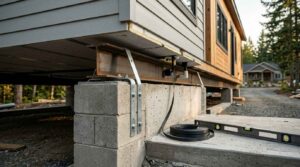
After curing, the home is positioned on the foundation using a crane or hydraulic lifting system. Anchor bolts, straps, or brackets connect the home’s frame to the foundation. The chassis may be removed at this stage, depending on local code requirements and the home’s structural design.
Once the foundation is poured and cured, securing the home’s frame to the new base often involves detailed structural carpentry work to reinforce connection points, close gaps, and ensure the structure meets local building standards.
Costs Involved in a Park Model Foundation Conversion
The total cost of a park model permanent foundation conversion varies based on foundation type, site conditions, local labor rates, and permit fees. Most projects in the United States fall in the range of $8,000 to $30,000 for the foundation work alone, not including site preparation, utility connections, or interior modifications.
Concrete slab foundations are typically the least expensive option, while perimeter stem wall and pier and beam systems cost more due to additional materials and labor. Site preparation costs — including grading, excavation, and drainage work — can add $2,000 to $8,000 depending on the condition of the lot.
Many homeowners use a foundation conversion as the starting point for a broader upgrade — pairing the project with home remodeling services allows you to address interior improvements, utility upgrades, and structural enhancements in a single coordinated effort.
Factors That Affect Total Project Cost
Several variables influence the final project cost. Soil conditions that require additional engineering or soil stabilization increase foundation costs. Remote or difficult-to-access sites add to equipment and labor expenses. Local permit fees range from a few hundred dollars to several thousand depending on the jurisdiction.
The home’s size and weight affect the complexity of the lifting and anchoring process. Homes that require chassis removal add labor and disposal costs. Utility reconnection — including water, sewer, and electrical hookups — is a separate cost category that should be budgeted alongside the foundation work.
Choosing the Right Contractor for Your Foundation Conversion
Selecting a qualified contractor is one of the most important decisions in a permanent foundation conversion. The work involves structural engineering, concrete installation, and coordination with local building officials — all of which require specific licensing and experience.
Look for contractors who hold a general contractor’s license in your state, have documented experience with manufactured or park model home foundations specifically, and can provide references from completed projects. Ask to see examples of their permit history and inspection records, which confirm that their work has passed official review.
Understanding the full foundation conversion process before you hire gives you the knowledge to evaluate contractor proposals accurately and ask the right questions during the bidding phase.
Get at least three written bids that itemize labor, materials, permit fees, and site preparation separately. Be cautious of bids that are significantly lower than others — foundation work is not an area where cutting costs produces acceptable results. A failed foundation inspection or structural deficiency discovered after the fact is far more expensive to correct than the savings from a low bid.
Verify that the contractor carries general liability insurance and workers’ compensation coverage. Request a written contract that specifies the scope of work, materials to be used, inspection milestones, payment schedule, and warranty terms before any work begins.
Conclusion
A park model permanent foundation conversion is a structural investment that changes how your home is classified, valued, and financed. Choosing the right foundation type, following the permit process carefully, and working with a licensed contractor are the three factors that determine whether the project delivers lasting results.
The conversion process connects directly to broader decisions about property use, financing eligibility, and long-term site improvements that affect the home’s value for years after the work is complete.
At Mr. Local Services, our network of skilled professionals includes foundation specialists, structural carpenters, and remodeling experts who can guide your park model conversion from site assessment through final inspection — contact us today to connect with a qualified contractor in your area.
Frequently Asked Questions
Does a park model home need a permanent foundation to be considered real property?
In most U.S. jurisdictions, a park model home must be placed on a permanent foundation and titled as real property before it qualifies for residential mortgage financing or is assessed as real estate. Requirements vary by state and county.
How long does a park model permanent foundation conversion take?
Most conversions take between four and ten weeks from permit approval to final inspection. Site preparation, concrete curing time, and inspection scheduling are the primary factors that affect the timeline.
Can any park model home be converted to a permanent foundation?
Most park model homes can be converted, but the home’s structural condition, chassis design, and local zoning rules all affect feasibility. A site assessment and structural review by a licensed contractor will confirm whether your specific home qualifies.
Do I need to remove the chassis when converting to a permanent foundation?
Chassis removal requirements vary by jurisdiction. Some local codes require chassis removal as part of the permanent foundation process, while others allow the chassis to remain encased within the foundation. Your building department will specify the requirement for your location.
Will a permanent foundation conversion increase my property taxes?
In most cases, yes. Converting to a permanent foundation reclassifies the home as real property, which is subject to real estate property taxes rather than personal property taxes. The increase depends on your local tax rate and the assessed value of the improved property.
What type of foundation is best for a park model home in a cold climate?
In cold climates with significant frost depth, a perimeter stem wall or pier foundation that extends below the frost line is typically required. Slab foundations in freeze-thaw climates can heave and crack without proper insulation and depth. A local engineer can specify the correct depth for your area.
Can I finance a park model foundation conversion with a home improvement loan?
Yes. Once the home is on a permanent foundation and titled as real property, it may be eligible for home equity loans, FHA 203(k) rehabilitation loans, or conventional home improvement financing. Eligibility depends on the lender’s requirements and the home’s appraised value after conversion.