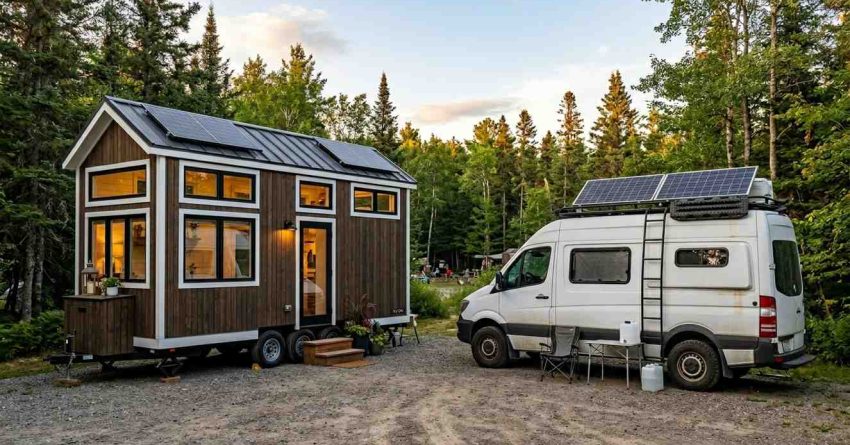
A tiny house on wheels (THOW) and a converted van both offer freedom from traditional housing — but they serve very different lifestyles, budgets, and long-term goals. Choosing between them means understanding how each option performs across cost, space, mobility, legal requirements, and daily maintenance demands.
This comparison matters now because mobile and alternative living options are growing rapidly across the USA, and the wrong choice can cost thousands in unexpected expenses or lifestyle mismatches.
This guide covers every major difference between THOWs and van life — from upfront costs and legal rules to maintenance demands and long-term financial value.
What Is a THOW and What Is Van Life?
Before comparing the two, it helps to understand exactly what each option involves and who typically chooses it.
Defining a Tiny House on Wheels (THOW)
A tiny house on wheels is a fully constructed dwelling built on a trailer chassis, designed to function as a permanent or semi-permanent home. THOWs typically range from 150 to 400 square feet and include standard residential features such as a kitchen, bathroom, sleeping loft, and living area. They are built to residential construction standards, which means they can include insulation, full plumbing, electrical systems, and HVAC. Most THOWs are custom-built or purchased from a specialized builder and cost between $30,000 and $150,000 depending on size, materials, and finish level.
Defining the Van Life Lifestyle
Van life refers to living full-time or part-time in a converted cargo van, camper van, or high-roof vehicle. Conversions range from basic sleeping setups to fully outfitted builds with kitchens, solar power, and composting toilets. The total cost of a van conversion varies widely — from under $5,000 for a DIY budget build to $80,000 or more for a professional high-end conversion. Van life prioritizes mobility and simplicity, and it attracts solo travelers, remote workers, and couples seeking low-overhead living with maximum flexibility.
Understanding how alternative housing compares to traditional builds starts with a broader look at investment decisions — our custom home investment analysis breaks down how unconventional housing choices stack up financially against spec homes.
Key Differences Between THOWs and Van Life
The most important differences between these two options come down to space, cost, and how freely you can move.
Size, Space, and Living Comfort
THOWs offer significantly more living space than vans. A standard THOW provides enough room for a full kitchen, a dedicated bathroom with a shower, a sleeping loft, and a sitting area. This makes them more practical for couples, families, or anyone who works from home and needs a defined workspace.
Vans, by contrast, require creative use of every square inch. Most van builds combine sleeping, cooking, and working areas into a single multi-use space. This works well for solo travelers or minimalist couples but becomes challenging for anyone who needs privacy, storage, or separation between living and working zones.
Cost to Build or Buy vs. Cost to Convert
THOWs carry a higher upfront cost. A professionally built THOW typically starts around $50,000 and can exceed $120,000 for a fully custom build. Financing options exist but are limited compared to traditional mortgages.
Van conversions offer a lower entry point. A used cargo van purchased for $15,000 to $30,000, combined with a DIY conversion costing $5,000 to $20,000, puts total costs well below most THOW builds. Professional van conversions close the gap but still tend to cost less than a comparable THOW.
Mobility and Travel Flexibility
Vans win on mobility. A converted van is a self-contained vehicle that can be driven anywhere a standard vehicle can go. Parking, repositioning, and spontaneous travel are straightforward.
THOWs require a tow vehicle rated for the trailer’s weight, which typically means a heavy-duty truck. Moving a THOW involves planning, permits in some states, and a towing setup that adds cost and complexity. THOWs are better suited to semi-permanent placement with occasional moves rather than frequent travel.
Legal and Zoning Considerations in the USA
Legal requirements are one of the most overlooked factors in the THOW vs van life decision, and they vary significantly by state and municipality.
THOW Parking, Zoning, and Registration Laws
THOWs occupy a legal gray area in most of the USA. They are typically classified as recreational vehicles (RVs) for registration purposes, which means they cannot be permanently parked in most residential zones without a variance or special permit. Some states and counties have adopted THOW-friendly zoning ordinances, but many have not. Finding legal long-term parking for a THOW requires research specific to your target location. Campgrounds, RV parks, and rural private land are the most common legal options.
Van Dwelling Regulations and Stealth Camping
Van dwellers face a different set of legal challenges. Urban van life often relies on stealth camping — parking in residential neighborhoods or commercial areas without drawing attention. Many cities have ordinances against sleeping in vehicles, and enforcement varies widely. National forests, Bureau of Land Management (BLM) land, and designated dispersed camping areas offer legal free camping options for van dwellers, making rural and semi-rural van life more legally straightforward than urban van life.
Maintenance, Repairs, and Upkeep Demands
Both options require ongoing maintenance, but the type and frequency of work differ considerably.
Maintaining a Tiny House on Wheels
A THOW has more systems to maintain than a van. Plumbing, electrical, HVAC, roofing, and the trailer chassis all require regular inspection and upkeep. Roof sealing is a recurring task, as any gap or crack can lead to water intrusion and structural damage. The trailer itself needs annual inspection for rust, wheel bearing condition, and brake function. Because THOWs are built to residential standards, many repairs require licensed contractors for plumbing and electrical work.
Whether you own a THOW or a converted van, keeping your mobile dwelling in top condition follows many of the same principles covered in our tiny home maintenance guide, which outlines the most common upkeep challenges and how to address them.
Maintaining a Converted Van
Van maintenance combines standard vehicle upkeep with the specific demands of a live-in conversion. Engine, transmission, tires, and brakes follow normal vehicle service schedules. The conversion systems — solar panels, batteries, water tanks, and ventilation fans — require periodic inspection and occasional replacement. Vans are generally easier and cheaper to maintain than THOWs because most repairs fall within the scope of a standard mechanic or a capable DIYer.
Which Option Suits Your Lifestyle and Goals?
The right choice depends on how you plan to live, who you are living with, and what you value most in a mobile home.
Best for Families, Couples, and Solo Travelers
THOWs are better suited to couples and small families who need defined living spaces, storage, and the comfort of a full kitchen and bathroom. The additional space makes daily life more manageable over the long term.
Van life is better suited to solo travelers and minimalist couples who prioritize freedom of movement over comfort and space. It is also a strong option for people who want to test mobile living before committing to a larger investment.
Long-Term Living vs. Part-Time Adventure
If you plan to live in your mobile home full-time for several years, a THOW offers more comfort, durability, and livability. The higher upfront cost is offset by a more residential living experience.
If you want a part-time adventure vehicle, a weekend escape, or a low-commitment entry into mobile living, a van conversion is the more practical and affordable starting point.
Financial Comparison — THOWs vs Van Life
Understanding the full financial picture requires looking beyond the purchase price to ongoing costs and long-term value.
Resale Value, Depreciation, and Long-Term Costs
THOWs depreciate more slowly than vans when well-maintained, and a quality custom build can retain significant resale value. However, the market for used THOWs is smaller than the market for used vehicles, which can make selling more difficult.
Vans depreciate as vehicles, which means their value declines steadily over time regardless of the conversion quality. A high-end van conversion does not add proportional resale value to the vehicle itself. On the other hand, the lower initial investment means the total financial exposure is smaller.
Ongoing costs for THOWs include RV park or land rental fees, trailer registration, and higher utility setup costs. Van life ongoing costs include fuel, vehicle insurance, campground fees, and maintenance. Both options eliminate or significantly reduce traditional housing costs such as rent, mortgage payments, and property taxes.
Evaluating long-term costs for mobile living requires the same financial discipline applied to any property decision — our housing investment analysis provides a detailed framework for comparing unconventional and traditional housing costs side by side.
Community, Amenities, and Off-Grid Capability
Both THOW and van life communities are active and well-established in the USA, with online forums, social media groups, and in-person meetups available for both.
Utilities, Solar, Water, and Waste Systems
THOWs can support more robust off-grid systems due to their larger size. Roof space allows for more solar panels, larger battery banks, and bigger water storage tanks. Many THOWs are built with composting toilets, greywater systems, and propane or electric cooking setups that function independently of hookups.
Vans are more limited by space but can still support effective off-grid systems. A well-designed van build with 200 to 400 watts of solar, a lithium battery bank, and a 20-gallon fresh water tank can support comfortable off-grid living for days or weeks at a time.
Off-grid capability is one of the most discussed features in the tiny living space, and our tiny home off-grid systems resource covers solar, water, and waste solutions that apply directly to both THOWs and van builds.
Conclusion
THOWs and van life each offer a genuine path to mobile, lower-cost living — but they serve different needs, budgets, and travel styles. The right choice depends on your space requirements, financial situation, and how much flexibility you need.
Both options come with real maintenance demands, legal considerations, and long-term financial trade-offs that deserve careful evaluation before committing to either path.
At Mr. Local Services, our team supports tiny home and mobile dwelling owners with reliable maintenance, repair, and upkeep services — so your home on wheels stays safe, functional, and well-maintained wherever you park it.
Frequently Asked Questions
How much does a tiny house on wheels cost compared to a van conversion?
A professionally built THOW typically costs between $50,000 and $150,000. A van conversion ranges from $20,000 for a basic DIY build to $80,000 or more for a professional setup, making van life the lower-cost entry point for most buyers.
Can you live in a THOW full-time legally in the USA?
Full-time THOW living is legal in many areas but requires finding compliant parking. Most THOWs are classified as RVs, which restricts where they can be permanently parked. RV parks, campgrounds, and rural private land are the most common legal long-term options.
Is van life cheaper than living in a tiny house on wheels?
Van life generally has lower upfront costs and lower ongoing fixed expenses than THOW living. However, fuel costs, vehicle depreciation, and the need for frequent campground fees can close the gap over time depending on your travel habits.
Which is better for off-grid living — a THOW or a van?
THOWs support more capable off-grid systems due to their larger roof area and storage capacity. Vans can be effectively set up for off-grid use but are limited by space. For extended off-grid living, a THOW typically offers more comfort and system capacity.
Do you need a special license to tow a THOW?
In most US states, a standard driver’s license is sufficient to tow a THOW, provided the combined weight of the tow vehicle and trailer stays within the license class limits. Some heavier builds may require a non-commercial Class A or B license depending on state law.
What are the biggest maintenance differences between a THOW and a van?
THOWs require maintenance across more systems — plumbing, electrical, HVAC, roofing, and the trailer chassis. Vans combine standard vehicle maintenance with conversion system upkeep. Van maintenance is generally simpler and less expensive because most work falls within standard automotive repair scope.
Which option has better resale value — a THOW or a converted van?
A well-maintained THOW from a reputable builder can hold its value better than a van conversion, but the resale market is smaller and slower. Vans depreciate as vehicles regardless of conversion quality, but their lower initial cost means the total financial risk is lower for most buyers.