Deck maintenance is the ongoing system of cleaning, inspecting, sealing, and repairing your deck to protect its structure, appearance, and safety over time. Whether you own a backyard composite deck, a cedar wraparound, or a commercial rooftop installation, consistent care directly determines whether your deck lasts ten years or thirty. Homeowners, landlords, and property managers all share the same reality — neglected decks fail faster and cost dramatically more to fix.
A well-maintained deck protects your investment, prevents safety hazards like collapses or rotted railings, and preserves curb appeal that contributes meaningfully to property value. Skipping routine care almost always costs more later.
This guide covers maintenance fundamentals, annual schedules, cleaning, inspection, preventive care, seasonal tasks, material-specific approaches, costs, repair decisions, and hiring professionals — everything you need.
Deck Maintenance Fundamentals: What It Is and Why It Matters
Deck maintenance is the structured combination of small, recurring tasks — washing, inspecting, sealing, tightening, and repairing — that collectively protect a deck from weather, biological growth, mechanical wear, and structural decline. Unlike repair, which addresses damage after it occurs, maintenance is proactive and prevents most failures from happening in the first place.
The core dimensions of deck care include surface cleaning, finish renewal, structural inspection, hardware checks, drainage management, and pest prevention. Each plays a distinct role in extending the lifespan of decking boards, joists, posts, railings, and fasteners.
According to the North American Deck and Railing Association (NADRA), an estimated 40 million decks in the United States are at least 20 years old and past their intended service life — most because maintenance was skipped or inconsistent. Decks that receive annual care routinely outlast their warranty periods by 10 to 15 years.
A consistent annual deck maintenance routine combines cleaning, inspection, sealing, and small repairs into a year-round system — our complete deck maintenance guide walks through every task, frequency, and decision point homeowners need to keep a deck performing for decades.
Building Your Annual Deck Maintenance Schedule
A reliable maintenance schedule organizes care into recurring intervals — daily habits, monthly checks, seasonal tasks, and annual deep work. This structure prevents the most common failure mode in deck ownership: forgetting tasks until visible damage forces emergency repair.
A typical annual cycle includes one major spring cleaning and inspection, monthly visual walkthroughs during peak-use months, a fall preparation pass before winter, and a winter check after major storms. Higher-traffic decks, decks under trees, and decks in coastal or freeze-thaw climates need more frequent attention.
Documentation matters more than most homeowners realize. Photographing your deck annually from the same angles creates a visual record that makes subtle changes — sagging, board separation, fastener movement, or finish wear — far easier to detect.
Putting these tasks on a calendar removes guesswork and prevents missed inspections — our annual deck maintenance schedule breaks the year into month-by-month action items so nothing slips through the cracks.
Cleaning Your Deck: The Foundation of Long-Term Care
Cleaning is the single most impactful maintenance task because nearly every form of deck damage begins with surface contamination. Dirt, pollen, algae, mildew, and organic debris trap moisture against the surface, accelerate finish breakdown, and create the conditions for rot and slip hazards. A clean deck simply lasts longer.
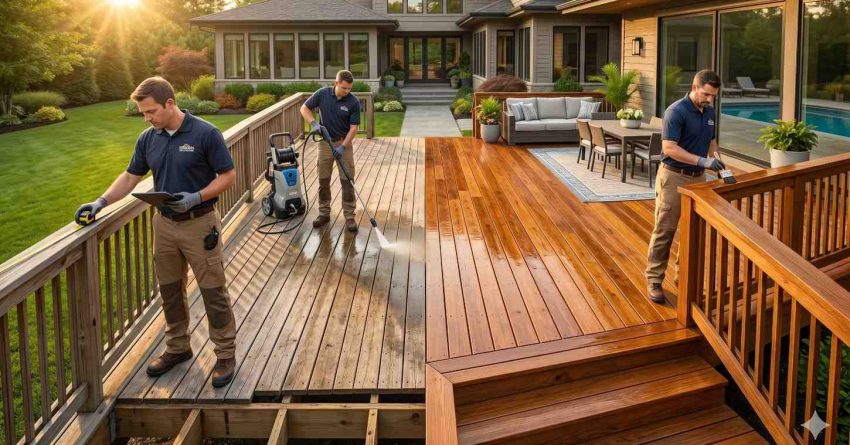
The cleaning process varies by material but generally follows the same sequence: remove furniture and debris, sweep thoroughly, apply an appropriate cleaner, agitate with the right tool, rinse completely, and allow full drying before any subsequent steps like sealing.
Wood decks typically benefit from oxygen-bleach or sodium-percarbonate cleaners that lift mildew and graying without damaging fibers. Composite decks require manufacturer-approved soaps that avoid stripping the protective cap layer. Both materials suffer when harsh chlorine bleach is used incorrectly — it kills surrounding plants, damages metal fasteners, and accelerates wood graying.
Pressure washers can damage soft wood fibers and composite caps when used at the wrong PSI or nozzle angle, which is why understanding safe pressure washing techniques is essential before pulling the trigger.
Common cleaning challenges include grease and BBQ stains, rust marks from metal furniture, tannin bleeding from leaves, and stubborn algae in shaded areas. Each requires a slightly different treatment approach to remove without damaging the surface beneath.
The right cleaning method depends on your decking material, the type of grime, and the time since your last wash — our step-by-step guide on how to clean a deck properly covers product selection, pressure settings, and the technique pros use to avoid stripping protective finishes.
Inspecting Your Deck for Damage, Wear, and Safety Risks
Inspection is the diagnostic layer of deck maintenance — the process of systematically evaluating every structural and surface component to catch problems while they’re small. Most deck collapses are not caused by sudden failure; they’re caused by gradual deterioration that went undetected for years.
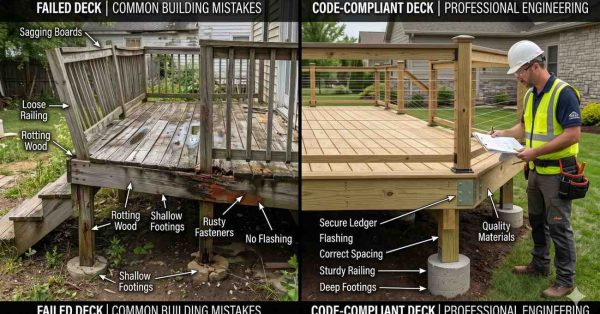
A complete inspection covers the ledger board (where the deck attaches to the house), joists and beams underneath the surface, posts and their footings, deck boards, railings and balusters, stairs and stringers, and all hardware including screws, joist hangers, and post anchors. Each element has specific failure modes worth knowing.
The U.S. Consumer Product Safety Commission reports that approximately 224,000 people are injured annually by deck and porch failures, with ledger separation and railing collapse being the most common structural causes. Most of these failures are preventable with annual inspection.
Warning signs include soft or spongy wood, dark staining around fasteners (indicating water intrusion), white mineral deposits, visible rust on hardware, wobbling railings, bouncy floor sections, and any gap forming between the deck and the house.
A thorough DIY deck inspection checklist gives homeowners a structured way to evaluate ledgers, joists, posts, railings, and fasteners — our guide walks through each component, what to look for, and which findings require professional follow-up.
Preventive Care: Stopping Damage Before It Starts
Preventive care is the maintenance philosophy of eliminating the conditions that cause deck damage rather than just responding to damage after it appears. Moisture, UV exposure, biological growth, pests, and physical wear are the five primary deterioration mechanisms, and each has prevention strategies that take minutes but save thousands.
Moisture prevention dominates the list because water — combined with oxygen and time — is responsible for the majority of structural failures. Effective tactics include applying joist tape to protect framing tops, maintaining a 1/8 to 1/4 inch gap between decking boards for drainage, ensuring proper ledger flashing, and resealing wood surfaces on schedule.
UV protection requires pigmented stains or sealers since clear coatings provide minimal sun defense. Pest prevention combines hardware checks, eliminating ground-contact debris, and treating substructure wood where appropriate. Furniture pads, planter risers, and proper grilling mats prevent the daily mechanical damage that adds up over years.
Water is the single biggest enemy of any deck, and our complete guide to preventing moisture damage explains drainage upgrades, sealing schedules, joist tape applications, and small habits that dramatically extend deck lifespan.
Seasonal Deck Maintenance Throughout the Year
Each season presents different threats to your deck, and matching your maintenance tasks to seasonal conditions produces dramatically better results than generic year-round care. A spring task list looks nothing like a fall list, and treating them the same wastes effort while missing critical windows.
Spring is the heaviest maintenance season — a deep clean to remove winter buildup, full structural inspection after freeze-thaw stress, replacement of any damaged boards, and resealing if scheduled. This is when most homeowners discover whether winter caused any hidden damage.
Summer focuses on UV mitigation, frequent quick cleanings to address grilling debris and entertainment wear, and watching for heat-related expansion and contraction. Fall is the preparation season — clearing leaves before they stain, performing a pre-winter inspection, and applying any final coatings while temperatures still allow proper curing. Winter care emphasizes snow removal with the right tools and quick checks after major storms.
Cold-climate homeowners face freeze-thaw cycles that crack boards and loosen fasteners, which is why winterizing your deck properly before the first hard freeze protects both the surface and the substructure.
Every season brings different threats — pollen and tannins in spring, UV and heat in summer, leaves and moisture in fall, snow and ice in winter — and our seasonal deck maintenance calendar tells you exactly what to do and when.
Material-Specific Deck Maintenance Approaches
Maintenance is not one-size-fits-all — the right tasks, products, and frequencies depend heavily on what your deck is made of. A pressure-treated pine deck demands a fundamentally different routine than a capped composite deck or an ipe hardwood installation.
Pressure-treated lumber requires the most attention because the wood remains biologically active. Annual cleaning and resealing every 2 to 3 years is typical. Cedar and redwood need similar resealing intervals but benefit from more gentle cleaners that preserve the natural oils. Tropical hardwoods like ipe last decades with only annual cleaning and occasional oil treatments — but they require those treatments to retain color.
Composite decking trades resealing for more attentive cleaning, since stains and mildew bond to the cap layer if left untreated. PVC decking is the lowest-maintenance option but still benefits from periodic washing. Aluminum decks essentially require only cleaning.
Wood requires a different approach than composite — our complete pillar on wood decking maintenance fundamentals covers cleaning, sanding, sealing, and species-specific care for cedar, redwood, pressure-treated, and tropical hardwoods.
Composite boards resist rot and insects but still need cleaning, mold control, and gap maintenance — our guide to maintaining composite decking covers brand-specific tips, cleaning products, and the mistakes that void manufacturer warranties.
Maintenance Costs and Budgeting
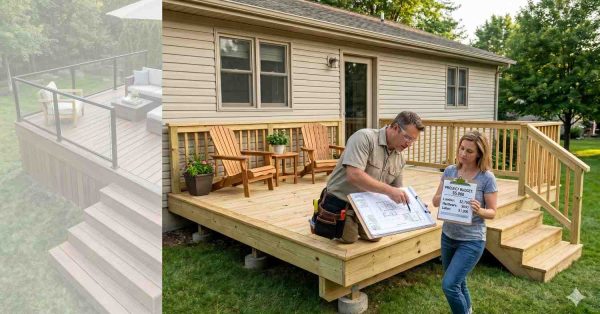
Deck maintenance costs vary widely based on material, deck size, climate, and whether you handle tasks yourself or hire professionals. Building a realistic annual budget prevents the common pattern of skipping maintenance when funds aren’t allocated — which leads to far more expensive repairs later.
For a typical 400-square-foot residential deck, DIY annual maintenance costs roughly $75 to $250 in cleaners, sealers, and small supplies. Professional maintenance — including cleaning and sealing — typically runs $400 to $1,200 per visit depending on region and deck condition. Larger or multi-level decks scale accordingly.
Over a 10-year ownership horizon, wood decks accumulate $3,000 to $8,000 in maintenance costs while composite and PVC decks typically range from $500 to $2,000. These numbers explain why long-term cost-of-ownership comparisons often favor composite despite its higher upfront price.
Maintenance budgets vary widely depending on the decking material, deck size, and whether you DIY or hire pros — our breakdown of deck maintenance costs by material gives realistic annual and 10-year cost projections for every decking type.
When Maintenance Isn’t Enough: Repair, Restoration, and Replacement
Maintenance has limits. At some point — usually signaled during routine inspection — a deck moves past what cleaning and sealing can address. Recognizing this transition prevents both wasted effort on a deck beyond saving and premature replacement of a deck that just needs targeted work.
Repair addresses isolated damage: a single rotted joist, a wobbly railing, a few cupped boards. Restoration is broader — stripping old finishes, sanding, structural reinforcement, and refinishing a tired but sound deck. Replacement is reserved for decks with widespread structural failure, code violations, or substructure rot that makes piecemeal fixes uneconomical.
A fading, weathered surface usually signals it’s time to refresh the finish, and our pillar on deck staining and sealing strategy explains product types, application methods, and how often each finish needs renewal.
When maintenance reveals damage beyond cleaning and sealing, the next question becomes whether a fix can extend the deck’s life or whether bigger work is needed — our complete guide on when deck repair makes sense walks through the decision and the repair options available.
Hiring Professional Deck Maintenance Services
Many homeowners and property managers reach a point where DIY maintenance becomes impractical — time constraints, the size of the deck, the need for consistent quality across a rental portfolio, or simply the desire to outsource a recurring chore. Professional maintenance services fill this gap.
A reputable deck maintenance provider should offer clear scope definitions (what is and isn’t included), itemized pricing, proof of insurance, before-and-after documentation, and a service warranty on their work. Annual contracts often deliver better pricing and prioritized scheduling than one-off visits.
What to ask before hiring: How many deck projects have you completed? Do you carry general liability and workers’ comp insurance? Will you provide a written scope and warranty? What products do you use, and are they manufacturer-approved for my decking type? References from recent local customers carry the most weight.
For homeowners who want consistent results without the labor, working with professional deck maintenance services through Mr. Local Services connects you to vetted contractors who handle cleaning, inspection, sealing, and minor repairs on annual contracts.
Conclusion
Deck maintenance is a system — cleaning, inspection, preventive care, seasonal tasks, and material-specific routines working together to protect your investment year after year.
Done consistently, this system extends deck life by decades, prevents safety failures, and dramatically lowers the long-term cost of ownership versus reactive repair cycles.
We help homeowners and property managers across the country find trusted local pros — connect with Mr. Local Services today to schedule professional deck care from vetted experts.
Frequently Asked Questions
How often should I clean my deck?
Most decks need a thorough cleaning at least once per year, typically in spring. High-traffic decks, decks under trees, or decks in humid climates benefit from a second cleaning in fall.
How often should a wood deck be resealed?
Wood decks generally need resealing every 2 to 3 years, though clear sealers may require annual reapplication. Watch for water no longer beading on the surface as your signal.
Do composite decks really need maintenance?
Yes — composite decks need regular cleaning to prevent mold, mildew, and tannin staining on the cap layer. They skip sealing but still require attentive care.
What’s the best time of year to maintain a deck?
Spring and early fall are ideal — mild temperatures and lower humidity allow cleaners and sealers to perform properly. Avoid extreme heat, freezing temperatures, or rainy periods.
How do I know if my deck needs repair instead of maintenance?
Signs include soft or rotted wood, wobbling railings, structural cracks, separation from the house, or hardware failure. Any of these warrants professional inspection.
Can I pressure wash my deck safely?
Yes, but use the right PSI (1,200–1,500 for wood, lower for composite), the proper nozzle, and keep distance from the surface. Improper pressure washing causes irreversible damage.
How much does professional deck maintenance cost annually?
Professional annual maintenance typically costs $400 to $1,200 for a standard residential deck, depending on size, condition, services included, and regional labor rates.